
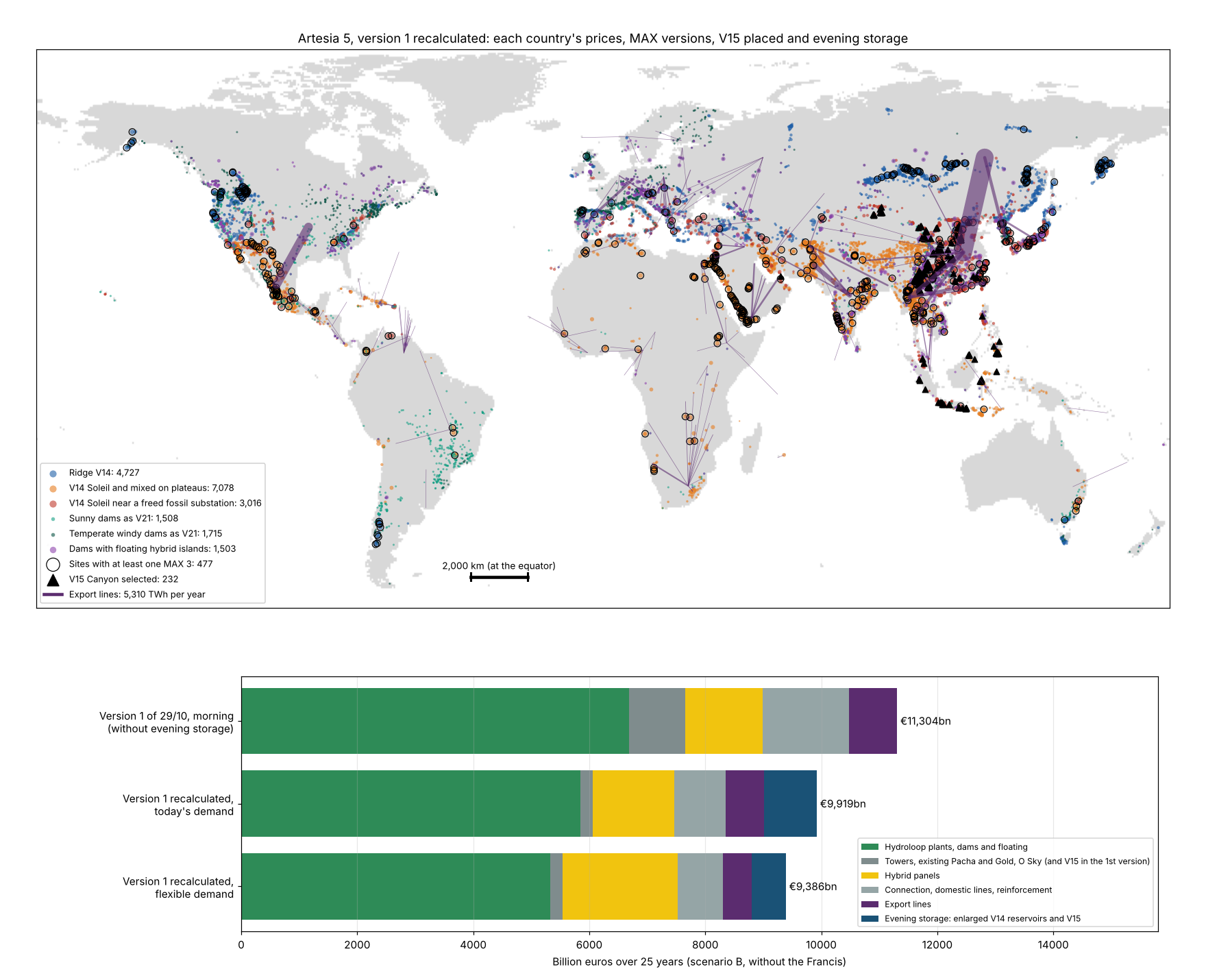
Artesia 5 world plan, version 1 recalculated: 95% of fossil electricity replaced in every country, evenings included, for 9,919 billion euros, below the 10,000 mark and 1,385 less than the first version, which did not yet count evening storage
The first version of Artesia 5 chose each plant at its delivered cost, line included, with lines at each country's price only in China and all plants at the French series price. Since then, the site has calculated what it lacked: the price of lines and the price of plants country by country, the MAX versions of the V14 Soleil, the ridge V14 and the V15 Canyon, the V15 ramparts, the wind of temperate dams, the large springs and the need for evening storage. This page redoes the same calculation with all of this. The objective does not change: 95% of fossil electricity replaced in every country, and now in the evening too.
Code (Python, free): calcul_plan_mondial_artesia_5_v1_recalcul.py (run without arguments for today's demand, with "souple" for flexible demand); the diagram: schema_plan_mondial_artesia_5_v1_recalcul.py; the results: the sites, the V15, the countries, the lines, the totals and those of flexible demand
Related pages: Artesia 5, first version | the Artesia 5 plants | evening storage | the price of plants | the price of lines
------------------------------
1. WHAT CHANGES IN THE CALCULATION
------------------------------
The calculation remains a linear optimisation: among all the measured sites, it chooses the plants, export lines and hybrid panels that deliver 95% of each country's fossil electricity at the lowest total cost. Seven things change:
* Lines at each country's price, everywhere and no longer only in China: converters, direct current, alternating current, substations and submarine cables from the price of lines page.
* Plants at each country's price: photovoltaics, wind, hydraulics and substations calibrated on the costs measured by IRENA.
* The MAX versions: the V14 of the same plateau, the same substation or the same ridge are grouped into MAX, MAX 2 and MAX 3, with their lower price. The calculation chooses them at the MAX price, then recounts each site with the MAX it can really make.
* The V15 placed: the 1,000 lump-sum V15 disappear, the 2,447 rampart sites enter one by one, at the price of their head, their tunnel and their country.
* The wind of temperate dams: 2,099 windy dams as V21, counted at two thirds like the sunny dams, and the 16 useful large springs as Gold 4.
* Hybrid panels without a ceiling: the limit of 20% per country is removed; they are only taken where they cost less than a well-placed plant, line and storage included.
* The evening: each country must have electricity by day and also from 5 pm to 5 am, when 52% of demand occurs. The evening comes from the V14's own storage, wind, lines, existing dams shifted to the evening (30% of their output at most), the V15 and, new, the enlarged reservoirs of the V14, up to three times their volume. Enlarging reservoirs follows the same rule as the MAX versions: from 135 million euros per GWh of storage for a single V14 to 107 for a MAX 3, because reservoirs, pipes and machines grow more slowly than storage. Storage loses 22% of what it pumps, and the plan produces that much more.
------------------------------
2. THE RESULT
------------------------------
* 9,919 billion, below the 10,000 mark, with the evening on top. The prices of each country and the MAX versions lower the plants by 1,082 billion (6,910 at the French price without MAX, 5,828 at the price of each country with MAX), the lines and connections by 772. The evening, which the first version did not count, takes back 905.
* If demand adapts, by getting one fifth of demand consumed at noon (vehicle charging, electrolysis, stored cold, water heaters), the plan comes down to 9,386 billion.
* The planet's evening, every day: 7,199 GWh returned by the V14's own storage, 7,285 by their enlarged reservoirs (2,901 in the MAX 3, 1,307 in the MAX 2, 1,596 in the MAX, 1,480 in the single V14), 2,352 by existing dams generating in the evening, 480 by the V15, that is 17.3 TWh, more than a third of the plan's demand.
------------------------------
3. THE PLANTS
------------------------------
* The plan's 14,822 V14 now make only 7,841 plants: 10,118 of them are grouped into 3,137 MAX, MAX 2 and MAX 3, of which 658 MAX 3. The calculation now prefers the plateaus that carry MAX, because their reservoirs are cheaper to enlarge for the evening.
* The V15 lose their place: of the 2,447 sites, the calculation keeps only 232, mostly in China (188) and Indonesia (27). Enlarging the reservoirs of a V14 costs 107 to 135 million euros per GWh of storage; a V15 on a real rampart with a head of 1,000 to 1,100 m costs 240 to 290. For evening storage alone, the V15 is beaten by the enlarged V14, which already exists on site. What it brings in addition, district cooling, black start after a general blackout, fire defence, water for cities, is not counted here.
* Hybrid panels rise a little, from 1,650 to 2,447 TWh, mostly in China where they cost 38% less than in France, and in Russia, where they produce for export.
------------------------------
4. THE COUNTRIES
------------------------------
The first 15 fossil countries. In TWh per year, except evening storage in GWh per day.
* China imports less: 1,795 TWh instead of 2,138, thanks to its plants and its hybrid panels at the Chinese price. It still depends on Russia for 1,339 TWh, Russian wind being the best evening power within its reach; this is the point to correct in version 2.
* Mexico becomes the great supplier of the United States: 636 TWh a year, its sunny plateaus and their enlarged reservoirs delivering by day and in the evening. This is already the idea of version 2, human development, which economics alone rediscovers.
* India enlarges its reservoirs by 649 GWh a day, and imports 442 TWh, mostly from Pakistan and Afghanistan.
* Germany, South Korea and South Africa import most of their electricity: few sites, no ramparts.
------------------------------
5. THE EXPORT LINES
------------------------------
146 lines, 5,310 TWh a year, 660 billion euros. The first twelve:
------------------------------
6. THE LIMITS
------------------------------
* The evening is that of an average day: winter and weeks without wind or sun require more storage than this calculation provides, especially far from the equator.
* The enlarged reservoirs assume that each plateau, each ridge and each substation has room for reservoirs two to three times larger, and their price follows the engineering rules of the MAX versions; each site will have to check it.
* Plant prices are those measured by IRENA on commercial farms, applied to the site's plants.
* The MAX versions are not yet applied to the Pacha, Gold and Sky (5 to 10 billion less), nor to the floating islands.
* The V15 are only counted as storage; their services for cities are not in the price of the kWh.
* China depends on Russia for more than a fifth of its electricity from the plan, which is a political risk that economics alone does not count.
------------------------------
7. CONCLUSION
------------------------------
Recalculated with everything the site has measured since the morning, the Artesia 5 plan, version 1, replaces 95% of each country's fossil electricity, evenings included, for 9,919 billion euros, below the 10,000 mark and 1,385 less than the first version, which did not guarantee the evening, and 9,386 if demand learns to consume at noon. The prices of each country and the MAX versions pay for evening storage and more. The V14 grouped into MAX and their enlarged reservoirs, which cost all the less as the MAX is large, become the battery of the plan, in place of the V15, which keep the ramparts of the cities where their services count. Version 2, human development, starts from this calculation to place the best plants in poor countries: for 60 billion more, 9,979 in total, low-HDI countries receive 693 billion instead of 444, and China now takes only 964 TWh from Russia.
------------------------------
SOURCES
------------------------------
The calculation (Python), the diagram (Python), the sites, the V15, the countries, the lines, the totals
The site's input data: price of lines, price of plants, V15 ramparts, wind of dams, large springs, energy by country (Our World in Data), and those of the first version
The site's good ideas
Olivier Muhleisen in collaboration with Claude (Anthropic), October 2026. Plans, diagrams, texts and figures under the CC BY 4.0 licence.
© 2009-2026 Onmyweb Production - TOS - Cookies information - Contact us - Free Copyright Open Source -
1. WHAT CHANGES IN THE CALCULATION
------------------------------
The calculation remains a linear optimisation: among all the measured sites, it chooses the plants, export lines and hybrid panels that deliver 95% of each country's fossil electricity at the lowest total cost. Seven things change:
* Lines at each country's price, everywhere and no longer only in China: converters, direct current, alternating current, substations and submarine cables from the price of lines page.
* Plants at each country's price: photovoltaics, wind, hydraulics and substations calibrated on the costs measured by IRENA.
* The MAX versions: the V14 of the same plateau, the same substation or the same ridge are grouped into MAX, MAX 2 and MAX 3, with their lower price. The calculation chooses them at the MAX price, then recounts each site with the MAX it can really make.
* The V15 placed: the 1,000 lump-sum V15 disappear, the 2,447 rampart sites enter one by one, at the price of their head, their tunnel and their country.
* The wind of temperate dams: 2,099 windy dams as V21, counted at two thirds like the sunny dams, and the 16 useful large springs as Gold 4.
* Hybrid panels without a ceiling: the limit of 20% per country is removed; they are only taken where they cost less than a well-placed plant, line and storage included.
* The evening: each country must have electricity by day and also from 5 pm to 5 am, when 52% of demand occurs. The evening comes from the V14's own storage, wind, lines, existing dams shifted to the evening (30% of their output at most), the V15 and, new, the enlarged reservoirs of the V14, up to three times their volume. Enlarging reservoirs follows the same rule as the MAX versions: from 135 million euros per GWh of storage for a single V14 to 107 for a MAX 3, because reservoirs, pipes and machines grow more slowly than storage. Storage loses 22% of what it pumps, and the plan produces that much more.
------------------------------
2. THE RESULT
------------------------------
| Billion euros over 25 years | First version (29/10, morning) | Recalculated version | Recalculated, flexible demand |
|---|---|---|---|
| Hydroloop plants, dams and floating islands | 6,671 | 5,828 | 5,309 |
| New Sky | 20 | 20 | 20 |
| Connection, internal lines, reinforcement | 1,491 | 883 | 784 |
| Export lines | 824 | 660 | 492 |
| Hybrid panels | 1,337 | 1,408 | 1,980 |
| V15 Canyon | 747 (lump sum) | 115 | 0 |
| V14 reservoirs enlarged for the evening | 0 | 790 | 588 |
| Titan towers, existing Pacha, Gold and Sky, O Sky | 215 | 215 | 215 |
| Total | 11,304 | 9,919 | 9,386 |
| Is the evening guaranteed? | no, 948 GW dispatchable estimated | yes, country by country | yes, country by country |
* 9,919 billion, below the 10,000 mark, with the evening on top. The prices of each country and the MAX versions lower the plants by 1,082 billion (6,910 at the French price without MAX, 5,828 at the price of each country with MAX), the lines and connections by 772. The evening, which the first version did not count, takes back 905.
* If demand adapts, by getting one fifth of demand consumed at noon (vehicle charging, electrolysis, stored cold, water heaters), the plan comes down to 9,386 billion.
* The planet's evening, every day: 7,199 GWh returned by the V14's own storage, 7,285 by their enlarged reservoirs (2,901 in the MAX 3, 1,307 in the MAX 2, 1,596 in the MAX, 1,480 in the single V14), 2,352 by existing dams generating in the evening, 480 by the V15, that is 17.3 TWh, more than a third of the plan's demand.
------------------------------
3. THE PLANTS
------------------------------
| Plant | Number | TWh per year | Billion euros, at the country's price | Grouped into MAX |
|---|---|---|---|---|
| Plateau V14 Soleil | 6,899 on 3,224 plateaus | 7,307 | 2,585 | 4,476 V14 in 1,236 MAX, MAX 2 and MAX 3 |
| Ridge V14 | 4,728 on 2,298 ridges | 4,601 | 1,710 | 3,136 V14 in 1,066 MAX |
| V14 Soleil near fossil substations | 3,016 on 1,139 substations | 2,683 | 1,133 | 2,414 V14 in 800 MAX |
| Mixed V14 Soleil | 179 | 182 | 75 | 92 V14 in 35 MAX |
| Windy temperate dams as V21 | 1,715 dams, 1,143 V14 | 343 | 134 | |
| Sunny dams as V21 | 1,508 dams | 177 | 60 | |
| Floating hybrid islands | 2,214 islands on 1,503 dams | 273 | 131 | |
| Gold 4 of the large springs | 9 | 0.4 | 0.1 | |
| Hybrid panels | about 30 million modules | 2,447 | 1,408 | |
| V15 Canyon | 232 sites | storage: 523 GWh | 115 | |
| New Pacha, Gold and Sky on the rainy V14 | 2,438, 1,146 and 229 | in the V14 | in the V14, and 20 for the Sky |
* The plan's 14,822 V14 now make only 7,841 plants: 10,118 of them are grouped into 3,137 MAX, MAX 2 and MAX 3, of which 658 MAX 3. The calculation now prefers the plateaus that carry MAX, because their reservoirs are cheaper to enlarge for the evening.
* The V15 lose their place: of the 2,447 sites, the calculation keeps only 232, mostly in China (188) and Indonesia (27). Enlarging the reservoirs of a V14 costs 107 to 135 million euros per GWh of storage; a V15 on a real rampart with a head of 1,000 to 1,100 m costs 240 to 290. For evening storage alone, the V15 is beaten by the enlarged V14, which already exists on site. What it brings in addition, district cooling, black start after a general blackout, fire defence, water for cities, is not counted here.
* Hybrid panels rise a little, from 1,650 to 2,447 TWh, mostly in China where they cost 38% less than in France, and in Russia, where they produce for export.
------------------------------
4. THE COUNTRIES
------------------------------
The first 15 fossil countries. In TWh per year, except evening storage in GWh per day.
| Country | Fossil electricity to replace | Output of the country's plants | Hybrid panels | Imports | Exports | Enlarged V14 reservoirs (GWh per day) | Existing dams shifted to the evening (GWh per day) | V15 |
|---|---|---|---|---|---|---|---|---|
| China | 5,893 | 2,315 | 1,815 | 1,795 | 0 | 2,085 | 1,148 | 188 |
| United States | 2,458 | 1,834 | 0 | 584 | 0 | 417 | 199 | 0 |
| India | 1,457 | 1,034 | 0 | 442 | 1 | 649 | 146 | 0 |
| Russia | 732 | 1,847 | 374 | 31 | 1,545 | 0 | 0 | 0 |
| Japan | 661 | 537 | 0 | 111 | 0 | 85 | 61 | 0 |
| Saudi Arabia | 424 | 447 | 0 | 0 | 0 | 361 | 0 | 0 |
| South Korea | 358 | 135 | 0 | 218 | 0 | 66 | 3 | 0 |
| Iran | 356 | 471 | 0 | 0 | 98 | 286 | 11 | 0 |
| Indonesia | 290 | 204 | 96 | 0 | 0 | 172 | 22 | 27 |
| Mexico | 252 | 942 | 0 | 10 | 636 | 696 | 24 | 0 |
| Taiwan | 238 | 50 | 1 | 183 | 0 | 40 | 4 | 0 |
| Egypt | 204 | 173 | 0 | 38 | 0 | 131 | 12 | 0 |
| Germany | 195 | 34 | 0 | 155 | 0 | 0 | 16 | 0 |
| Turkey | 192 | 209 | 0 | 0 | 24 | 0 | 47 | 0 |
| South Africa | 190 | 24 | 0 | 162 | 0 | 13 | 2 | 0 |
* China imports less: 1,795 TWh instead of 2,138, thanks to its plants and its hybrid panels at the Chinese price. It still depends on Russia for 1,339 TWh, Russian wind being the best evening power within its reach; this is the point to correct in version 2.
* Mexico becomes the great supplier of the United States: 636 TWh a year, its sunny plateaus and their enlarged reservoirs delivering by day and in the evening. This is already the idea of version 2, human development, which economics alone rediscovers.
* India enlarges its reservoirs by 649 GWh a day, and imports 442 TWh, mostly from Pakistan and Afghanistan.
* Germany, South Korea and South Africa import most of their electricity: few sites, no ramparts.
------------------------------
5. THE EXPORT LINES
------------------------------
146 lines, 5,310 TWh a year, 660 billion euros. The first twelve:
| From | To | TWh per year | GW | km on land | km under the sea | Billion euros |
|---|---|---|---|---|---|---|
| Russia | China | 1,339 | 305.7 | 3,207 | 0 | 132.2 |
| Mexico | United States | 636 | 145.2 | 2,201 | 0 | 157.7 |
| Myanmar | China | 317 | 72.3 | 2,447 | 0 | 26.3 |
| Pakistan | India | 316 | 72.1 | 1,657 | 0 | 21.1 |
| Russia | South Korea | 206 | 47.0 | 2,644 | 0 | 22.0 |
| Myanmar | Taiwan | 203 | 46.3 | 2,548 | 252 | 30.8 |
| Thailand | China | 197 | 45.1 | 2,553 | 0 | 16.8 |
| Spain | Germany | 163 | 37.2 | 1,753 | 0 | 47.2 |
| North Korea | Japan | 116 | 26.6 | 260 | 779 | 31.9 |
| Yemen | United Arab Emirates | 107 | 24.5 | 1,577 | 0 | 9.5 |
| Afghanistan | Bangladesh | 105 | 24.0 | 3,070 | 0 | 10.1 |
| Afghanistan | India | 95 | 21.7 | 2,191 | 0 | 7.4 |
------------------------------
6. THE LIMITS
------------------------------
* The evening is that of an average day: winter and weeks without wind or sun require more storage than this calculation provides, especially far from the equator.
* The enlarged reservoirs assume that each plateau, each ridge and each substation has room for reservoirs two to three times larger, and their price follows the engineering rules of the MAX versions; each site will have to check it.
* Plant prices are those measured by IRENA on commercial farms, applied to the site's plants.
* The MAX versions are not yet applied to the Pacha, Gold and Sky (5 to 10 billion less), nor to the floating islands.
* The V15 are only counted as storage; their services for cities are not in the price of the kWh.
* China depends on Russia for more than a fifth of its electricity from the plan, which is a political risk that economics alone does not count.
------------------------------
7. CONCLUSION
------------------------------
Recalculated with everything the site has measured since the morning, the Artesia 5 plan, version 1, replaces 95% of each country's fossil electricity, evenings included, for 9,919 billion euros, below the 10,000 mark and 1,385 less than the first version, which did not guarantee the evening, and 9,386 if demand learns to consume at noon. The prices of each country and the MAX versions pay for evening storage and more. The V14 grouped into MAX and their enlarged reservoirs, which cost all the less as the MAX is large, become the battery of the plan, in place of the V15, which keep the ramparts of the cities where their services count. Version 2, human development, starts from this calculation to place the best plants in poor countries: for 60 billion more, 9,979 in total, low-HDI countries receive 693 billion instead of 444, and China now takes only 964 TWh from Russia.
------------------------------
SOURCES
------------------------------
The calculation (Python), the diagram (Python), the sites, the V15, the countries, the lines, the totals
The site's input data: price of lines, price of plants, V15 ramparts, wind of dams, large springs, energy by country (Our World in Data), and those of the first version
The site's good ideas
Olivier Muhleisen in collaboration with Claude (Anthropic), October 2026. Plans, diagrams, texts and figures under the CC BY 4.0 licence.
© 2009-2026 Onmyweb Production - TOS - Cookies information - Contact us - Free Copyright Open Source -