
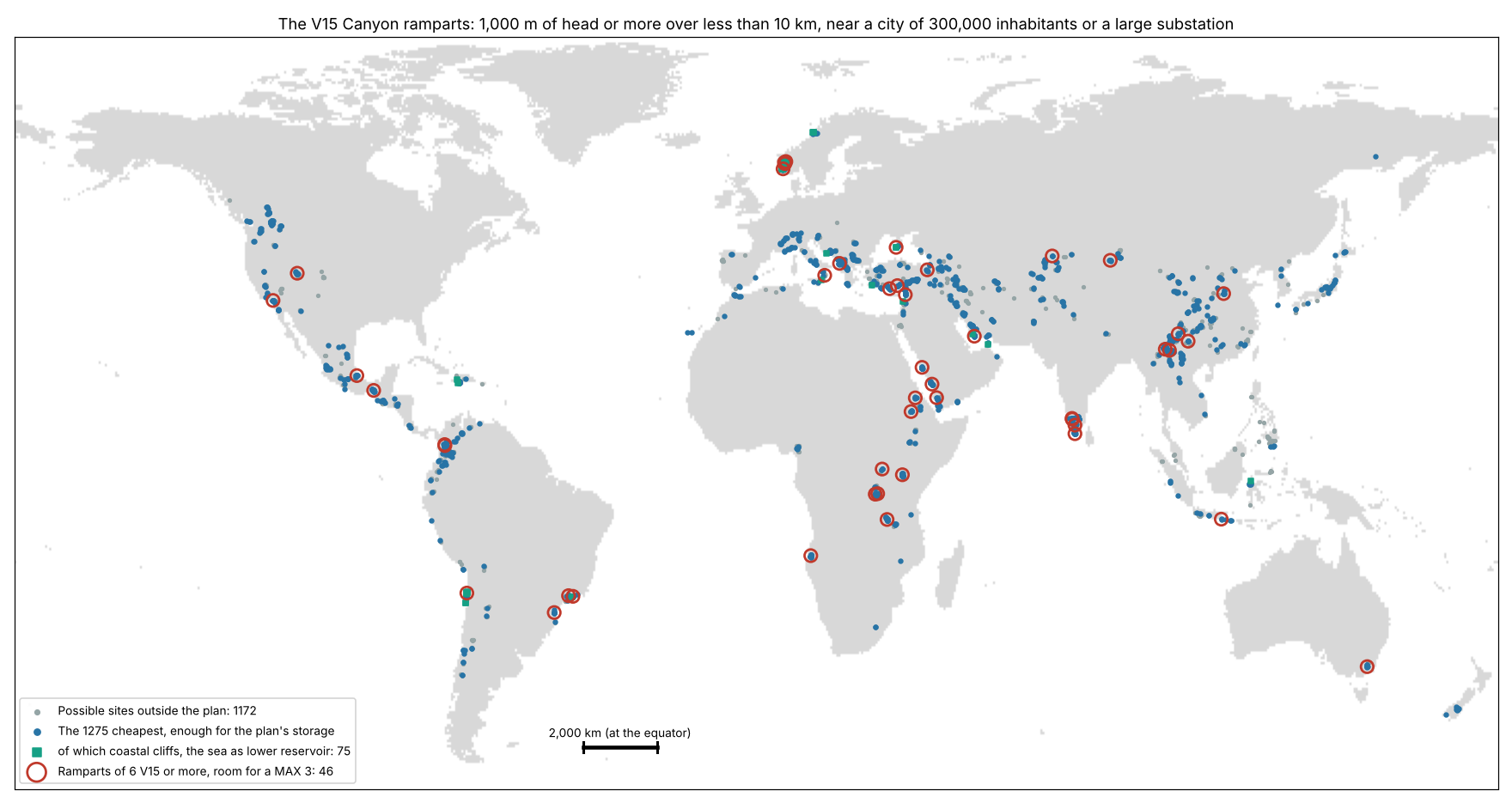
The ramparts of the V15 Canyon: 2,447 sites with a head of 1,000 m or more near a city or a large substation, on 1,368 ramparts, 5.3 TWh of possible storage, almost twice what the Artesia 5 plan requires, but not always where it is needed
The V15 Canyon is the battery of the plan: two reservoirs 1,000 or 2,000 m apart in height, a shaft, a cavern powerhouse. The Artesia 5 plan counts 1,000 of them, but without placing them: it was the only large plant of the plan whose location was unknown. This page does for it what the plateau scan did for the V14 Soleil: it reads the relief of the world, kilometre by kilometre, and looks for the ramparts. It prepares the Artesia 5 recalculation and the V15 Canyon MAX.
Code (Python, free): balayage_remparts_v15.py; the map: carte_remparts_v15.py; the results: remparts_v15.csv (one site per line) and remparts_v15_grappes.csv (one rampart per line)
Related pages: V15 Canyon | V15 Canyon MAX | the need for evening storage | the best locations | the Artesia 5 plants
Code (Python, free): balayage_remparts_v15.py; the map: carte_remparts_v15.py; the results: remparts_v15.csv (one site per line) and remparts_v15_grappes.csv (one rampart per line)
Related pages: V15 Canyon | V15 Canyon MAX | the need for evening storage | the best locations | the Artesia 5 plants
------------------------------
1. THE METHOD
------------------------------
* The relief: GMTED2010, the mean altitude of the world at 30 arc seconds, about one kilometre, already used for the plateau scan. The 86 tiles that carry land, from Tierra del Fuego to Greenland, were all read with their edges, so as not to cut the ramparts at the boundary of two tiles; only Antarctica is left aside.
* The upper reservoir: a cell at 3,500 m altitude at most, flat enough for a reservoir (less than 200 m difference with its neighbours over 2.5 km).
* The lower reservoir: the nearest cell, 10 km at most horizontally, that is at least 1,000 m lower and also flat enough, or the sea. The useful head is counted up to 2,000 m, as on the V15 page.
* The grid: a city of 300,000 inhabitants or more within 50 km (GeoNames), or a plant of 500 MW or more within 30 km (WRI world database), whose substation can receive the V15.
* The sites: one every 3 km at least, each with its shaft. Sites less than 6 km from one another form a rampart: that is where the V15 MAX can be built.
* Exclusions: the Grand Canyon, the Little Colorado canyon, Yosemite and Uluru, as the V15 rule requires; the other parks and protected lands are not read (see the limits).
* The price of each site: that of the V15 page at its head, 473 M€ at 1,000 m (200 MW, 1,962 MWh), 650 M€ at 1,500 m, 815 M€ at 2,000 m, plus 15 M€ per kilometre of tunnel beyond the 3 km the page already counts. The reservoirs remain those of the V15, 2 × 800,000 m³.
------------------------------
2. THE RESULT
------------------------------
* The storage exists: 5.3 TWh possible, 1.8 times the plan's 2.9 TWh, without touching the listed canyons.
* The real ramparts are lower and less steep than the reference V15: half of the sites have a head between 1,000 and 1,050 m, and the lower reservoir is on average 7.8 km away horizontally, instead of 2 km. More sites are therefore needed (1,275 instead of 1,000) and longer tunnels: the plan's storage costs 754 billion instead of 650, 16% more.
* The MAX versions make up half the gap: grouped on their ramparts, these 1,275 V15 make 832 plants and about 697 billion, 7% more than the plan assumed.
------------------------------
3. THE COUNTRIES
------------------------------
Where there are almost no ramparts: the plain of eastern China, northern India and Pakistan (9), the eastern United States, Western and Northern Europe outside Norway (France 11, Spain 10, Switzerland 9, Austria 6, Germany and the United Kingdom none), Russia (8), South Korea (2), Taiwan, Egypt, South Africa (2). Yet these are large grids, often those that will have the most solar and wind surplus to store. Their evening storage will have to come from elsewhere: from the V14 reservoirs, from lines to countries with ramparts, or from other batteries. This is what the Artesia 5 recalculation will have to say.
------------------------------
4. THE 25 LARGEST RAMPARTS
------------------------------
The large ramparts are above all the escarpments of the African rifts (Tanganyika, Kenya, Angola), the Serra do Mar in Brazil, the Andes of Colombia, the fjords of Norway, the Atacama coast and the Ghats of southern India. The ramparts of the metropolises of the V15 page are there too, shorter: Medellín 20 sites, Sanaa 22, San Bernardino above Los Angeles 15, Seattle 12, Portland 11, Santiago 10, Beirut 8, Bogotá 8, Vancouver 6, Almaty 6, Kabul 6, Tehran 3.
------------------------------
5. THE MAX VERSIONS
------------------------------
Of the 2,447 sites, 1,520 are on ramparts that carry two or more: 63 MAX 3, 77 MAX 2 and 344 MAX possible, that is 1,557 plants instead of 2,447. But the V15 Canyon MAX has one condition: a grid that gives it 400 MW of surplus per V15, 2.4 GW for a MAX 3. Only 6 of the ramparts of six V15 or more are within 50 km of a city of one million inhabitants. The large African ramparts are near medium-sized cities: their MAX 3 will only fill with large lines or large solar and wind farms next to them. For the plan's storage, the grouping gives 35 MAX 3, 32 MAX 2 and 172 MAX, and about 57 billion of savings, less than the 92 of the cautious case on the MAX page.
------------------------------
6. WHAT IT CHANGES FOR ARTESIA 5
------------------------------
* The V15 become sites: 1,275 named sites, with their head, their tunnel, their city or substation and their price. The Artesia 5 recalculation will be able to choose them one by one, like the V14, at delivered cost, line included.
* Storage costs a little more: about 697 billion with the MAX versions, instead of the 650 for the battery part assumed until now.
* It is not where the largest surpluses are: China has 369 sites, but almost all in the south-west (Yunnan, Guizhou, Sichuan) and on the edge of the Taihang, far from the east coast. Western Europe, northern India and the eastern United States have almost none. The recalculation will have to count the lines between storage and surpluses, or keep part of the storage elsewhere.
------------------------------
7. THE LIMITS
------------------------------
* Relief at one kilometre smooths the cliffs: a mean altitude per cell rounds off ridges and valley floors. A rampart of 1,000 m over 3 km often appears there as 800 m over 5. The count is a minimum, especially in the Alps, where high-head pumped storage plants already exist (Bieudron, Nant de Drance) and which the scan finds little of.
* Rock cannot be seen on a map: karst, gypsum or a fault in the shaft, and the site falls. These are possible sites, not validated sites.
* Parks, protected lands and the lands of indigenous peoples are not read: the World Database on Protected Areas (WDPA) remains to be crossed. Part of the sites will fall.
* People: an upper reservoir above a city can only be authorised with its cells and its buffer reservoir (V15 page). The scan reads neither the villages nor the roads below the reservoirs.
* The price of a site comes from the V15 page, at its head; the tunnel is counted at 15 M€ per km, an average for a tunnel 5 m in diameter.
------------------------------
8. CONCLUSION
------------------------------
The ramparts exist: 2,447 V15 Canyon sites with a head of 1,000 m or more, near a city or a large substation, for 5.3 TWh of storage, almost twice what the plan requires. They are lower and less steep than the reference V15, so that the plan's 2.9 TWh cost 754 billion instead of 650, and about 697 with the MAX versions. They are above all in south-western China, Turkey, Iran, the Andes, Mexico, southern India, Norway and on the African rifts, and almost absent from Western Europe, northern India and the eastern United States. The Artesia 5 recalculation will take them one by one, with the price of the lines that connect them to the surpluses.
------------------------------
SOURCES
------------------------------
The scan (Python), the map (Python), the 2,447 sites (CSV), the 1,368 ramparts (CSV)
GMTED2010 (USGS), GeoNames (CC BY 4.0), WRI: Global Power Plant Database (CC BY 4.0), global-land-mask
The V15 Canyon, the V15 Canyon MAX, the best locations, the Artesia 5 plan
The site's good ideas
Olivier Muhleisen in collaboration with Claude (Anthropic), October 2026. Plans, diagrams, texts and figures under the CC BY 4.0 licence.
© 2009-2026 Onmyweb Production - TOS - Cookies information - Contact us - Free Copyright Open Source -
1. THE METHOD
------------------------------
* The relief: GMTED2010, the mean altitude of the world at 30 arc seconds, about one kilometre, already used for the plateau scan. The 86 tiles that carry land, from Tierra del Fuego to Greenland, were all read with their edges, so as not to cut the ramparts at the boundary of two tiles; only Antarctica is left aside.
* The upper reservoir: a cell at 3,500 m altitude at most, flat enough for a reservoir (less than 200 m difference with its neighbours over 2.5 km).
* The lower reservoir: the nearest cell, 10 km at most horizontally, that is at least 1,000 m lower and also flat enough, or the sea. The useful head is counted up to 2,000 m, as on the V15 page.
* The grid: a city of 300,000 inhabitants or more within 50 km (GeoNames), or a plant of 500 MW or more within 30 km (WRI world database), whose substation can receive the V15.
* The sites: one every 3 km at least, each with its shaft. Sites less than 6 km from one another form a rampart: that is where the V15 MAX can be built.
* Exclusions: the Grand Canyon, the Little Colorado canyon, Yosemite and Uluru, as the V15 rule requires; the other parks and protected lands are not read (see the limits).
* The price of each site: that of the V15 page at its head, 473 M€ at 1,000 m (200 MW, 1,962 MWh), 650 M€ at 1,500 m, 815 M€ at 2,000 m, plus 15 M€ per kilometre of tunnel beyond the 3 km the page already counts. The reservoirs remain those of the V15, 2 × 800,000 m³.
------------------------------
2. THE RESULT
------------------------------
| Sites | Storage | Returned at peak per year | Investment | |
|---|---|---|---|---|
| All possible sites | 2,447, on 1,368 ramparts | 5.3 TWh | 1,787 TWh | €1,425bn |
| of which coastal cliffs, with the sea as lower reservoir | 94 (Norway 55, Chile 18) | |||
| What the Artesia 5 plan requires: 1,000 reference V15 | 1,000 | 2.9 TWh | 986 TWh | €650bn (battery part) |
| The cheapest that give this storage | 1,275 | 2.9 TWh | 986 TWh | €754bn |
| The same, grouped into MAX versions | 832 plants (35 MAX 3, 32 MAX 2, 172 MAX, 593 single) | 2.9 TWh | 986 TWh | about €697bn |
* The storage exists: 5.3 TWh possible, 1.8 times the plan's 2.9 TWh, without touching the listed canyons.
* The real ramparts are lower and less steep than the reference V15: half of the sites have a head between 1,000 and 1,050 m, and the lower reservoir is on average 7.8 km away horizontally, instead of 2 km. More sites are therefore needed (1,275 instead of 1,000) and longer tunnels: the plan's storage costs 754 billion instead of 650, 16% more.
* The MAX versions make up half the gap: grouped on their ramparts, these 1,275 V15 make 832 plants and about 697 billion, 7% more than the plan assumed.
------------------------------
3. THE COUNTRIES
------------------------------
| Country | Sites | Possible storage (GWh) | Median head | Among the 1,275 cheapest | Ramparts of 6 V15 or more | Coastal cliffs |
|---|---|---|---|---|---|---|
| China | 369 | 797.3 | 1,046 m | 176 | 6 | 0 |
| Turkey | 178 | 377.4 | 1,028 m | 78 | 3 | 2 |
| Iran | 130 | 288.9 | 1,044 m | 76 | 1 | 1 |
| Colombia | 116 | 254.5 | 1,064 m | 62 | 2 | 0 |
| Mexico | 113 | 246.3 | 1,062 m | 57 | 2 | 0 |
| United States | 111 | 231.6 | 1,021 m | 45 | 2 | 0 |
| India | 97 | 230.1 | 1,137 m | 73 | 4 | 0 |
| Norway | 84 | 190.5 | 1,123 m | 69 | 4 | 55 |
| Brazil | 62 | 134.4 | 1,080 m | 38 | 3 | 1 |
| Tanzania | 57 | 127.4 | 1,082 m | 37 | 1 | 0 |
| DR Congo | 57 | 124.4 | 1,061 m | 22 | 2 | 0 |
| Indonesia | 56 | 118.1 | 1,030 m | 18 | 1 | 2 |
| Italy | 50 | 105.5 | 1,018 m | 26 | 1 | 3 |
| Yemen | 46 | 100.2 | 1,052 m | 20 | 1 | 0 |
| Japan | 44 | 92.6 | 1,040 m | 23 | 0 | 0 |
| Canada | 41 | 99.7 | 1,187 m | 36 | 0 | 0 |
| Saudi Arabia | 40 | 96.5 | 1,216 m | 28 | 2 | 0 |
| Ethiopia | 36 | 75.0 | 1,024 m | 17 | 1 | 0 |
| Chile | 35 | 83.6 | 1,098 m | 28 | 1 | 18 |
| Kenya | 33 | 80.1 | 1,234 m | 27 | 1 | 0 |
Where there are almost no ramparts: the plain of eastern China, northern India and Pakistan (9), the eastern United States, Western and Northern Europe outside Norway (France 11, Spain 10, Switzerland 9, Austria 6, Germany and the United Kingdom none), Russia (8), South Korea (2), Taiwan, Egypt, South Africa (2). Yet these are large grids, often those that will have the most solar and wind surplus to store. Their evening storage will have to come from elsewhere: from the V14 reservoirs, from lines to countries with ramparts, or from other batteries. This is what the Artesia 5 recalculation will have to say.
------------------------------
4. THE 25 LARGEST RAMPARTS
------------------------------
| Rampart, nearest city or substation | Country | Latitude; longitude | Possible V15 | Mean head | Possible storage (GWh) | Coastal cliff |
|---|---|---|---|---|---|---|
| Sumbawanga | Tanzania | -8.03; 31.80 | 32 | 1,200 m | 75.3 | |
| Eldoret | Kenya | 0.60; 35.52 | 31 | 1,248 m | 75.9 | |
| Lubango | Angola | -15.01; 13.29 | 27 | 1,152 m | 61.0 | |
| Serra do Mar, near the Angra plant | Brazil | -22.86; -44.42 | 17 | 1,130 m | 37.7 | |
| Bello | Colombia | 6.42; -75.54 | 16 | 1,172 m | 36.8 | |
| Aurland, Sogn | Norway | 61.03; 7.24 | 15 | 1,241 m | 36.5 | yes |
| Tocopilla | Chile | -22.23; -70.16 | 13 | 1,363 m | 34.8 | yes |
| Taubaté | Brazil | -22.73; -45.49 | 13 | 1,131 m | 28.8 | |
| Kundah, Nilgiri | India | 11.47; 76.68 | 12 | 1,104 m | 26.0 | |
| Khamis Mushait | Saudi Arabia | 18.08; 42.71 | 11 | 1,138 m | 24.6 | |
| Latakia | Syria | 35.34; 36.23 | 11 | 1,075 m | 23.2 | |
| Medellín | Colombia | 6.23; -75.49 | 11 | 1,045 m | 22.6 | |
| Teni | India | 10.18; 77.39 | 10 | 1,636 m | 32.1 | |
| Jiaozuo | China | 35.55; 113.47 | 10 | 1,117 m | 21.9 | |
| Aurland, Sogn | Norway | 60.85; 6.89 | 9 | 1,301 m | 23.0 | yes |
| Ta’if | Saudi Arabia | 21.32; 40.29 | 9 | 1,235 m | 21.8 | |
| Uvira | DR Congo | -3.15; 28.93 | 9 | 1,123 m | 19.8 | |
| Xalapa de Enríquez | Mexico | 19.73; -96.85 | 9 | 1,103 m | 19.5 | |
| Tirunelveli | India | 8.52; 77.39 | 8 | 1,234 m | 19.4 | |
| Baoshan | China | 24.82; 99.31 | 8 | 1,178 m | 18.5 | |
| Taraz | Kazakhstan | 42.81; 71.87 | 8 | 1,166 m | 18.3 | |
| Liupanshui | China | 26.37; 104.85 | 8 | 1,141 m | 17.9 | |
| San Bernardino, above Riverside | United States | 34.23; -117.19 | 8 | 1,140 m | 17.9 | |
| Sima, Eidfjord | Norway | 60.63; 7.01 | 8 | 1,138 m | 17.9 | yes |
| Joinville | Brazil | -25.99; -48.96 | 8 | 1,129 m | 17.7 |
The large ramparts are above all the escarpments of the African rifts (Tanganyika, Kenya, Angola), the Serra do Mar in Brazil, the Andes of Colombia, the fjords of Norway, the Atacama coast and the Ghats of southern India. The ramparts of the metropolises of the V15 page are there too, shorter: Medellín 20 sites, Sanaa 22, San Bernardino above Los Angeles 15, Seattle 12, Portland 11, Santiago 10, Beirut 8, Bogotá 8, Vancouver 6, Almaty 6, Kabul 6, Tehran 3.
------------------------------
5. THE MAX VERSIONS
------------------------------
Of the 2,447 sites, 1,520 are on ramparts that carry two or more: 63 MAX 3, 77 MAX 2 and 344 MAX possible, that is 1,557 plants instead of 2,447. But the V15 Canyon MAX has one condition: a grid that gives it 400 MW of surplus per V15, 2.4 GW for a MAX 3. Only 6 of the ramparts of six V15 or more are within 50 km of a city of one million inhabitants. The large African ramparts are near medium-sized cities: their MAX 3 will only fill with large lines or large solar and wind farms next to them. For the plan's storage, the grouping gives 35 MAX 3, 32 MAX 2 and 172 MAX, and about 57 billion of savings, less than the 92 of the cautious case on the MAX page.
------------------------------
6. WHAT IT CHANGES FOR ARTESIA 5
------------------------------
* The V15 become sites: 1,275 named sites, with their head, their tunnel, their city or substation and their price. The Artesia 5 recalculation will be able to choose them one by one, like the V14, at delivered cost, line included.
* Storage costs a little more: about 697 billion with the MAX versions, instead of the 650 for the battery part assumed until now.
* It is not where the largest surpluses are: China has 369 sites, but almost all in the south-west (Yunnan, Guizhou, Sichuan) and on the edge of the Taihang, far from the east coast. Western Europe, northern India and the eastern United States have almost none. The recalculation will have to count the lines between storage and surpluses, or keep part of the storage elsewhere.
------------------------------
7. THE LIMITS
------------------------------
* Relief at one kilometre smooths the cliffs: a mean altitude per cell rounds off ridges and valley floors. A rampart of 1,000 m over 3 km often appears there as 800 m over 5. The count is a minimum, especially in the Alps, where high-head pumped storage plants already exist (Bieudron, Nant de Drance) and which the scan finds little of.
* Rock cannot be seen on a map: karst, gypsum or a fault in the shaft, and the site falls. These are possible sites, not validated sites.
* Parks, protected lands and the lands of indigenous peoples are not read: the World Database on Protected Areas (WDPA) remains to be crossed. Part of the sites will fall.
* People: an upper reservoir above a city can only be authorised with its cells and its buffer reservoir (V15 page). The scan reads neither the villages nor the roads below the reservoirs.
* The price of a site comes from the V15 page, at its head; the tunnel is counted at 15 M€ per km, an average for a tunnel 5 m in diameter.
------------------------------
8. CONCLUSION
------------------------------
The ramparts exist: 2,447 V15 Canyon sites with a head of 1,000 m or more, near a city or a large substation, for 5.3 TWh of storage, almost twice what the plan requires. They are lower and less steep than the reference V15, so that the plan's 2.9 TWh cost 754 billion instead of 650, and about 697 with the MAX versions. They are above all in south-western China, Turkey, Iran, the Andes, Mexico, southern India, Norway and on the African rifts, and almost absent from Western Europe, northern India and the eastern United States. The Artesia 5 recalculation will take them one by one, with the price of the lines that connect them to the surpluses.
------------------------------
SOURCES
------------------------------
The scan (Python), the map (Python), the 2,447 sites (CSV), the 1,368 ramparts (CSV)
GMTED2010 (USGS), GeoNames (CC BY 4.0), WRI: Global Power Plant Database (CC BY 4.0), global-land-mask
The V15 Canyon, the V15 Canyon MAX, the best locations, the Artesia 5 plan
The site's good ideas
Olivier Muhleisen in collaboration with Claude (Anthropic), October 2026. Plans, diagrams, texts and figures under the CC BY 4.0 licence.
© 2009-2026 Onmyweb Production - TOS - Cookies information - Contact us - Free Copyright Open Source -