
Hydroloop Muhleisen 2026, V14 Soleil: the V14 without wind turbines, for sunny countries. 500 MWp of trackers on the plateau, basins covered with floating panels, 998 GWh a year at 30 €/MWh, almost the price of the wind V14, a panel field that harvests its own water, and a mixed variant with 30 wind turbines that sells its electricity better. 19/10/26
The V14 is the cheapest plant on the site, but it needs a 15 to 20 km ridge with more than 6.5 m/s of wind, and such ridges are limited. The Hydroloop plan (in French) already said so on 10 October: in hot countries, sunny relief is far more abundant than windy relief, and solar trackers can replace the wind turbines for an equal or lower price; in the hourly model, it is almost the case: 30 €/MWh instead of 28. The 10,000 billion target world plan (in French) needed it to ease its bottleneck, large wind turbines. This page costs it with the hourly model. We keep everything hydraulic from the V14, the two 800,000 m³ basins, the penstocks, the plant, the 588 MWh of storage, and replace the 40 wind turbines with 500 MWp of trackers on the plateau. Result: 998 GWh a year for 445 M€, 0.45 M€ per annual GWh and 30 €/MWh, two euros from the wind V14. Two things change everything else. Water first: in a hot climate, the basins must be covered, and the panel field becomes the collector that fills them. Value next: solar produces at midday, when sunny countries already have too much solar, and the V14 Soleil sells its MWh at 49 € where the wind V14 sells it at 73 on the same price profile. Hence the mixed V14 Soleil, 30 wind turbines and 200 MWp, at the same price, which sells it at 63.
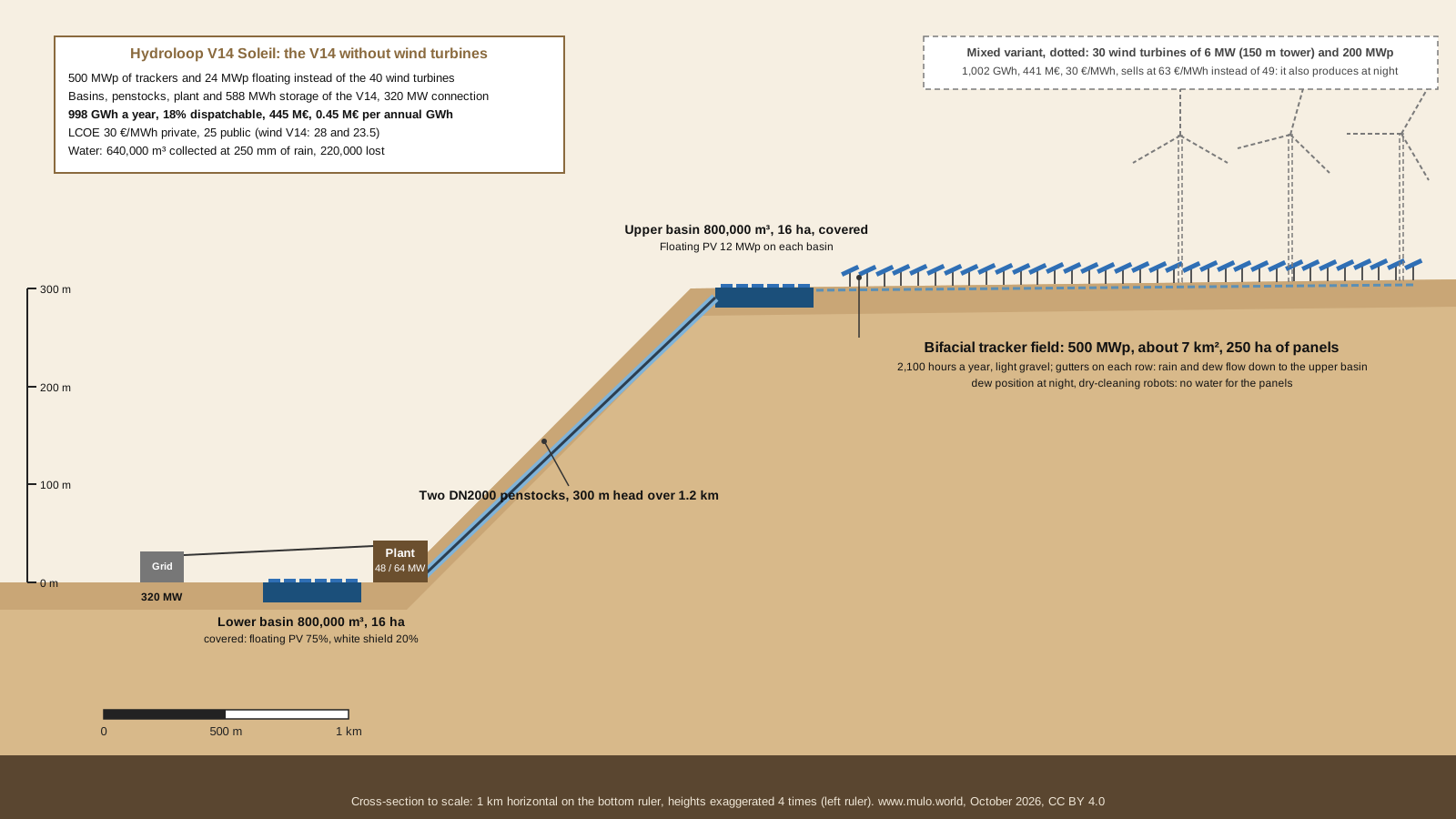
Diagram code (Python, free): schema_hydroloop_v14_soleil.py; hourly model: hydroloop_muhleisen_2026_v14_soleil_simulation.py (arguments: number of 6 MW wind turbines, mean wind in m/s, MWp of trackers, equivalent hours of the trackers, floating MWp, grid connection in MW, pumps in MW, turbines in MW, storage in MWh, price of photovoltaics in M€/MWp)
Neighbouring versions: V14 Soleil MAX, MAX 2 and MAX 3 | V14, the head of the plan | V12, the catchment of dry sites (in French) | V9, the covered basins (in French) | V15 Canyon; the 10,000 billion target world plan (in French)
------------------------------
1. THE PRINCIPLE: KEEP THE HYDRAULICS, CHANGE THE SOURCE
------------------------------
In a V14, wind makes up 63% of the price and 97% of the energy; the hydraulics, basins, penstocks, plant and storage, make up the rest and do not depend on what fills them. The V14 Soleil keeps the hydraulics as they are and changes the energy source.
Why 500 MWp and a 320 MW grid connection. The model tried 300 to 750 MWp, 240 and 320 MW of connection, 64 to 200 MW of pumps, 48 to 96 MW of turbines and 588 to 2,352 MWh of storage. The cheapest kWh comes out on a plateau of 500 to 550 MWp with 320 MW of connection; we take the bottom of the plateau: the trackers give at most 425 MW at midday, the pumps take 64, and only 26 GWh a year are curtailed, 2.4% of production. At 240 MW, too much is curtailed; at 750 MWp, about 310 GWh are curtailed. And as for the wind V14, enlarging the basins or the machines raises the price of the kWh: the plant's storage serves the evening peak; the rest of the grid's storage is the job of the V15 Canyon.
------------------------------
2. THE FIGURES IN A SERIES OF 10 PLANTS
------------------------------
Same method as the V14: hourly model over 8,760 hours, same control of pumps and turbines, same French 2026 series prices. Photovoltaics are counted at the price of the V14 trackers, 0.57 M€/MWp installed, floating at 0.75 M€/MWp as on the V11 (in French). The reference site is at 25° latitude, 2,100 equivalent tracker hours a year: Rajasthan, southern Morocco or inland Australia.
Sensitivity to sun, to the price of photovoltaics and to wind. Wind speeds are given at the 150 m hub, as on the V14 and plan pages: a ridge at 6 m/s gives 6.2 m/s at the hub.
------------------------------
3. THE VALUE OF THE MIDDAY MWH
------------------------------
The cost of the kWh does not tell the whole story. In countries where solar is already everywhere, midday electricity is worth almost nothing and evening electricity is expensive. To measure it, the model sells each hour on the price profile of a sunny country, 67.5 €/MWh on average: 60 €/MWh from midnight to 6 am, 70 in the morning, 30 from 9 am to 4 pm, 80 in the late afternoon, 130 from 6 pm to 10 pm, 80 from 10 pm to midnight. It is an assumption, not a real market, but it is the shape that prices already take in California, South Australia, Chile or Spain in spring.
Three readings:
* On the cost of the kWh, the V14 Soleil is as good as the wind V14. On the value of the kWh, it is not: two thirds of its electricity goes out between 9 am and 4 pm, and the profile pays it 30 €/MWh. It pays back in ten years instead of six. It is still profitable, but it is a plant for countries where midday electricity keeps its value, or for a buyer who consumes during the day: desalination plant, electrolysis, mine, air conditioning of cities.
* The mixed version fixes most of it at the same price. Thirty wind turbines produce at night and in winter, when the trackers sleep; the solar field has only 200 MWp, and the plant sells at 63 €/MWh. Wherever the ridge gives 5.5 m/s or more at the hub, the mixed version is the one to build.
* Doubling the storage raises the value but not the profitability: the extra basins and machines cost more than they bring in. The evening of sunny countries is won at grid level, with the V15 Canyon and the other plants, not by enlarging each V14.
------------------------------
4. WATER: COVERED BASINS, A FIELD THAT HARVESTS
------------------------------
A sunny country is a dry country, and an open basin loses about 2.5 m of water a year there. The two 800,000 m³ basins are 16 ha each (four times the 4 ha of those of the V9, for four times the volume): uncovered, 800,000 m³ would go each year, a whole basin. The V14 Soleil takes the two solutions already described on the site.
* The V9 cover on both basins: 75% floating photovoltaics on variable-level anchoring, 20% white shield, 5% channels, all sloping towards gutters. Evaporation drops by 85%, and the 24 floating MWp produce 2,100 x 0.75 hours, cooled by the water.
* The V12 gutters on each row of trackers, with the dew position at night and the rain position when the rain gauge switches on. The field is on the plateau, above the upper basin: the water flows down by gravity.
The V14 Soleil is self-sufficient in water above about 75 mm of rain a year, which covers Rajasthan, Morocco, the Asir in Arabia and inland Australia, but not the heart of the Sahara or northern Chile, where less than 20 mm falls: there, the water comes from elsewhere, from a desalination plant powered by the plant or from a mine that recycles it. The surplus of wet years goes through the turbines or to the villages. The mixed version, with only 100 ha of panels, is only self-sufficient above about 200 mm; below that, it adds the V12 clay catchment under the trackers. The panels are cleaned by dry robots, as in all the large desert fields: no water for them.
The first filling is the only real constraint: one full basin and the bottom of the other, about 900,000 m³. At 250 mm, the field supplies it in two or three years, at 150 mm in five; below that, or to go faster, it is brought in once, from a city's treated wastewater, a temporary borehole or an existing canal. In the meantime, the trackers already sell directly, and the turbines start with the first water.
The wastewater treatment plant of the neighbouring city is the best of these sources, and not only for the first filling. A city discharges 150 to 250 litres of treated water per inhabitant per day, summer and winter: 8 million m³ a year for 100,000 inhabitants, enough to fill both basins in six weeks and then cover the 220,000 m³ of evaporation with 3% of the flow, through a single pipe to the lower basin. Two rules: never this water in a basin kept for a city's water, and covered basins, which the V14 Soleil already has, because the nitrates and phosphates of an effluent grow algae in a basin open to the sun. And if the treatment plant is higher than the lower basin, its water can be turbined on the way, through its own pipe and a rain Pelton: at 300 m, 1 m³/s is worth 2.65 MW and 23 GWh a year, a city of 400,000 inhabitants; this requires a city above the plant, a city terraced on a slope or an upper city next to a lower city, which is checked on the map before anything else. The details, the five cases, the world cross-check and gravity irrigation are on the page Hydroloop and city water (in French).
------------------------------
5. WHERE TO BUILD IT
------------------------------
The V14 Soleil needs neither a long ridge nor wind: a 300 m slope over less than 1.5 km, a sunny 7 km² plateau above it, more than 1,800 tracker hours a year, a 320 MW substation less than 30 km away. This is the most common relief in hot countries, and it is where a large part of the world's coal is burned. On 23/10/2026, the relief scan of the sun belt (in French) counted them: 21,986 plateaus, 39,068 sites with more than 1,800 tracker hours, 27,523 less than 150 km from a large city.
What must not be done: lay 7 km² of trackers on cultivated land, a protected area or a nomads' grazing route without them; the best locations page (in French) keeps its four exclusion rules. A plateau of stone or bare steppe above a slope is what these countries lack least.
------------------------------
6. WHAT IT CHANGES FOR THE WORLD PLAN
------------------------------
The 10,000 billion target plan counts, in its scenario B, 5,100 V14 on ridges at 6 m/s (6.2 at the hub), at 0.49 M€ per annual GWh including the line, and that is what pushes it to 4,010 GW of large wind turbines. With the 20 M€ line counted the same way, the V14 Soleil is at 0.47 and the mixed version at 0.46. A first calculation, to be taken up on the plan page, keeping the same number of sites: a V14 Soleil produces 998 GWh where the ridge V14 produces 787, so each site replaces more hybrid panels, the most expensive item in the plan. Half of these ridges as V14 Soleil or mixed brings the plan from 9,905 to about 9,750 to 9,770 billion euros; all of them, to about 9,600 to 9,640, with 2,790 to 3,710 GW of large wind turbines instead of 4,010, the same 17,360 TWh and roughly the same guaranteed power in the evening. The price drops little; what changes is that the plan no longer depends on a single industry. Update of 19/10: the 10,000 billion target world plan optimised for sun (in French) keeps all the ridges, half as V14 Soleil and the other half as mixed, 9,620 billion euros and 3,250 GW of large wind turbines.
------------------------------
7. THE SIX CAVEATS
------------------------------
* The model is simple. The sun follows the solar elevation at 25° latitude, with clouds drawn at random day by day, as in the model published since V10, and the tracker hours are an input, not a measurement. A real tracker produces earlier in the morning and later in the evening than this curve, which should rather work in the plant's favour.
* The price profile is an assumption. It says what midday solar is worth in a country that already has a lot of it; in a country that has little, the V14 Soleil sells better. The capacity payments and the dispatchable premium, counted on the V14 page, are not counted here for any of the plants.
* The prices are French series prices. Trackers cost less in India, the Middle East or Chile (0.38 M€ per annual GWh at 0.45 M€/MWp); the hard ground of the plateaus, the heat and transport push them up. The reference figure keeps the site's price.
* The water is estimated. 2.5 m of evaporation in the open, 85% less under the V9 cover, 95% of the rain harvested by the gutters: none of these figures has yet been measured on a 16 ha basin. And the first filling takes two to five years of collection between 250 and 150 mm of rain, and requires an outside source below that.
* Heat and dust. Panel efficiency drops at 45 °C, which the 2,100 hours already count, and sand settles on the covered basins as on the panels; dry cleaning is an operating item, included in the 6,000 € per MWp.
* The midday kWh may be worth even less. If sunny countries all equip themselves at the same time, the midday price falls below 30 €/MWh, and it is the mixed version, or a daytime buyer, that saves the plant.
------------------------------
8. CONCLUSION
------------------------------
The V14 Soleil holds. By keeping all the hydraulics of the V14 and replacing its 40 wind turbines with 500 MWp of trackers on the plateau, it produces 998 GWh a year for 445 M€, 30 €/MWh private and 25 public, almost the price of the wind V14, on sites that hot countries have in abundance. Its covered basins and gutters make it self-sufficient in water above 75 mm of rain a year. Its weakness is the time at which it produces: at midday, in a country already full of solar, its MWh is worth 49 € instead of 73, and it pays back in ten years instead of six. The mixed V14 Soleil, 30 wind turbines and 200 MWp, at the same price, fixes most of it and pays back in 7.6 years. For the world plan, both ease the bottleneck of large wind turbines. A 16 ha covered basin under the sun remains to be measured, and the first V14 Soleil can be built where a solar field and a pumped-storage plant already exist side by side, as at Pinnapuram. Update of 29/10/2026: the V14 Soleil MAX brings together two, four or six V14 Soleil on a single plateau, down to 26.9 €/MWh in MAX 3.
------------------------------
SOURCES
------------------------------
The hourly model of the V14 Soleil (Python, no library)
Hydroloop Muhleisen 2026 V14, the head of the plan: prices item by item and sensitivity to wind
The parameterised hourly model of the V13 and V14, whose control the V14 Soleil reuses
Hydroloop Muhleisen 2026 V12: the gutters, the dew position and the clay catchment (in French)
Hydroloop Muhleisen 2026 V9: basin covers and floating photovoltaics (in French)
Hydroloop Muhleisen 2026 V11: the price of floating photovoltaics (in French)
Hydroloop world plan: the solar variant announced on 10/10/26 (in French)
10,000 billion target world plan (in French)
The best locations in the world for large Hydroloops, including Pinnapuram (in French)
World Bank: Global Solar Atlas, the world's solar yield
IEA PVPS: Snapshot of Global PV Markets
The site's good ideas (in French)
Olivier Muhleisen in collaboration with Claude (Anthropic), October 2026. Royalty-free plans, open source, CC BY 4.0.
© 2009-2026 Onmyweb Production - TOS - Cookies information - Contact us - Free Copyright Open Source -
1. THE PRINCIPLE: KEEP THE HYDRAULICS, CHANGE THE SOURCE
------------------------------
In a V14, wind makes up 63% of the price and 97% of the energy; the hydraulics, basins, penstocks, plant and storage, make up the rest and do not depend on what fills them. The V14 Soleil keeps the hydraulics as they are and changes the energy source.
| Item | V14 | V14 Soleil | Mixed V14 Soleil |
|---|---|---|---|
| Wind | 40 x 6 MW, 150 m towers | none | 30 x 6 MW, 150 m towers |
| Bifacial trackers | 15 MWp, plus 1 MWp on slopes | 500 MWp on the plateau, about 7 km² | 200 MWp, about 3 km² |
| Floating photovoltaics | none | 24 MWp, 12 on each basin | 24 MWp |
| Basins | 2 x 800,000 m³, 588 MWh | the same, covered like the V9 | the same, covered |
| Plant | 48 MW of turbines, 64 MW of variable-speed pumps | the same | the same |
| Grid connection | 240 MW, shared 400 kV substation | 320 MW | 320 MW |
| Water | rain reservoir 500,000 m³ | gutters on the 500 MWp, the reservoir becomes the store of collected water | gutters on the 200 MWp, reservoir |
| What the site needs | a 15 to 20 km ridge with more than 6.5 m/s | a sunny 7 km² plateau above a 300 m slope | a 3 km² plateau and a 12 km ridge at 6 m/s (6.2 at the 150 m hub) |
| Electricity sold | 885 GWh | 998 GWh | 1,002 GWh |
| Dispatchable share | 19% | 18% | 20% |
| Investment in series | 364 M€ | 445 M€ | 441 M€ |
| Investment per annual GWh | 0.41 M€ | 0.45 M€ | 0.44 M€ |
| Private / public LCOE | 28 / 23.5 €/MWh | 30 / 25 €/MWh | 30 / 25 €/MWh |
| Value of the MWh sold, price profile of a sunny country | 73 €/MWh | 49 €/MWh | 63 €/MWh |
| Payback time at this profile | 6.1 years | 10.2 years | 7.6 years |
Why 500 MWp and a 320 MW grid connection. The model tried 300 to 750 MWp, 240 and 320 MW of connection, 64 to 200 MW of pumps, 48 to 96 MW of turbines and 588 to 2,352 MWh of storage. The cheapest kWh comes out on a plateau of 500 to 550 MWp with 320 MW of connection; we take the bottom of the plateau: the trackers give at most 425 MW at midday, the pumps take 64, and only 26 GWh a year are curtailed, 2.4% of production. At 240 MW, too much is curtailed; at 750 MWp, about 310 GWh are curtailed. And as for the wind V14, enlarging the basins or the machines raises the price of the kWh: the plant's storage serves the evening peak; the rest of the grid's storage is the job of the V15 Canyon.
------------------------------
2. THE FIGURES IN A SERIES OF 10 PLANTS
------------------------------
Same method as the V14: hourly model over 8,760 hours, same control of pumps and turbines, same French 2026 series prices. Photovoltaics are counted at the price of the V14 trackers, 0.57 M€/MWp installed, floating at 0.75 M€/MWp as on the V11 (in French). The reference site is at 25° latitude, 2,100 equivalent tracker hours a year: Rajasthan, southern Morocco or inland Australia.
| Item | V14 (M€) | V14 Soleil (M€) | Mixed V14 Soleil (M€) | What changes |
|---|---|---|---|---|
| Wind | 229 | 0 | 171.8 | 30 wind turbines instead of 40 in the mixed version |
| Photovoltaics, trackers and floating | 9.05 | 303.0 (285 of trackers, 18 floating) | 132.0 | the energy source |
| Water: gutters on the rows, basin covers | 0 | 10.3 | 5.3 | the covered basins and the V12 gutters |
| Basins, penstocks, plant, reservoir | 102.2 | 102.2 | 102.2 | nothing |
| Grid connection | 22 | 29.3 | 29.3 | 320 MW instead of 240 |
| Instrumentation | 0.5 | 0.5 | 0.5 | nothing |
| Total | 364 (total of the V14 page) | 445.3 | 441.1 | |
| OPEX per year | 4.3 | 4.8 | 5.1 | 6,000 € per MWp per year for photovoltaics |
| Energy produced | 915 GWh of wind | 1,083 GWh of solar | 615 GWh of wind and 456 of solar | |
| Pumped and turbined | 220 and 166 GWh | 238 and 180 GWh | 272 and 205 GWh | |
| Electricity sold | 885 GWh | 998 GWh | 1,002 GWh |
Sensitivity to sun, to the price of photovoltaics and to wind. Wind speeds are given at the 150 m hub, as on the V14 and plan pages: a ridge at 6 m/s gives 6.2 m/s at the hub.
| Case | Sold | Investment per annual GWh | Private / public LCOE | Payback at the sunny price profile |
|---|---|---|---|---|
| V14 Soleil, poorer site, 1,800 hours (Andalusia, humid Deccan) | 871 GWh | 0.51 M€ | 34.3 / 28.7 €/MWh | 11.6 years |
| V14 Soleil, reference, 2,100 hours | 998 GWh | 0.45 M€ | 30 / 25 €/MWh | 10.2 years |
| V14 Soleil, desert, 2,400 hours (Atacama, Arabia, Sahara) | 1,095 GWh | 0.41 M€ | 27.3 / 22.9 €/MWh | 9.3 years |
| V14 Soleil, photovoltaics at the price of sunny countries, 0.45 M€/MWp | 998 GWh | 0.38 M€ | 26.3 / 22.1 €/MWh | 8.7 years |
| Mixed V14 Soleil, wind of 5.5 m/s | 894 GWh | 0.49 M€ | 33.6 / 28.2 €/MWh | 8.6 years |
| Mixed V14 Soleil, wind of 6.2 m/s at the hub (ridge at 6 m/s), reference | 1,002 GWh | 0.44 M€ | 30 / 25 €/MWh | 7.6 years |
| Mixed V14 Soleil, wind of 6.7 m/s | 1,073 GWh | 0.41 M€ | 28 / 23.5 €/MWh | 7.0 years |
| Mixed V14 Soleil, 1,800 hours of sun | 940 GWh | 0.47 M€ | 32 / 26.8 €/MWh | 7.9 years |
| Mixed V14 Soleil, photovoltaics at 0.45 M€/MWp | 1,002 GWh | 0.41 M€ | 28.4 / 23.9 €/MWh | 7.1 years |
------------------------------
3. THE VALUE OF THE MIDDAY MWH
------------------------------
The cost of the kWh does not tell the whole story. In countries where solar is already everywhere, midday electricity is worth almost nothing and evening electricity is expensive. To measure it, the model sells each hour on the price profile of a sunny country, 67.5 €/MWh on average: 60 €/MWh from midnight to 6 am, 70 in the morning, 30 from 9 am to 4 pm, 80 in the late afternoon, 130 from 6 pm to 10 pm, 80 from 10 pm to midnight. It is an assumption, not a real market, but it is the shape that prices already take in California, South Australia, Chile or Spain in spring.
| Plant | Average value of the MWh sold | Revenue per year | Payback time |
|---|---|---|---|
| Wind V14, 6.7 m/s at the hub (ridge at 6.5 m/s) | 73 €/MWh | 65 M€ | 6.1 years |
| Wind V14 on a ridge at 6 m/s (6.2 at the hub) | 74 €/MWh | 58 M€ | 6.8 years |
| V14 Soleil | 49 €/MWh | 49 M€ | 10.2 years |
| Mixed V14 Soleil | 63 €/MWh | 63 M€ | 7.6 years |
| V14 Soleil with double storage (1,176 MWh, 96 MW of pumps and turbines) | 56 €/MWh | 55 M€ | 10.5 years |
| Mixed V14 Soleil with double storage | 73 €/MWh | 69 M€ | 8.1 years |
Three readings:
* On the cost of the kWh, the V14 Soleil is as good as the wind V14. On the value of the kWh, it is not: two thirds of its electricity goes out between 9 am and 4 pm, and the profile pays it 30 €/MWh. It pays back in ten years instead of six. It is still profitable, but it is a plant for countries where midday electricity keeps its value, or for a buyer who consumes during the day: desalination plant, electrolysis, mine, air conditioning of cities.
* The mixed version fixes most of it at the same price. Thirty wind turbines produce at night and in winter, when the trackers sleep; the solar field has only 200 MWp, and the plant sells at 63 €/MWh. Wherever the ridge gives 5.5 m/s or more at the hub, the mixed version is the one to build.
* Doubling the storage raises the value but not the profitability: the extra basins and machines cost more than they bring in. The evening of sunny countries is won at grid level, with the V15 Canyon and the other plants, not by enlarging each V14.
------------------------------
4. WATER: COVERED BASINS, A FIELD THAT HARVESTS
------------------------------
A sunny country is a dry country, and an open basin loses about 2.5 m of water a year there. The two 800,000 m³ basins are 16 ha each (four times the 4 ha of those of the V9, for four times the volume): uncovered, 800,000 m³ would go each year, a whole basin. The V14 Soleil takes the two solutions already described on the site.
* The V9 cover on both basins: 75% floating photovoltaics on variable-level anchoring, 20% white shield, 5% channels, all sloping towards gutters. Evaporation drops by 85%, and the 24 floating MWp produce 2,100 x 0.75 hours, cooled by the water.
* The V12 gutters on each row of trackers, with the dew position at night and the rain position when the rain gauge switches on. The field is on the plateau, above the upper basin: the water flows down by gravity.
| Water balance per year | Rain of 100 mm | Rain of 150 mm | Rain of 250 mm |
|---|---|---|---|
| Collected by 250 ha of panels (95%) and dew (0.2 mm x 100 nights) | 288,000 m³ | 406,000 m³ | 644,000 m³ |
| Evaporation from the covered basins | -120,000 m³ | -120,000 m³ | -120,000 m³ |
| Evaporation from the store of collected water (60,000 m³ in a semi-arid climate on the V12 page, about 1.7 times more in a hot climate) | -100,000 m³ | -100,000 m³ | -100,000 m³ |
| Balance | +68,000 m³ | +186,000 m³ | +424,000 m³ |
The V14 Soleil is self-sufficient in water above about 75 mm of rain a year, which covers Rajasthan, Morocco, the Asir in Arabia and inland Australia, but not the heart of the Sahara or northern Chile, where less than 20 mm falls: there, the water comes from elsewhere, from a desalination plant powered by the plant or from a mine that recycles it. The surplus of wet years goes through the turbines or to the villages. The mixed version, with only 100 ha of panels, is only self-sufficient above about 200 mm; below that, it adds the V12 clay catchment under the trackers. The panels are cleaned by dry robots, as in all the large desert fields: no water for them.
The first filling is the only real constraint: one full basin and the bottom of the other, about 900,000 m³. At 250 mm, the field supplies it in two or three years, at 150 mm in five; below that, or to go faster, it is brought in once, from a city's treated wastewater, a temporary borehole or an existing canal. In the meantime, the trackers already sell directly, and the turbines start with the first water.
The wastewater treatment plant of the neighbouring city is the best of these sources, and not only for the first filling. A city discharges 150 to 250 litres of treated water per inhabitant per day, summer and winter: 8 million m³ a year for 100,000 inhabitants, enough to fill both basins in six weeks and then cover the 220,000 m³ of evaporation with 3% of the flow, through a single pipe to the lower basin. Two rules: never this water in a basin kept for a city's water, and covered basins, which the V14 Soleil already has, because the nitrates and phosphates of an effluent grow algae in a basin open to the sun. And if the treatment plant is higher than the lower basin, its water can be turbined on the way, through its own pipe and a rain Pelton: at 300 m, 1 m³/s is worth 2.65 MW and 23 GWh a year, a city of 400,000 inhabitants; this requires a city above the plant, a city terraced on a slope or an upper city next to a lower city, which is checked on the map before anything else. The details, the five cases, the world cross-check and gravity irrigation are on the page Hydroloop and city water (in French).
------------------------------
5. WHERE TO BUILD IT
------------------------------
The V14 Soleil needs neither a long ridge nor wind: a 300 m slope over less than 1.5 km, a sunny 7 km² plateau above it, more than 1,800 tracker hours a year, a 320 MW substation less than 30 km away. This is the most common relief in hot countries, and it is where a large part of the world's coal is burned. On 23/10/2026, the relief scan of the sun belt (in French) counted them: 21,986 plateaus, 39,068 sites with more than 1,800 tracker hours, 27,523 less than 150 km from a large city.
| Region | Tracker hours | Version | Why |
|---|---|---|---|
| Rajasthan, Gujarat, edges of the Deccan (India) | 1,900 to 2,200 | Soleil, mixed on the windy edges | India's coal, Pinnapuram as a model |
| Gansu, Qinghai, Ningxia, Inner Mongolia (China) | 1,900 to 2,300 | mixed | sun and wind on the same plateaus, ultra-high-voltage lines to the east |
| Atlas and Anti-Atlas (Morocco), high plateaus of Algeria | 2,000 to 2,300 | Soleil, mixed on the Atlas | Noor Ouarzazate and the wind farms of southern Morocco are already there |
| Hejaz and Asir (Arabia), Oman, Iranian plateau | 2,200 to 2,500 | Soleil | escarpments of 300 to 2,000 m above the coast, desalination to power |
| Northern Chile, Norte Chico, dry Andes | 2,300 to 2,800 | Soleil | the best sun in the world, mines that consume day and night |
| Southwestern United States, northern Mexico | 2,000 to 2,400 | Soleil, mixed | plateau edges, lines to Phoenix, Las Vegas, Monterrey |
| South Africa, Namibia, Western and South Australia, Queensland | 2,000 to 2,400 | mixed | the coal of the Highveld and eastern Australia, wind and sun together |
| Anatolia, Andalusia, Murcia | 1,800 to 2,100 | mixed | the top of the European range |
What must not be done: lay 7 km² of trackers on cultivated land, a protected area or a nomads' grazing route without them; the best locations page (in French) keeps its four exclusion rules. A plateau of stone or bare steppe above a slope is what these countries lack least.
------------------------------
6. WHAT IT CHANGES FOR THE WORLD PLAN
------------------------------
The 10,000 billion target plan counts, in its scenario B, 5,100 V14 on ridges at 6 m/s (6.2 at the hub), at 0.49 M€ per annual GWh including the line, and that is what pushes it to 4,010 GW of large wind turbines. With the 20 M€ line counted the same way, the V14 Soleil is at 0.47 and the mixed version at 0.46. A first calculation, to be taken up on the plan page, keeping the same number of sites: a V14 Soleil produces 998 GWh where the ridge V14 produces 787, so each site replaces more hybrid panels, the most expensive item in the plan. Half of these ridges as V14 Soleil or mixed brings the plan from 9,905 to about 9,750 to 9,770 billion euros; all of them, to about 9,600 to 9,640, with 2,790 to 3,710 GW of large wind turbines instead of 4,010, the same 17,360 TWh and roughly the same guaranteed power in the evening. The price drops little; what changes is that the plan no longer depends on a single industry. Update of 19/10: the 10,000 billion target world plan optimised for sun (in French) keeps all the ridges, half as V14 Soleil and the other half as mixed, 9,620 billion euros and 3,250 GW of large wind turbines.
------------------------------
7. THE SIX CAVEATS
------------------------------
* The model is simple. The sun follows the solar elevation at 25° latitude, with clouds drawn at random day by day, as in the model published since V10, and the tracker hours are an input, not a measurement. A real tracker produces earlier in the morning and later in the evening than this curve, which should rather work in the plant's favour.
* The price profile is an assumption. It says what midday solar is worth in a country that already has a lot of it; in a country that has little, the V14 Soleil sells better. The capacity payments and the dispatchable premium, counted on the V14 page, are not counted here for any of the plants.
* The prices are French series prices. Trackers cost less in India, the Middle East or Chile (0.38 M€ per annual GWh at 0.45 M€/MWp); the hard ground of the plateaus, the heat and transport push them up. The reference figure keeps the site's price.
* The water is estimated. 2.5 m of evaporation in the open, 85% less under the V9 cover, 95% of the rain harvested by the gutters: none of these figures has yet been measured on a 16 ha basin. And the first filling takes two to five years of collection between 250 and 150 mm of rain, and requires an outside source below that.
* Heat and dust. Panel efficiency drops at 45 °C, which the 2,100 hours already count, and sand settles on the covered basins as on the panels; dry cleaning is an operating item, included in the 6,000 € per MWp.
* The midday kWh may be worth even less. If sunny countries all equip themselves at the same time, the midday price falls below 30 €/MWh, and it is the mixed version, or a daytime buyer, that saves the plant.
------------------------------
8. CONCLUSION
------------------------------
The V14 Soleil holds. By keeping all the hydraulics of the V14 and replacing its 40 wind turbines with 500 MWp of trackers on the plateau, it produces 998 GWh a year for 445 M€, 30 €/MWh private and 25 public, almost the price of the wind V14, on sites that hot countries have in abundance. Its covered basins and gutters make it self-sufficient in water above 75 mm of rain a year. Its weakness is the time at which it produces: at midday, in a country already full of solar, its MWh is worth 49 € instead of 73, and it pays back in ten years instead of six. The mixed V14 Soleil, 30 wind turbines and 200 MWp, at the same price, fixes most of it and pays back in 7.6 years. For the world plan, both ease the bottleneck of large wind turbines. A 16 ha covered basin under the sun remains to be measured, and the first V14 Soleil can be built where a solar field and a pumped-storage plant already exist side by side, as at Pinnapuram. Update of 29/10/2026: the V14 Soleil MAX brings together two, four or six V14 Soleil on a single plateau, down to 26.9 €/MWh in MAX 3.
------------------------------
SOURCES
------------------------------
The hourly model of the V14 Soleil (Python, no library)
Hydroloop Muhleisen 2026 V14, the head of the plan: prices item by item and sensitivity to wind
The parameterised hourly model of the V13 and V14, whose control the V14 Soleil reuses
Hydroloop Muhleisen 2026 V12: the gutters, the dew position and the clay catchment (in French)
Hydroloop Muhleisen 2026 V9: basin covers and floating photovoltaics (in French)
Hydroloop Muhleisen 2026 V11: the price of floating photovoltaics (in French)
Hydroloop world plan: the solar variant announced on 10/10/26 (in French)
10,000 billion target world plan (in French)
The best locations in the world for large Hydroloops, including Pinnapuram (in French)
World Bank: Global Solar Atlas, the world's solar yield
IEA PVPS: Snapshot of Global PV Markets
The site's good ideas (in French)
Olivier Muhleisen in collaboration with Claude (Anthropic), October 2026. Royalty-free plans, open source, CC BY 4.0.
© 2009-2026 Onmyweb Production - TOS - Cookies information - Contact us - Free Copyright Open Source -