
Hydroloop Muhleisen 2026, version 15 Canyon: the high-head battery, 1,500 m of drop, 2,940 MWh of storage, 300 MW returned every evening for ten hours, 46 €/MWh of storage service, and it also produces, 492 GWh a year in the full version with its wind turbines and hybrid panels; it cools data centres, restarts the city after a blackout, defends the escarpment against fire and desalinates seawater on the coast, for the escarpments that overlook large cities. 17/10/26
Version 14 had closed the series of production plants: after it, the levers that remain, the wind on the site and the price of wind turbines, are not ours. Version 15 does not go back on that. It opens another series, that of storage: it does not produce its own electricity, it stores that of others, the surplus of the 89 million hybrid panels (in French) and wind farms, and returns it in the evening. To do so, it seeks what the first fourteen versions did not have: the head. At 1,500 m, one cubic metre of water is worth five times more than at 300 m, and the two basins of the V14 store 2,940 MWh instead of 588. And when the ridge is windy, it also produces: ten 6 MW wind turbines and a thousand hybrid panels in the full version, 492 GWh a year, on top of the 986 it returns at peak. The machines have existed for thirty years in the Alps. The sites are the escarpments that overlook large cities, coastal cliffs and plateau edges, and the best locations page (in French) lists them. The name comes from canyons, and the site says so straight away: protected canyons and sacred lands are not among them.
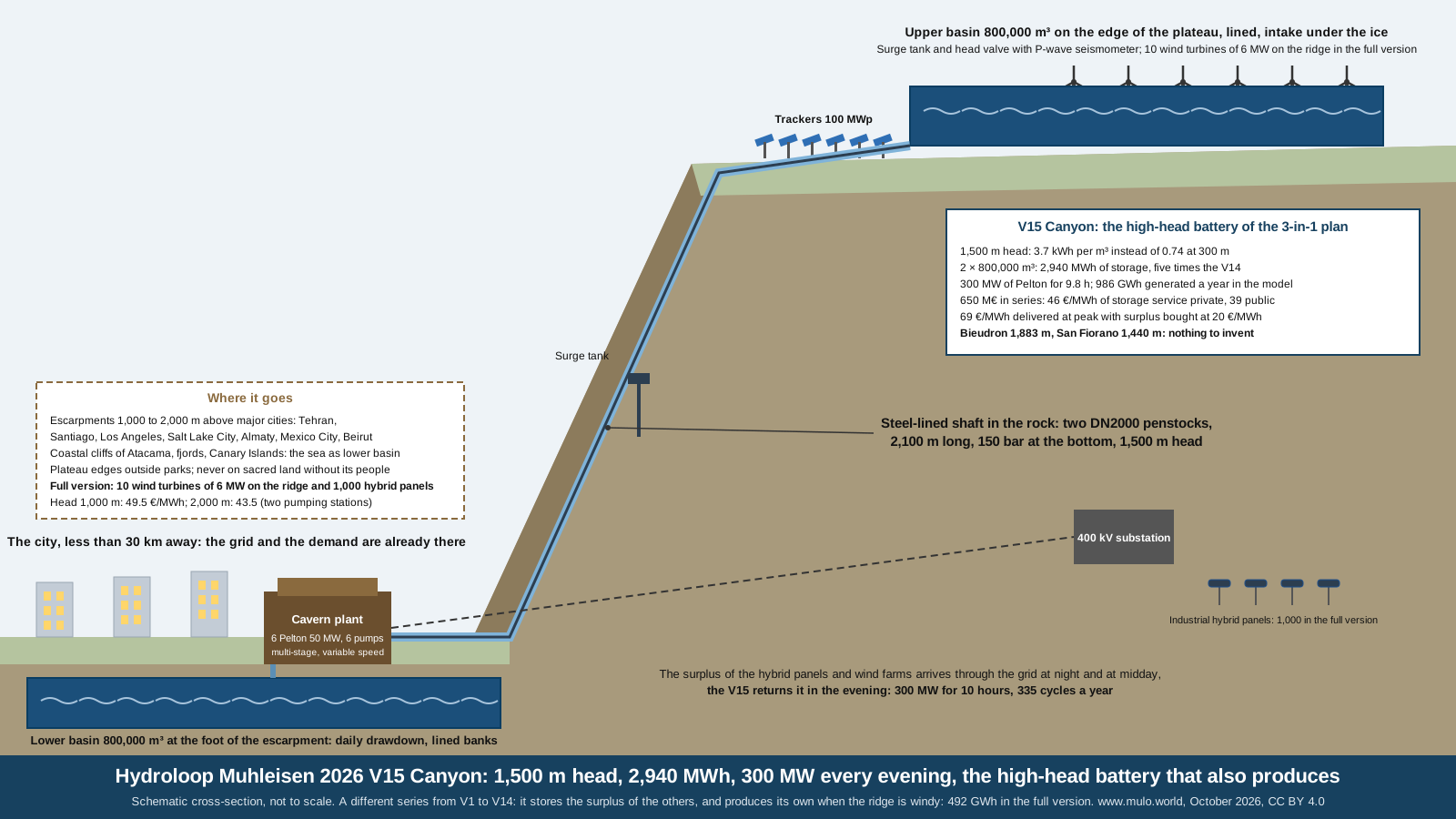
Diagram code (Python, free): schema_hydroloop_v15.py
Diagram code (Python, free): schema_hydroloop_v15.py
------------------------------
THE PRINCIPLE: ANOTHER SERIES, NOT A TALLER V14
------------------------------
A Hydroloop plant of series 1 to 14 sells GWh that it produces with its wind turbines and panels, and keeps a fifth of them for a chosen hour thanks to its basins. Its kWh is judged on the production price, 28 to 36 €/MWh. The V15 sells something else: GWh shifted in time and guaranteed power. It buys the grid's surplus when it is worth nothing, at night when the wind blows and at midday when the sun shines, and returns it from 5 pm to 11 pm and from 6 am to 9 am, when the grid pays for it. Its kWh is judged on the price of the storage service, in euros per MWh cycled, and it compares with batteries and gas peaking plants, not with wind turbines.
Why the head: the energy of one cubic metre is proportional to the height from which it falls. 0.39 kWh at 160 m, 0.74 at 300 m, 1.47 at 600 m, 3.68 at 1,500 m, turbine efficiency included. To store the same energy, a V15 needs five times less water than a V14, or it stores five times more with the same water. The page keeps the second choice: the basins of the V14, 2 × 800,000 m³, and 2,940 MWh.
------------------------------
1. THE PHYSICS OF HIGH HEAD, AND WHY NOTHING NEEDS TO BE INVENTED
------------------------------
* Pressure. 1,500 m of water means 150 bar at the bottom of the penstock. No surface penstock holds that on a slope: the penstock is a steel-lined shaft, two DN2000 steel tubes sealed in a shaft drilled in sound rock, at 45° or vertical, the rock taking part of the pressure. It has been the technique of all Alpine high heads since the 1950s.
* The penstock does not cost five times more. For the same power, the flow is five times lower than at 300 m, so the diameter goes from 4 m to 2 m for 300 MW. The wall is thicker, 75 mm at the bottom against 30, but the mass of steel per metre is of the same order. What costs is drilling the shaft: 58 M€ for the two tubes and the shaft, against 13 for the two penstocks of the V14.
* The turbines. The Pelton is the turbine of high heads, and the higher the head, the better it performs. Bieudron, in Switzerland, has been running three 423 MW Pelton turbines under 1,883 m of head since 1998, the world record. Six 50 MW Pelton turbines under 1,500 m are catalogue machines for the three big turbine makers.
* The pumps. This is the point closest to the limit. A reversible pump-turbine does not go beyond 700 to 800 m in one stage; beyond that, the pump is separated from the turbine, which the Hydroloop has done since V1, and multi-stage pumps are used: Edolo, in Italy, has pumped at 1,265 m since 1985, San Fiorano at 1,440 m. At 1,500 m, these are five- or six-stage pumps; at 2,000 m, two pumping stations in series with an intermediate basin. The frequency converters of the V14 remain: the V15 pumps as the surplus comes, from 0 to 300 MW.
* Water hammer. At 150 bar, closing an injector too fast raises the pressure by tens of bars in one second. Three catalogue remedies: a surge tank at the top of the shaft, jet deflectors on each Pelton, which divert the jet before slowly closing the injector, and staggered closing of the pumps. The surge vessel of the small versions is no longer enough; the surge tank replaces it.
* Altitude. The upper basin is at 2,000 or 3,000 m on most sites: intake under the ice and bubbler, as the V14 already provides for frost, and the floating cover of the V9 where winter lasts. The sun is 10 to 20% better there, and the colder air makes the panels perform better.
------------------------------
2. THE HOURLY MODEL, ADAPTED TO STORAGE
------------------------------
The model of versions 10 to 14 produced wind and sun and decided what to pump. The V15 model starts from the other end: it receives a surplus available on the grid, at night when the wind blows and from 10 am to 4 pm when the sun shines, up to 400 MW, at a low price; it pumps with its own photovoltaics first, the surplus next; it generates from 5 pm to 11 pm and from 6 am to 9 am as long as the upper basin is not empty. 8,760 hours, pump efficiency 0.87, turbine 0.90, round trip 78%. The code is published: hydroloop_muhleisen_2026_v15_simulation.py, run without arguments for the reference case, or with the head, the volume, the powers, the photovoltaics, the available surplus and the two prices.
The higher the head, the less the service costs: the machines and the shaft cost roughly the same per MW, and storage per m³ grows with the head. The reduced V15 shows the opposite: below 200 MW, the shaft and the cavern weigh too much. High head is made for large volumes.
------------------------------
2 bis. THE FULL V15: IT ALSO PRODUCES
------------------------------
A battery alone is a waste on a site that has a plateau, a ridge and a substation. The full version adds what the other pages of the site know how to do: ten 6 MW wind turbines on the ridge of the upper basin, like a V14 reduced to what the ridge gives, and a thousand industrial Muhleisen hybrid solar panels, on the plateau and around the lower basin, 62 MWp of solar and 10 MW of series wind, 28 ha. The model pumps its own production first, then the grid surplus, and sells directly what the full basins do not take.
What the table says, plainly:
* Storage pays for the site. The 986 GWh returned at peak do not move from one variant to another: they come from the head and the basins, not from the machines that produce.
* The wind turbines pay for themselves: 57 M€ for 216 GWh, a kWh at 26 €/MWh that sells at 70 directly or 120 once stored, paid back in 4.5 years on their own account. As soon as the lidar gives 6 m/s on the ridge, they go in; the full V15 is then a V14 whose storage has been multiplied by five and whose wind has been reduced to what the ridge gives.
* The hybrid panels are the kWh that is no longer bought: 57 M€ for 106 GWh, 47 €/MWh, which replace surplus bought at 20 or sell at 70. They pay back in ten years on their own account, better if the grid surplus becomes rare or expensive, and they occupy land that the plant has already fenced.
* Without the grid surplus, the V15 does not live: 282 GWh returned instead of 986, payback in eighteen years. Own production does not fill 2,940 MWh every day; the 89 million hybrid panels of the plan and the wind farms do. The V15 is made for a grid that has surplus, and that is exactly the grid the 3-in-1 plan builds.
The version kept is therefore the full one wherever the ridge gives 6 m/s, the battery with hybrid panels elsewhere. In both cases, the storage service stays at 46 €/MWh; own production is added at 26 €/MWh for wind and 47 for the panels. The published model takes the wind turbines, the ridge wind and the number of hybrid panels as arguments 9, 10 and 11.
------------------------------
3. THE FIGURES IN A SERIES OF 10 PLANTS
------------------------------
Reference revenue: 986 GWh returned at peak at 120 €/MWh, 118.3 M€; 47 GWh of photovoltaics sold directly at 70, 3.3; capacity payment for 300 MW guaranteed every evening, 12; frequency reserve, 2; total 135 M€. Purchase of surplus, 1,135 GWh at 20 €/MWh, 22.7; OPEX 10. Net 102 M€ a year, payback in 6.3 years. If the peak is paid only 90 €/MWh, 73 M€ net and 8.9 years. The V15 pays back more slowly than a V14 (4.3 to 5.1 years) because it pays for its energy; but it sells what nobody else in the plan sells, guaranteed power at a fixed time.
------------------------------
4. WHERE IT GOES: THE ESCARPMENT, NOT THE PROTECTED CANYON
------------------------------
It needs 1,000 to 2,000 m of drop within 5 horizontal km, a flat area of 20 to 30 ha at the top and bottom, sound rock for the shaft, and a substation or a city within reach. Wind is not required, but it is welcome: at 6 m/s on the ridge, the full version adds its wind turbines. That gives four families of sites, detailed on the best locations page (in French):
* The escarpments above major cities. Tehran has the Alborz 2,000 m above it at 15 km; Santiago, Los Angeles, Salt Lake City, Almaty, Mexico City, Beirut, Cape Town, Caracas all have an escarpment of 1,000 to 2,000 m less than 30 km from millions of inhabitants. The lower basin is in the city or at its gate, the grid is there, and the V15 returns its power where it is consumed, without a new line.
* Coastal cliffs, with the sea as the lower basin. The Atacama coast drops 1,000 to 2,000 m straight into the Pacific; the Chilean Espejo de Tarapacá project is designed exactly this way, on the model of the Yanbaru plant in Okinawa, which pumped seawater for twenty years. Norwegian fjords, the Canary Islands, Madeira and Réunion have the same geometry. Seawater: fully lined upper basin, duplex steels and anodes as for Shore Power (in French), leak monitoring, and the upper basin never less than 500 m from a water intake.
* Plateau edges outside parks: Colorado outside parks and outside tribal lands without their agreement, Drakensberg, Western Ghats, Ethiopian escarpments, the edge of the Tibetan plateau, the Alps and the Pyrenees where Bieudron showed the way.
* Large mining pits. Bingham Canyon is 1,200 m deep, Chuquicamata 850: a copper pit is a V15 already dug, with the mine's extra-high-voltage substation, and it is the mines idea from the Hydroloop plan page (in French) taken to its conclusion.
And what it leaves alone: protected canyons and sacred lands. The name Canyon comes from the geometry, not from a site. In 2021 and 2022, the US Federal Energy Regulatory Commission refused two pumped-storage projects on the rim of the Little Colorado canyon, in Arizona, after opposition from the Navajo Nation. That is the V15 rule: a plateau edge, yes; tribal or sacred land, only with its people, for them, or not at all.
------------------------------
5. ITS PLACE IN THE 3-IN-1 PLAN
------------------------------
The 4-in-1 plan (in French), which succeeds the 3-in-1 (in French), replaces 90% of fossil electricity with 87,000 Hydroloop plants, 89 million hybrid panels and 1,500 Titan Claudia towers, and counts 1,750 billion euros of grids, interconnections and long-duration storage to make it all firm. The V15 is the form that part of this line can take: a thousand V15 on the escarpments of large cities means 2.9 TWh of storage, 300 GW returned every evening for ten hours, 986 TWh a year shifted from midday and night to the peak, for 650 billion euros. A thousand V15 means a thousand 300 MW coal units no longer switched on in the evening. It is not added to the plan, it specifies its storage, and it does so where the plan needs it: in the cities, not on the ridges.
------------------------------
6. SAFETY: ONE HAZARD, ONE BARRIER
------------------------------
* Water hammer at 150 bar: surge tank, jet deflectors, slow closing of the injectors, staggered tripping of the pumps, emergency closure tests at commissioning. In hydraulic short circuit, the deflectors work permanently: they are doubled and inspected every month.
* Shaft failure: sound rock required by the geological survey, steel lining over the whole height, drainage gallery, leak monitoring by differential flow meters between top and bottom.
* Failure of the upper basin above a city: this is the risk that decides the site. Lined class B basin in two cells of 400,000 m³, empty buffer basin halfway down sized for one cell, piezometers, bottom outlet, hazard study, P-wave seismometer on the head valve, and a lower basin sized to receive the whole upper basin. Never an upper basin directly above a neighbourhood without relief or a buffer basin to protect it.
* Earthquake: the escarpments that overlook cities are often active faults (Tehran, Los Angeles, Santiago, Almaty). Seismic design of the basins and the cavern, and a head valve that closes on P waves, before the shaking.
* Freezing of the upper basin at altitude: intake under the ice, bubbler, floating cover where winter lasts.
* Drawdown: 800,000 m³ going up and down every day. Lined and drained banks on both basins, nothing in bare earth.
* Seawater, on coastal sites: full lining, duplex steels, anodes, leak monitoring, distance to water intakes.
* Access and altitude: track or construction cable car up to the upper basin, and the machines in the cavern at the bottom, accessible all year round.
------------------------------
7. POINTS TO WATCH
------------------------------
* The price of the surplus. The V15 lives on the gap between the midday price and the evening price. At 20 €/MWh purchase, 69 €/MWh delivered; at 40, 92. A grid where the surplus sells at 40 €/MWh does not need the V15; a grid with negative prices pays it back in six years. This is the assumption that makes the result, before geology.
* Availability of the surplus: 400 MW of surplus available at night and at midday is what 89 million hybrid panels and the existing wind farms give; without them, 250 MW and 57.5 €/MWh.
* Six-stage 50 MW pumps are at the upper limit of what runs; the V15 at 2,000 m needs two stations in series, which adds a cavern. The hydraulic short circuit permanently consumes part of what it pumps to regulate power: 2 to 4% less round-trip efficiency during regulation hours, to be taken off the 78%, which the model does not do yet.
* The geology of the shaft is non-negotiable: karst, gypsum or a fault in the shaft, and the site is ruled out. The survey (boreholes, geophysics) costs 2 to 5 M€ and comes before anything else.
* The 100 MWp of photovoltaics assumes 150 ha of plateau near the upper basin; without them, the service does not change, own production disappears.
* The series figures only apply from the tenth identical plant, and a high head is never quite identical to another: the shaft is redone at each site.
* The hourly model is published but simple: it does not know the hour-by-hour prices of a real market or the constraints of the grid. Its first validation will be one year of data from an existing pumped-storage plant.
------------------------------
8. THE TEN IMPROVEMENTS OF 17/10/26: WHAT THE V15 DOES FOR THE CITY
------------------------------
Reread with the list of good ideas and the previous inventions, the V15 gains ten things, including four services for the population that no other version provides, because no other is in the city.
What the site does not add: two upper basins at different heights, a second cycle per day, 400 MW pumps. The model is already at 335 cycles a year; the limit is the surplus the grid gives to store, not the machine.
Update of 17/10/26: version 16 Pacha 3 (in French) gives the coastal V15 a rain lake and a belt canal on the mountain: rain turbined at 1,500 m is worth 3.7 kWh per m³, and it arrives at the bottom as fresh water, for the city, without desalination. Never above a city: urban escarpments remain for the V15.
Update of 29/10/26: the V15 Canyon MAX brings together two, four or six V15 on a single escarpment, with one shaft, one cavern and one substation: up to 1,800 MW and 17.7 GWh, and the stored MWh 19% cheaper in MAX 3.
Update of 29/10/26: the escarpment scan (in French) finds 2,447 V15 sites with 1,000 m of head or more near a city or a large substation, 5.3 TWh of possible storage.
------------------------------
UPDATE OF 17/10/26: PELTON OR FRANCIS
------------------------------
The question was asked again for all versions on 17/10/26 and decided version by version: at 1,500 m, there is no question, a reversible pump-turbine does not go beyond 800 m, and the hydraulic short circuit of the V15 only works with a separate turbine and pump. The V15 keeps its six Pelton turbines and its six multi-stage pumps. The general rule, written on 17/10/26 after rereading all the versions: the Pelton was never a price choice but a flexibility choice (variable-speed pumping while generating, deflectors reacting in less than a second, flat efficiency at part load, robustness to sediment), made when the pumps were not yet variable speed. Since then, variable-speed reversible Francis units (Goldisthal 302 m, Kazunogawa, Tehri) adjust their pumping power just as finely. Version-by-version result: at 160 m, the Pelton is out of place and the reversible Francis or the pump-as-turbine wins 2 to 4 €/MWh; at 300 m, the two machines are level within 0.5 €/MWh, and the choice depends on what the grid pays (primary reserve) and on the water (sediment, torrent, rain); at 1,500 m, Pelton without discussion. The Pelton stays on torrents (V5, V6), the Pacha and the V15.
------------------------------
CONCLUSION
------------------------------
Version 15 Canyon is not a bigger plant, it is another trade: the battery of the plan, which also produces when the ridge is windy. 1,500 m of head, two basins of 800,000 m³, 2,940 MWh, 300 MW returned every evening for ten hours, 986 GWh a year shifted from midday to the peak, for 650 M€ and 46 €/MWh of service, 69 delivered, three to four times less than a lithium battery that lasts four times less; with its ten improvements, 655 M€, a payback in 5.6 years, and four services for the city, cooling for neighbourhoods, public buildings and data centres, restart after a blackout, fire defence of the escarpment and, on the coast, fresh water for 400,000 inhabitants; and in the full version, 492 GWh of own production with ten wind turbines and a thousand hybrid panels, the wind turbines paid back in 4.5 years on their own account. The Pelton turbines of Bieudron and the pumps of San Fiorano have proven the machines for thirty years; the steel-lined shaft is the technique of the Alps; the hourly model is published. It goes on the escarpments that overlook large cities, coastal cliffs and large mining pits, never on a protected canyon or sacred land, and its upper basin in two cells with a buffer basin turns the no-overhang rule into a built protection. With a thousand V15, the 3-in-1 plan has its storage where it consumes. Plans, diagrams, texts and code under the CC BY 4.0 licence.
------------------------------
SOURCES
------------------------------
The hourly model of the V15 (Python, no library)
The best locations in the world for large Hydroloops (in French)
Hydroloop Muhleisen 2026 V14, the last of the production series
3-in-1 world plan (in French)
Hydroloop world plan, including the open-pit mines idea (in French)
Wikipedia: Bieudron power station, 1,883 m of head, 423 MW Pelton turbines
Wikipedia: San Fiorano, pumping at 1,440 m
Wikipedia: Edolo, pumping at 1,265 m
Wikipedia: Yanbaru, Okinawa, seawater pumped storage
Wikipedia: Espejo de Tarapacá, Atacama cliff with the Pacific as lower basin
Wikipedia: Kidston, 250 MW pumped storage in a former open-pit gold mine
FERC, US Federal Energy Regulatory Commission: refusal of the preliminary permits for the Little Colorado pumped-storage projects (2021 and 2022), opposition of the Navajo Nation
Wikipedia: Pelton wheel
Wikipedia: water hammer, surge tank
Wikipedia: Kops II, hydraulic short circuit on high head
Wikipedia: reverse osmosis, 60 to 70 bar for seawater
Wikipedia: Fraîcheur de Paris, urban cooling network (in French)
Wikipedia: black start
Wikipedia: pumped-storage hydroelectricity
IHA: pumped storage factsheet
The site's good ideas (in French)
Olivier Muhleisen in collaboration with Claude (Anthropic), October 2026. Plans, diagrams, texts and code under the CC BY 4.0 licence: free to use, copy and modify, provided the author is credited.
© 2009-2026 Onmyweb Production - TOS - Cookies information - Contact us - Free Copyright Open Source -
THE PRINCIPLE: ANOTHER SERIES, NOT A TALLER V14
------------------------------
A Hydroloop plant of series 1 to 14 sells GWh that it produces with its wind turbines and panels, and keeps a fifth of them for a chosen hour thanks to its basins. Its kWh is judged on the production price, 28 to 36 €/MWh. The V15 sells something else: GWh shifted in time and guaranteed power. It buys the grid's surplus when it is worth nothing, at night when the wind blows and at midday when the sun shines, and returns it from 5 pm to 11 pm and from 6 am to 9 am, when the grid pays for it. Its kWh is judged on the price of the storage service, in euros per MWh cycled, and it compares with batteries and gas peaking plants, not with wind turbines.
Why the head: the energy of one cubic metre is proportional to the height from which it falls. 0.39 kWh at 160 m, 0.74 at 300 m, 1.47 at 600 m, 3.68 at 1,500 m, turbine efficiency included. To store the same energy, a V15 needs five times less water than a V14, or it stores five times more with the same water. The page keeps the second choice: the basins of the V14, 2 × 800,000 m³, and 2,940 MWh.
| Item | Version 14 | Version 15 Canyon |
|---|---|---|
| Role | produce and smooth its own production | store the grid's surplus and return it at peak |
| Head | 300 m | 1,500 m (1,000 to 2,000 depending on the site) |
| Basins | 2 × 800,000 m³ | 2 × 800,000 m³, lined, daily drawdown |
| Usable storage | 588 MWh | 2,940 MWh |
| Energy per m³ | 0.74 kWh | 3.68 kWh |
| Pelton | 8 × 6 MW, 48 MW | 6 × 50 MW, 300 MW, 9.8 h at full power |
| Pumps | 64 MW variable speed | 6 × 50 MW multi-stage variable speed, 300 MW |
| Flow | 23 m³/s in generation | 23 m³/s in generation, 18 in pumping: the same flow for six times the power |
| Penstock | two DN2000, 1 km, 30 bar | two DN2000 in a steel-lined shaft, 2,100 m, 150 bar at the bottom |
| Wind | 240 MW, the reason for being | none required for storage; 10 × 6 MW on the ridge in the full version, as soon as the lidar gives 6 m/s |
| Photovoltaics | 16 MWp | 100 MWp on the plateau, pumped on site, plus 1,000 industrial hybrid panels (62 MWp and 10 MW of wind) in the full version |
| Sites | windy ridge of 15 to 20 km, 300 m slope | escarpment of 1,000 to 2,000 m within 5 horizontal km, near a city or a substation |
| Investment in series | 364 M€ | 650 M€ |
| What it sells | 885 GWh produced, 28 €/MWh | 986 GWh returned at peak, 46 €/MWh of service, 69 delivered with surplus at 20 |
------------------------------
1. THE PHYSICS OF HIGH HEAD, AND WHY NOTHING NEEDS TO BE INVENTED
------------------------------
* Pressure. 1,500 m of water means 150 bar at the bottom of the penstock. No surface penstock holds that on a slope: the penstock is a steel-lined shaft, two DN2000 steel tubes sealed in a shaft drilled in sound rock, at 45° or vertical, the rock taking part of the pressure. It has been the technique of all Alpine high heads since the 1950s.
* The penstock does not cost five times more. For the same power, the flow is five times lower than at 300 m, so the diameter goes from 4 m to 2 m for 300 MW. The wall is thicker, 75 mm at the bottom against 30, but the mass of steel per metre is of the same order. What costs is drilling the shaft: 58 M€ for the two tubes and the shaft, against 13 for the two penstocks of the V14.
* The turbines. The Pelton is the turbine of high heads, and the higher the head, the better it performs. Bieudron, in Switzerland, has been running three 423 MW Pelton turbines under 1,883 m of head since 1998, the world record. Six 50 MW Pelton turbines under 1,500 m are catalogue machines for the three big turbine makers.
* The pumps. This is the point closest to the limit. A reversible pump-turbine does not go beyond 700 to 800 m in one stage; beyond that, the pump is separated from the turbine, which the Hydroloop has done since V1, and multi-stage pumps are used: Edolo, in Italy, has pumped at 1,265 m since 1985, San Fiorano at 1,440 m. At 1,500 m, these are five- or six-stage pumps; at 2,000 m, two pumping stations in series with an intermediate basin. The frequency converters of the V14 remain: the V15 pumps as the surplus comes, from 0 to 300 MW.
* Water hammer. At 150 bar, closing an injector too fast raises the pressure by tens of bars in one second. Three catalogue remedies: a surge tank at the top of the shaft, jet deflectors on each Pelton, which divert the jet before slowly closing the injector, and staggered closing of the pumps. The surge vessel of the small versions is no longer enough; the surge tank replaces it.
* Altitude. The upper basin is at 2,000 or 3,000 m on most sites: intake under the ice and bubbler, as the V14 already provides for frost, and the floating cover of the V9 where winter lasts. The sun is 10 to 20% better there, and the colder air makes the panels perform better.
------------------------------
2. THE HOURLY MODEL, ADAPTED TO STORAGE
------------------------------
The model of versions 10 to 14 produced wind and sun and decided what to pump. The V15 model starts from the other end: it receives a surplus available on the grid, at night when the wind blows and from 10 am to 4 pm when the sun shines, up to 400 MW, at a low price; it pumps with its own photovoltaics first, the surplus next; it generates from 5 pm to 11 pm and from 6 am to 9 am as long as the upper basin is not empty. 8,760 hours, pump efficiency 0.87, turbine 0.90, round trip 78%. The code is published: hydroloop_muhleisen_2026_v15_simulation.py, run without arguments for the reference case, or with the head, the volume, the powers, the photovoltaics, the available surplus and the two prices.
| Reference case | Value |
|---|---|
| Usable storage | 2,943 MWh, 9.8 h of Pelton at 300 MW |
| Photovoltaics produced | 170 GWh, of which 123 pumped on site and 47 sold directly |
| Grid surplus pumped | 1,135 GWh |
| Energy generated at peak | 986 GWh |
| Full cycles | 335 a year |
| Pelton running | 3,285 h; pumps running 4,913 h |
| Sensitivity | Investment | Generated | Storage service, private | Remark |
|---|---|---|---|---|
| Head 1,000 m, 200 MW | 473 M€ | 657 GWh | 49.5 €/MWh | 1,962 MWh, four-stage pumps, shaft at 100 bar |
| Head 1,500 m, 300 MW (reference) | 650 M€ | 986 GWh | 46 €/MWh | 2,943 MWh |
| Head 2,000 m, 400 MW | 815 M€ | 1,314 GWh | 43.5 €/MWh | 3,924 MWh, two pumping stations in series, Bieudron territory |
| Reduced V15: 2 × 160,000 m³, 60 MW | 180 M€ | 197 GWh | 61 €/MWh | the storage of the V14 with five times less water; the fixed costs of the shaft weigh |
| Available surplus 250 MW instead of 400 | 650 M€ | 791 GWh | 57.5 €/MWh | 269 cycles: the V15 is worth what the grid gives it to store |
| Without photovoltaics | 593 M€ | 985 GWh | 46 €/MWh | PV does not change the service, it replaces 123 GWh of purchases with own production |
The higher the head, the less the service costs: the machines and the shaft cost roughly the same per MW, and storage per m³ grows with the head. The reduced V15 shows the opposite: below 200 MW, the shaft and the cavern weigh too much. High head is made for large volumes.
------------------------------
2 bis. THE FULL V15: IT ALSO PRODUCES
------------------------------
A battery alone is a waste on a site that has a plateau, a ridge and a substation. The full version adds what the other pages of the site know how to do: ten 6 MW wind turbines on the ridge of the upper basin, like a V14 reduced to what the ridge gives, and a thousand industrial Muhleisen hybrid solar panels, on the plateau and around the lower basin, 62 MWp of solar and 10 MW of series wind, 28 ha. The model pumps its own production first, then the grid surplus, and sells directly what the full basins do not take.
| Variant, 1,500 m, 300 MW | Investment | Own production | Returned at peak | Net per year | Payback |
|---|---|---|---|---|---|
| Battery only (100 MWp of trackers) | 650 M€ | 170 GWh | 986 GWh | 102 M€ | 6.3 years |
| Battery + 1,000 hybrid panels, without a windy ridge | 707 M€ | 276 GWh | 986 GWh | 105 M€ | 6.7 years |
| Full: + 10 wind turbines of 6 MW at 6.5 m/s + 1,000 hybrid panels | 765 M€ | 492 GWh (PV 170, wind 216, hybrids 106) | 986 GWh | 112 M€ | 6.8 years |
| Full, ridge at 5.5 m/s | 765 M€ | 437 GWh | 986 GWh | 110 M€ | 7.0 years |
| Full without grid surplus (isolated grid) | 765 M€ | 492 GWh | 282 GWh | 43 M€ | 17.8 years |
What the table says, plainly:
* Storage pays for the site. The 986 GWh returned at peak do not move from one variant to another: they come from the head and the basins, not from the machines that produce.
* The wind turbines pay for themselves: 57 M€ for 216 GWh, a kWh at 26 €/MWh that sells at 70 directly or 120 once stored, paid back in 4.5 years on their own account. As soon as the lidar gives 6 m/s on the ridge, they go in; the full V15 is then a V14 whose storage has been multiplied by five and whose wind has been reduced to what the ridge gives.
* The hybrid panels are the kWh that is no longer bought: 57 M€ for 106 GWh, 47 €/MWh, which replace surplus bought at 20 or sell at 70. They pay back in ten years on their own account, better if the grid surplus becomes rare or expensive, and they occupy land that the plant has already fenced.
* Without the grid surplus, the V15 does not live: 282 GWh returned instead of 986, payback in eighteen years. Own production does not fill 2,940 MWh every day; the 89 million hybrid panels of the plan and the wind farms do. The V15 is made for a grid that has surplus, and that is exactly the grid the 3-in-1 plan builds.
The version kept is therefore the full one wherever the ridge gives 6 m/s, the battery with hybrid panels elsewhere. In both cases, the storage service stays at 46 €/MWh; own production is added at 26 €/MWh for wind and 47 for the panels. The published model takes the wind turbines, the ridge wind and the number of hybrid panels as arguments 9, 10 and 11.
------------------------------
3. THE FIGURES IN A SERIES OF 10 PLANTS
------------------------------
| Item | M€ | Remark |
|---|---|---|
| Six 50 MW Pelton turbines under 1,500 m, generators, spherical valves, deflectors | 210 | 700 €/kW, catalogue machines |
| Six 50 MW variable-speed multi-stage pumps, converters | 210 | 700 €/kW, hybrid bearings against drive currents; with hydraulic short circuit (point 8), fixed-speed pumps and 185 M€ |
| Cavern plant, surge tank, access tunnel | 60 | civil works over 60 years |
| Steel-lined shaft, two DN2000 penstocks over 2,100 m | 58 | 150 bar at the bottom, sound rock required |
| Lined basins 2 × 800,000 m³, embankments, drainage, outlet | 23 | class B, P-wave seismometer |
| Photovoltaics 100 MWp, bifacial trackers on the plateau | 57 | pumped on site |
| Rain reservoir, catchment | 3 | closed circuit, rain water |
| Grid connection, share of a 400 kV substation | 25 | 300 MW |
| Lidar, instrumentation, seismometer, spare parts | 0.7 | |
| Total | 650 | The first plant: 800 to 850 M€ |
| OPEX per year | 10 | 1.5% of the investment |
| Price of the storage service | Private, 4% over 30 years (machines) and 60 years (civil works) | Public, 3% over 35 and 60 years |
|---|---|---|
| Service only, per MWh returned at peak | 46 €/MWh | 39 €/MWh |
| With surplus bought at 0 €/MWh (negative price hours) | 46 | 39 |
| With surplus bought at 20 €/MWh (reference) | 69 | 62 |
| With surplus bought at 40 €/MWh | 92 | 85 |
| For comparison: 4 h lithium battery, 2026 | 120 to 200 €/MWh cycled, lifetime 15 years; gas peaking plant: 150 to 250 €/MWh | |
Reference revenue: 986 GWh returned at peak at 120 €/MWh, 118.3 M€; 47 GWh of photovoltaics sold directly at 70, 3.3; capacity payment for 300 MW guaranteed every evening, 12; frequency reserve, 2; total 135 M€. Purchase of surplus, 1,135 GWh at 20 €/MWh, 22.7; OPEX 10. Net 102 M€ a year, payback in 6.3 years. If the peak is paid only 90 €/MWh, 73 M€ net and 8.9 years. The V15 pays back more slowly than a V14 (4.3 to 5.1 years) because it pays for its energy; but it sells what nobody else in the plan sells, guaranteed power at a fixed time.
------------------------------
4. WHERE IT GOES: THE ESCARPMENT, NOT THE PROTECTED CANYON
------------------------------
It needs 1,000 to 2,000 m of drop within 5 horizontal km, a flat area of 20 to 30 ha at the top and bottom, sound rock for the shaft, and a substation or a city within reach. Wind is not required, but it is welcome: at 6 m/s on the ridge, the full version adds its wind turbines. That gives four families of sites, detailed on the best locations page (in French):
* The escarpments above major cities. Tehran has the Alborz 2,000 m above it at 15 km; Santiago, Los Angeles, Salt Lake City, Almaty, Mexico City, Beirut, Cape Town, Caracas all have an escarpment of 1,000 to 2,000 m less than 30 km from millions of inhabitants. The lower basin is in the city or at its gate, the grid is there, and the V15 returns its power where it is consumed, without a new line.
* Coastal cliffs, with the sea as the lower basin. The Atacama coast drops 1,000 to 2,000 m straight into the Pacific; the Chilean Espejo de Tarapacá project is designed exactly this way, on the model of the Yanbaru plant in Okinawa, which pumped seawater for twenty years. Norwegian fjords, the Canary Islands, Madeira and Réunion have the same geometry. Seawater: fully lined upper basin, duplex steels and anodes as for Shore Power (in French), leak monitoring, and the upper basin never less than 500 m from a water intake.
* Plateau edges outside parks: Colorado outside parks and outside tribal lands without their agreement, Drakensberg, Western Ghats, Ethiopian escarpments, the edge of the Tibetan plateau, the Alps and the Pyrenees where Bieudron showed the way.
* Large mining pits. Bingham Canyon is 1,200 m deep, Chuquicamata 850: a copper pit is a V15 already dug, with the mine's extra-high-voltage substation, and it is the mines idea from the Hydroloop plan page (in French) taken to its conclusion.
And what it leaves alone: protected canyons and sacred lands. The name Canyon comes from the geometry, not from a site. In 2021 and 2022, the US Federal Energy Regulatory Commission refused two pumped-storage projects on the rim of the Little Colorado canyon, in Arizona, after opposition from the Navajo Nation. That is the V15 rule: a plateau edge, yes; tribal or sacred land, only with its people, for them, or not at all.
------------------------------
5. ITS PLACE IN THE 3-IN-1 PLAN
------------------------------
The 4-in-1 plan (in French), which succeeds the 3-in-1 (in French), replaces 90% of fossil electricity with 87,000 Hydroloop plants, 89 million hybrid panels and 1,500 Titan Claudia towers, and counts 1,750 billion euros of grids, interconnections and long-duration storage to make it all firm. The V15 is the form that part of this line can take: a thousand V15 on the escarpments of large cities means 2.9 TWh of storage, 300 GW returned every evening for ten hours, 986 TWh a year shifted from midday and night to the peak, for 650 billion euros. A thousand V15 means a thousand 300 MW coal units no longer switched on in the evening. It is not added to the plan, it specifies its storage, and it does so where the plan needs it: in the cities, not on the ridges.
------------------------------
6. SAFETY: ONE HAZARD, ONE BARRIER
------------------------------
* Water hammer at 150 bar: surge tank, jet deflectors, slow closing of the injectors, staggered tripping of the pumps, emergency closure tests at commissioning. In hydraulic short circuit, the deflectors work permanently: they are doubled and inspected every month.
* Shaft failure: sound rock required by the geological survey, steel lining over the whole height, drainage gallery, leak monitoring by differential flow meters between top and bottom.
* Failure of the upper basin above a city: this is the risk that decides the site. Lined class B basin in two cells of 400,000 m³, empty buffer basin halfway down sized for one cell, piezometers, bottom outlet, hazard study, P-wave seismometer on the head valve, and a lower basin sized to receive the whole upper basin. Never an upper basin directly above a neighbourhood without relief or a buffer basin to protect it.
* Earthquake: the escarpments that overlook cities are often active faults (Tehran, Los Angeles, Santiago, Almaty). Seismic design of the basins and the cavern, and a head valve that closes on P waves, before the shaking.
* Freezing of the upper basin at altitude: intake under the ice, bubbler, floating cover where winter lasts.
* Drawdown: 800,000 m³ going up and down every day. Lined and drained banks on both basins, nothing in bare earth.
* Seawater, on coastal sites: full lining, duplex steels, anodes, leak monitoring, distance to water intakes.
* Access and altitude: track or construction cable car up to the upper basin, and the machines in the cavern at the bottom, accessible all year round.
------------------------------
7. POINTS TO WATCH
------------------------------
* The price of the surplus. The V15 lives on the gap between the midday price and the evening price. At 20 €/MWh purchase, 69 €/MWh delivered; at 40, 92. A grid where the surplus sells at 40 €/MWh does not need the V15; a grid with negative prices pays it back in six years. This is the assumption that makes the result, before geology.
* Availability of the surplus: 400 MW of surplus available at night and at midday is what 89 million hybrid panels and the existing wind farms give; without them, 250 MW and 57.5 €/MWh.
* Six-stage 50 MW pumps are at the upper limit of what runs; the V15 at 2,000 m needs two stations in series, which adds a cavern. The hydraulic short circuit permanently consumes part of what it pumps to regulate power: 2 to 4% less round-trip efficiency during regulation hours, to be taken off the 78%, which the model does not do yet.
* The geology of the shaft is non-negotiable: karst, gypsum or a fault in the shaft, and the site is ruled out. The survey (boreholes, geophysics) costs 2 to 5 M€ and comes before anything else.
* The 100 MWp of photovoltaics assumes 150 ha of plateau near the upper basin; without them, the service does not change, own production disappears.
* The series figures only apply from the tenth identical plant, and a high head is never quite identical to another: the shaft is redone at each site.
* The hourly model is published but simple: it does not know the hour-by-hour prices of a real market or the constraints of the grid. Its first validation will be one year of data from an existing pumped-storage plant.
------------------------------
8. THE TEN IMPROVEMENTS OF 17/10/26: WHAT THE V15 DOES FOR THE CITY
------------------------------
Reread with the list of good ideas and the previous inventions, the V15 gains ten things, including four services for the population that no other version provides, because no other is in the city.
| Improvement | Where it comes from | What it does | Investment | Per year |
|---|---|---|---|---|
| 1. Urban cooling | Titan Claudia: cooling network with sea or river water, buildings cooled without chillers | The upper basin is at 2,500 m, its water at 5 to 10 °C cools every night by radiation. In generation, 23 m³/s go down to the city: warmed by 6 °C, 580 MW of cooling for ten hours. A heat exchanger and a cooling network supply 200 MW of air conditioning, first hospitals, schools, retirement homes and neighbourhoods, then data centres, and the lukewarm water goes back up to cool there. | +24 M€ (exchanger, 10 km of network) | +13 M€ (670 GWh of cooling at 20 €/MWh) |
| 2. Black start and inertia | The synchronous generators of the Pelton turbines | Six Pelton turbines restart a metropolis after a blackout without help from the grid, and provide the inertia that grids full of panels are losing. Two services that batteries only provide with costly electronics. | +1 M€ (diesel starter set, automation) | +3 M€ |
| 3. Fire defence of the escarpment | The cities on the site list burn every summer | A shaft at 150 bar and 800,000 m³ at the top: hydrants and sprinklers by gravity over the whole slope, without a pump or electricity on the day everything fails. | +3 M€ | public service, not sold |
| 4. Desalination, coastal V15 only | Lima, Antofagasta, Cape Town on the site list | Reverse osmosis requires 60 to 70 bar and its high-pressure pumps are its most expensive item. A branch of the shaft at the 600 m level feeds the membranes without a pump. 1 m³/s, 86,000 m³ a day, the water of 400,000 inhabitants; 4.7 kWh/m³ instead of 3, but on surplus at 20 €/MWh: 0.09 €/m³ of energy against 0.30 at the grid price. Brine diluted in the return to the sea. | +40 M€ (coastal option, not counted in the total) | +11 M€ net (31 million m³ at 0.6 €/m³, minus energy and operation) |
| 5. Upper basin in two cells and buffer basin | The page's no-overhang rule, made constructive | Two cells of 400,000 m³ separated by a dyke: what can escape is halved. An empty buffer basin halfway down, sized for one cell, stops what escapes. The no-overhang rule becomes a built protection. | +6 M€ | the site becomes permittable above a city |
| 6. Hydraulic short circuit | Austrian high heads (Kops II) | Pump and generate at the same time: the pump runs flat out at fixed speed, the Pelton absorbs the excess with its deflectors, net power is adjusted from 0 to 100% in seconds, and the plant switches from pumping to generating without stopping. Fixed-speed pumps, cheaper than the converters of the V14, with the same flexibility. | -25 M€ (fixed-speed pumps, converters removed) | frequency reserve provided by the Pelton |
| 7. Cluster of three on a 400 kV substation | Lever of the V14 | Three V15 on the same escarpment share the substation, a crew and a stock of Pelton runners. The Alborz or the Sierra Nevada can host ten. | -7 M€ (substation 18 instead of 25) | -1 M€ of operation |
| 8. Basin spoil for the embankments | Basic civil engineering | 1.6 million m³ of excavation do not leave the site. | -2 M€ | |
| 9. Floating photovoltaics on the lower basin | V9 and V11, option for dry sites | 8 ha in the city, 8 MWp, V9 variable-level anchoring for the drawdown, evaporation of the lower basin halved where water is scarce. | +5 M€ | +0.9 M€ (13 GWh) |
| 10. Snow as catchment | V12 rain reservoir | At 2,500 m, the upper basin collects the spring melt of its catchment through a belt canal: summer evaporation is covered without trucks. White floating cover of the V9 on dry sites. | +1 M€ | zero tanker trucks |
| Improved V15, excluding desalination | same storage, same 986 GWh, four more services for the city | 655 M€ | 118 M€ net, payback in 5.6 years instead of 6.3 | |
| Improved coastal V15, with desalination | battery, water tower and cooling network of a seaside city | 695 M€ | 129 M€ net, payback in 5.4 years |
What the site does not add: two upper basins at different heights, a second cycle per day, 400 MW pumps. The model is already at 335 cycles a year; the limit is the surplus the grid gives to store, not the machine.
Update of 17/10/26: version 16 Pacha 3 (in French) gives the coastal V15 a rain lake and a belt canal on the mountain: rain turbined at 1,500 m is worth 3.7 kWh per m³, and it arrives at the bottom as fresh water, for the city, without desalination. Never above a city: urban escarpments remain for the V15.
Update of 29/10/26: the V15 Canyon MAX brings together two, four or six V15 on a single escarpment, with one shaft, one cavern and one substation: up to 1,800 MW and 17.7 GWh, and the stored MWh 19% cheaper in MAX 3.
Update of 29/10/26: the escarpment scan (in French) finds 2,447 V15 sites with 1,000 m of head or more near a city or a large substation, 5.3 TWh of possible storage.
------------------------------
UPDATE OF 17/10/26: PELTON OR FRANCIS
------------------------------
The question was asked again for all versions on 17/10/26 and decided version by version: at 1,500 m, there is no question, a reversible pump-turbine does not go beyond 800 m, and the hydraulic short circuit of the V15 only works with a separate turbine and pump. The V15 keeps its six Pelton turbines and its six multi-stage pumps. The general rule, written on 17/10/26 after rereading all the versions: the Pelton was never a price choice but a flexibility choice (variable-speed pumping while generating, deflectors reacting in less than a second, flat efficiency at part load, robustness to sediment), made when the pumps were not yet variable speed. Since then, variable-speed reversible Francis units (Goldisthal 302 m, Kazunogawa, Tehri) adjust their pumping power just as finely. Version-by-version result: at 160 m, the Pelton is out of place and the reversible Francis or the pump-as-turbine wins 2 to 4 €/MWh; at 300 m, the two machines are level within 0.5 €/MWh, and the choice depends on what the grid pays (primary reserve) and on the water (sediment, torrent, rain); at 1,500 m, Pelton without discussion. The Pelton stays on torrents (V5, V6), the Pacha and the V15.
------------------------------
CONCLUSION
------------------------------
Version 15 Canyon is not a bigger plant, it is another trade: the battery of the plan, which also produces when the ridge is windy. 1,500 m of head, two basins of 800,000 m³, 2,940 MWh, 300 MW returned every evening for ten hours, 986 GWh a year shifted from midday to the peak, for 650 M€ and 46 €/MWh of service, 69 delivered, three to four times less than a lithium battery that lasts four times less; with its ten improvements, 655 M€, a payback in 5.6 years, and four services for the city, cooling for neighbourhoods, public buildings and data centres, restart after a blackout, fire defence of the escarpment and, on the coast, fresh water for 400,000 inhabitants; and in the full version, 492 GWh of own production with ten wind turbines and a thousand hybrid panels, the wind turbines paid back in 4.5 years on their own account. The Pelton turbines of Bieudron and the pumps of San Fiorano have proven the machines for thirty years; the steel-lined shaft is the technique of the Alps; the hourly model is published. It goes on the escarpments that overlook large cities, coastal cliffs and large mining pits, never on a protected canyon or sacred land, and its upper basin in two cells with a buffer basin turns the no-overhang rule into a built protection. With a thousand V15, the 3-in-1 plan has its storage where it consumes. Plans, diagrams, texts and code under the CC BY 4.0 licence.
------------------------------
SOURCES
------------------------------
The hourly model of the V15 (Python, no library)
The best locations in the world for large Hydroloops (in French)
Hydroloop Muhleisen 2026 V14, the last of the production series
3-in-1 world plan (in French)
Hydroloop world plan, including the open-pit mines idea (in French)
Wikipedia: Bieudron power station, 1,883 m of head, 423 MW Pelton turbines
Wikipedia: San Fiorano, pumping at 1,440 m
Wikipedia: Edolo, pumping at 1,265 m
Wikipedia: Yanbaru, Okinawa, seawater pumped storage
Wikipedia: Espejo de Tarapacá, Atacama cliff with the Pacific as lower basin
Wikipedia: Kidston, 250 MW pumped storage in a former open-pit gold mine
FERC, US Federal Energy Regulatory Commission: refusal of the preliminary permits for the Little Colorado pumped-storage projects (2021 and 2022), opposition of the Navajo Nation
Wikipedia: Pelton wheel
Wikipedia: water hammer, surge tank
Wikipedia: Kops II, hydraulic short circuit on high head
Wikipedia: reverse osmosis, 60 to 70 bar for seawater
Wikipedia: Fraîcheur de Paris, urban cooling network (in French)
Wikipedia: black start
Wikipedia: pumped-storage hydroelectricity
IHA: pumped storage factsheet
The site's good ideas (in French)
Olivier Muhleisen in collaboration with Claude (Anthropic), October 2026. Plans, diagrams, texts and code under the CC BY 4.0 licence: free to use, copy and modify, provided the author is credited.
© 2009-2026 Onmyweb Production - TOS - Cookies information - Contact us - Free Copyright Open Source -