
The large springs for the Gold 4: of the 419 measured karst springs of the WoKaS world database, 16 are useful to an Artesia 5 plant, for 446 GWh a year and 124 million euros; open data are too scarce to place all the Gold of the plan
The Gold 4 fills the lake of a plant with a large karst, volcanic or artesian spring that flows out on its own by gravity: it is the cheapest kWh on the site, 21.5 €/MWh on a Pacha 2. The Artesia 5 plan counts the Gold as an average, on 47% of the Pacha, without knowing which sites have a spring. This page looks for the large known springs near the plants of the plan.
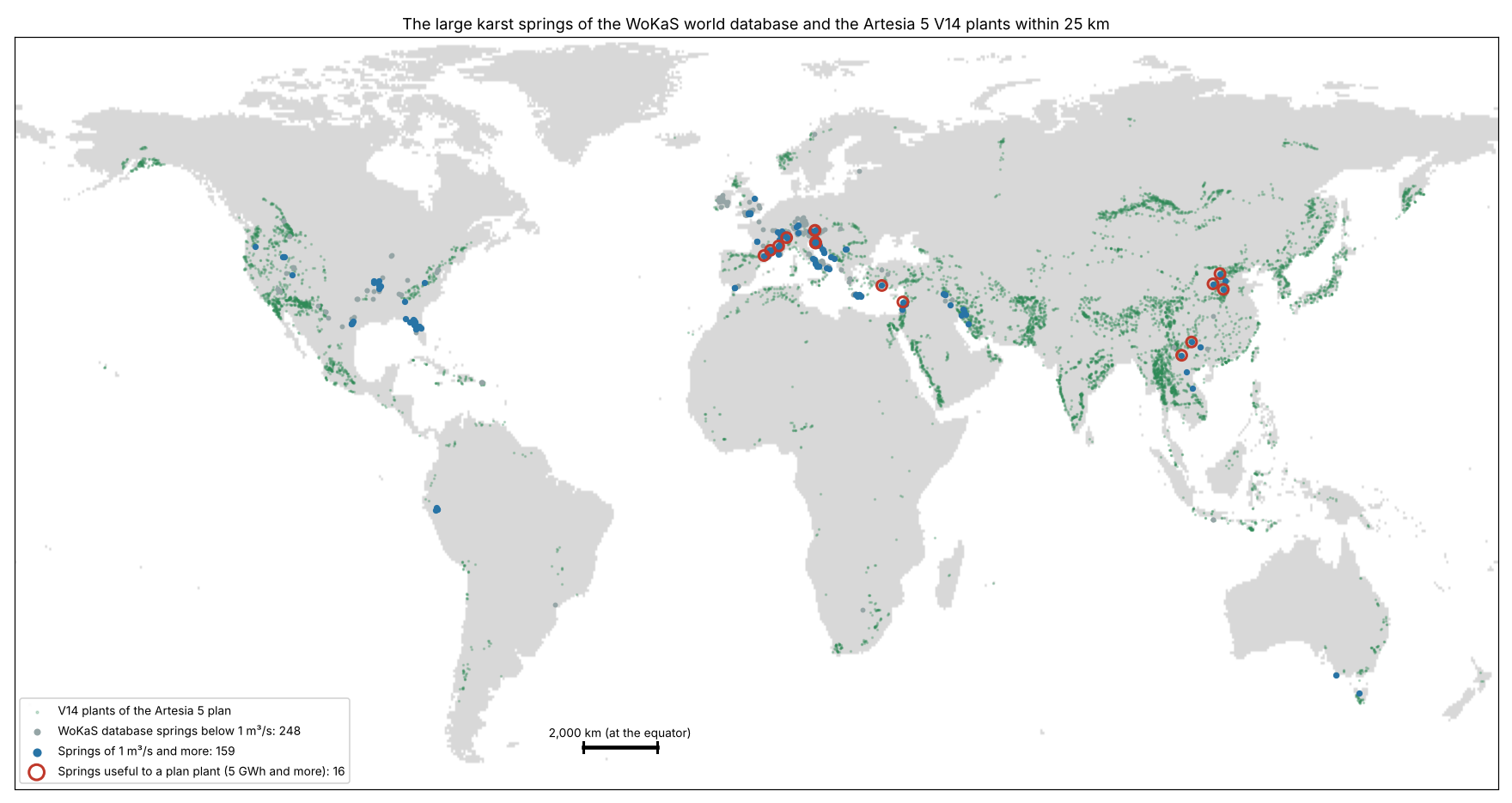
Code (Python, free): sources_wokas_debit.py (reads the WoKaS flow series and gives sources_karstiques_wokas.csv); gold4_sources_artesia_5.py (places the springs near the plants and gives gold4_sources_artesia_5.csv); the map: carte_gold4_sources.py
Related pages: Gold 4 | the Artesia 5 plants | the wind of temperate dams | Artesia 5
------------------------------
1. THE METHOD
------------------------------
* The springs: the WoKaS world database (World Karst Spring hydrograph, Olarinoye and colleagues, Scientific Data 2020, CC BY 4.0) is the only open database of measured springs at world scale. It gives the flow series of 419 karst springs with their position. For each one, the calculation takes the mean flow and the low-water flow, the one not reached 10% of the time.
* Doubtful flows: two springs exceed 50 m³/s, Podstenjšek in Slovenia (188 m³/s, probably a river or a unit error) and the Xe Bang Fai cave in Laos (76 m³/s, an underground river). They are kept in the table, not in the calculation.
* The plants: the Soleil, ridge, mixed and substation V14 of the Artesia 5 plan. A spring counts if it has 1 m³/s or more and lies 25 km or less from a plant.
* The head: the altitudes come from the GMTED2010 relief. The lower lake of the plant is taken 300 m below its site; the spring gives the height between itself and this lower lake, without exceeding 300 m. A spring lower than the lower lake is of no use.
* The flow taken: half of the average between the low-water flow and the mean flow, without exceeding 10 m³/s, to leave drinking water and the river first, as on the Gold 4 page.
* Energy and price: flow taken × 9.81 × head × 88% efficiency, all year round; 2 M€ for the intake plus 0.5 M€ per km of pipe to the plant. This is the energy of the spring water itself, a minimum: the gain of the Gold 4 on a Pacha, whose lake no longer empties, is not counted here.
------------------------------
2. THE RESULT
------------------------------
* The price is very low: 124 M€ for 446 GWh a year, 0.28 M€ per annual GWh, a third less than a good V14 (0.42 M€). The Gold 4 keeps its advantage where it is found.
* The quantity is small: 446 GWh is 0.003% of the plan's 17,360 TWh. A single spring, Kirkgözler near Antalya in Turkey, gives a quarter of the total.
* 29 nearby springs are too low: they emerge at the foot of the ridges where the plan places its ridge V14, below the lower lake. They would suit a plant placed lower down, a valley Pacha, better.
------------------------------
3. THE SIXTEEN USEFUL SPRINGS
------------------------------
------------------------------
4. WHY SO FEW
------------------------------
* The open database is small: 419 springs, almost all in Europe, the United States and China, mostly springs monitored by researchers. The large springs of Mexico, Peru, Yemen, Iran or South-East Asia, where the plan places many plants, are not in it or hardly at all.
* Half the world has no known karst: volcanic and artesian springs, which the Gold 4 can also use, are in no open world database.
* The plan's 47% of Gold cannot be checked with these data. National spring inventories (BRGM in France, USGS in the United States, geological surveys of China, Iran, Mexico, Turkey) would allow it: that is the next step, country by country.
------------------------------
5. CONCLUSION
------------------------------
The Gold 4 remains the cheapest kWh on the site, but the large known and open springs place it on only 16 plants of the plan, for 446 GWh a year and 124 million euros. These sixteen springs enter the next Artesia 5 calculation. For the rest, the plan keeps its average of Gold on the Pacha, while waiting for the national spring inventories.
------------------------------
SOURCES
------------------------------
The flow of the springs (Python), the 419 springs (CSV), the placement near the plants (Python), the 159 springs of 1 m³/s or more (CSV), the map (Python)
WoKaS: World Karst Spring hydrograph database, Olarinoye and colleagues, Scientific Data 2020 (CC BY 4.0), GMTED2010 (USGS)
The Gold 4, the Artesia 5 plants, the Artesia 5 plan
The site's good ideas
Olivier Muhleisen in collaboration with Claude (Anthropic), October 2026. Plans, diagrams, texts and figures under the CC BY 4.0 licence.
© 2009-2026 Onmyweb Production - TOS - Cookies information - Contact us - Free Copyright Open Source -
1. THE METHOD
------------------------------
* The springs: the WoKaS world database (World Karst Spring hydrograph, Olarinoye and colleagues, Scientific Data 2020, CC BY 4.0) is the only open database of measured springs at world scale. It gives the flow series of 419 karst springs with their position. For each one, the calculation takes the mean flow and the low-water flow, the one not reached 10% of the time.
* Doubtful flows: two springs exceed 50 m³/s, Podstenjšek in Slovenia (188 m³/s, probably a river or a unit error) and the Xe Bang Fai cave in Laos (76 m³/s, an underground river). They are kept in the table, not in the calculation.
* The plants: the Soleil, ridge, mixed and substation V14 of the Artesia 5 plan. A spring counts if it has 1 m³/s or more and lies 25 km or less from a plant.
* The head: the altitudes come from the GMTED2010 relief. The lower lake of the plant is taken 300 m below its site; the spring gives the height between itself and this lower lake, without exceeding 300 m. A spring lower than the lower lake is of no use.
* The flow taken: half of the average between the low-water flow and the mean flow, without exceeding 10 m³/s, to leave drinking water and the river first, as on the Gold 4 page.
* Energy and price: flow taken × 9.81 × head × 88% efficiency, all year round; 2 M€ for the intake plus 0.5 M€ per km of pipe to the plant. This is the energy of the spring water itself, a minimum: the gain of the Gold 4 on a Pacha, whose lake no longer empties, is not counted here.
------------------------------
2. THE RESULT
------------------------------
| Springs | GWh per year | Million euros | |
|---|---|---|---|
| Measured springs of the WoKaS database | 419 | ||
| Of 1 m³/s or more, with a position | 159 | ||
| 25 km or less from a V14 plant of the plan | 49 | ||
| High enough to give a head | 20 | 450 | 176 |
| Useful, 5 GWh or more | 16 | 446 | 124 |
* The price is very low: 124 M€ for 446 GWh a year, 0.28 M€ per annual GWh, a third less than a good V14 (0.42 M€). The Gold 4 keeps its advantage where it is found.
* The quantity is small: 446 GWh is 0.003% of the plan's 17,360 TWh. A single spring, Kirkgözler near Antalya in Turkey, gives a quarter of the total.
* 29 nearby springs are too low: they emerge at the foot of the ridges where the plan places its ridge V14, below the lower lake. They would suit a plant placed lower down, a valley Pacha, better.
------------------------------
3. THE SIXTEEN USEFUL SPRINGS
------------------------------
| Spring | Country | Mean flow (m³/s) | Low water (m³/s) | Nearest plant of the plan | Useful head (m) | GWh per year | M€ |
|---|---|---|---|---|---|---|---|
| Kirkgözler | Turkey | 17.5 | 10.7 | Substation V14 Soleil, 6.0 km | 300 | 113.4 | 5.0 |
| Shentou | China | 6.3 | 4.0 | Substation V14 Soleil, 5.6 km | 300 | 58.4 | 4.8 |
| Nandong | China | 6.5 | 3.4 | Substation V14 Soleil, 12.1 km | 218 | 41.0 | 8.1 |
| Rijecina | Croatia | 6.7 | 0.0 | Substation V14 Soleil, 17.1 km | 300 | 38.0 | 10.5 |
| Zvir | Croatia | 4.6 | 1.3 | Substation V14 Soleil, 7.4 km | 300 | 33.5 | 5.7 |
| Xinan | China | 7.8 | 4.0 | Substation V14 Soleil, 17.9 km | 144 | 32.0 | 11.0 |
| Liulin springs | China | 2.9 | 2.0 | Substation V14 Soleil, 5.9 km | 300 | 27.6 | 4.9 |
| The Hers at Bélesta (Fontestorbes spring) | France | 2.1 | 1.5 | Ridge V14, 24.1 km | 300 | 20.2 | 14.1 |
| Pießling-Ursprung | Austria | 2.2 | 1.6 | Ridge V14, 12.9 km | 275 | 19.8 | 8.4 |
| Lake Tseuzier | Switzerland | 2.6 | 0.2 | Ridge V14, 19.1 km | 300 | 15.5 | 11.5 |
| The Vis at Blandas (Lafoux de la Vis) | France | 4.6 | 2.5 | Ridge V14, 24.2 km | 87 | 11.7 | 14.1 |
| Houzhai Subterranean river part | China | 1.0 | 0.4 | Substation V14 Soleil, 0.5 km | 300 | 8.2 | 2.3 |
| Rettenbachquelle | Austria | 1.1 | 0.8 | Ridge V14, 6.0 km | 232 | 7.9 | 5.0 |
| Martinšcica | Croatia | 1.2 | 0.1 | Substation V14 Soleil, 4.6 km | 300 | 6.8 | 4.3 |
| Qachqouch | Lebanon | 1.1 | 0.1 | Substation V14 Soleil, 4.2 km | 300 | 6.5 | 4.1 |
| Archiane (spring) | France | 1.8 | 1.3 | Ridge V14, 15.8 km | 97 | 5.7 | 9.9 |
------------------------------
4. WHY SO FEW
------------------------------
* The open database is small: 419 springs, almost all in Europe, the United States and China, mostly springs monitored by researchers. The large springs of Mexico, Peru, Yemen, Iran or South-East Asia, where the plan places many plants, are not in it or hardly at all.
* Half the world has no known karst: volcanic and artesian springs, which the Gold 4 can also use, are in no open world database.
* The plan's 47% of Gold cannot be checked with these data. National spring inventories (BRGM in France, USGS in the United States, geological surveys of China, Iran, Mexico, Turkey) would allow it: that is the next step, country by country.
------------------------------
5. CONCLUSION
------------------------------
The Gold 4 remains the cheapest kWh on the site, but the large known and open springs place it on only 16 plants of the plan, for 446 GWh a year and 124 million euros. These sixteen springs enter the next Artesia 5 calculation. For the rest, the plan keeps its average of Gold on the Pacha, while waiting for the national spring inventories.
------------------------------
SOURCES
------------------------------
The flow of the springs (Python), the 419 springs (CSV), the placement near the plants (Python), the 159 springs of 1 m³/s or more (CSV), the map (Python)
WoKaS: World Karst Spring hydrograph database, Olarinoye and colleagues, Scientific Data 2020 (CC BY 4.0), GMTED2010 (USGS)
The Gold 4, the Artesia 5 plants, the Artesia 5 plan
The site's good ideas
Olivier Muhleisen in collaboration with Claude (Anthropic), October 2026. Plans, diagrams, texts and figures under the CC BY 4.0 licence.
© 2009-2026 Onmyweb Production - TOS - Cookies information - Contact us - Free Copyright Open Source -