
Hydroloop Muhleisen 2026, V14 Soleil MAX, MAX 2 and MAX 3: two, four or six V14 Soleil brought together on a single plateau, with a single slope, a single plant and a single substation; up to 5.9 TWh a year, 10% less per kWh, and 42% fewer plants for the Artesia 5 plan
The V14 Soleil is the plant that makes the most electricity in the Artesia 5 plan (in French): 6,460 on 3,610 plateaus, plus 2,957 near fossil substations. Many of these plateaus carry two, four, six or more, each with its slope, its basins, its plant and its substation. The MAX version brings them together into a single plant: the trackers are multiplied, and the rest is enlarged instead of repeated. MAX is two V14 Soleil on one site; MAX 2, four; MAX 3, six.
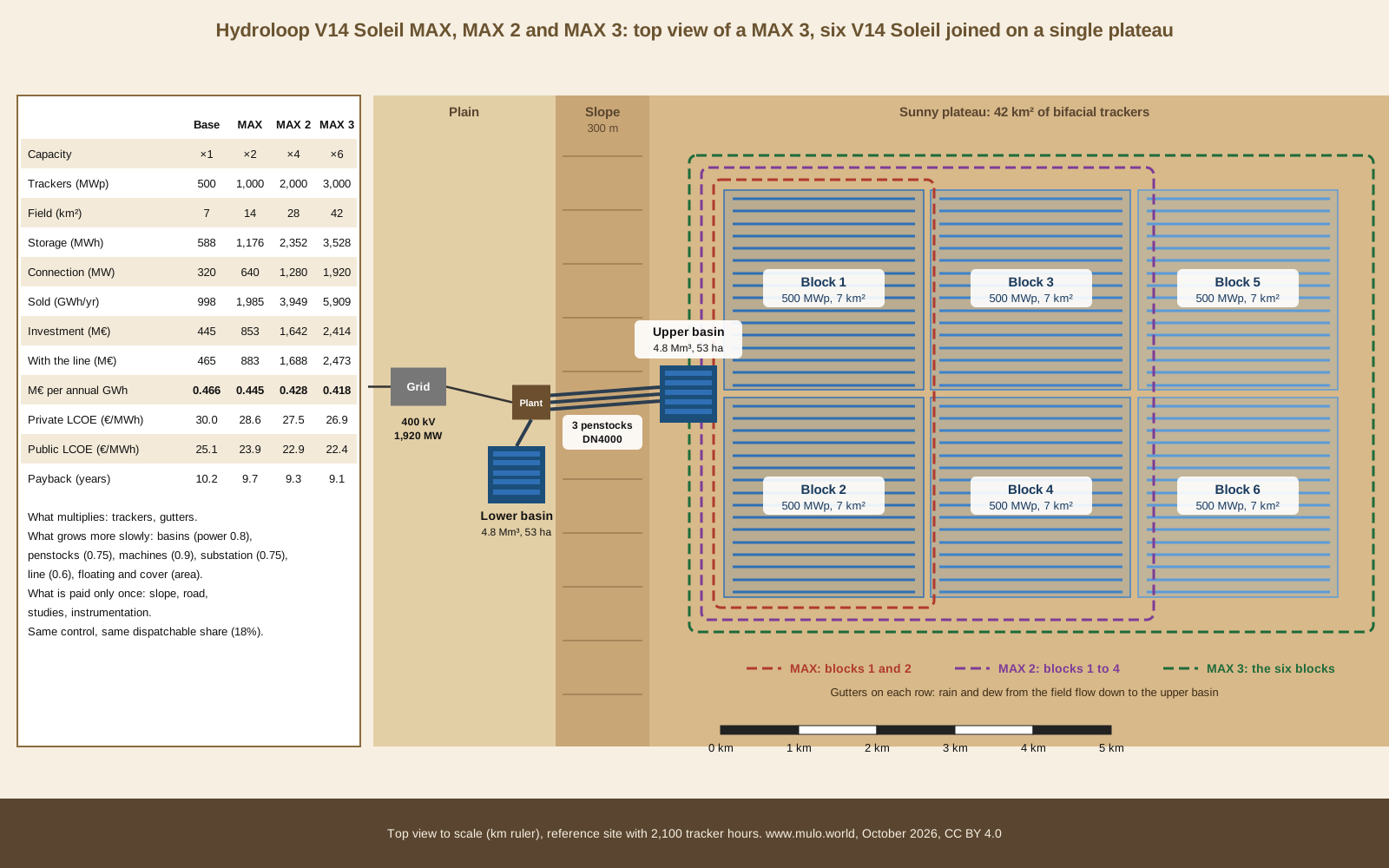
Diagram code (Python, free): schema_hydroloop_v14_soleil_max.py; calculation (hourly model of the V14 Soleil and costs item by item): hydroloop_muhleisen_2026_v14_soleil_max_calcul.py
Related pages: V14 Soleil | ridge V14 MAX | V15 Canyon MAX | the plants of Artesia 5 (in French) | the sun-belt plateaus (in French) | Artesia 5 (in French)
------------------------------
1. THE PRINCIPLE: MULTIPLY THE PANELS, ENLARGE THE REST
------------------------------
A V14 Soleil is 500 MWp of trackers on 7 km² of plateau, two covered basins of 800,000 m³ (588 MWh), two penstocks on a 300 m slope, a plant with 48 MW of turbines and 64 MW of pumps, and a 320 MW substation. Six V14 Soleil side by side on a large plateau means six developed slopes, six plants, six substations and six lines. The MAX 3 keeps only one of each, larger.
* What multiplies: the trackers and their gutters. One MWp of panels costs the same on a small or a large field; the reference calculation counts no discount.
* What grows more slowly: the basins, deeper (from 5 m to 9 m in MAX 3), hence more volume for less embankment and liner; the penstocks, three DN4000 instead of twelve DN2000; the turbines and pumps, larger units in a single plant; the substation, a single 400 kV transformer; the line, a single more heavily loaded line. The calculation applies an engineering rule to each, cost follows size to a power below 1: 0.8 for the basins, 0.75 for the penstocks and the substation, 0.9 for the machines, 0.6 for the line.
* What is paid only once: the slope, the road, the studies and the instrumentation.
* What does not change: the hourly control, the dispatchable share (18%), the sales profile and the sizing rule of the V14 Soleil, 500 MWp for 320 MW of connection, 64 MW of pumps, 48 MW of turbines and 588 MWh of storage, multiplied by 2, 4 or 6.
------------------------------
2. THE THREE SIZES
------------------------------
* The kWh drops by 4.5% in MAX, 8% in MAX 2 and 10% in MAX 3. That is less than one would hope from a plant "three times bigger for the price of two": the trackers make up 61% of the price of a V14 Soleil, and they do not get cheaper with size. All the saving comes from the other third, which drops by about a third in MAX 3.
* Production is a little less than six times that of the V14 Soleil (5,909 GWh instead of 5,988): deeper basins have less surface, hence fewer floating panels and less direct rain. It is counted.
* A MAX 3 is the size of the largest solar parks already built: the Bhadla park, in Rajasthan, carries about 2,245 MW on about 57 km². So it is not a leap into the unknown for the panels; the novelty is the 3.5 GWh pumped-storage plant set at the edge of the plateau.
------------------------------
3. ITEM BY ITEM
------------------------------
In millions of euros, French 2026 series prices as on the V14 Soleil page. In brackets, the price of 2, 4 or 6 separate V14 Soleil.
The operating cost follows the same logic: 4.8 M€ a year for one V14 Soleil, 22.3 M€ for a MAX 3 instead of 28.8 for six.
------------------------------
4. THE MIXED VERSION AND THE SUBSTATION V14 SOLEIL
------------------------------
The same rule applies to the other two V14 Soleil of the plan. The mixed version also multiplies its wind turbines (30, 60, 120, 180) and needs a 12 km windy ridge per V14: a mixed MAX 3 needs 72 km of ridge at the edge of the plateau, which is rare. The substation V14 Soleil, set near a fossil plant that is closing, pays 10 M€ more to link its field in the plain to its head on the hill; in MAX, this link also grows more slowly than the plant. Its sites range from 1,500 to 2,100 tracker hours.
* The mixed version keeps its advantage: the same price per kWh as the V14 Soleil, 63 € per MWh sold instead of 49, and 6.8 years of payback in MAX 3.
* The substation V14 Soleil gains a little more than the plateau one: 11% in MAX 3, because its field-to-head link is also shared. At 1,500 hours, it remains expensive (0.59 M€ per GWh in MAX 3): it is a plant for countries without a better site, eastern China, Japan, Korea.
------------------------------
5. SENSITIVITY
------------------------------
The only real lever of the MAX 3 on the panels is the construction site: one camp, one assembly crew, grouped purchasing of 3 GWp. Five percent less on the trackers gives 0.404 M€ per GWh. This discount is not counted in the reference calculation.
------------------------------
6. WATER: THE MAX 3 IS MORE SELF-SUFFICIENT
------------------------------
The panel field harvests rain and dew, the covered basins lose a little. The field grows six times, the basin surface only 3.3 times. A V14 Soleil is self-sufficient in water above about 75 mm of rain a year; a MAX is above about 50 mm, a MAX 2 above 37 mm, a MAX 3 above 30 mm. The MAX 3 therefore goes where the V14 Soleil had to bring its water from elsewhere: the southern Algerian Sahara, inland Arabia, the Thar desert. The first filling remains the real constraint: 5.4 Mm³ for a MAX 3 (one full basin and the bottom of the other), to be brought once from a city, a canal or a temporary borehole, or collected in about five years at 100 mm of rain and in two years at 250 mm.
------------------------------
7. WHERE TO BUILD IT, AND WHAT IT CHANGES FOR ARTESIA 5
------------------------------
A MAX needs a single-piece plateau of 14 km², a MAX 2 of 28 km², a MAX 3 of 42 km², above a 300 m slope. The plateau scan (in French) has already counted them: the number of V14 Soleil a plateau can carry comes from its surface. In the Artesia 5 plan, on the list of plants (in French):
* 42% fewer plants: 5,520 construction sites, plants and substations instead of 9,480, for the same electricity. That is as many fewer grid connections, public inquiries and operating crews, which matters more than the euros for the feasibility of the plan.
* About 210 billion euros saved out of the 4,517 billion of these three plants, keeping the same sites. This is only an estimate: the next Artesia 5 calculation will redo the choice of each plant with the MAX versions, the real line prices of each country, the wind of temperate dams and the large springs, and a cheaper V14 Soleil may take the place of hybrid panels or export lines.
------------------------------
7 bis. PACHA, GOLD, SKY AND O SKY IN A MAX
------------------------------
In the plan, a V14 set under 1,500 mm of rain or more receives a Pacha lake, and nearly one in two a Gold; some Golds receive a Sky, and some Skys an O Sky. When the V14 of a site are brought together into a MAX, these additions follow, but they do not all gain:
* Pacha: the rain does not grow with the plant, it depends on the mountain captured, and the belt canal stays just as long. What is shared is the lake, deeper, and the rain Pelton, a single larger one: about 10% of the price of a Pacha.
* Gold: each stream and each spring keeps its intake and its pipe. Nothing to share, the Gold stays as it is.
* Sky: its lower lake and its pumps join the MAX plant, like the basins and machines of the V14; it gains like the hydraulics, 15 to 20% of its price.
* O Sky: floating panels on the lakes, which multiply. Nothing to gain.
On the Pacha, Gold and Sky of the plan (156 billion in all), that is on the order of 5 to 10 billion more, counted in the Artesia 5 recalculation.
------------------------------
8. THE LIMITS
------------------------------
* The powers of 0.6 to 0.9 are engineering rules, taken from hydroelectricity and grids, not quotes. They can vary from one site to another, especially for the basins, whose price depends on the ground.
* A single substation is a single point of failure: a MAX 3 that trips means 1.9 GW missing at once. The grid connection has two 400 kV circuits for this reason, and large grids already know how to handle plants of this size (a nuclear reactor is 1 to 1.6 GW).
* The plateau must be in one piece. A plateau cut by ravines will make several smaller MAX, not one MAX 3.
* Trackers are counted at the same price per MWp, without a size discount: this is prudent, and it is why the gain stays at 10%.
* The first filling grows with the plant: 5.4 Mm³ of water for a MAX 3.
------------------------------
9. CONCLUSION
------------------------------
The V14 Soleil MAX holds, but it works no miracle on the price: the panels make up two thirds of the plant and do not get cheaper with size. By bringing together two, four or six V14 Soleil on a single plateau, with one slope, one plant and one substation, the kWh drops by 4.5%, 8% and 10%, down to 26.9 €/MWh private and 22.4 public for a 3 GWp MAX 3 that sells 5.9 TWh a year. What it changes most is the number of construction sites: the Artesia 5 plan would go from 9,480 V14 Soleil to 5,520 plants, for about 210 billion less. And a MAX 3 is self-sufficient in water from 30 mm of rain a year. The MAX versions of the ridge V14 are on their own page, the V14 MAX, then Artesia 5 will be recalculated with them.
------------------------------
SOURCES
------------------------------
The calculation of the MAX versions (Python, no library), the diagram (Python)
The V14 Soleil and its hourly model, the V14, the sun-belt plateaus (in French), the plants of Artesia 5 (in French), the Artesia 5 plan (in French)
The site's good ideas (in French)
Olivier Muhleisen in collaboration with Claude (Anthropic), October 2026. Plans, diagrams, texts and figures under the CC BY 4.0 licence.
© 2009-2026 Onmyweb Production - TOS - Cookies information - Contact us - Free Copyright Open Source -
1. THE PRINCIPLE: MULTIPLY THE PANELS, ENLARGE THE REST
------------------------------
A V14 Soleil is 500 MWp of trackers on 7 km² of plateau, two covered basins of 800,000 m³ (588 MWh), two penstocks on a 300 m slope, a plant with 48 MW of turbines and 64 MW of pumps, and a 320 MW substation. Six V14 Soleil side by side on a large plateau means six developed slopes, six plants, six substations and six lines. The MAX 3 keeps only one of each, larger.
* What multiplies: the trackers and their gutters. One MWp of panels costs the same on a small or a large field; the reference calculation counts no discount.
* What grows more slowly: the basins, deeper (from 5 m to 9 m in MAX 3), hence more volume for less embankment and liner; the penstocks, three DN4000 instead of twelve DN2000; the turbines and pumps, larger units in a single plant; the substation, a single 400 kV transformer; the line, a single more heavily loaded line. The calculation applies an engineering rule to each, cost follows size to a power below 1: 0.8 for the basins, 0.75 for the penstocks and the substation, 0.9 for the machines, 0.6 for the line.
* What is paid only once: the slope, the road, the studies and the instrumentation.
* What does not change: the hourly control, the dispatchable share (18%), the sales profile and the sizing rule of the V14 Soleil, 500 MWp for 320 MW of connection, 64 MW of pumps, 48 MW of turbines and 588 MWh of storage, multiplied by 2, 4 or 6.
------------------------------
2. THE THREE SIZES
------------------------------
| V14 Soleil | MAX | MAX 2 | MAX 3 | |
|---|---|---|---|---|
| Capacity | ×1 | ×2 | ×4 | ×6 |
| Trackers | 500 MWp, 7 km² | 1,000 MWp, 14 km² | 2,000 MWp, 28 km² | 3,000 MWp, 42 km² |
| Upper and lower basins | 800,000 m³, 16 ha, 5 m | 1.6 Mm³, 25 ha, 6.3 m | 3.2 Mm³, 40 ha, 7.9 m | 4.8 Mm³, 53 ha, 9.1 m |
| Storage | 588 MWh | 1,176 MWh | 2,352 MWh | 3,528 MWh |
| Penstocks | 2 DN2000 | 2 DN2800 | 2 DN4000 | 3 DN4000 |
| Turbines and pumps | 48 and 64 MW | 96 and 128 MW | 192 and 256 MW | 288 and 384 MW |
| Grid connection | 320 MW | 640 MW | 1,280 MW | 1,920 MW, two 400 kV circuits |
| Floating photovoltaics on the basins | 24 MWp | 38 MWp | 60 MWp | 79 MWp |
| Electricity sold | 998 GWh | 1,985 GWh | 3,949 GWh | 5,909 GWh |
| Investment in series | 445 M€ | 853 M€ | 1,642 M€ | 2,414 M€ |
| With the line to the grid | 465 M€ | 883 M€ | 1,688 M€ | 2,473 M€ |
| M€ per annual GWh, line included | 0.466 | 0.445 | 0.428 | 0.418 |
| Private / public LCOE | 30.0 / 25.1 €/MWh | 28.6 / 23.9 €/MWh | 27.5 / 22.9 €/MWh | 26.9 / 22.4 €/MWh |
| Payback time at the sunny price profile | 10.2 years | 9.7 years | 9.3 years | 9.1 years |
* The kWh drops by 4.5% in MAX, 8% in MAX 2 and 10% in MAX 3. That is less than one would hope from a plant "three times bigger for the price of two": the trackers make up 61% of the price of a V14 Soleil, and they do not get cheaper with size. All the saving comes from the other third, which drops by about a third in MAX 3.
* Production is a little less than six times that of the V14 Soleil (5,909 GWh instead of 5,988): deeper basins have less surface, hence fewer floating panels and less direct rain. It is counted.
* A MAX 3 is the size of the largest solar parks already built: the Bhadla park, in Rajasthan, carries about 2,245 MW on about 57 km². So it is not a leap into the unknown for the panels; the novelty is the 3.5 GWh pumped-storage plant set at the edge of the plateau.
------------------------------
3. ITEM BY ITEM
------------------------------
In millions of euros, French 2026 series prices as on the V14 Soleil page. In brackets, the price of 2, 4 or 6 separate V14 Soleil.
| Item | V14 Soleil | MAX (2 separate) | MAX 2 (4 separate) | MAX 3 (6 separate) | Why |
|---|---|---|---|---|---|
| Bifacial trackers | 285.0 | 570.0 (570.0) | 1,140.0 (1,140.0) | 1,710.0 (1,710.0) | multiplies |
| Gutters on the rows | 8.3 | 16.6 (16.6) | 33.2 (33.2) | 49.8 (49.8) | multiplies |
| Floating photovoltaics on the basins | 18.0 | 28.6 (36.0) | 45.4 (72.0) | 59.4 (108.0) | follows the basin surface |
| Basin covers | 2.0 | 3.2 (4.0) | 5.0 (8.0) | 6.6 (12.0) | follows the surface |
| Upper and lower basins | 19.1 | 33.3 (38.2) | 57.9 (76.4) | 80.1 (114.6) | deeper, power 0.8 |
| Penstocks on the slope | 13.3 | 22.4 (26.6) | 37.6 (53.2) | 51.0 (79.8) | larger, power 0.75 |
| Plant: turbines and pumps | 67.8 | 126.5 (135.6) | 236.1 (271.2) | 340.1 (406.8) | larger units, power 0.9 |
| Substation and grid connection | 29.3 | 49.3 (58.6) | 82.9 (117.2) | 112.3 (175.8) | a single substation, power 0.75 |
| Line to the grid | 20.0 | 30.3 (40.0) | 45.9 (80.0) | 58.6 (120.0) | a more heavily loaded line, power 0.6 |
| Road, studies, miscellaneous | 2.0 | 2.6 (4.0) | 3.5 (8.0) | 4.1 (12.0) | almost once only |
| Instrumentation | 0.5 | 0.6 (1.0) | 0.8 (2.0) | 0.9 (3.0) | almost once only |
| Total, line included | 465.3 | 883.3 (930.6) | 1,688.3 (1,861.2) | 2,472.9 (2,791.8) | saving: 11.4% in MAX 3 |
The operating cost follows the same logic: 4.8 M€ a year for one V14 Soleil, 22.3 M€ for a MAX 3 instead of 28.8 for six.
------------------------------
4. THE MIXED VERSION AND THE SUBSTATION V14 SOLEIL
------------------------------
The same rule applies to the other two V14 Soleil of the plan. The mixed version also multiplies its wind turbines (30, 60, 120, 180) and needs a 12 km windy ridge per V14: a mixed MAX 3 needs 72 km of ridge at the edge of the plateau, which is rare. The substation V14 Soleil, set near a fossil plant that is closing, pays 10 M€ more to link its field in the plain to its head on the hill; in MAX, this link also grows more slowly than the plant. Its sites range from 1,500 to 2,100 tracker hours.
| Plant | Sold (GWh per year) | Dispatchable | Investment, line included (M€) | M€ per annual GWh | Private / public LCOE (€/MWh) | Value of the MWh sold (€) | Payback (years) |
|---|---|---|---|---|---|---|---|
| V14 Soleil base | 998 | 18% | 465 | 0.466 | 30.0 / 25.1 | 49 | 10.2 |
| V14 Soleil MAX | 1,985 | 18% | 883 | 0.445 | 28.6 / 23.9 | 49 | 9.7 |
| V14 Soleil MAX 2 | 3,949 | 18% | 1,688 | 0.428 | 27.5 / 22.9 | 49 | 9.3 |
| V14 Soleil MAX 3 | 5,909 | 18% | 2,473 | 0.418 | 26.9 / 22.4 | 49 | 9.1 |
| Mixed V14 Soleil base | 1,002 | 20% | 461 | 0.460 | 30.0 / 25.1 | 63 | 7.6 |
| Mixed V14 Soleil MAX | 1,989 | 21% | 875 | 0.440 | 28.7 / 24.0 | 63 | 7.2 |
| Mixed V14 Soleil MAX 2 | 3,952 | 21% | 1,671 | 0.423 | 27.6 / 23.0 | 63 | 6.9 |
| Mixed V14 Soleil MAX 3 | 5,909 | 21% | 2,447 | 0.414 | 27.1 / 22.6 | 64 | 6.8 |
| Substation V14 Soleil, 2,100 h base | 998 | 18% | 475 | 0.476 | 30.4 / 25.4 | 49 | 10.4 |
| Substation V14 Soleil, 2,100 h MAX | 1,985 | 18% | 898 | 0.453 | 28.9 / 24.1 | 49 | 9.9 |
| Substation V14 Soleil, 2,100 h MAX 2 | 3,949 | 18% | 1,711 | 0.433 | 27.8 / 23.1 | 49 | 9.4 |
| Substation V14 Soleil, 2,100 h MAX 3 | 5,909 | 18% | 2,502 | 0.423 | 27.2 / 22.6 | 49 | 9.2 |
| Substation V14 Soleil, 1,500 h base | 719 | 25% | 475 | 0.661 | 42.2 / 35.3 | 52 | 14.0 |
| Substation V14 Soleil, 1,500 h MAX | 1,427 | 25% | 898 | 0.630 | 40.2 / 33.6 | 52 | 13.3 |
| Substation V14 Soleil, 1,500 h MAX 2 | 2,834 | 25% | 1,711 | 0.604 | 38.7 / 32.2 | 52 | 12.7 |
| Substation V14 Soleil, 1,500 h MAX 3 | 4,237 | 25% | 2,502 | 0.591 | 37.9 / 31.5 | 52 | 12.4 |
* The mixed version keeps its advantage: the same price per kWh as the V14 Soleil, 63 € per MWh sold instead of 49, and 6.8 years of payback in MAX 3.
* The substation V14 Soleil gains a little more than the plateau one: 11% in MAX 3, because its field-to-head link is also shared. At 1,500 hours, it remains expensive (0.59 M€ per GWh in MAX 3): it is a plant for countries without a better site, eastern China, Japan, Korea.
------------------------------
5. SENSITIVITY
------------------------------
| Case | V14 Soleil, M€ per annual GWh | MAX 3, M€ per annual GWh | MAX 3, private / public LCOE (€/MWh) | MAX 3, payback (years) |
|---|---|---|---|---|
| Reference, 2,100 hours, trackers at 0.57 M€/MWp | 0.466 | 0.418 | 26.9 / 22.4 | 9.1 |
| Trackers 5% cheaper on the single 3 GWp site of the MAX 3 (one camp, one crew, grouped purchasing) | 0.466 | 0.404 | 26.1 / 21.7 | 8.8 |
| Trackers at the price of sunny countries, 0.45 M€/MWp | 0.403 | 0.356 | 23.3 / 19.5 | 7.7 |
| Poorer site, 1,800 hours | 0.534 | 0.481 | 31.0 / 25.8 | 10.3 |
| Desert, 2,400 hours | 0.425 | 0.381 | 24.5 / 20.4 | 8.3 |
The only real lever of the MAX 3 on the panels is the construction site: one camp, one assembly crew, grouped purchasing of 3 GWp. Five percent less on the trackers gives 0.404 M€ per GWh. This discount is not counted in the reference calculation.
------------------------------
6. WATER: THE MAX 3 IS MORE SELF-SUFFICIENT
------------------------------
The panel field harvests rain and dew, the covered basins lose a little. The field grows six times, the basin surface only 3.3 times. A V14 Soleil is self-sufficient in water above about 75 mm of rain a year; a MAX is above about 50 mm, a MAX 2 above 37 mm, a MAX 3 above 30 mm. The MAX 3 therefore goes where the V14 Soleil had to bring its water from elsewhere: the southern Algerian Sahara, inland Arabia, the Thar desert. The first filling remains the real constraint: 5.4 Mm³ for a MAX 3 (one full basin and the bottom of the other), to be brought once from a city, a canal or a temporary borehole, or collected in about five years at 100 mm of rain and in two years at 250 mm.
------------------------------
7. WHERE TO BUILD IT, AND WHAT IT CHANGES FOR ARTESIA 5
------------------------------
A MAX needs a single-piece plateau of 14 km², a MAX 2 of 28 km², a MAX 3 of 42 km², above a 300 m slope. The plateau scan (in French) has already counted them: the number of V14 Soleil a plateau can carry comes from its surface. In the Artesia 5 plan, on the list of plants (in French):
| Plant in the plan | V14 of the plan | MAX 3 | MAX 2 | MAX | Plants after grouping | Estimated saving |
|---|---|---|---|---|---|---|
| Plateau V14 Soleil | 6,437 | 258 | 176 | 582 | 4,037 | 125 bn€ |
| V14 Soleil near fossil substations | 2,951 | 95 | 193 | 487 | 1,410 | 86 bn€ |
| Mixed V14 Soleil | 92 | 1 | 0 | 14 | 73 | 1 bn€ |
| Total | 9,480 | 354 | 369 | 1,083 | 5,520 | about 210 bn€ |
* 42% fewer plants: 5,520 construction sites, plants and substations instead of 9,480, for the same electricity. That is as many fewer grid connections, public inquiries and operating crews, which matters more than the euros for the feasibility of the plan.
* About 210 billion euros saved out of the 4,517 billion of these three plants, keeping the same sites. This is only an estimate: the next Artesia 5 calculation will redo the choice of each plant with the MAX versions, the real line prices of each country, the wind of temperate dams and the large springs, and a cheaper V14 Soleil may take the place of hybrid panels or export lines.
------------------------------
7 bis. PACHA, GOLD, SKY AND O SKY IN A MAX
------------------------------
In the plan, a V14 set under 1,500 mm of rain or more receives a Pacha lake, and nearly one in two a Gold; some Golds receive a Sky, and some Skys an O Sky. When the V14 of a site are brought together into a MAX, these additions follow, but they do not all gain:
* Pacha: the rain does not grow with the plant, it depends on the mountain captured, and the belt canal stays just as long. What is shared is the lake, deeper, and the rain Pelton, a single larger one: about 10% of the price of a Pacha.
* Gold: each stream and each spring keeps its intake and its pipe. Nothing to share, the Gold stays as it is.
* Sky: its lower lake and its pumps join the MAX plant, like the basins and machines of the V14; it gains like the hydraulics, 15 to 20% of its price.
* O Sky: floating panels on the lakes, which multiply. Nothing to gain.
On the Pacha, Gold and Sky of the plan (156 billion in all), that is on the order of 5 to 10 billion more, counted in the Artesia 5 recalculation.
------------------------------
8. THE LIMITS
------------------------------
* The powers of 0.6 to 0.9 are engineering rules, taken from hydroelectricity and grids, not quotes. They can vary from one site to another, especially for the basins, whose price depends on the ground.
* A single substation is a single point of failure: a MAX 3 that trips means 1.9 GW missing at once. The grid connection has two 400 kV circuits for this reason, and large grids already know how to handle plants of this size (a nuclear reactor is 1 to 1.6 GW).
* The plateau must be in one piece. A plateau cut by ravines will make several smaller MAX, not one MAX 3.
* Trackers are counted at the same price per MWp, without a size discount: this is prudent, and it is why the gain stays at 10%.
* The first filling grows with the plant: 5.4 Mm³ of water for a MAX 3.
------------------------------
9. CONCLUSION
------------------------------
The V14 Soleil MAX holds, but it works no miracle on the price: the panels make up two thirds of the plant and do not get cheaper with size. By bringing together two, four or six V14 Soleil on a single plateau, with one slope, one plant and one substation, the kWh drops by 4.5%, 8% and 10%, down to 26.9 €/MWh private and 22.4 public for a 3 GWp MAX 3 that sells 5.9 TWh a year. What it changes most is the number of construction sites: the Artesia 5 plan would go from 9,480 V14 Soleil to 5,520 plants, for about 210 billion less. And a MAX 3 is self-sufficient in water from 30 mm of rain a year. The MAX versions of the ridge V14 are on their own page, the V14 MAX, then Artesia 5 will be recalculated with them.
------------------------------
SOURCES
------------------------------
The calculation of the MAX versions (Python, no library), the diagram (Python)
The V14 Soleil and its hourly model, the V14, the sun-belt plateaus (in French), the plants of Artesia 5 (in French), the Artesia 5 plan (in French)
The site's good ideas (in French)
Olivier Muhleisen in collaboration with Claude (Anthropic), October 2026. Plans, diagrams, texts and figures under the CC BY 4.0 licence.
© 2009-2026 Onmyweb Production - TOS - Cookies information - Contact us - Free Copyright Open Source -