
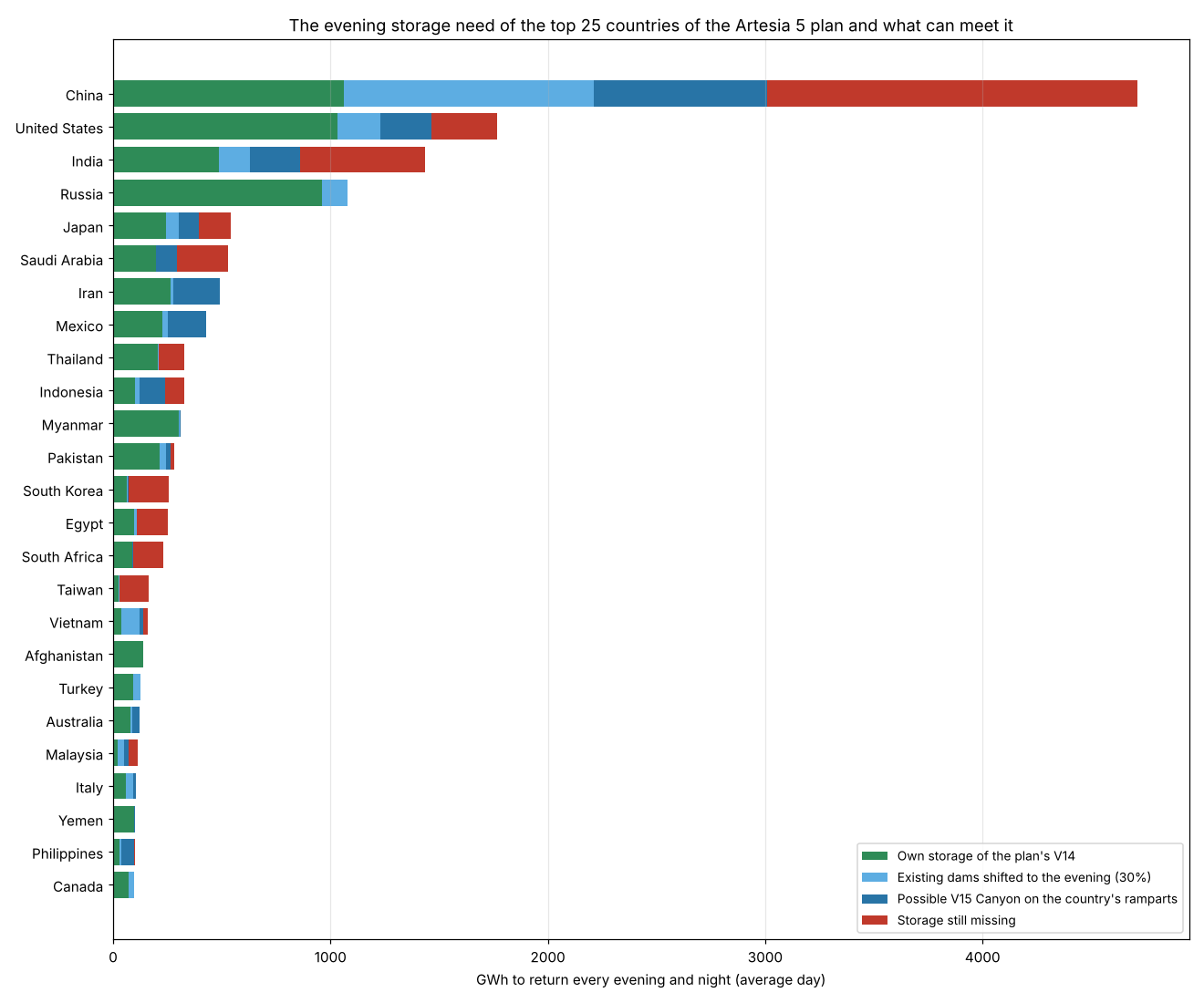
The need for evening storage country by country: the Artesia 5 plan produces mostly at noon, its V14 and the existing dams return 9.6 TWh every evening, the possible V15 at best 5 more, and about 4.5 TWh a day are still missing, above all in China and India
The Artesia 5 plan replaces fossil electricity mostly with sun: its V14 Soleil, its hybrid panels and its floating islands produce at noon, and in the evening, when demand is highest, they sleep. Each V14 already keeps 18% of its output for the evening, and the plan counts 1,000 V15 Canyon on top. The rampart scan showed that these V15 are not always where they are needed. This page measures, country by country, what must be returned every evening and every night, and what can return it, before the plan is recalculated.
Code (Python, free): stockage_soir_pays.py (arguments: folder, evening demand profile, flat or flexible, share of existing dams that can be shifted); the chart: schema_stockage_soir_pays.py; the country table: stockage_soir_pays.csv
Related pages: the V15 ramparts | V15 Canyon MAX | the price of plants | Artesia 5
------------------------------
1. THE METHOD: AN AVERAGE DAY, HOUR BY HOUR
------------------------------
* Demand: the fossil electricity the plan replaces in each country, spread over an average day with today's shape, lower at night (0.85), normal by day (1), higher from 5 pm to 11 pm (1.25).
* The sun: the plateau and substation V14 Soleil, the solar share of the mixed plants, 80% of the hybrid panels and floating islands, on a daytime curve from 6 am to 6 pm.
* Wind and the rest: the ridge V14, the wind share of the mixed plants and hybrid panels, the V21 dams, the Pacha and the plants already counted, spread over the 24 hours.
* V14 storage: 18% of the output of the V14 Soleil, 19% of the ridge V14 and 20% of the mixed plants, returned from 5 pm to 5 am, as in their hourly model.
* Exchanges: an exporting country sends a share of its output as it comes out, sun included; an importing country receives it with the average shape of the exporting countries. Storage is therefore counted where the electricity is consumed.
* Existing dams: today's hydropower (Ember and Our World in Data) is not replaced by the plan, but a reservoir dam can generate in the evening rather than at noon. We count 30% of its output as shiftable to the evening, a cautious share because of reserved flows and the other uses of the water.
* Storage to add: what is missing in the evening and at night, once all this is counted, within the limit of the noon surplus that can be pumped, with 78% round-trip efficiency.
------------------------------
2. THE RESULT FOR THE WORLD
------------------------------
* The plan has two and a half times too little added storage: it counts 2.9 TWh of V15, 6.8 would be needed on top of the storage of the V14 and existing dams.
* The ramparts are not enough: even by building all possible V15 in the countries that need them, about 4.5 TWh a day are missing, because the ramparts are mostly in countries that already have enough storage (Iran, Mexico, Turkey, Colombia, African rifts).
* Storage costs energy: pumping the noon surplus to return it in the evening loses 22%. The plan will have to produce about 940 TWh more per year, a little over 5%, or curtail less surplus at noon.
------------------------------
3. THE FIRST 20 COUNTRIES
------------------------------
In GWh per day, except the first two columns in TWh per year.
* China carries more than a third of the shortfall: 1.7 TWh a day. It has few ramparts near its large eastern cities, its hybrid panels produce at noon, and its 2,138 TWh of imports arrive with the solar shape of neighbouring countries.
* India, Saudi Arabia, Egypt, Thailand, South Africa are sunny countries with almost no wind: all their evening must come from storage.
* South Korea, Taiwan, Japan and Germany import a lot and have almost no ramparts.
* Russia, Iran, Mexico, Myanmar and Afghanistan have no shortfall: Russia produces mostly wind, and the others have enough ramparts or export their sun with the storage of their V14.
------------------------------
4. IF DEMAND ADAPTS
------------------------------
Getting people to consume at noon is the cheapest way to reduce storage: shifting one fifth of demand to the middle of the day halves the shortfall. In sunny countries, this is already what midday tariffs do in California, Australia or Chile.
------------------------------
5. HOW TO FILL THE SHORTFALL, AND WHAT IT COSTS
------------------------------
* Enlarge the V14 reservoirs where storage is missing: the V14 Soleil of China, India, Arabia or Egypt are placed on plateaus above a 300 m slope. Their hydraulic part (reservoirs, pipes, powerhouse) costs 102 million euros for 588 MWh, about 174 million euros per GWh of storage, less than a V15 (220). Doubling or tripling the reservoirs of the V14 in these countries, as on the V14 Soleil MAX, covers the shortfall wherever there are V14. For the 4.5 TWh a day that are missing, about 790 billion euros at the French price, 710 at the price of each country.
* Consuming at noon: with flexible demand, the shortfall falls to 2.1 TWh a day and to about 370 billion.
* More wind at night: a ridge V14 also produces at night; where the plan hesitates between a V14 Soleil and a ridge V14, the recalculation will have to count the value of the evening.
* The lines: Russia and Canada, rich in wind and dams, can send power to their neighbours in the evening.
------------------------------
6. WHAT IT CHANGES FOR THE ARTESIA 5 RECALCULATION
------------------------------
Update of 29/10: the recalculated plan now guarantees the evening in every country, mainly through the enlarged reservoirs of the V14 and MAX (7.3 TWh a day), for 9,919 billion euros.
The plan only counted the energy of the year, not the hour at which it arrives. The recalculation will have to add, country by country, an evening constraint: the V14 storage, the existing dams, the V15 on the country's ramparts, the enlarged V14 reservoirs and the night wind must cover the evening need of this table. It will also have to produce about 5% more for storage losses. The cost of the plan will rise accordingly, by around 400 to 800 billion depending on whether demand adapts or not, which takes back part of the reduction given by the prices of plants country by country.
------------------------------
7. THE LIMITS
------------------------------
* An average day is not a year: in winter the sun gives less and the nights are longer; a week without wind or sun requires several days of storage that this model does not count. The real need is greater, especially far from the equator.
* The shape of demand is today's, the same in every country. Hot countries consume more in the afternoon for air conditioning, which helps the sun.
* Existing dams are only counted as 30% shiftable; this figure varies a lot from one dam to another. Nuclear plants, which run day and night, are not counted: they do not replace the plan's fossil power.
* Existing pumped storage plants, about 180 GW in the world, are not counted: they already serve today's grid.
* Exchanges follow the average shape of exporting countries; a controlled line could bring more in the evening.
------------------------------
8. CONCLUSION
------------------------------
The Artesia 5 plan has the energy of the year, but not yet that of the evening. Its V14 return 7.3 TWh every evening, the existing dams can return 2.3 more, and 6.8 still have to be added: two and a half times the plan's V15. The ramparts are not where they are needed, and about 4.5 TWh a day are missing, above all in China and India. The cheapest solution is twofold: get people to consume at noon, and enlarge the V14 reservoirs in the countries that lack ramparts. The Artesia 5 recalculation will count this evening need, country by country.
------------------------------
SOURCES
------------------------------
The calculation (Python), the countries (CSV), the chart (Python)
The Artesia 5 plan and its files of sites and countries, the V15 ramparts and their sites, the price of plants country by country
Our World in Data, energy data (Ember and Energy Institute) for existing hydropower
The site's good ideas
Olivier Muhleisen in collaboration with Claude (Anthropic), October 2026. Plans, diagrams, texts and figures under the CC BY 4.0 licence.
© 2009-2026 Onmyweb Production - TOS - Cookies information - Contact us - Free Copyright Open Source -
1. THE METHOD: AN AVERAGE DAY, HOUR BY HOUR
------------------------------
* Demand: the fossil electricity the plan replaces in each country, spread over an average day with today's shape, lower at night (0.85), normal by day (1), higher from 5 pm to 11 pm (1.25).
* The sun: the plateau and substation V14 Soleil, the solar share of the mixed plants, 80% of the hybrid panels and floating islands, on a daytime curve from 6 am to 6 pm.
* Wind and the rest: the ridge V14, the wind share of the mixed plants and hybrid panels, the V21 dams, the Pacha and the plants already counted, spread over the 24 hours.
* V14 storage: 18% of the output of the V14 Soleil, 19% of the ridge V14 and 20% of the mixed plants, returned from 5 pm to 5 am, as in their hourly model.
* Exchanges: an exporting country sends a share of its output as it comes out, sun included; an importing country receives it with the average shape of the exporting countries. Storage is therefore counted where the electricity is consumed.
* Existing dams: today's hydropower (Ember and Our World in Data) is not replaced by the plan, but a reservoir dam can generate in the evening rather than at noon. We count 30% of its output as shiftable to the evening, a cautious share because of reserved flows and the other uses of the water.
* Storage to add: what is missing in the evening and at night, once all this is counted, within the limit of the noon surplus that can be pumped, with 78% round-trip efficiency.
------------------------------
2. THE RESULT FOR THE WORLD
------------------------------
| Every evening and every night, average day | GWh per day |
|---|---|
| Returned by the plan's own V14 storage | 7,311 |
| Returned by existing dams shifted to the evening | 2,293 |
| Storage to add | 6,803 |
| of which what the plan's V15 Canyon bring (1,275 sites kept) | 2,813 |
| of which what all possible V15 in the countries concerned could bring | 5,062 |
| Storage still missing even with all possible V15 | about 4,540 |
| Evening peak to be covered by this added storage | about 1,200 GW |
* The plan has two and a half times too little added storage: it counts 2.9 TWh of V15, 6.8 would be needed on top of the storage of the V14 and existing dams.
* The ramparts are not enough: even by building all possible V15 in the countries that need them, about 4.5 TWh a day are missing, because the ramparts are mostly in countries that already have enough storage (Iran, Mexico, Turkey, Colombia, African rifts).
* Storage costs energy: pumping the noon surplus to return it in the evening loses 22%. The plan will have to produce about 940 TWh more per year, a little over 5%, or curtail less surplus at noon.
------------------------------
3. THE FIRST 20 COUNTRIES
------------------------------
In GWh per day, except the first two columns in TWh per year.
| Country | Fossil electricity replaced (TWh/yr) | Solar output of the plan (TWh/yr) | Wind output of the plan (TWh/yr) | Own V14 storage | Existing dams shifted | Storage to add | Possible V15 on the country's ramparts | Still missing |
|---|---|---|---|---|---|---|---|---|
| China | 5,893 | 2,934 | 486 | 1,062 | 1,148 | 2,503 | 797 | 1,706 |
| India | 1,457 | 974 | 58 | 485 | 146 | 804 | 230 | 574 |
| United States | 2,458 | 932 | 1,176 | 1,032 | 199 | 536 | 232 | 304 |
| Saudi Arabia | 424 | 400 | 0 | 197 | 0 | 330 | 96 | 233 |
| Japan | 661 | 352 | 272 | 242 | 61 | 240 | 93 | 147 |
| Iran | 356 | 451 | 97 | 266 | 11 | 216 | 289 | 0 |
| Indonesia | 290 | 248 | 14 | 99 | 22 | 205 | 118 | 87 |
| South Korea | 358 | 145 | 59 | 64 | 3 | 188 | 4 | 184 |
| Mexico | 252 | 462 | 6 | 228 | 24 | 175 | 246 | 0 |
| Egypt | 204 | 192 | 0 | 95 | 12 | 146 | 0 | 146 |
| South Africa | 190 | 177 | 3 | 87 | 2 | 144 | 4 | 140 |
| Taiwan | 238 | 88 | 10 | 24 | 4 | 136 | 0 | 136 |
| Thailand | 150 | 443 | 9 | 206 | 6 | 116 | 0 | 116 |
| Malaysia | 152 | 70 | 7 | 22 | 29 | 62 | 19 | 43 |
| Germany | 195 | 6 | 8 | 5 | 16 | 62 | 0 | 62 |
| Philippines | 90 | 75 | 5 | 29 | 10 | 59 | 56 | 4 |
| Iraq | 141 | 9 | 12 | 8 | 2 | 53 | 4 | 49 |
| United Arab Emirates | 116 | 12 | 0 | 6 | 0 | 51 | 17 | 34 |
| Israel | 65 | 75 | 0 | 37 | 0 | 51 | 0 | 51 |
| Algeria | 91 | 64 | 22 | 43 | 0 | 50 | 8 | 42 |
* China carries more than a third of the shortfall: 1.7 TWh a day. It has few ramparts near its large eastern cities, its hybrid panels produce at noon, and its 2,138 TWh of imports arrive with the solar shape of neighbouring countries.
* India, Saudi Arabia, Egypt, Thailand, South Africa are sunny countries with almost no wind: all their evening must come from storage.
* South Korea, Taiwan, Japan and Germany import a lot and have almost no ramparts.
* Russia, Iran, Mexico, Myanmar and Afghanistan have no shortfall: Russia produces mostly wind, and the others have enough ramparts or export their sun with the storage of their V14.
------------------------------
4. IF DEMAND ADAPTS
------------------------------
| Shape of demand | Storage to add (GWh per day) | Shortfall even with all possible V15 | Evening peak |
|---|---|---|---|
| Today's, with an evening peak (reference) | 6,803 | 4,539 | 1,194 GW |
| Flat, no evening peak | 6,526 | 4,292 | 1,338 GW |
| Flexible: one fifth of demand shifted to 10 am to 4 pm (vehicle charging, electrolysis, stored cold, water heaters) | 4,108 | 2,126 | 972 GW |
Getting people to consume at noon is the cheapest way to reduce storage: shifting one fifth of demand to the middle of the day halves the shortfall. In sunny countries, this is already what midday tariffs do in California, Australia or Chile.
------------------------------
5. HOW TO FILL THE SHORTFALL, AND WHAT IT COSTS
------------------------------
* Enlarge the V14 reservoirs where storage is missing: the V14 Soleil of China, India, Arabia or Egypt are placed on plateaus above a 300 m slope. Their hydraulic part (reservoirs, pipes, powerhouse) costs 102 million euros for 588 MWh, about 174 million euros per GWh of storage, less than a V15 (220). Doubling or tripling the reservoirs of the V14 in these countries, as on the V14 Soleil MAX, covers the shortfall wherever there are V14. For the 4.5 TWh a day that are missing, about 790 billion euros at the French price, 710 at the price of each country.
* Consuming at noon: with flexible demand, the shortfall falls to 2.1 TWh a day and to about 370 billion.
* More wind at night: a ridge V14 also produces at night; where the plan hesitates between a V14 Soleil and a ridge V14, the recalculation will have to count the value of the evening.
* The lines: Russia and Canada, rich in wind and dams, can send power to their neighbours in the evening.
------------------------------
6. WHAT IT CHANGES FOR THE ARTESIA 5 RECALCULATION
------------------------------
Update of 29/10: the recalculated plan now guarantees the evening in every country, mainly through the enlarged reservoirs of the V14 and MAX (7.3 TWh a day), for 9,919 billion euros.
The plan only counted the energy of the year, not the hour at which it arrives. The recalculation will have to add, country by country, an evening constraint: the V14 storage, the existing dams, the V15 on the country's ramparts, the enlarged V14 reservoirs and the night wind must cover the evening need of this table. It will also have to produce about 5% more for storage losses. The cost of the plan will rise accordingly, by around 400 to 800 billion depending on whether demand adapts or not, which takes back part of the reduction given by the prices of plants country by country.
------------------------------
7. THE LIMITS
------------------------------
* An average day is not a year: in winter the sun gives less and the nights are longer; a week without wind or sun requires several days of storage that this model does not count. The real need is greater, especially far from the equator.
* The shape of demand is today's, the same in every country. Hot countries consume more in the afternoon for air conditioning, which helps the sun.
* Existing dams are only counted as 30% shiftable; this figure varies a lot from one dam to another. Nuclear plants, which run day and night, are not counted: they do not replace the plan's fossil power.
* Existing pumped storage plants, about 180 GW in the world, are not counted: they already serve today's grid.
* Exchanges follow the average shape of exporting countries; a controlled line could bring more in the evening.
------------------------------
8. CONCLUSION
------------------------------
The Artesia 5 plan has the energy of the year, but not yet that of the evening. Its V14 return 7.3 TWh every evening, the existing dams can return 2.3 more, and 6.8 still have to be added: two and a half times the plan's V15. The ramparts are not where they are needed, and about 4.5 TWh a day are missing, above all in China and India. The cheapest solution is twofold: get people to consume at noon, and enlarge the V14 reservoirs in the countries that lack ramparts. The Artesia 5 recalculation will count this evening need, country by country.
------------------------------
SOURCES
------------------------------
The calculation (Python), the countries (CSV), the chart (Python)
The Artesia 5 plan and its files of sites and countries, the V15 ramparts and their sites, the price of plants country by country
Our World in Data, energy data (Ember and Energy Institute) for existing hydropower
The site's good ideas
Olivier Muhleisen in collaboration with Claude (Anthropic), October 2026. Plans, diagrams, texts and figures under the CC BY 4.0 licence.
© 2009-2026 Onmyweb Production - TOS - Cookies information - Contact us - Free Copyright Open Source -