
Hydroloop Muhleisen 2026, V15 Canyon MAX, MAX 2 and MAX 3: two, four or six V15 on a single escarpment, with a single shaft, a single cavern and a single substation; up to 1,800 MW and 17.7 GWh of storage, and the stored MWh 19% cheaper, the largest drop of the MAX versions
The V15 Canyon is the battery of the plan: 1,500 m of head, 2,943 MWh of storage, 300 MW returned every evening. It is also the most expensive plant per GWh in the Artesia 5 plan (in French), 1.84 M€, because it is used to store and not to produce. After the V14 Soleil MAX and the ridge V14 MAX, this is the third MAX page, and the one where size pays the most: a V15 has almost no panels or wind turbines, all its price is in the shaft, the cavern, the basins and the machines, which grow more slowly than the plant. MAX is two V15 on one escarpment; MAX 2, four; MAX 3, six.
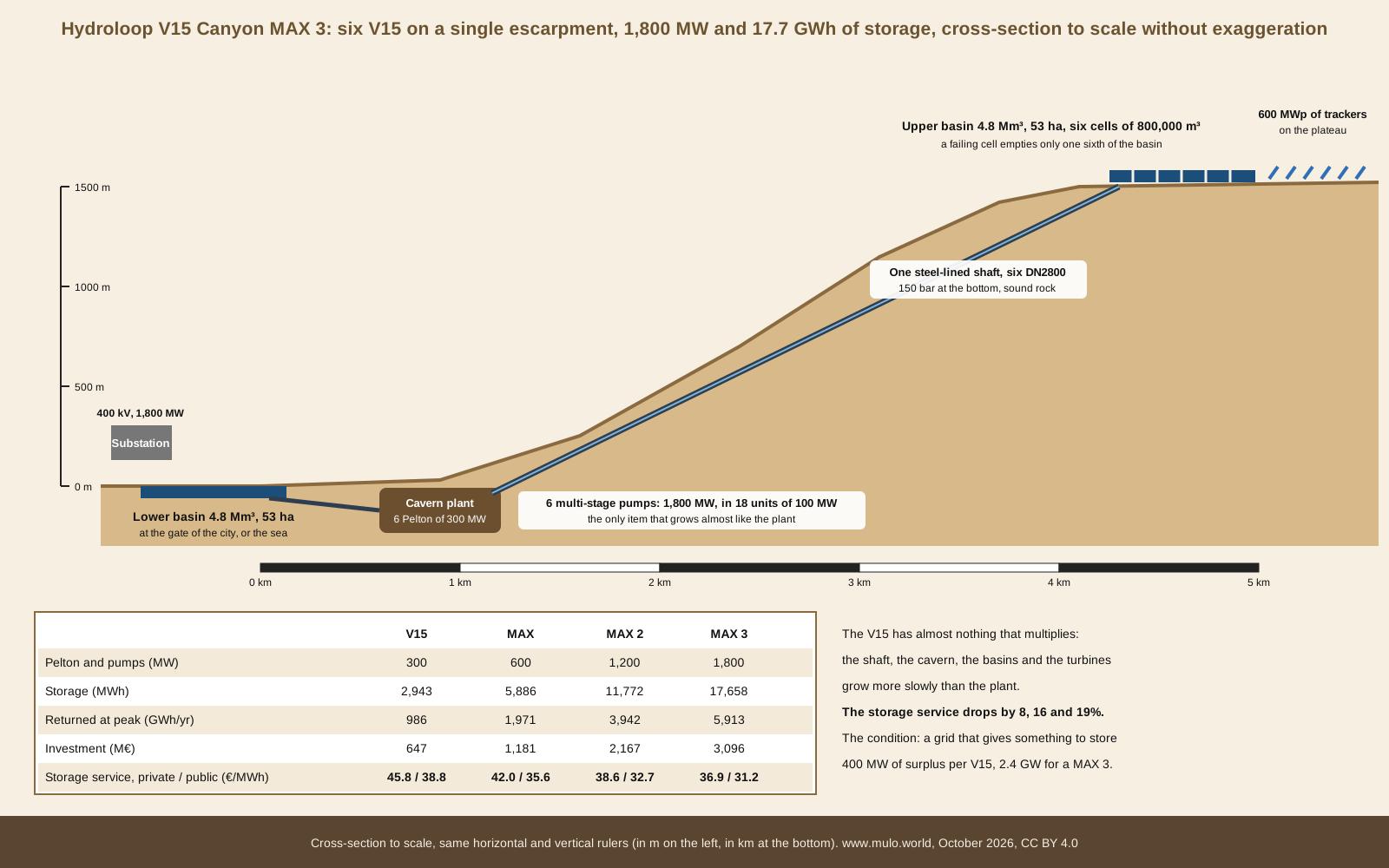
Diagram code (Python, free): schema_hydroloop_v15_max.py; calculation (hourly model of the V15 and costs item by item): hydroloop_muhleisen_2026_v15_max_calcul.py
Related pages: V15 Canyon | the V15 escarpments (in French) | V14 Soleil MAX | V14 MAX | the plants of Artesia 5 (in French) | Artesia 5 (in French)
------------------------------
1. THE PRINCIPLE: ONE ESCARPMENT, ONE SHAFT
------------------------------
A V15 is two basins of 800,000 m³ 1,500 m apart, a steel-lined shaft with two DN2000 penstocks, a cavern plant with six 50 MW Pelton turbines and six pumps, 100 MWp of trackers on the plateau and a 300 MW connection. On an escarpment like the Alborz above Tehran or the Sierra Nevada, the V15 page fits up to ten in a cluster, each with its shaft and cavern. The MAX 3 brings six together on a single site.
* Almost nothing multiplies: only the 100 MWp of trackers per V15. That is the difference with the V14, where the panels and wind turbines make up 60% of the price and block the gain.
* The turbines get bigger: six 300 MW Pelton turbines instead of 36 of 50 MW. That is the size of Bieudron, in Switzerland, which has generated 423 MW per runner under 1,883 m since 1998. Power 0.85.
* The pumps, much less: a multi-stage pump under 1,500 m is not made in 300 MW. Units of 100 MW are added in the same cavern, which only saves on converters, auxiliaries and assembly. Power 0.95, the most prudent item of the calculation.
* The civil works, the most: a single longer cavern (power 0.7), a single shaft drilled for six DN2800 tubes instead of six shafts for two DN2000 tubes (0.75), deeper basins in cells (0.8), a single 400 kV substation (0.75).
* What does not change: the head, the hourly model, the pumping and generating hours, 335 cycles a year, and the surplus required from the grid: 400 MW per V15, so 2.4 GW for a MAX 3.
------------------------------
2. THE THREE SIZES
------------------------------
* The storage service drops by 8% in MAX, 16% in MAX 2 and 19% in MAX 3, twice as much as for the V14. This was expected: the V15 is almost all civil works and machines.
* A MAX 3 is the size of the largest pumped-storage plants in the world: Bath County, in Virginia, is about 3 GW and 24 GWh; Fengning, in China, 3.6 GW. The MAX 3 is 1.8 GW and 17.7 GWh, but under a 1,500 m head, about four times that of these plants, hence much smaller basins for the same energy.
* The cluster of the V15 page is already a first step: three V15 on a shared substation save 7 M€ each. The MAX takes the idea all the way by also sharing the shaft, the cavern and the basins.
------------------------------
3. ITEM BY ITEM
------------------------------
In millions of euros, series prices of the V15 page (battery only, without the improvements of 17/10, which add up in the same way). In brackets, the price of 2, 4 or 6 separate V15.
The operating cost stays at 1.5% of the investment, as on the V15 page: 9.7 M€ a year for one V15, 46.4 M€ for a MAX 3 instead of 58 for six.
------------------------------
4. THE REAL CONDITION: THE GRID SURPLUS
------------------------------
The V15 page already said it: it is worth what the grid gives it to store. A MAX 3 needs 2.4 GW of surplus at night and at midday at the same substation, the equivalent of a large solar park and a large wind farm on its own. Only the large grids of metropolises and regions with massive solar provide it. If the grid gives only 250 MW per V15:
A MAX 3 that receives only 250 MW of surplus per V15 still costs the same per stored MWh as a well-served single V15. Size makes up for a less generous grid; it does not replace it. The selection rule: the MAX 3 in the metropolises of large grids (Tehran, Los Angeles, Santiago, Mexico City), the MAX or the single V15 near medium-sized cities.
------------------------------
5. WHAT IT CHANGES FOR ARTESIA 5
------------------------------
The Artesia 5 plan counts 1,000 V15, 405 TWh and 747 billion euros, without placing them one by one: they go on the escarpments of large cities, which the best locations page (in French) describes without yet counting them escarpment by escarpment. So it is not yet possible to say how many will be MAX 3. Three cases on the battery part (650 M€ per V15):
The prudent case will be kept in the Artesia 5 recalculation: about 90 billion less, 400 sites instead of 1,000, for the same storage and the same 300 GW returned every evening. Update of 29/10: the escarpment scan (in French) has placed the V15; as the real escarpments are lower, 1,275 are needed for the same storage, which group into 35 MAX 3, 32 MAX 2 and 172 MAX, 832 plants, for about 57 billion saved. With the V14 Soleil MAX and the V14 MAX, the MAX versions save the plan about 360 billion euros, before the recalculation.
------------------------------
6. PACHA 3, SKY 3, O SKY 3 AND STATION CASTLE 3 IN A MAX
------------------------------
Several plants on the site are built on the coastal V15: the Pacha 3 (in French) adds a rain lake, the Gold 3 (in French) a stream or a spring, the Sky 3 (in French) and the Sky Artesia (in French) a lower lake, the O Sky 3 floating panels, the Station Castle 3 the city's water. In a MAX, they follow the V15, but they do not all gain:
* Pacha 3: the rain does not grow with the plant, it depends on the mountain captured, and the belt canal stays just as long. What is shared is the lake, deeper, and the rain Pelton, a single larger one: about 10% of the price of the Pacha.
* Gold 3 and Sky Artesia: each stream and each spring keeps its intake and its pipe. Nothing to share.
* Sky 3: its lower lake and its pumps join the MAX cavern; it gains like the hydraulics of the V15, 15 to 20%.
* O Sky 3: floating panels, which multiply. Nothing to gain.
* Station Castle 3: the treatment plant and the water tower are sized to the city, not to the plant. Nothing to gain, but a MAX 3 serves a city six times larger.
------------------------------
7. THE LIMITS
------------------------------
* The powers of 0.7 to 0.95 are engineering rules, not quotes. They come from the large pumped-storage plants, but a 1,500 m shaft remains a unique structure at each site.
* Six cells of 800,000 m³ above a city: the no-overhang rule of the V15 applies six times. A failing cell empties only one sixth of the upper basin, and the buffer basin remains sized for one cell, but a MAX 3 only goes above an escarpment that protects the city.
* A single substation, 1.8 GW: the size of a large nuclear reactor. The grid must be able to lose it at once, hence two 400 kV circuits.
* The upper flat: 53 ha of basins and 600 MWp of trackers (about 9 km²) 1,500 m above the city. Without the plateau, the battery is kept and the trackers are lost, as on the V15 page.
* The surplus: without 2.4 GW to store, the MAX 3 loses half of its advantage (section 4).
------------------------------
8. CONCLUSION
------------------------------
The V15 Canyon is the plant where size pays the most, because it has almost nothing that multiplies. By bringing together two, four or six V15 on a single escarpment, with one shaft, one cavern and one substation, the stored MWh drops by 8, 16 and 19%, down to 36.9 €/MWh private and 31.2 public for a MAX 3 of 1,800 MW and 17.7 GWh, which pays back in 4.9 years. The condition is a large grid that gives it 2.4 GW of surplus to store: the MAX 3 is made for metropolises. For Artesia 5, the prudent case gives about 90 billion less and 400 sites instead of 1,000. The three MAX pages are done; the next step is the recalculation of Artesia 5.
------------------------------
SOURCES
------------------------------
The calculation of the MAX versions (Python, no library), the diagram (Python)
The V15 Canyon and its hourly model, the V14 Soleil MAX, the V14 MAX, the plants of Artesia 5 (in French), the Artesia 5 plan (in French)
The site's good ideas (in French)
Olivier Muhleisen in collaboration with Claude (Anthropic), October 2026. Plans, diagrams, texts and figures under the CC BY 4.0 licence.
© 2009-2026 Onmyweb Production - TOS - Cookies information - Contact us - Free Copyright Open Source -
1. THE PRINCIPLE: ONE ESCARPMENT, ONE SHAFT
------------------------------
A V15 is two basins of 800,000 m³ 1,500 m apart, a steel-lined shaft with two DN2000 penstocks, a cavern plant with six 50 MW Pelton turbines and six pumps, 100 MWp of trackers on the plateau and a 300 MW connection. On an escarpment like the Alborz above Tehran or the Sierra Nevada, the V15 page fits up to ten in a cluster, each with its shaft and cavern. The MAX 3 brings six together on a single site.
* Almost nothing multiplies: only the 100 MWp of trackers per V15. That is the difference with the V14, where the panels and wind turbines make up 60% of the price and block the gain.
* The turbines get bigger: six 300 MW Pelton turbines instead of 36 of 50 MW. That is the size of Bieudron, in Switzerland, which has generated 423 MW per runner under 1,883 m since 1998. Power 0.85.
* The pumps, much less: a multi-stage pump under 1,500 m is not made in 300 MW. Units of 100 MW are added in the same cavern, which only saves on converters, auxiliaries and assembly. Power 0.95, the most prudent item of the calculation.
* The civil works, the most: a single longer cavern (power 0.7), a single shaft drilled for six DN2800 tubes instead of six shafts for two DN2000 tubes (0.75), deeper basins in cells (0.8), a single 400 kV substation (0.75).
* What does not change: the head, the hourly model, the pumping and generating hours, 335 cycles a year, and the surplus required from the grid: 400 MW per V15, so 2.4 GW for a MAX 3.
------------------------------
2. THE THREE SIZES
------------------------------
| V15 | MAX | MAX 2 | MAX 3 | |
|---|---|---|---|---|
| Capacity | ×1 | ×2 | ×4 | ×6 |
| Pelton and pumps | 300 and 300 MW | 600 and 600 MW | 1,200 and 1,200 MW | 1,800 and 1,800 MW |
| Upper and lower basins | 800,000 m³, 16 ha | 1.6 Mm³, 25 ha, two cells | 3.2 Mm³, 40 ha, four cells | 4.8 Mm³, 53 ha, six cells |
| Storage | 2,943 MWh | 5,886 MWh | 11,772 MWh | 17,658 MWh |
| Steel-lined shaft | 2 DN2000 | 2 DN2800 | 4 DN2800 | 6 DN2800 |
| Trackers on the plateau | 100 MWp | 200 MWp | 400 MWp | 600 MWp |
| Grid surplus to store | 400 MW | 800 MW | 1.6 GW | 2.4 GW |
| Returned at peak | 986 GWh | 1,971 GWh | 3,942 GWh | 5,913 GWh |
| Investment in series | 647 M€ | 1,181 M€ | 2,167 M€ | 3,096 M€ |
| Per MWh of storage | 220,000 € | 201,000 € | 184,000 € | 175,000 € |
| Storage service, private / public | 45.8 / 38.8 €/MWh | 42.0 / 35.6 €/MWh | 38.6 / 32.7 €/MWh | 36.9 / 31.2 €/MWh |
| Delivered with surplus bought at 20 €/MWh, private | 68.8 €/MWh | 65.0 €/MWh | 61.7 €/MWh | 59.9 €/MWh |
| Payback time | 6.3 years | 5.7 years | 5.2 years | 4.9 years |
* The storage service drops by 8% in MAX, 16% in MAX 2 and 19% in MAX 3, twice as much as for the V14. This was expected: the V15 is almost all civil works and machines.
* A MAX 3 is the size of the largest pumped-storage plants in the world: Bath County, in Virginia, is about 3 GW and 24 GWh; Fengning, in China, 3.6 GW. The MAX 3 is 1.8 GW and 17.7 GWh, but under a 1,500 m head, about four times that of these plants, hence much smaller basins for the same energy.
* The cluster of the V15 page is already a first step: three V15 on a shared substation save 7 M€ each. The MAX takes the idea all the way by also sharing the shaft, the cavern and the basins.
------------------------------
3. ITEM BY ITEM
------------------------------
In millions of euros, series prices of the V15 page (battery only, without the improvements of 17/10, which add up in the same way). In brackets, the price of 2, 4 or 6 separate V15.
| Item | V15 | MAX (2 separate) | MAX 2 (4 separate) | MAX 3 (6 separate) | Why |
|---|---|---|---|---|---|
| Pelton, generators, valves, deflectors | 210.0 | 378.5 (420.0) | 682.3 (840.0) | 963.0 (1,260.0) | bigger, 300 MW instead of 50, like Bieudron; power 0.85 |
| Variable-speed multi-stage pumps, converters | 210.0 | 405.7 (420.0) | 783.7 (840.0) | 1,152.0 (1,260.0) | mostly units are added, power 0.95 |
| Cavern plant, surge tank, access tunnel | 60.0 | 97.5 (120.0) | 158.3 (240.0) | 210.3 (360.0) | a single longer cavern, power 0.7 |
| Steel-lined shaft and penstocks | 58.0 | 97.5 (116.0) | 164.0 (232.0) | 222.4 (348.0) | a single shaft for more tubes, power 0.75 |
| Lined upper and lower basins | 23.0 | 40.0 (46.0) | 69.7 (92.0) | 96.4 (138.0) | deeper, in cells, power 0.8 |
| Photovoltaics on the plateau | 57.0 | 114.0 (114.0) | 228.0 (228.0) | 342.0 (342.0) | multiplies |
| Rain reservoir, catchment | 3.0 | 5.2 (6.0) | 9.1 (12.0) | 12.6 (18.0) | power 0.8 |
| Grid connection, 400 kV substation | 25.0 | 42.0 (50.0) | 70.7 (100.0) | 95.8 (150.0) | a single substation, power 0.75 |
| Instrumentation, seismometer, stock | 0.7 | 0.9 (1.4) | 1.1 (2.8) | 1.2 (4.2) | almost once only |
| Total | 646.7 | 1,181.4 (1,293.4) | 2,167.0 (2,586.8) | 3,095.8 (3,880.2) | saving: 20.2% in MAX 3 |
The operating cost stays at 1.5% of the investment, as on the V15 page: 9.7 M€ a year for one V15, 46.4 M€ for a MAX 3 instead of 58 for six.
------------------------------
4. THE REAL CONDITION: THE GRID SURPLUS
------------------------------
The V15 page already said it: it is worth what the grid gives it to store. A MAX 3 needs 2.4 GW of surplus at night and at midday at the same substation, the equivalent of a large solar park and a large wind farm on its own. Only the large grids of metropolises and regions with massive solar provide it. If the grid gives only 250 MW per V15:
| Plant and surplus | Returned at peak (GWh per year) | Investment (M€) | Service, private / public (€/MWh) | Delivered with surplus at 20 €/MWh | Payback (years) |
|---|---|---|---|---|---|
| V15, 400 MW of surplus per V15, reference | 986 | 647 | 45.8 / 38.8 | 68.8 | 6.3 |
| MAX, 400 MW of surplus per V15, reference | 1,971 | 1,181 | 42.0 / 35.6 | 65.0 | 5.7 |
| MAX 2, 400 MW of surplus per V15, reference | 3,942 | 2,167 | 38.6 / 32.7 | 61.7 | 5.2 |
| MAX 3, 400 MW of surplus per V15, reference | 5,913 | 3,096 | 36.9 / 31.2 | 59.9 | 4.9 |
| V15, 250 MW of surplus per V15 | 792 | 647 | 56.9 / 48.3 | 78.9 | 7.7 |
| MAX, 250 MW of surplus per V15 | 1,585 | 1,181 | 52.2 / 44.3 | 74.2 | 7.0 |
| MAX 2, 250 MW of surplus per V15 | 3,170 | 2,167 | 48.0 / 40.7 | 70.0 | 6.3 |
| MAX 3, 250 MW of surplus per V15 | 4,755 | 3,096 | 45.9 / 38.9 | 67.8 | 6.0 |
A MAX 3 that receives only 250 MW of surplus per V15 still costs the same per stored MWh as a well-served single V15. Size makes up for a less generous grid; it does not replace it. The selection rule: the MAX 3 in the metropolises of large grids (Tehran, Los Angeles, Santiago, Mexico City), the MAX or the single V15 near medium-sized cities.
------------------------------
5. WHAT IT CHANGES FOR ARTESIA 5
------------------------------
The Artesia 5 plan counts 1,000 V15, 405 TWh and 747 billion euros, without placing them one by one: they go on the escarpments of large cities, which the best locations page (in French) describes without yet counting them escarpment by escarpment. So it is not yet possible to say how many will be MAX 3. Three cases on the battery part (650 M€ per V15):
| Case | Sites | Saving |
|---|---|---|
| All V15 grouped in pairs (MAX) | 500 | about 57 bn€ |
| Prudent case: half in MAX 3, a quarter in MAX 2, a quarter alone | about 400 | about 92 bn€ |
| All in MAX 3 | about 170 | about 131 bn€ |
The prudent case will be kept in the Artesia 5 recalculation: about 90 billion less, 400 sites instead of 1,000, for the same storage and the same 300 GW returned every evening. Update of 29/10: the escarpment scan (in French) has placed the V15; as the real escarpments are lower, 1,275 are needed for the same storage, which group into 35 MAX 3, 32 MAX 2 and 172 MAX, 832 plants, for about 57 billion saved. With the V14 Soleil MAX and the V14 MAX, the MAX versions save the plan about 360 billion euros, before the recalculation.
------------------------------
6. PACHA 3, SKY 3, O SKY 3 AND STATION CASTLE 3 IN A MAX
------------------------------
Several plants on the site are built on the coastal V15: the Pacha 3 (in French) adds a rain lake, the Gold 3 (in French) a stream or a spring, the Sky 3 (in French) and the Sky Artesia (in French) a lower lake, the O Sky 3 floating panels, the Station Castle 3 the city's water. In a MAX, they follow the V15, but they do not all gain:
* Pacha 3: the rain does not grow with the plant, it depends on the mountain captured, and the belt canal stays just as long. What is shared is the lake, deeper, and the rain Pelton, a single larger one: about 10% of the price of the Pacha.
* Gold 3 and Sky Artesia: each stream and each spring keeps its intake and its pipe. Nothing to share.
* Sky 3: its lower lake and its pumps join the MAX cavern; it gains like the hydraulics of the V15, 15 to 20%.
* O Sky 3: floating panels, which multiply. Nothing to gain.
* Station Castle 3: the treatment plant and the water tower are sized to the city, not to the plant. Nothing to gain, but a MAX 3 serves a city six times larger.
------------------------------
7. THE LIMITS
------------------------------
* The powers of 0.7 to 0.95 are engineering rules, not quotes. They come from the large pumped-storage plants, but a 1,500 m shaft remains a unique structure at each site.
* Six cells of 800,000 m³ above a city: the no-overhang rule of the V15 applies six times. A failing cell empties only one sixth of the upper basin, and the buffer basin remains sized for one cell, but a MAX 3 only goes above an escarpment that protects the city.
* A single substation, 1.8 GW: the size of a large nuclear reactor. The grid must be able to lose it at once, hence two 400 kV circuits.
* The upper flat: 53 ha of basins and 600 MWp of trackers (about 9 km²) 1,500 m above the city. Without the plateau, the battery is kept and the trackers are lost, as on the V15 page.
* The surplus: without 2.4 GW to store, the MAX 3 loses half of its advantage (section 4).
------------------------------
8. CONCLUSION
------------------------------
The V15 Canyon is the plant where size pays the most, because it has almost nothing that multiplies. By bringing together two, four or six V15 on a single escarpment, with one shaft, one cavern and one substation, the stored MWh drops by 8, 16 and 19%, down to 36.9 €/MWh private and 31.2 public for a MAX 3 of 1,800 MW and 17.7 GWh, which pays back in 4.9 years. The condition is a large grid that gives it 2.4 GW of surplus to store: the MAX 3 is made for metropolises. For Artesia 5, the prudent case gives about 90 billion less and 400 sites instead of 1,000. The three MAX pages are done; the next step is the recalculation of Artesia 5.
------------------------------
SOURCES
------------------------------
The calculation of the MAX versions (Python, no library), the diagram (Python)
The V15 Canyon and its hourly model, the V14 Soleil MAX, the V14 MAX, the plants of Artesia 5 (in French), the Artesia 5 plan (in French)
The site's good ideas (in French)
Olivier Muhleisen in collaboration with Claude (Anthropic), October 2026. Plans, diagrams, texts and figures under the CC BY 4.0 licence.
© 2009-2026 Onmyweb Production - TOS - Cookies information - Contact us - Free Copyright Open Source -