
Hydroloop Muhleisen 2026, V14 MAX, MAX 2 and MAX 3: two, four or six ridge V14 on a single hydraulic site, up to 240 wind turbines on 90 km of ridge and 5.2 TWh a year, 7% less per kWh and 42% fewer plants for Artesia 5
The ridge V14 is the second plant of the Artesia 5 plan (in French): 5,205 plants on 2,615 ridges, 5,131 TWh a year. A long ridge often carries several, each with its 40 wind turbines over 15 km, its slope, its basins, its plant and its substation. The V14 MAX keeps all the wind turbines and builds only one hydraulic site, in the middle of the ridge, linked to the wind turbines by an electrical backbone. After the V14 Soleil MAX, this is the second MAX page. MAX is two V14 on one site; MAX 2, four; MAX 3, six.
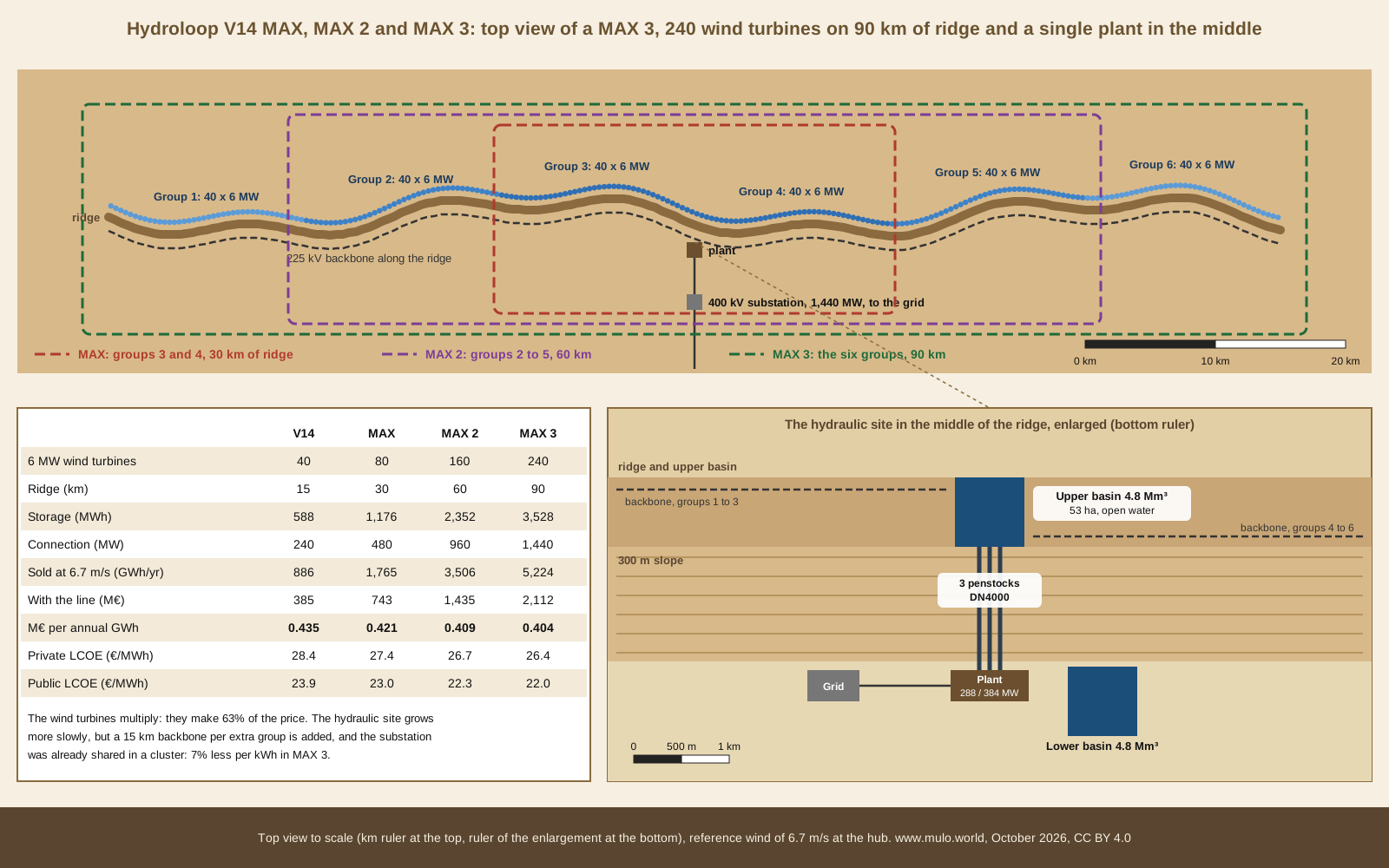
Diagram code (Python, free): schema_hydroloop_v14_max.py; calculation (hourly model of the V14 and costs item by item): hydroloop_muhleisen_2026_v14_max_calcul.py
Related pages: V14 | V14 Soleil MAX | V15 Canyon MAX | the plants of Artesia 5 (in French) | the wind scan (in French) | Artesia 5 (in French)
------------------------------
1. THE PRINCIPLE: ONE RIDGE, ONE PLANT
------------------------------
A V14 is 40 wind turbines of 6 MW on a 15 km ridge, two basins of 800,000 m³ (588 MWh), two penstocks on a 300 m slope, a plant with 48 MW of turbines and 64 MW of pumps, and a 240 MW connection to a 400 kV substation already shared by three plants in a cluster. On a 90 km ridge, the plan places six V14, so six developed slopes, six pairs of basins, six plants. The MAX 3 keeps only one, in the middle, larger.
* What multiplies: the wind turbines, with their 150 m towers and wake steering, and the small tracker field. The ridge does not get shorter: 30 km for a MAX, 60 for a MAX 2, 90 for a MAX 3.
* What grows more slowly: the basins, deeper (9 m in MAX 3), the penstocks (three DN4000), the plant (larger units in a single building), the substation and the line to the grid. Same engineering rules as for the V14 Soleil MAX: cost follows size to the power 0.8 for the basins, 0.75 for the penstocks, 0.9 for the machines, 0.6 for the line.
* What is added: a 225 kV electrical backbone along the ridge, to bring the current of the distant groups to the plant: 15 km per extra group, 0.5 M€ per km, and 0.3% losses per extra group.
* What grows almost as fast: the substation. The V14 already shares it with two neighbours (22 M€ instead of 30); the MAX only gains the difference, power 0.85.
* What does not change: the hourly control, the dispatchable share (19%), the sizing rule of the V14, 240 MW of wind for 240 MW of connection, 64 MW of pumps, 48 MW of turbines and 588 MWh of storage, multiplied by 2, 4 or 6.
------------------------------
2. THE THREE SIZES
------------------------------
* The kWh drops by 3% in MAX, 6% in MAX 2 and 7% in MAX 3, a little less than for the V14 Soleil (4.5, 8 and 10%). Three reasons: the wind turbines make up 63% of the price and do not get cheaper with size; the substation was already shared in a cluster; the backbone costs money and loses a little current.
* The MAX 2 is the right size: from MAX 2 to MAX 3, the gain is only one percent, because the backbone grows by 30 km. On a 90 km ridge, a MAX 2 and a MAX do almost as well as a MAX 3, with two better-placed hydraulic sites.
* A MAX 3 is the size of the largest onshore wind farms: 1,440 MW over 90 km, the order of magnitude of the large Gansu wind farms in China or SunZia in New Mexico. The novelty is the pumped-storage plant in the middle.
------------------------------
3. ITEM BY ITEM
------------------------------
In millions of euros, French 2026 series prices, wind at 0.91 M€/MW as on the V14 page. In brackets, the price of 2, 4 or 6 separate V14.
The operating cost: 4.5 M€ a year for a V14 in this page's model, 21.2 M€ for a MAX 3 instead of 27.3 for six.
------------------------------
4. THE THREE WINDS
------------------------------
The relative gain of the MAX is the same at all winds, around 7% in MAX 3. Wind matters far more than size: a single V14 on a ridge at 7.7 m/s (0.368) beats a MAX 3 on a ridge at 6.7 (0.404). The MAX does not replace the choice of the best ridges, it adds to it.
------------------------------
5. WHAT IT CHANGES FOR ARTESIA 5
------------------------------
The wind scan (in French) counts, for each ridge, how many V14 it can carry on its windy kilometres. In the Artesia 5 plan, on the list of plants (in French), grouping the V14 of each ridge into MAX 3, then MAX 2, then MAX:
* 42% fewer ridge plants: 3,010 hydraulic sites instead of 5,201, for the same electricity, within 1% of losses in the backbones. The wind turbines, however, all stay.
* About 60 billion saved out of the 1,916 billion of the ridge V14. With the V14 Soleil, the MAX versions save the plan about 270 billion and bring its V14 from 14,681 to 8,530 plants. These figures will be redone in the next Artesia 5 calculation, which will choose each plant with its MAX versions and the real line prices of each country.
* The ridges of Russia and the United States, where the plan places 1,884 and 1,123 TWh of ridge V14, are the longest: that is where the MAX 2 and MAX 3 will go first.
------------------------------
5 bis. PACHA, GOLD, SKY AND O SKY IN A MAX
------------------------------
In the plan, a V14 set under 1,500 mm of rain or more receives a Pacha lake, and nearly one in two a Gold; some Golds receive a Sky, and some Skys an O Sky. When the V14 of a site are brought together into a MAX, these additions follow, but they do not all gain:
* Pacha: the rain does not grow with the plant, it depends on the mountain captured, and the belt canal stays just as long. What is shared is the lake, deeper, and the rain Pelton, a single larger one: about 10% of the price of a Pacha.
* Gold: each stream and each spring keeps its intake and its pipe. Nothing to share, the Gold stays as it is.
* Sky: its lower lake and its pumps join the MAX plant, like the basins and machines of the V14; it gains like the hydraulics, 15 to 20% of its price.
* O Sky: floating panels on the lakes, which multiply. Nothing to gain.
On the Pacha, Gold and Sky of the plan (156 billion in all), that is on the order of 5 to 10 billion more, counted in the Artesia 5 recalculation.
------------------------------
6. THE LIMITS
------------------------------
* A 300 m slope is needed in the middle of the ridge, not just somewhere along it. If the best slope is at the end, the backbone gets longer, and two MAX are better than one MAX 2.
* The powers of 0.6 to 0.9 are engineering rules, not quotes, as on the V14 Soleil MAX page.
* The backbone crosses 30 to 90 km of ridge: it is one more line to get accepted, even if it can be buried under the wind turbines' access track, which already exists.
* A single hydraulic site is a single point of failure for the storage of the whole ridge; the wind turbines, however, keep selling directly if the plant stops.
* The wind turbines are counted at the same price per MW: a farm of 240 machines generally gets a better price and cheaper maintenance per machine, which is not counted.
------------------------------
7. CONCLUSION
------------------------------
The V14 MAX holds: by bringing together two, four or six V14 on the same ridge on a single hydraulic site, the kWh drops by 3, 6 and 7%, down to 26.4 €/MWh private and 22.0 public for a MAX 3 of 240 wind turbines that sells 5.2 TWh a year. The right size is the MAX 2, on 60 km of ridge; beyond that, the backbone eats the gain. For the Artesia 5 plan, the 5,201 ridge V14 become 3,010 plants, for about 60 billion less, and with the V14 Soleil MAX, about 270 billion and 6,000 fewer hydraulic construction sites. The next step is the recalculation of Artesia 5 with these MAX versions, the real line prices of each country, the wind of temperate dams and the large springs.
------------------------------
SOURCES
------------------------------
The calculation of the MAX versions (Python, no library), the diagram (Python)
The V14, the V14 Soleil MAX, the wind scan (in French), the plants of Artesia 5 (in French), the Artesia 5 plan (in French)
The site's good ideas (in French)
Olivier Muhleisen in collaboration with Claude (Anthropic), October 2026. Plans, diagrams, texts and figures under the CC BY 4.0 licence.
© 2009-2026 Onmyweb Production - TOS - Cookies information - Contact us - Free Copyright Open Source -
1. THE PRINCIPLE: ONE RIDGE, ONE PLANT
------------------------------
A V14 is 40 wind turbines of 6 MW on a 15 km ridge, two basins of 800,000 m³ (588 MWh), two penstocks on a 300 m slope, a plant with 48 MW of turbines and 64 MW of pumps, and a 240 MW connection to a 400 kV substation already shared by three plants in a cluster. On a 90 km ridge, the plan places six V14, so six developed slopes, six pairs of basins, six plants. The MAX 3 keeps only one, in the middle, larger.
* What multiplies: the wind turbines, with their 150 m towers and wake steering, and the small tracker field. The ridge does not get shorter: 30 km for a MAX, 60 for a MAX 2, 90 for a MAX 3.
* What grows more slowly: the basins, deeper (9 m in MAX 3), the penstocks (three DN4000), the plant (larger units in a single building), the substation and the line to the grid. Same engineering rules as for the V14 Soleil MAX: cost follows size to the power 0.8 for the basins, 0.75 for the penstocks, 0.9 for the machines, 0.6 for the line.
* What is added: a 225 kV electrical backbone along the ridge, to bring the current of the distant groups to the plant: 15 km per extra group, 0.5 M€ per km, and 0.3% losses per extra group.
* What grows almost as fast: the substation. The V14 already shares it with two neighbours (22 M€ instead of 30); the MAX only gains the difference, power 0.85.
* What does not change: the hourly control, the dispatchable share (19%), the sizing rule of the V14, 240 MW of wind for 240 MW of connection, 64 MW of pumps, 48 MW of turbines and 588 MWh of storage, multiplied by 2, 4 or 6.
------------------------------
2. THE THREE SIZES
------------------------------
| V14 | MAX | MAX 2 | MAX 3 | |
|---|---|---|---|---|
| Capacity | ×1 | ×2 | ×4 | ×6 |
| 6 MW wind turbines | 40 over 15 km | 80 over 30 km | 160 over 60 km | 240 over 90 km |
| Upper and lower basins | 800,000 m³, 16 ha | 1.6 Mm³, 25 ha | 3.2 Mm³, 40 ha | 4.8 Mm³, 53 ha |
| Storage | 588 MWh | 1,176 MWh | 2,352 MWh | 3,528 MWh |
| Turbines and pumps | 48 and 64 MW | 96 and 128 MW | 192 and 256 MW | 288 and 384 MW |
| Backbone along the ridge | none | 15 km | 45 km | 75 km |
| Grid connection | 240 MW | 480 MW | 960 MW | 1,440 MW |
| Electricity sold, wind of 6.7 m/s at the hub | 886 GWh | 1,765 GWh | 3,506 GWh | 5,224 GWh |
| Investment in series | 365 M€ | 713 M€ | 1,389 M€ | 2,053 M€ |
| With the line to the grid | 385 M€ | 743 M€ | 1,435 M€ | 2,112 M€ |
| M€ per annual GWh, line included | 0.435 | 0.421 | 0.409 | 0.404 |
| Private / public LCOE | 28.4 / 23.9 €/MWh | 27.4 / 23.0 €/MWh | 26.7 / 22.3 €/MWh | 26.4 / 22.0 €/MWh |
| Payback time at the V14 Soleil price profile | 6.1 years | 5.9 years | 5.7 years | 5.7 years |
* The kWh drops by 3% in MAX, 6% in MAX 2 and 7% in MAX 3, a little less than for the V14 Soleil (4.5, 8 and 10%). Three reasons: the wind turbines make up 63% of the price and do not get cheaper with size; the substation was already shared in a cluster; the backbone costs money and loses a little current.
* The MAX 2 is the right size: from MAX 2 to MAX 3, the gain is only one percent, because the backbone grows by 30 km. On a 90 km ridge, a MAX 2 and a MAX do almost as well as a MAX 3, with two better-placed hydraulic sites.
* A MAX 3 is the size of the largest onshore wind farms: 1,440 MW over 90 km, the order of magnitude of the large Gansu wind farms in China or SunZia in New Mexico. The novelty is the pumped-storage plant in the middle.
------------------------------
3. ITEM BY ITEM
------------------------------
In millions of euros, French 2026 series prices, wind at 0.91 M€/MW as on the V14 page. In brackets, the price of 2, 4 or 6 separate V14.
| Item | V14 | MAX (2 separate) | MAX 2 (4 separate) | MAX 3 (6 separate) | Why |
|---|---|---|---|---|---|
| 6 MW wind turbines, 150 m towers | 229.0 | 458.0 (458.0) | 916.0 (916.0) | 1,374.0 (1,374.0) | multiply |
| Bifacial photovoltaics, trackers and slopes | 9.1 | 18.2 (18.2) | 36.5 (36.5) | 54.7 (54.7) | multiplies |
| Gutters | 0.3 | 0.5 (0.5) | 1.1 (1.1) | 1.6 (1.6) | multiply |
| Upper and lower basins | 19.1 | 33.3 (38.2) | 57.9 (76.4) | 80.1 (114.6) | deeper, power 0.8 |
| Rain reservoir | 2.0 | 3.5 (4.0) | 6.1 (8.0) | 8.4 (12.0) | power 0.8 |
| Penstocks on the slope | 13.3 | 22.4 (26.6) | 37.6 (53.2) | 51.0 (79.8) | larger, power 0.75 |
| Plant: turbines and pumps | 67.8 | 126.5 (135.6) | 236.1 (271.2) | 340.1 (406.8) | larger units, power 0.9 |
| Backbone along the ridge | 0.0 | 7.5 (0.0) | 22.5 (0.0) | 37.5 (0.0) | new: 15 km of 225 kV line per extra group |
| Substation and grid connection | 22.0 | 39.7 (44.0) | 71.5 (88.0) | 100.9 (132.0) | already shared in a cluster in the V14, power 0.85 |
| Line to the grid | 20.0 | 30.3 (40.0) | 45.9 (80.0) | 58.6 (120.0) | a more heavily loaded line, power 0.6 |
| Road, studies, miscellaneous | 2.0 | 2.6 (4.0) | 3.5 (8.0) | 4.1 (12.0) | almost once only |
| Instrumentation | 0.5 | 0.6 (1.0) | 0.8 (2.0) | 0.9 (3.0) | almost once only |
| Total, line included | 385.1 | 743.1 (770.2) | 1,435.4 (1,540.3) | 2,111.8 (2,310.5) | saving: 8.6% in MAX 3 |
The operating cost: 4.5 M€ a year for a V14 in this page's model, 21.2 M€ for a MAX 3 instead of 27.3 for six.
------------------------------
4. THE THREE WINDS
------------------------------
| Plant and wind at the 150 m hub | Sold (GWh per year) | Dispatchable | Investment, line included (M€) | M€ per annual GWh | Private / public LCOE (€/MWh) | Payback (years) |
|---|---|---|---|---|---|---|
| V14, weak site, 5.7 m/s | 689 | 23% | 385 | 0.559 | 36.5 / 30.7 | 7.8 |
| MAX, weak site, 5.7 m/s | 1,374 | 23% | 743 | 0.541 | 35.2 / 29.5 | 7.5 |
| MAX 2, weak site, 5.7 m/s | 2,728 | 23% | 1,435 | 0.526 | 34.3 / 28.7 | 7.3 |
| MAX 3, weak site, 5.7 m/s | 4,065 | 24% | 2,112 | 0.520 | 33.9 / 28.3 | 7.2 |
| V14, reference, 6.7 m/s | 886 | 19% | 385 | 0.435 | 28.4 / 23.9 | 6.1 |
| MAX, reference, 6.7 m/s | 1,765 | 19% | 743 | 0.421 | 27.4 / 23.0 | 5.9 |
| MAX 2, reference, 6.7 m/s | 3,506 | 19% | 1,435 | 0.409 | 26.7 / 22.3 | 5.7 |
| MAX 3, reference, 6.7 m/s | 5,224 | 19% | 2,112 | 0.404 | 26.4 / 22.0 | 5.7 |
| V14, strong site, 7.7 m/s | 1,047 | 16% | 385 | 0.368 | 24.0 / 20.2 | 5.2 |
| MAX, strong site, 7.7 m/s | 2,086 | 16% | 743 | 0.356 | 23.2 / 19.4 | 5.0 |
| MAX 2, strong site, 7.7 m/s | 4,144 | 16% | 1,435 | 0.346 | 22.6 / 18.9 | 4.9 |
| MAX 3, strong site, 7.7 m/s | 6,174 | 17% | 2,112 | 0.342 | 22.3 / 18.7 | 4.8 |
The relative gain of the MAX is the same at all winds, around 7% in MAX 3. Wind matters far more than size: a single V14 on a ridge at 7.7 m/s (0.368) beats a MAX 3 on a ridge at 6.7 (0.404). The MAX does not replace the choice of the best ridges, it adds to it.
| Price of wind power | V14, M€ per annual GWh | MAX 3, M€ per annual GWh | MAX 3, private / public LCOE (€/MWh) |
|---|---|---|---|
| Reference, 0.91 M€/MW | 0.435 | 0.404 | 26.4 / 22.0 |
| Wind at 1.2 M€/MW, 150 m towers included (high price of the V14 page) | 0.518 | 0.489 | 31.3 / 26.0 |
------------------------------
5. WHAT IT CHANGES FOR ARTESIA 5
------------------------------
The wind scan (in French) counts, for each ridge, how many V14 it can carry on its windy kilometres. In the Artesia 5 plan, on the list of plants (in French), grouping the V14 of each ridge into MAX 3, then MAX 2, then MAX:
| Plant in the plan | V14 of the plan | MAX 3 | MAX 2 | MAX | Plants after grouping | Estimated saving |
|---|---|---|---|---|---|---|
| Ridge V14 | 5,201 | 172 | 162 | 845 | 3,010 | about 60 bn€ |
| Reminder: V14 Soleil, mixed and substation V14 Soleil (MAX page) | 9,480 | 354 | 369 | 1,083 | 5,520 | about 210 bn€ |
| The four V14 of the plan | 14,681 | 526 | 531 | 1,928 | 8,530 | about 270 bn€ |
* 42% fewer ridge plants: 3,010 hydraulic sites instead of 5,201, for the same electricity, within 1% of losses in the backbones. The wind turbines, however, all stay.
* About 60 billion saved out of the 1,916 billion of the ridge V14. With the V14 Soleil, the MAX versions save the plan about 270 billion and bring its V14 from 14,681 to 8,530 plants. These figures will be redone in the next Artesia 5 calculation, which will choose each plant with its MAX versions and the real line prices of each country.
* The ridges of Russia and the United States, where the plan places 1,884 and 1,123 TWh of ridge V14, are the longest: that is where the MAX 2 and MAX 3 will go first.
------------------------------
5 bis. PACHA, GOLD, SKY AND O SKY IN A MAX
------------------------------
In the plan, a V14 set under 1,500 mm of rain or more receives a Pacha lake, and nearly one in two a Gold; some Golds receive a Sky, and some Skys an O Sky. When the V14 of a site are brought together into a MAX, these additions follow, but they do not all gain:
* Pacha: the rain does not grow with the plant, it depends on the mountain captured, and the belt canal stays just as long. What is shared is the lake, deeper, and the rain Pelton, a single larger one: about 10% of the price of a Pacha.
* Gold: each stream and each spring keeps its intake and its pipe. Nothing to share, the Gold stays as it is.
* Sky: its lower lake and its pumps join the MAX plant, like the basins and machines of the V14; it gains like the hydraulics, 15 to 20% of its price.
* O Sky: floating panels on the lakes, which multiply. Nothing to gain.
On the Pacha, Gold and Sky of the plan (156 billion in all), that is on the order of 5 to 10 billion more, counted in the Artesia 5 recalculation.
------------------------------
6. THE LIMITS
------------------------------
* A 300 m slope is needed in the middle of the ridge, not just somewhere along it. If the best slope is at the end, the backbone gets longer, and two MAX are better than one MAX 2.
* The powers of 0.6 to 0.9 are engineering rules, not quotes, as on the V14 Soleil MAX page.
* The backbone crosses 30 to 90 km of ridge: it is one more line to get accepted, even if it can be buried under the wind turbines' access track, which already exists.
* A single hydraulic site is a single point of failure for the storage of the whole ridge; the wind turbines, however, keep selling directly if the plant stops.
* The wind turbines are counted at the same price per MW: a farm of 240 machines generally gets a better price and cheaper maintenance per machine, which is not counted.
------------------------------
7. CONCLUSION
------------------------------
The V14 MAX holds: by bringing together two, four or six V14 on the same ridge on a single hydraulic site, the kWh drops by 3, 6 and 7%, down to 26.4 €/MWh private and 22.0 public for a MAX 3 of 240 wind turbines that sells 5.2 TWh a year. The right size is the MAX 2, on 60 km of ridge; beyond that, the backbone eats the gain. For the Artesia 5 plan, the 5,201 ridge V14 become 3,010 plants, for about 60 billion less, and with the V14 Soleil MAX, about 270 billion and 6,000 fewer hydraulic construction sites. The next step is the recalculation of Artesia 5 with these MAX versions, the real line prices of each country, the wind of temperate dams and the large springs.
------------------------------
SOURCES
------------------------------
The calculation of the MAX versions (Python, no library), the diagram (Python)
The V14, the V14 Soleil MAX, the wind scan (in French), the plants of Artesia 5 (in French), the Artesia 5 plan (in French)
The site's good ideas (in French)
Olivier Muhleisen in collaboration with Claude (Anthropic), October 2026. Plans, diagrams, texts and figures under the CC BY 4.0 licence.
© 2009-2026 Onmyweb Production - TOS - Cookies information - Contact us - Free Copyright Open Source -