
The price of power lines country by country: a 1,000 km line costs 234 M€ per GW in China, 383 in Japan, 830 in the United States and 2,664 in Germany, where the law buries it; 214 countries calibrated on five large real projects and the World Bank price level
Until now, the site's plans counted their lines at the price of a cautious European project, the same everywhere: 200 M€ per GW for a pair of converters and 0.30 M€ per km and per GW of direct current line, that is 500 M€ per GW for 1,000 km. Yet the same structure costs three times less in China and almost twice as much in the United States. This page gives a price per country, for each component of the grid, in a table that will serve the following plans, starting with Artesia 5.
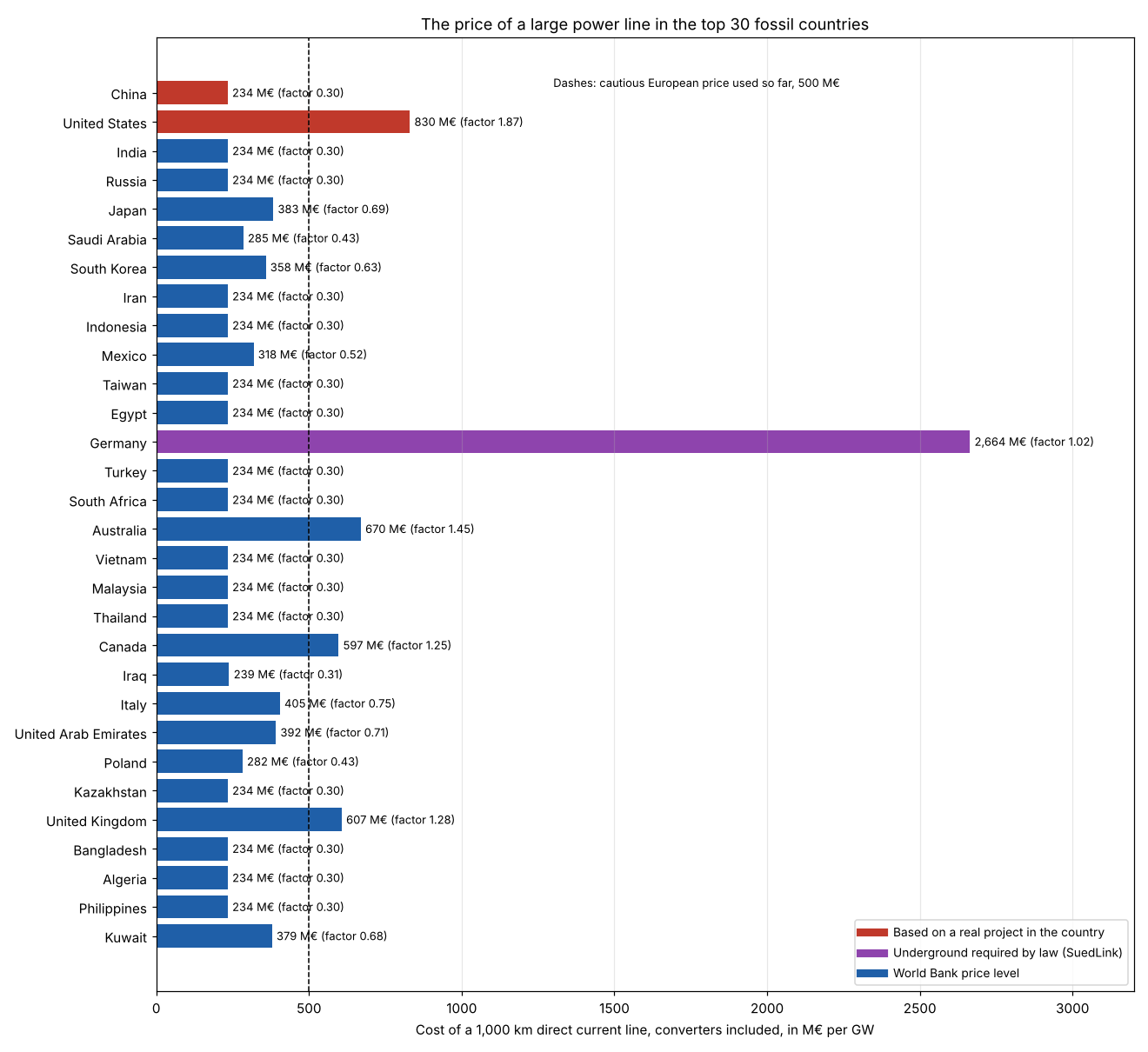
Code (Python, free): prix_lignes_electriques_pays.py (reads niveau_prix_banque_mondiale.csv and electricite_pays_prix_part_fossile.csv); the chart: schema_prix_lignes_electriques_pays.py; the result, one country per line: prix_lignes_electriques_pays.csv
Related pages: Artesia 5 world plan, version 1 | the price of plants country by country | Artesia 4, grids recalculated (in French) | reusable substations | electricity country by country
------------------------------
1. THE REAL PROJECTS
------------------------------
Five large direct current lines built or under construction, converted into euros per GW of capacity. The factor is what must be applied to the cautious European price to find the real cost.
* The factor applies to the items that depend on the country: the line, the pylons, the trenches, the land, the substations and their labour. The converters, bought on the world market, only follow 40% of it: 200 × (0.6 + 0.4 × factor) M€ per GW. The submarine cable, laid by the same ships everywhere, follows the same rule: 1.61 × (0.6 + 0.4 × factor) M€ per km and per GW, calibrated on Viking Link to within 2 M€.
* The gaps are enormous: a kilometre of line costs six times more in the United States than in China, and a 1,000 km line including converters three and a half times more. It is not the cables that cost more, it is the land, the studies, the legal challenges, the labour and the length of the works.
------------------------------
2. THE OTHER COUNTRIES: THE PRICE LEVEL
------------------------------
* The data: the price level of each country, the ratio between the purchasing power parity conversion factor and the exchange rate (World Bank, PA.NUS.PPP divided by PA.NUS.FCRF, 2024 for almost all), the United States being 1. It measures what the same goods and services cost locally.
* The rule: factor = (price level ÷ 0.75)², at least 0.30 and at most 2.5. The level 0.75 is that of Germany and France, where the cautious European price was built. The square comes from the real projects: the cost of lines rises faster than prices, because expensive countries add studies, legal challenges and undergrounding to wages. The floor of 0.30 is the Chinese price, the lowest ever measured.
* The check: the rule gives 0.43 for China (0.30 in reality), 0.38 for Brazil (0.42), 0.38 for Chile (0.70) and 1.78 for the United States (1.87). It is accurate to within 25% on average, cautious for China and a little optimistic for Chile, whose Atacama desert is expensive to cross. Where a real project exists, it is the project that gives the factor.
* Countries without reliable data: 36 countries (Iran, Taiwan, Venezuela, Egypt and Nigeria after their devaluations, exchange rate years that are too old) take the median of their continent: 0.35 in Asia, 0.34 in Africa, 0.60 in Europe, 0.60 in North America, 0.43 in South America, 0.87 in Oceania.
------------------------------
3. THE TABLE: THE FIRST 40 FOSSIL COUNTRIES
------------------------------
In M€ per GW of capacity; direct and alternating current in M€ per km and per GW; the last column gives a 1,000 km direct current line, converters included. The CSV file gives the 214 countries and also the new substation, the existing substation, the submarine cable and the radius of the country.
------------------------------
4. WHAT THIS CHANGES FOR THE PLANS
------------------------------
* The plan's countries are almost all cheaper than Europe: China, India, Russia, Indonesia, Central Asia, the Middle East and Africa are between 0.30 and 0.45. The most expensive lines are in the United States, Australia, Canada, the United Kingdom and, buried, Germany.
* A first test on Artesia 5, version 1: with these prices, the plan's grid goes from 2,315 to about 1,550 billion and the plan from 11,304 to about 10,506 billion. The plants remain almost the same, but the United States, where lines are expensive, imports more from Mexico (865 TWh instead of 230). This is only a test: the plan will be recalculated with these prices in its next update.
* A line between two countries is counted at the price of each one on the part that crosses it, based on its radius (half the square root of its area), and at the average of the two beyond.
------------------------------
5. THE LIMITS
------------------------------
* Only five real projects: India, Russia, Africa and the Middle East have no large recent project with a public and complete cost. Their prices come from the rule and the Chinese floor.
* Relief, climate and legal challenges are not counted country by country: a line in the mountains, in the jungle or in a country where every pylon is contested costs more than the average of its country.
* Germany has two prices here: 0.61 M€ per km and per GW for an overhead alternating current line, and 2.46 for a direct current line, which it buries by law.
* The years: the projects range from 2019 to today, converted into euros at the exchange rate of their year, without correcting for inflation.
------------------------------
SOURCES
------------------------------
The calculation (Python), the price of lines in 214 countries (CSV), the World Bank price level (CSV), the chart (Python)
Changji-Guquan (Powerline), Xingu-Rio (NS Energy), Kimal-Lo Aguirre (Reporte Minero), TransWest Express (Wikipedia), SuedLink (Enerdata), Viking Link (Solar Power Portal)
World Bank: purchasing power parity conversion factor, World Bank: official exchange rate, GeoNames: area of countries
The Artesia 5 world plan, version 1, Artesia 4, grids recalculated (in French)
The site's good ideas
Olivier Muhleisen in collaboration with Claude (Anthropic), October 2026. Plans, diagrams, texts and figures under the CC BY 4.0 licence.
© 2009-2026 Onmyweb Production - TOS - Cookies information - Contact us - Free Copyright Open Source -
1. THE REAL PROJECTS
------------------------------
Five large direct current lines built or under construction, converted into euros per GW of capacity. The factor is what must be applied to the cautious European price to find the real cost.
| Country | Project | Characteristics | Real cost | M€ per GW | Cautious European price | Factor |
|---|---|---|---|---|---|---|
| China | Changji-Guquan, in service in 2019 | ±1,100 kV, 12 GW, 3,293 km overhead | CNY 40.7bn, €5.27bn | 439 | 1,188 | 0.30 |
| Brazil | Xingu-Rio, in service in 2019 | ±800 kV, 4 GW, 2,539 km overhead | $2.14bn, €1.90bn | 475 | 962 | 0.42 |
| Chile | Kimal-Lo Aguirre, under construction | ±600 kV, 3 GW, 1,342 km overhead | $1.48bn, €1.37bn | 457 | 603 | 0.70 |
| United States | TransWest Express, under construction | ±600 kV, 3 GW, 1,172 km overhead | $3bn, €2.78bn | 927 | 552 | 1.87 |
| Germany | SuedLink, under construction | 525 kV, 4 GW, 700 km underground (the law requires new direct current lines to be buried there) | €10bn | 2,500 | 410 | 8.2 for direct current on land |
| United Kingdom and Denmark | Viking Link, in service in 2023 (check) | 1.4 GW, 765 km of which 620 under the sea | £1.7bn, €1.98bn | 1,414 | model of this page: 1,412 | used to calibrate the submarine cable |
* The factor applies to the items that depend on the country: the line, the pylons, the trenches, the land, the substations and their labour. The converters, bought on the world market, only follow 40% of it: 200 × (0.6 + 0.4 × factor) M€ per GW. The submarine cable, laid by the same ships everywhere, follows the same rule: 1.61 × (0.6 + 0.4 × factor) M€ per km and per GW, calibrated on Viking Link to within 2 M€.
* The gaps are enormous: a kilometre of line costs six times more in the United States than in China, and a 1,000 km line including converters three and a half times more. It is not the cables that cost more, it is the land, the studies, the legal challenges, the labour and the length of the works.
------------------------------
2. THE OTHER COUNTRIES: THE PRICE LEVEL
------------------------------
* The data: the price level of each country, the ratio between the purchasing power parity conversion factor and the exchange rate (World Bank, PA.NUS.PPP divided by PA.NUS.FCRF, 2024 for almost all), the United States being 1. It measures what the same goods and services cost locally.
* The rule: factor = (price level ÷ 0.75)², at least 0.30 and at most 2.5. The level 0.75 is that of Germany and France, where the cautious European price was built. The square comes from the real projects: the cost of lines rises faster than prices, because expensive countries add studies, legal challenges and undergrounding to wages. The floor of 0.30 is the Chinese price, the lowest ever measured.
* The check: the rule gives 0.43 for China (0.30 in reality), 0.38 for Brazil (0.42), 0.38 for Chile (0.70) and 1.78 for the United States (1.87). It is accurate to within 25% on average, cautious for China and a little optimistic for Chile, whose Atacama desert is expensive to cross. Where a real project exists, it is the project that gives the factor.
* Countries without reliable data: 36 countries (Iran, Taiwan, Venezuela, Egypt and Nigeria after their devaluations, exchange rate years that are too old) take the median of their continent: 0.35 in Asia, 0.34 in Africa, 0.60 in Europe, 0.60 in North America, 0.43 in South America, 0.87 in Oceania.
------------------------------
3. THE TABLE: THE FIRST 40 FOSSIL COUNTRIES
------------------------------
In M€ per GW of capacity; direct and alternating current in M€ per km and per GW; the last column gives a 1,000 km direct current line, converters included. The CSV file gives the 214 countries and also the new substation, the existing substation, the submarine cable and the radius of the country.
| Country | Price level (United States = 1) | Factor | Spring | Converters | Direct current on land, per km | Alternating 400 kV, per km | Reinforcement | 1,000 km of direct current |
|---|---|---|---|---|---|---|---|---|
| China | 0.49 | 0.30 | real project | 144 | 0.090 | 0.18 | 30 | 234 |
| United States | 1.00 | 1.87 | real project | 270 | 0.561 | 1.12 | 187 | 830 |
| India | 0.24 | 0.30 | price level | 144 | 0.090 | 0.18 | 30 | 234 |
| Russia | 0.31 | 0.30 | price level | 144 | 0.090 | 0.18 | 30 | 234 |
| Japan | 0.62 | 0.69 | price level | 175 | 0.208 | 0.41 | 69 | 383 |
| Saudi Arabia | 0.49 | 0.43 | price level | 155 | 0.130 | 0.26 | 43 | 285 |
| South Korea | 0.59 | 0.63 | price level | 170 | 0.188 | 0.38 | 63 | 358 |
| Iran | 0.35 | 0.30 | price level | 144 | 0.090 | 0.18 | 30 | 234 |
| Indonesia | 0.30 | 0.30 | price level | 144 | 0.090 | 0.18 | 30 | 234 |
| Mexico | 0.54 | 0.52 | price level | 162 | 0.157 | 0.31 | 52 | 318 |
| Taiwan | 0.35 | 0.30 | price level | 144 | 0.090 | 0.18 | 30 | 234 |
| Egypt | 0.34 | 0.30 | price level | 144 | 0.090 | 0.18 | 30 | 234 |
| Germany | 0.76 | 1.02 | law: underground | 202 | 2.462 | 0.61 | 102 | 2,664 |
| Turkey | 0.35 | 0.30 | price level | 144 | 0.090 | 0.18 | 30 | 234 |
| South Africa | 0.41 | 0.30 | price level | 144 | 0.090 | 0.18 | 30 | 234 |
| Australia | 0.90 | 1.45 | price level | 236 | 0.434 | 0.87 | 145 | 670 |
| Vietnam | 0.29 | 0.30 | price level | 144 | 0.090 | 0.18 | 30 | 234 |
| Malaysia | 0.31 | 0.30 | price level | 144 | 0.090 | 0.18 | 30 | 234 |
| Thailand | 0.30 | 0.30 | price level | 144 | 0.090 | 0.18 | 30 | 234 |
| Canada | 0.84 | 1.25 | price level | 220 | 0.376 | 0.75 | 125 | 597 |
| Iraq | 0.42 | 0.31 | price level | 145 | 0.094 | 0.19 | 31 | 239 |
| Italy | 0.65 | 0.75 | price level | 180 | 0.225 | 0.45 | 75 | 405 |
| United Arab Emirates | 0.63 | 0.71 | price level | 177 | 0.214 | 0.43 | 71 | 392 |
| Poland | 0.49 | 0.43 | price level | 154 | 0.128 | 0.26 | 43 | 282 |
| Kazakhstan | 0.35 | 0.30 | price level | 144 | 0.090 | 0.18 | 30 | 234 |
| United Kingdom | 0.85 | 1.28 | price level | 223 | 0.384 | 0.77 | 128 | 607 |
| Bangladesh | 0.26 | 0.30 | price level | 144 | 0.090 | 0.18 | 30 | 234 |
| Algeria | 0.33 | 0.30 | price level | 144 | 0.090 | 0.18 | 30 | 234 |
| Philippines | 0.34 | 0.30 | price level | 144 | 0.090 | 0.18 | 30 | 234 |
| Kuwait | 0.62 | 0.68 | price level | 174 | 0.204 | 0.41 | 68 | 379 |
| Argentina | 0.46 | 0.37 | price level | 150 | 0.112 | 0.22 | 37 | 262 |
| Pakistan | 0.24 | 0.30 | price level | 144 | 0.090 | 0.18 | 30 | 234 |
| Brazil | 0.46 | 0.42 | real project | 154 | 0.127 | 0.25 | 42 | 280 |
| Spain | 0.61 | 0.66 | price level | 173 | 0.197 | 0.39 | 66 | 370 |
| Uzbekistan | 0.27 | 0.30 | price level | 144 | 0.090 | 0.18 | 30 | 234 |
| Israel | 0.95 | 1.59 | price level | 248 | 0.478 | 0.96 | 159 | 726 |
| Netherlands | 0.79 | 1.11 | price level | 209 | 0.335 | 0.67 | 112 | 544 |
| Singapore | 0.62 | 0.68 | price level | 175 | 0.205 | 0.41 | 68 | 380 |
| Qatar | 0.60 | 0.63 | price level | 171 | 0.190 | 0.38 | 63 | 361 |
| Oman | 0.48 | 0.42 | price level | 153 | 0.125 | 0.25 | 42 | 279 |
------------------------------
4. WHAT THIS CHANGES FOR THE PLANS
------------------------------
* The plan's countries are almost all cheaper than Europe: China, India, Russia, Indonesia, Central Asia, the Middle East and Africa are between 0.30 and 0.45. The most expensive lines are in the United States, Australia, Canada, the United Kingdom and, buried, Germany.
* A first test on Artesia 5, version 1: with these prices, the plan's grid goes from 2,315 to about 1,550 billion and the plan from 11,304 to about 10,506 billion. The plants remain almost the same, but the United States, where lines are expensive, imports more from Mexico (865 TWh instead of 230). This is only a test: the plan will be recalculated with these prices in its next update.
* A line between two countries is counted at the price of each one on the part that crosses it, based on its radius (half the square root of its area), and at the average of the two beyond.
------------------------------
5. THE LIMITS
------------------------------
* Only five real projects: India, Russia, Africa and the Middle East have no large recent project with a public and complete cost. Their prices come from the rule and the Chinese floor.
* Relief, climate and legal challenges are not counted country by country: a line in the mountains, in the jungle or in a country where every pylon is contested costs more than the average of its country.
* Germany has two prices here: 0.61 M€ per km and per GW for an overhead alternating current line, and 2.46 for a direct current line, which it buries by law.
* The years: the projects range from 2019 to today, converted into euros at the exchange rate of their year, without correcting for inflation.
------------------------------
SOURCES
------------------------------
The calculation (Python), the price of lines in 214 countries (CSV), the World Bank price level (CSV), the chart (Python)
Changji-Guquan (Powerline), Xingu-Rio (NS Energy), Kimal-Lo Aguirre (Reporte Minero), TransWest Express (Wikipedia), SuedLink (Enerdata), Viking Link (Solar Power Portal)
World Bank: purchasing power parity conversion factor, World Bank: official exchange rate, GeoNames: area of countries
The Artesia 5 world plan, version 1, Artesia 4, grids recalculated (in French)
The site's good ideas
Olivier Muhleisen in collaboration with Claude (Anthropic), October 2026. Plans, diagrams, texts and figures under the CC BY 4.0 licence.
© 2009-2026 Onmyweb Production - TOS - Cookies information - Contact us - Free Copyright Open Source -