
Hydroloop Muhleisen 2026, version 14: version 13 with everything that was left, 885 GWh at 28 to 32.5 €/MWh, and why it is the last of the series. 10/10/26
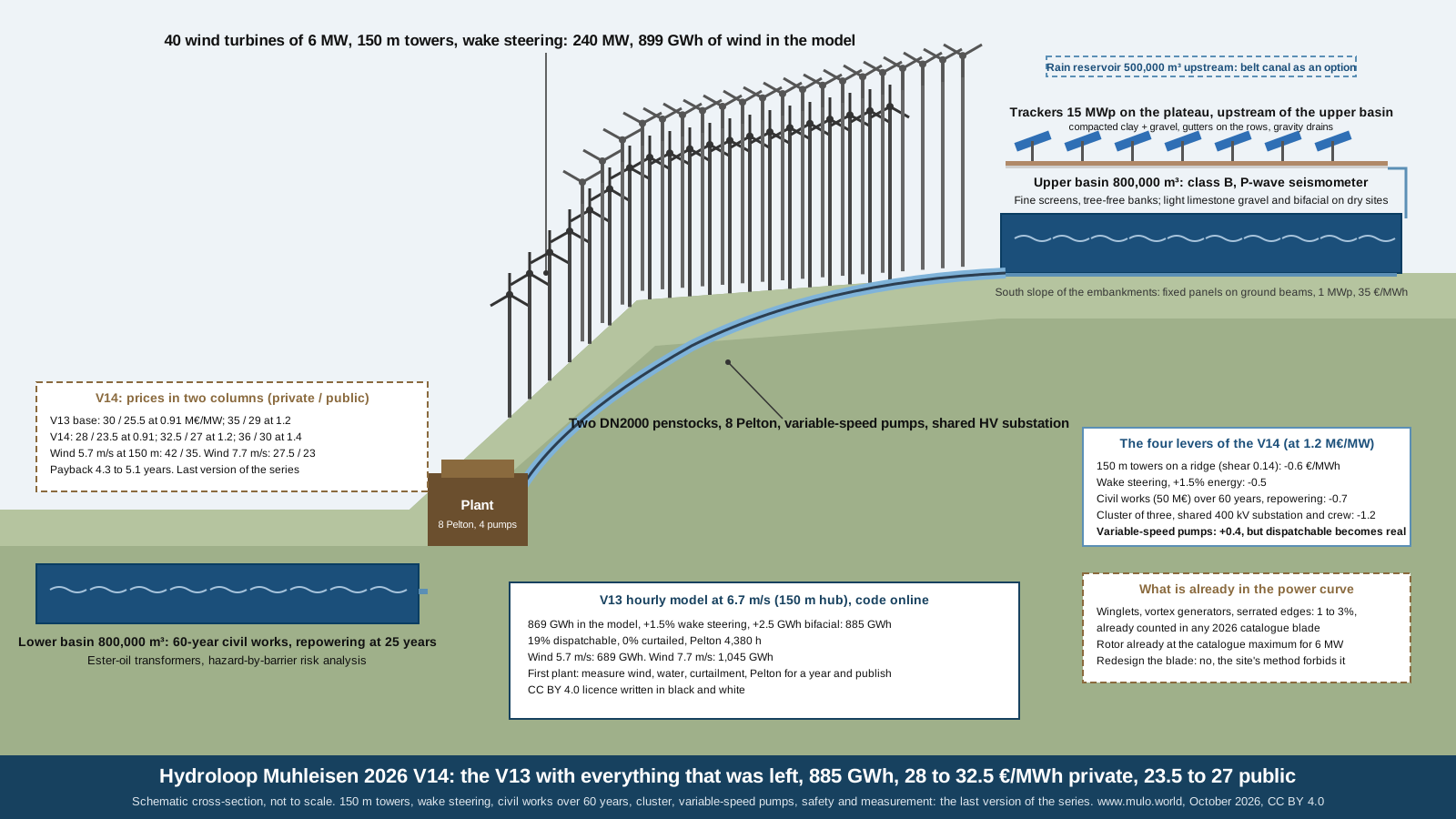
Version 14 of the 2026 redesign of the Hydroloop. It starts from version 13 (in French) and adds the last levers that hold, found by rereading the 435 ideas on the Good ideas page (in French): 150 m towers, wake steering, depreciation of the civil works over 60 years, three plants in a cluster on a shared substation. None of them is an invention; they are all catalogue, software or accounting choices, and that is why they hold. It also corrects a hidden assumption of the model, the variable-speed pumps, and adds what makes a 240 MW plant safe and measurable: seismometer, screens, ester oil, two penstocks, risk analysis, first year of measurement. Result: 885 GWh, 19% dispatchable, 364 to 436 M€ depending on the price of wind power, 28 to 32.5 €/MWh private and 23.5 to 27 public. It also explains why the blades are not redesigned, and why, after it, only two things remain that we do not control: the wind on the site and the price of wind turbines.
Added 19/10/26: the V14 Soleil keeps all the hydraulics of this version and replaces the 40 wind turbines with 500 MWp of trackers for sunny countries, 998 GWh at 30 €/MWh, with a mixed variant of 30 wind turbines and 200 MWp.
Added 29/10/26: the V14 MAX brings together two, four or six V14 on the same ridge on a single hydraulic site, up to 240 wind turbines and 26.4 €/MWh in MAX 3.
------------------------------
THE PRINCIPLE: WHAT REMAINS ONCE THE SIZE IS DONE
------------------------------
Version 13 had taken the size gain and shown that beyond a factor of four it runs out, because wind power weighs 68% of the price and the floor is its own kWh. What remains, then, is everything that makes the same machine produce more, everything that better depreciates what lasts, and everything that can be shared. Version 14 was built by rereading the whole good ideas page with this question in mind. Four price levers came out of it, one correction of the model, and eight points of safety and method.
------------------------------
1. THE FOUR PRICE LEVERS, COSTED ONE BY ONE
------------------------------
At the wind price of the previous versions, 0.91 M€/MW, the same sequence goes from 30.2 to 27.9 €/MWh private and from 25.5 to 23.4 public. The gap from V13 to V14 is 2.5 €/MWh in both columns.
------------------------------
2. THE CORRECTION: VARIABLE-SPEED PUMPS
------------------------------
The hourly model absorbs the wind surplus continuously, from 0 to 64 MW, hour by hour. Fixed-speed pumps cannot do that: a 16 MW pump runs at 16 MW or not at all, and a 10 MW surplus would be curtailed. Modern pumped-storage plants use variable-speed units, with frequency converters, precisely to pump as the wind blows. It costs 10 to 15% more on the pumps and converters, 6 M€ on version 13, and it requires hybrid bearings with ceramic balls, as the list says for any machine on a variable-speed drive, against the stray currents that pit the raceways. +0.4 €/MWh, and the 19% dispatchable becomes true instead of being an assumption in the code. All versions since V8 should have stated it.
------------------------------
3. WHY THE BLADES ARE NOT REDESIGNED
------------------------------
The question comes up naturally: curved tips like aircraft wings, serrated edges, whale bumps. Curved tips are called winglets and have equipped Enercon blades for twenty years; with vortex generators, serrated trailing edges and Gurney flaps, they are worth 1 to 3% of energy. But these gains are already in the catalogue power curve used by the model: a 2026 blade has them all. The rotor is already at the catalogue maximum for 6 MW (175 to 180 m, class III). Redesigning a blade ourselves is what the site's method forbids: test every idea against the commercial machine before announcing it. Whale tubercles, examined on the good ideas page, help after stall, not on a pitch-regulated blade. Where we still gain is around the machine: its height, its wake, its lifetime.
------------------------------
4. SAFETY AND METHOD: THE EIGHT POINTS
------------------------------
* P-wave seismometer on the head valve: P waves arrive a few seconds before the destructive S waves; the signal closes the head valve and stops the pumps before the shaking, as on Japanese pumped-storage plants. 50 k€, for an upper basin that holds 650 MWh of potential energy.
* Fine screens in front of the Pelton injectors and tree-free banks: since version 11, the basins are open water in temperate climates, so algae and leaves; the list said so for the trompe Hydroloop, it had to be carried over.
* Bifacial modules on the trackers: at the same price, 8 to 12% more on light limestone gravel (albedo 0.35 to 0.45), 15 to 18% on white gravel, 2 to 3 GWh a year on this field. Local light gravel, 0 to 5 € more per tonne, is the right compromise on dry sites with a catchment; pure white (30 to 60 € per tonne) is only justified with a nearby quarry; in temperate climates, we keep the meadow and the sheep, as light gravel gets overgrown and trampled. Light gravel also keeps the clay cooler, so less cracked.
* Biodegradable ester oil in the HV transformers and bearings next to the basins: less containment to build, no mineral oil fire, no pollution of the basin in case of a leak.
* Two DN2000 penstocks instead of one DN2800: +3 M€, a failure costs 24 MW of peak and not 48, and the spare parts stock keeps its meaning for the rest. Version 13 said "becomes debatable again"; version 14 decides.
* Risk analysis, one hazard, one barrier: dam failure (hazard study, piezometers, settling, bottom outlet), water hammer (surge vessel, staggered pump tripping), earthquake (P waves, head valve), transformer fire (ester, fire walls), drought (V12 catchment, reservoir), frost (intake under the ice, bubbler), lightning on 40 machines (surge arresters per machine, optical fibre rather than copper for measurements), blade fall (distance to tracks and to the plant). This is the first Hydroloop page to have one; the idea comes from the Vortex.
* First year of measurement: the first plant publishes, machine by machine and month by month, the hub wind, the water balance, curtailment, Pelton hours and round-trip efficiency, to recalibrate the hourly model of all versions. Measure before claiming, the rule of the ASD and the dome, applied to 400 M€.
* Licence: the pages said "royalty free", which has no precise legal meaning. Version 14 writes it down: plans, diagrams, texts and code under the Creative Commons Attribution 4.0 licence (CC BY 4.0), the only condition being to credit the author. The idea comes from the Vortex.
------------------------------
5. THE FIGURES IN A SERIES OF 10 PLANTS
------------------------------
Private LCOE at 4% over 30 years for the machines and 60 years for the civil works, public at 3% over 35 and 60 years. Reference revenue at the low price: 885 GWh at 90 €/MWh, 79.7 M€; dispatchable premium 3.4; capacity payment 5.6; frequency reserve 0.5; OPEX 4.3; net 84.9 M€.
------------------------------
6. WHY THIS IS THE LAST VERSION OF THE SERIES
------------------------------
After version 14, the levers that remain are not ours. The price of wind power, which makes up 70% of the price, is set by the market: between 0.91 and 1.4 M€/MW, the kWh goes from 28 to 36. The wind on the site, which only the version 10 lidar campaign measures: between 5.7 and 7.7 m/s at the hub, the kWh goes from 42 to 27.5. Everything else has been taken: size (V13), height, wake, depreciation, sharing (V14), water (V9, V12), verification (V10), cost (V11). A version 15 announcing less would either have to invent a wind turbine, which the site forbids itself, or change the calculation method, which version 10 made impossible. Update of 17/10/26: version 15 Canyon does not contradict the above; it opens another series, that of pure high-head storage, which does not produce its own electricity but stores that of others. The production series therefore ends here, and what it leaves is a plant that anyone can calculate, with its two price columns, its three winds, its costed options and its named hazards. What is missing is no longer a version: it is a site, a quote and an engineering firm.
Update of 17/10/26: version 16 Pacha 2 does not reopen the series either; it adds to the V14 what the mountain gives, a rain lake and a belt canal, and with 30 to 45 km of belt canal, the kWh goes from 28 to 24 and 23.6 €/MWh.
------------------------------
7. POINTS TO WATCH
------------------------------
* The shear of 0.14 is that of an open ridge; in a forest or on a plateau, it is 0.2 to 0.25 and the 150 m towers gain more; at the edge of a cliff, it can be zero. The lidar measures the profile, not just the speed.
* Wake steering gives 1 to 3% depending on the layout of the wind farm and the wind rose; 1.5% is a median value from the literature, not a promise.
* Depreciation over 60 years assumes an owner who thinks in decades; a private investor may refuse and count everything over 30 years, which adds back 0.7 €/MWh.
* The cluster assumes three compatible sites within 30 km and a 400 kV substation: it is one more site condition, and it further reduces the number of sites.
* Variable-speed pumps are the technology of new pumped-storage plants; at this power, the converters are standard equipment, but their own losses (2 to 3%) must be taken off the round-trip efficiency, which the model does not do yet.
* Bifacial on light gravel loses a third of its gain if the gravel is not maintained (dust, vegetation).
* The series figures only apply from the tenth identical plant onwards.
------------------------------
UPDATE OF 17/10/26: PELTON OR FRANCIS AT 48 MW
------------------------------
The V14 already has variable-speed pumps and their converters; variable-speed reversible Francis units of 4 × 16 MW, on the Goldisthal model (302 m, 1,060 MW), would replace them together with the eight Pelton turbines with four machines: about 12 to 15 M€ less out of 364, i.e. 28 → 27.1 €/MWh, then +0.5 for the lost primary reserve and part load: 27.6 against 28, a draw. The variable-speed reversible Francis is the world standard at this head and becomes the series machine of the V14 on clean water; the Pelton stays in the catalogue for sites with sediment, and it remains mandatory on the V15 and recommended on the V16 Pacha 2. Over the 5,000 V14 of the plan, 65 billion euros less to build, for the same kWh within 0.5 €. The general rule, written on 17/10/26 after rereading all the versions: the Pelton was never a price choice but a flexibility choice (variable-speed pumping while generating, deflectors reacting in less than a second, flat efficiency at part load, robustness to sediment), made when the pumps were not yet variable speed. Since then, variable-speed reversible Francis units (Goldisthal 302 m, Kazunogawa, Tehri) adjust their pumping power just as finely. Version-by-version result: at 160 m, the Pelton is out of place and the reversible Francis or the pump-as-turbine wins 2 to 4 €/MWh; at 300 m, the two machines are level within 0.5 €/MWh, and the choice depends on what the grid pays (primary reserve) and on the water (sediment, torrent, rain); at 1,500 m, Pelton without discussion. The Pelton stays on torrents (V5, V6), the Pacha and the V15.
------------------------------
CONCLUSION
------------------------------
Version 14 contains no invention, and that is its strength: taller towers, wake software, a way of accounting for the civil works, a shared substation, pumps that all new pumped-storage plants have, and eight points of safety and method that the list of good ideas already contained. 885 GWh, 19% dispatchable, 28 to 32.5 €/MWh private and 23.5 to 27 public, on an hourly basis that anyone can redo. It closes the series by saying where the floor is and why: the wind and the price of wind turbines, which are not ours. Plans, diagrams, texts and code under the CC BY 4.0 licence.
------------------------------
SOURCES
------------------------------
Hydroloop Muhleisen 2026 V13, the starting version (in French)
The parameterised hourly model (unchanged in version 14, run at 6.7 m/s)
Hydroloop Muhleisen 2026 V10, the lidar campaign (in French)
The site's good ideas, reread in full for this version (in French)
Wikipedia: wind shear, variation of wind with height
Wikipedia: wind farm
Wikipedia: pumped-storage hydroelectricity, variable-speed units
Wikipedia: earthquake early warning in Japan, P and S waves
Creative Commons Attribution 4.0 licence
Olivier Muhleisen in collaboration with Claude (Anthropic), October 2026. Plans, diagrams, texts and code under the CC BY 4.0 licence: free to use, copy and modify, provided the author is credited.
© 2009-2026 Onmyweb Production - TOS - Cookies information - Contact us - Free Copyright Open Source -
THE PRINCIPLE: WHAT REMAINS ONCE THE SIZE IS DONE
------------------------------
Version 13 had taken the size gain and shown that beyond a factor of four it runs out, because wind power weighs 68% of the price and the floor is its own kWh. What remains, then, is everything that makes the same machine produce more, everything that better depreciates what lasts, and everything that can be shared. Version 14 was built by rereading the whole good ideas page with this question in mind. Four price levers came out of it, one correction of the model, and eight points of safety and method.
| Item | Version 13 | Version 14 |
|---|---|---|
| Wind turbines | 40 x 6 MW, 120 m hub | 40 x 6 MW, 150 m hub, wake steering |
| Wind at the hub (site at 6.5 m/s at 120 m) | 6.5 m/s | 6.7 m/s (shear 0.14 on a ridge) |
| Pumps | 4 x 16 MW fixed speed (the model assumed continuous operation) | 4 x 16 MW variable speed, frequency converters |
| Penstock | one DN2800 | two DN2000, a failure costs 24 MW and not 48 |
| Grid connection | own 225 kV HV substation, 30 M€ | 400 kV substation shared by three plants in a cluster, 22 M€ per plant |
| Photovoltaics | 15 MWp trackers, 1 MWp on slopes | same, bifacial modules; light limestone gravel on dry sites |
| Depreciation | everything over 30 years (private) or 35 (public) | civil works (50 M€) over 60 years, wind turbines replaced at 25 years on the same structures |
| Safety | V10 instrumentation, surge vessel | plus P-wave seismometer, fine screens and tree-free banks, ester oil, risk analysis |
| Electricity sold in the model | 833 GWh | 885 GWh |
| Dispatchable share | 20% | 19% |
| Investment in series | 352 M€ at 0.91 M€/MW; 421 at 1.2 | 364 M€ at 0.91; 436 at 1.2 |
| Private / public LCOE | 30 / 25.5 at 0.91; 35 / 29 at 1.2 | 28 / 23.5 at 0.91; 32.5 / 27 at 1.2 |
| Payback time | 4.4 / 5.3 years | 4.3 / 5.1 years |
------------------------------
1. THE FOUR PRICE LEVERS, COSTED ONE BY ONE
------------------------------
| Lever | What it is | Effect | Cumulative private LCOE at 1.2 M€/MW |
|---|---|---|---|
| Version 13 base | 35.1 | ||
| 150 m towers | On a ridge, wind shear is low (exponent 0.14): 30 more metres give 6.7 m/s instead of 6.5. The model finds 869 GWh instead of 833. Extra cost 5% on the wind turbines, 14 M€. | +36 GWh, -0.6 €/MWh | 34.5 |
| Wake steering | The upwind machines turn a few degrees off axis to deflect their wake away from the downwind machines. Software, standard with the manufacturers, measured on real wind farms. | +1.5% energy, -0.5 | 34.0 |
| Civil works over 60 years | Basins, penstocks, reservoir and buildings (50 M€) last twice as long as the wind turbines. They are depreciated over 60 years; the wind turbines are replaced at 25 years on the same structures (repowering), and the second wind farm costs less than the first. | -0.7 | 33.3 |
| Cluster of three | Three plants 20 or 30 km apart share a 400 kV substation (22 M€ each instead of 30), a crew, a workshop and a spare parts stock (OPEX 4.3 M€ instead of 4.9). | -1.2 | 32.1 |
| Variable-speed pumps | See below. +6 M€. | +0.4 | 32.5 |
| Bifacial on light gravel | +2.5 GWh | -0.1 | 32.5 (rounded) |
At the wind price of the previous versions, 0.91 M€/MW, the same sequence goes from 30.2 to 27.9 €/MWh private and from 25.5 to 23.4 public. The gap from V13 to V14 is 2.5 €/MWh in both columns.
------------------------------
2. THE CORRECTION: VARIABLE-SPEED PUMPS
------------------------------
The hourly model absorbs the wind surplus continuously, from 0 to 64 MW, hour by hour. Fixed-speed pumps cannot do that: a 16 MW pump runs at 16 MW or not at all, and a 10 MW surplus would be curtailed. Modern pumped-storage plants use variable-speed units, with frequency converters, precisely to pump as the wind blows. It costs 10 to 15% more on the pumps and converters, 6 M€ on version 13, and it requires hybrid bearings with ceramic balls, as the list says for any machine on a variable-speed drive, against the stray currents that pit the raceways. +0.4 €/MWh, and the 19% dispatchable becomes true instead of being an assumption in the code. All versions since V8 should have stated it.
------------------------------
3. WHY THE BLADES ARE NOT REDESIGNED
------------------------------
The question comes up naturally: curved tips like aircraft wings, serrated edges, whale bumps. Curved tips are called winglets and have equipped Enercon blades for twenty years; with vortex generators, serrated trailing edges and Gurney flaps, they are worth 1 to 3% of energy. But these gains are already in the catalogue power curve used by the model: a 2026 blade has them all. The rotor is already at the catalogue maximum for 6 MW (175 to 180 m, class III). Redesigning a blade ourselves is what the site's method forbids: test every idea against the commercial machine before announcing it. Whale tubercles, examined on the good ideas page, help after stall, not on a pitch-regulated blade. Where we still gain is around the machine: its height, its wake, its lifetime.
------------------------------
4. SAFETY AND METHOD: THE EIGHT POINTS
------------------------------
* P-wave seismometer on the head valve: P waves arrive a few seconds before the destructive S waves; the signal closes the head valve and stops the pumps before the shaking, as on Japanese pumped-storage plants. 50 k€, for an upper basin that holds 650 MWh of potential energy.
* Fine screens in front of the Pelton injectors and tree-free banks: since version 11, the basins are open water in temperate climates, so algae and leaves; the list said so for the trompe Hydroloop, it had to be carried over.
* Bifacial modules on the trackers: at the same price, 8 to 12% more on light limestone gravel (albedo 0.35 to 0.45), 15 to 18% on white gravel, 2 to 3 GWh a year on this field. Local light gravel, 0 to 5 € more per tonne, is the right compromise on dry sites with a catchment; pure white (30 to 60 € per tonne) is only justified with a nearby quarry; in temperate climates, we keep the meadow and the sheep, as light gravel gets overgrown and trampled. Light gravel also keeps the clay cooler, so less cracked.
* Biodegradable ester oil in the HV transformers and bearings next to the basins: less containment to build, no mineral oil fire, no pollution of the basin in case of a leak.
* Two DN2000 penstocks instead of one DN2800: +3 M€, a failure costs 24 MW of peak and not 48, and the spare parts stock keeps its meaning for the rest. Version 13 said "becomes debatable again"; version 14 decides.
* Risk analysis, one hazard, one barrier: dam failure (hazard study, piezometers, settling, bottom outlet), water hammer (surge vessel, staggered pump tripping), earthquake (P waves, head valve), transformer fire (ester, fire walls), drought (V12 catchment, reservoir), frost (intake under the ice, bubbler), lightning on 40 machines (surge arresters per machine, optical fibre rather than copper for measurements), blade fall (distance to tracks and to the plant). This is the first Hydroloop page to have one; the idea comes from the Vortex.
* First year of measurement: the first plant publishes, machine by machine and month by month, the hub wind, the water balance, curtailment, Pelton hours and round-trip efficiency, to recalibrate the hourly model of all versions. Measure before claiming, the rule of the ASD and the dome, applied to 400 M€.
* Licence: the pages said "royalty free", which has no precise legal meaning. Version 14 writes it down: plans, diagrams, texts and code under the Creative Commons Attribution 4.0 licence (CC BY 4.0), the only condition being to credit the author. The idea comes from the Vortex.
------------------------------
5. THE FIGURES IN A SERIES OF 10 PLANTS
------------------------------
| Item | V13 base (M€) | V14 (M€) | What changes |
|---|---|---|---|
| Wind 240 MW | 219 at 0.91; 288 at 1.2 | 229 at 0.91; 302 at 1.2 | 150 m towers: +5% |
| Bifacial photovoltaics, trackers and slopes | 9.05 | 9.05 | bifacial at the same price |
| Basins, drainage, embankments | 19.1 | 19.1 | nothing |
| Pelton, pumps, plant, trompe | 61.8 | 67.8 | variable speed: +6 |
| Penstocks | 10.3 | 13.3 | two DN2000: +3 |
| Rain reservoir | 2.0 | 2.0 | nothing |
| Grid connection | 30 | 22 | 400 kV substation shared by three |
| Lidar, stock, instrumentation, seismometer, soiling | 0.35 | 0.5 | +0.15 |
| Total | 352 at 0.91; 421 at 1.2 | 364 at 0.91; 436 at 1.2 | |
| OPEX per year | 4.9 | 4.3 | shared crew and stock |
| Wind at the 150 m hub | Sold | Dispatchable | Private / public LCOE at 0.91 | Private / public LCOE at 1.2 | Payback at 1.2 |
|---|---|---|---|---|---|
| 5.7 m/s (weak site) | 689 GWh | 24% | 36 / 30 | 42 / 35 | 6.5 years |
| 6.7 m/s (reference) | 885 GWh | 19% | 28 / 23.5 | 32.5 / 27 | 5.1 years |
| 7.7 m/s (strong site) | 1,045 GWh | 17% | 23.5 / 20 | 27.5 / 23 | 4.4 years |
Private LCOE at 4% over 30 years for the machines and 60 years for the civil works, public at 3% over 35 and 60 years. Reference revenue at the low price: 885 GWh at 90 €/MWh, 79.7 M€; dispatchable premium 3.4; capacity payment 5.6; frequency reserve 0.5; OPEX 4.3; net 84.9 M€.
| Indicator (series of 10) | V8 | V11 | V13 | V14 |
|---|---|---|---|---|
| Electricity sold | 210 GWh | 226 GWh | 833 GWh | 885 GWh |
| Dispatchable share | 24% | 20% | 20% | 19% |
| Investment (wind at 0.91 / 1.2 M€/MW) | 106 | 109 / 126 | 352 / 421 | 364 / 436 |
| Private LCOE (0.91 / 1.2) | 37 | 35 / 39.4 | 30 / 35 | 28 / 32.5 |
| Public LCOE (0.91 / 1.2) | 31 | 29.5 / 33 | 25.5 / 29 | 23.5 / 27 |
| Basis of the figure | equivalent hours | hourly model | hourly model | hourly model, variable-speed pumps, civil works over 60 years |
------------------------------
6. WHY THIS IS THE LAST VERSION OF THE SERIES
------------------------------
After version 14, the levers that remain are not ours. The price of wind power, which makes up 70% of the price, is set by the market: between 0.91 and 1.4 M€/MW, the kWh goes from 28 to 36. The wind on the site, which only the version 10 lidar campaign measures: between 5.7 and 7.7 m/s at the hub, the kWh goes from 42 to 27.5. Everything else has been taken: size (V13), height, wake, depreciation, sharing (V14), water (V9, V12), verification (V10), cost (V11). A version 15 announcing less would either have to invent a wind turbine, which the site forbids itself, or change the calculation method, which version 10 made impossible. Update of 17/10/26: version 15 Canyon does not contradict the above; it opens another series, that of pure high-head storage, which does not produce its own electricity but stores that of others. The production series therefore ends here, and what it leaves is a plant that anyone can calculate, with its two price columns, its three winds, its costed options and its named hazards. What is missing is no longer a version: it is a site, a quote and an engineering firm.
Update of 17/10/26: version 16 Pacha 2 does not reopen the series either; it adds to the V14 what the mountain gives, a rain lake and a belt canal, and with 30 to 45 km of belt canal, the kWh goes from 28 to 24 and 23.6 €/MWh.
------------------------------
7. POINTS TO WATCH
------------------------------
* The shear of 0.14 is that of an open ridge; in a forest or on a plateau, it is 0.2 to 0.25 and the 150 m towers gain more; at the edge of a cliff, it can be zero. The lidar measures the profile, not just the speed.
* Wake steering gives 1 to 3% depending on the layout of the wind farm and the wind rose; 1.5% is a median value from the literature, not a promise.
* Depreciation over 60 years assumes an owner who thinks in decades; a private investor may refuse and count everything over 30 years, which adds back 0.7 €/MWh.
* The cluster assumes three compatible sites within 30 km and a 400 kV substation: it is one more site condition, and it further reduces the number of sites.
* Variable-speed pumps are the technology of new pumped-storage plants; at this power, the converters are standard equipment, but their own losses (2 to 3%) must be taken off the round-trip efficiency, which the model does not do yet.
* Bifacial on light gravel loses a third of its gain if the gravel is not maintained (dust, vegetation).
* The series figures only apply from the tenth identical plant onwards.
------------------------------
UPDATE OF 17/10/26: PELTON OR FRANCIS AT 48 MW
------------------------------
The V14 already has variable-speed pumps and their converters; variable-speed reversible Francis units of 4 × 16 MW, on the Goldisthal model (302 m, 1,060 MW), would replace them together with the eight Pelton turbines with four machines: about 12 to 15 M€ less out of 364, i.e. 28 → 27.1 €/MWh, then +0.5 for the lost primary reserve and part load: 27.6 against 28, a draw. The variable-speed reversible Francis is the world standard at this head and becomes the series machine of the V14 on clean water; the Pelton stays in the catalogue for sites with sediment, and it remains mandatory on the V15 and recommended on the V16 Pacha 2. Over the 5,000 V14 of the plan, 65 billion euros less to build, for the same kWh within 0.5 €. The general rule, written on 17/10/26 after rereading all the versions: the Pelton was never a price choice but a flexibility choice (variable-speed pumping while generating, deflectors reacting in less than a second, flat efficiency at part load, robustness to sediment), made when the pumps were not yet variable speed. Since then, variable-speed reversible Francis units (Goldisthal 302 m, Kazunogawa, Tehri) adjust their pumping power just as finely. Version-by-version result: at 160 m, the Pelton is out of place and the reversible Francis or the pump-as-turbine wins 2 to 4 €/MWh; at 300 m, the two machines are level within 0.5 €/MWh, and the choice depends on what the grid pays (primary reserve) and on the water (sediment, torrent, rain); at 1,500 m, Pelton without discussion. The Pelton stays on torrents (V5, V6), the Pacha and the V15.
------------------------------
CONCLUSION
------------------------------
Version 14 contains no invention, and that is its strength: taller towers, wake software, a way of accounting for the civil works, a shared substation, pumps that all new pumped-storage plants have, and eight points of safety and method that the list of good ideas already contained. 885 GWh, 19% dispatchable, 28 to 32.5 €/MWh private and 23.5 to 27 public, on an hourly basis that anyone can redo. It closes the series by saying where the floor is and why: the wind and the price of wind turbines, which are not ours. Plans, diagrams, texts and code under the CC BY 4.0 licence.
------------------------------
SOURCES
------------------------------
Hydroloop Muhleisen 2026 V13, the starting version (in French)
The parameterised hourly model (unchanged in version 14, run at 6.7 m/s)
Hydroloop Muhleisen 2026 V10, the lidar campaign (in French)
The site's good ideas, reread in full for this version (in French)
Wikipedia: wind shear, variation of wind with height
Wikipedia: wind farm
Wikipedia: pumped-storage hydroelectricity, variable-speed units
Wikipedia: earthquake early warning in Japan, P and S waves
Creative Commons Attribution 4.0 licence
Olivier Muhleisen in collaboration with Claude (Anthropic), October 2026. Plans, diagrams, texts and code under the CC BY 4.0 licence: free to use, copy and modify, provided the author is credited.
© 2009-2026 Onmyweb Production - TOS - Cookies information - Contact us - Free Copyright Open Source -