
Artesia 4 world plan: a single list of measured sites, ridges, plateaus and dams, ranked by cost per GWh. 3,387 ridge Hydroloop V14, 10,177 V14 Soleil and 1,560 existing dams, with 2,426 Pacha lakes and 1,140 Gold: 95% of the planet's fossil electricity in 25 years for 8,685 billion euros, 212 less than Artesia 3, 8,418 with the Francis turbine, and 16,533 new plant sites instead of 17,661. 27/10/26
The Artesia 3 plan had counted the plateaus of the sun belt, but it kept two assumed lines: the 5,000 ridge V14 of plan A and the wind of the 4,880 mixed plants. The wind scan measured them: 4,295 cautious ridge sites near a large city, windier than the reference site, and only 290 mixed plants that have their wind on the edge of their plateau. And the page on existing reservoirs counted the sunny peaking dams where a V21 Barrage can be installed without a new lake. This plan puts these three lists into one: 26,528 measured sites, ranked by M€ per annual GWh, and takes the cheapest in order until the TWh required. Result: 3,387 ridge V14 at 0.36 M€ per GWh, the cheapest plants of the plan, 10,177 V14 Soleil on the best plateaus, 69 mixed plants where the edge has its wind, 1,560 existing dams equipped as V21, and 2,426 Pacha lakes and 1,140 Gold where it rains more than 1,500 mm, ridges included. The same 17,360 TWh, 95% of fossil fuels, for 8,685 billion euros without betting on the turbine (scenario B), 8,418 with the Francis (scenario A), 212 billion less than Artesia 3, and 16,533 new plant sites instead of 17,661. In exchange, the plan becomes more solar: 1,526 GW of large wind turbines instead of 2,779, 6,010 GWp of photovoltaics instead of 4,230, and more noon power to sell. Scenario B is the site's reference.
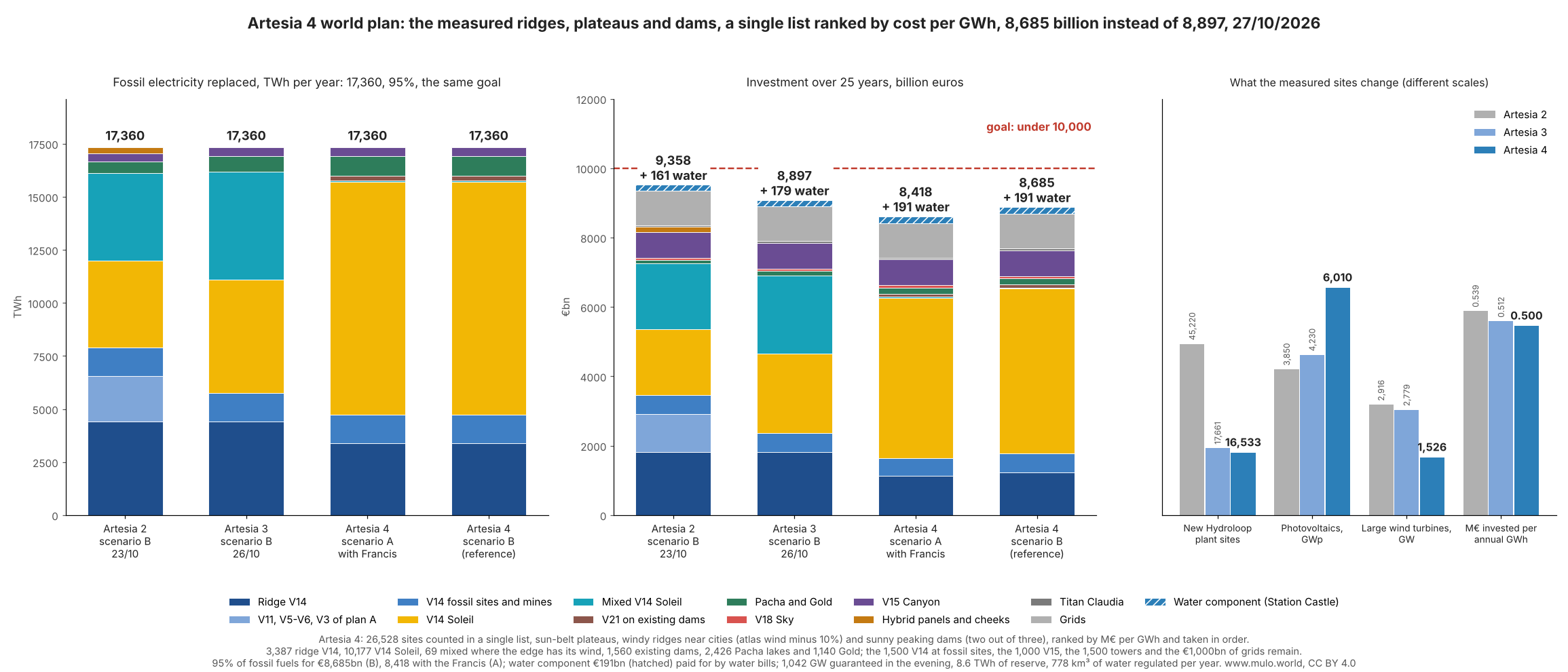
Chart code (Python, free): schema_plan_mondial_artesia_4.py; the calculation of the plan: calcul_plan_mondial_artesia_4.py (reads plateaux_ceinture_soleil.csv, plateaux_rebord_vent.csv, cretes_vent_v14.csv and v21_retenues_1mw.csv; optional arguments: caution on wind, 0.9 by default, and 0 to remove the dams); the wind on the edge of each plateau: vent_rebord_plateaux.py; the list of the 15,193 plants it places, one per line: plan_mondial_artesia_4_sites.csv, and by country: plan_mondial_artesia_4_pays.csv
Chart code (Python, free): schema_plan_mondial_artesia_4.py; the calculation of the plan: calcul_plan_mondial_artesia_4.py (reads plateaux_ceinture_soleil.csv, plateaux_rebord_vent.csv, cretes_vent_v14.csv and v21_retenues_1mw.csv; optional arguments: caution on wind, 0.9 by default, and 0 to remove the dams); the wind on the edge of each plateau: vent_rebord_plateaux.py; the list of the 15,193 plants it places, one per line: plan_mondial_artesia_4_sites.csv, and by country: plan_mondial_artesia_4_pays.csv
------------------------------
1. THE RULE: A SINGLE LIST, THREE KINDS OF SITES
------------------------------
* The plateaus: the 20,298 cautious sites of Artesia 3 (class A and B plateaus, free or shared, less than 150 km from a city of 100,000 inhabitants), each with its tracker hours, its rain and, new, the wind measured on the edge of its plateau. Each site receives the cheapest plant per GWh: a V14 Soleil (465 M€, 871 to 1,167 GWh depending on the sun, 15 M€ more for make-up water below 75 mm of rain), or a mixed plant (461 M€, 940 to 1,096 GWh) if the edge still has 12 km at 6 m/s for it and 200 mm of rain. The rule of Artesia 2 and 3, "one plant in two is a mixed plant", is removed: it assumed a wind that the scan did not find.
* The ridges: the 4,295 cautious sites of the wind scan, ridges of 12 km or more overlooking a 300 m slope, at 6.5 m/s or more, free or shared, less than 150 km from a large city. A ridge V14 costs 364 M€, as in all the previous plans; what it sells comes from the V14 hourly model at the wind of its ridge, calibrated on the 885 GWh of the reference site at 6.7 m/s, with the atlas wind reduced by 10%, because the Global Wind Atlas often overestimates mountain ridges. Mean cautious wind of the ridges taken: 7.9 m/s, 1,044 GWh.
* The dams: the 1,935 sunny peaking dams of the WRI world database (1,800 tracker hours or more, capacity factor of 45% at most), with the trackers, the downstream pumping station and the cost of the V21 calibrated on Hoover. As on the reservoirs page, only two out of three are counted, those with a downstream reservoir: each dam taken counts for two thirds of its output and its cost.
* The lakes: wherever 1,500 mm of rain or more falls, on a plateau or a ridge, the plant receives a Pacha 2 lake (31.1 M€, 155.6 GWh) and a Gold on 47% of them (6.4 M€, 56 GWh), included in its merit. The ridges of the west coast of New Zealand, southern Chile, Japan and the Cascades receive 808.
* The order: the 26,528 sites are ranked by M€ per GWh and taken up to the 15,100 TWh that the ridge V14 and the plateau fleet made in Artesia 3. The last one taken is at 0.448 M€ per GWh. The 1,500 V14 on fossil sites, the 1,000 V15, the 1,500 towers, the existing Pacha and Gold and the 1,000 billion of grids remain as in Artesia 3.
------------------------------
2. WHAT CHANGES COMPARED WITH ARTESIA 3
------------------------------
------------------------------
3. THE FLEET, AS THE LIST GIVES IT
------------------------------
The first thirty countries, by TWh; 131 countries in all, the file by country gives the others. The page electricity country by country compares these TWh with the fossil electricity and the price of each country, and the page Artesia 4, grids recalculated (in French) replaces the 1,000 billion lump sum for grids with a plant-by-plant calculation.
What the list says: the ridges bring plants back to temperate countries. The United States goes from 355 plants to 474 ridge V14, 356 V14 Soleil and 371 dams; Russia (Kamchatka, Sayan, Baikal, Primorye), New Zealand, Japan, Canada, Spain, northern China, Turkey, Austria, Greece and France receive ridge V14 that Artesia 3 did not give them on named sites; Chile and Argentina have both, Patagonia and the Atacama. The dams give Brazil, India, China, Spain and Portugal a share of the plan without a new lake. Mexico, Peru, Iran, Yemen and Arabia keep their plateaus. India receives 101 V14 Soleil, 25 mixed plants and 123 dams, China 176 ridges, 30 plateaus and 96 dams: the large coal countries now each have their share, without a political variant.
------------------------------
4. THE TWO SCENARIOS: 17,360 TWh, 95% OF FOSSIL ELECTRICITY
------------------------------
Why this mix:
* The total does not move, 17,360 TWh: a redone plan never shows a lower objective than the previous one. The 15,100 TWh of the ridge V14 and of the Artesia 3 plateau fleet are redone TWh for TWh by the single list.
* The ridges come first because they are the cheapest per GWh, not by choice: 3,387 of the 4,295 cautious ridges are below 0.448 M€ per GWh, even with the atlas wind reduced by 10%. The other 908, the least windy, stay behind with 9,705 plateau sites, 375 dams and 347 possible mixed plants, the plan's margin, from 0.448 to 0.47 M€ per GWh for the next 2,500.
* The dams save only 11 billion, because they are barely cheaper than the last plateau, but they remove 209 new plants and give plants to Brazil, India, Spain and Portugal without one more hectare.
* The Francis still separates the two scenarios: 268 billion, less than Artesia 3 because there are 15,133 V14 instead of 16,261. Without confirmation from a manufacturer, scenario A costs 8,685 billion like B.
* The 1,000 billion of grids do not move: the ridges of temperate countries are near their cities and bring production closer to demand, which lightens the export lines from Mexico, Peru and Chile that Artesia 3 required.
------------------------------
5. WHAT THE LIST GAINS, AND WHAT IT GIVES IN EXCHANGE
------------------------------
* It gains 212 billion euros (479 with the Francis) for the same electricity; the margin below 10,000 goes from 1,103 to 1,315 billion, 13% of the total.
* It keeps only counted lines: each ridge V14, each plateau and each dam of the plan is a line of the file, with its position, its city, its wind or sun and its rain. What remains assumed is the 1,500 V14 on fossil sites, the 1,000 V15 and the towers.
* It removes 1,128 new sites: 16,533 plants instead of 17,661, and 1,560 dams that already have their operators, their lines and their water permits.
* It returns more water: 778 km³ regulated per year instead of 629, 5,126 Pacha lakes instead of 4,144, and 21 TWh of turbinable rain in seasonal reserve.
* It brings plants closer to the cities of the North: the ridges near Seattle, Anchorage, Petropavlovsk, Christchurch, Obihiro, Oviedo, Grenoble or Beijing replace mixed plants assumed deep in the sun belt; temperate countries import less.
* In exchange it gives up wind: 1,526 GW of large wind turbines instead of 2,779, 54 GW less evening power (1,042 instead of 1,096, not counting the dam turbines) and output concentrated in the daytime. The mixed plant wanted to combine night wind with daytime sun on the same site; the scan showed that sunny plateaus have almost no wind, and the plan takes note.
* It sells much more noon power: 10,177 V14 Soleil instead of 4,881, 6,010 GWp of photovoltaics instead of 4,230. Each V14 Soleil shifts a fifth of its output to the evening through its head, but two thirds remain between 9 am and 4 pm, often in countries that do not consume a quarter of it. Desalination, mines, electrolysis and export lines are the condition of the plan, even more than with Artesia 3.
------------------------------
6. THE TIMETABLE: THREE PHASES IN 25 YEARS
------------------------------
Phase 2 requires about 1,000 new plant construction sites a year and 150 dams equipped, and 105 GW of wind turbines a year instead of 190; the photovoltaics of the V14 Soleil, 5,090 GWp, is installed at about 230 GWp a year over 22 years, a third of today's world production. The plan grows the industry whose prices fall fastest, and asks half as much of the wind industry.
------------------------------
7. THE CAVEATS TO READ BEFORE QUOTING THIS PAGE
------------------------------
* The caveats of each page remain in full, those of Artesia 3, the wind scan, the existing reservoirs, the V14 Soleil and the plateau pages: plants that guarantee only a fifth of their output at a fixed hour, thirty-year average rainfall, 2026 series prices. This plan adds up potentials.
* The ridge wind is that of the Global Wind Atlas reduced by 10%. With the atlas wind as it is, the plan takes 3,986 ridges and costs 8,538 billion; with 20% less, 2,174 ridges and 8,824 billion. The scan's ridge criterion is the strictest of the three it tried; with a less strict criterion, there are twice as many ridges near cities. Each ridge also needs a flat area for its upper reservoir, which is not checked.
* The sites are counted at 1 km; protected areas are not in the list, and they will affect the ridges (parks of Alaska, Kamchatka, Patagonia, the Alps and New Zealand) more than the plateaus. The plan uses only half of the cautious plateaus and 79% of the cautious ridges; if one site taken in four fell, the next ones replace it for about 170 billion more.
* The dams are costed like on the reservoirs page, by the example of Hoover, and counted at two out of three; each dam depends on its operator, its water permit and the operating rule of its reservoir. Without them, the plan costs 8,696 billion.
* The sun is that of the Global Solar Atlas times 1.25 for trackers, read at the centre of the plateau; at 1.2 instead of 1.25, the plan rises by 131 billion, to 8,816.
* The make-up water of the 1,198 V14 Soleil without rain is costed at 15 M€ each, an average; in the Atacama and the deep Sahara, some will cost 30 to 50 M€, others will have no water at all.
* The price of machines: at the market price of wind power, 1.2 M€/MW, scenario B rises by about 440 billion, to 9,130, less than Artesia 3 because there are fewer wind turbines; at the price of trackers in sunny countries, 0.45 M€/MWp instead of 0.57, it falls by about 720 billion, to 7,960. The plan now depends more on the price of photovoltaics than on that of wind power.
* The value of the noon kWh is the caveat that grows the most: 10,177 V14 Soleil sell two thirds of their electricity between 9 am and 4 pm; without desalination, electrolysis, mines and export lines, part of these TWh find no buyer at 30 €/MWh.
* The Francis is counted only in scenario A, for 268 billion. Without confirmation from a manufacturer, scenario A costs 8,685 billion, like B: that is why B is the reference.
------------------------------
8. THE CHANCES OF SUCCESS, REREAD AFTER THIS PLAN
------------------------------
The chances are those of the index, reread on 27/10/2026 after this plan; what moves, and why:
* Technical, brick by brick: 90%, unchanged. The V21 only adds trackers, a pumping station and a tunnel to a dam that is already running.
* Costs to within plus or minus 25%: from 73 to 74%. The ridges and edges are measured, the plan no longer contains any assumed wind line, and the margin rises to 1,315 billion; but it depends more on the price of trackers and the value of noon. One point more.
* Partial deployment, 30 to 50% in 25 years: from 70 to 71%. 1,128 fewer new sites, 1,560 dams that already have an operator, and ridges near the cities of temperate countries, which have their own reasons to build.
* Complete plan, 95% in 25 years: 34 to 38%, unchanged. Fewer doors and fewer wind turbines to build, but 230 GWp of photovoltaics a year and a noon twice as large to sell; the two balance out.
* Slowing warming if the plan is carried out: 80%, unchanged; 1.5 °C: less than 10%, and 2 °C: 49%, unchanged.
------------------------------
9. CONCLUSION
------------------------------
The Artesia 4 world plan applies the rule of Artesia 3, the best-performing plants first, to a list where everything is measured: 26,528 plateau, ridge and dam sites, each with its sun, its wind or its dam, its rain and its city. 3,387 ridge V14, 10,177 V14 Soleil, 69 mixed plants, 1,560 existing dams, 2,426 Pacha lakes and 1,140 Gold make 15,100 TWh for 6,187 billion, 0.410 M€ per GWh. It still replaces 95% of the planet's fossil electricity in 25 years, for 8,685 billion euros without betting on the turbine (scenario B), 8,418 with the Francis (scenario A), 212 billion less than Artesia 3, with 16,533 new plant sites instead of 17,661, 778 km³ of regulated water per year, 1,042 GW guaranteed in the evening and 8.6 TWh of reserve. What it gives in exchange: the wind of the mixed plants, which was not there, and a more solar plan, which sells more noon power. What it requires: a year of measurement on 100 ridges, the agreement of the operators of 1,560 dams, the water of 1,198 deserts, the protected areas of all the lists, and customers for noon. The plans, diagrams, code, list of sites and figures are on this site, under the CC BY 4.0 licence, with their caveats.
------------------------------
SOURCES
------------------------------
The calculation of the plan (Python, reads the three lists), the 15,193 plants placed, one per line (CSV), by country, the chart, the wind on the edge of the plateaus and its file
The wind scan, the scan of the plateaus of the sun belt, the crossing with people and rain (in French), existing reservoirs
Artesia 3 world plan, the previous version of this plan, Artesia 2 (in French), world plan 10,000 billion objective: the ranking by cost per annual GWh (in French)
Hydroloop V14, V14 Soleil and mixed V14 Soleil, V21 Barrage, Pacha 2, Gold 2
Global Wind Atlas 3 (DTU and World Bank), Global Solar Atlas (World Bank), WRI: Global Power Plant Database, Global Human Settlement Layer, WorldClim 2.1, USGS GMTED2010
SIPRI: world military spending
The site's good ideas
Olivier Muhleisen in collaboration with Claude (Anthropic), October 2026. Plans, diagrams, texts and figures under the CC BY 4.0 licence.
© 2009-2026 Onmyweb Production - TOS - Cookies information - Contact us - Free Copyright Open Source -
1. THE RULE: A SINGLE LIST, THREE KINDS OF SITES
------------------------------
* The plateaus: the 20,298 cautious sites of Artesia 3 (class A and B plateaus, free or shared, less than 150 km from a city of 100,000 inhabitants), each with its tracker hours, its rain and, new, the wind measured on the edge of its plateau. Each site receives the cheapest plant per GWh: a V14 Soleil (465 M€, 871 to 1,167 GWh depending on the sun, 15 M€ more for make-up water below 75 mm of rain), or a mixed plant (461 M€, 940 to 1,096 GWh) if the edge still has 12 km at 6 m/s for it and 200 mm of rain. The rule of Artesia 2 and 3, "one plant in two is a mixed plant", is removed: it assumed a wind that the scan did not find.
* The ridges: the 4,295 cautious sites of the wind scan, ridges of 12 km or more overlooking a 300 m slope, at 6.5 m/s or more, free or shared, less than 150 km from a large city. A ridge V14 costs 364 M€, as in all the previous plans; what it sells comes from the V14 hourly model at the wind of its ridge, calibrated on the 885 GWh of the reference site at 6.7 m/s, with the atlas wind reduced by 10%, because the Global Wind Atlas often overestimates mountain ridges. Mean cautious wind of the ridges taken: 7.9 m/s, 1,044 GWh.
* The dams: the 1,935 sunny peaking dams of the WRI world database (1,800 tracker hours or more, capacity factor of 45% at most), with the trackers, the downstream pumping station and the cost of the V21 calibrated on Hoover. As on the reservoirs page, only two out of three are counted, those with a downstream reservoir: each dam taken counts for two thirds of its output and its cost.
* The lakes: wherever 1,500 mm of rain or more falls, on a plateau or a ridge, the plant receives a Pacha 2 lake (31.1 M€, 155.6 GWh) and a Gold on 47% of them (6.4 M€, 56 GWh), included in its merit. The ridges of the west coast of New Zealand, southern Chile, Japan and the Cascades receive 808.
* The order: the 26,528 sites are ranked by M€ per GWh and taken up to the 15,100 TWh that the ridge V14 and the plateau fleet made in Artesia 3. The last one taken is at 0.448 M€ per GWh. The 1,500 V14 on fossil sites, the 1,000 V15, the 1,500 towers, the existing Pacha and Gold and the 1,000 billion of grids remain as in Artesia 3.
------------------------------
2. WHAT CHANGES COMPARED WITH ARTESIA 3
------------------------------
| Item | Artesia 3, scenario B | Artesia 4, scenario B | Why |
|---|---|---|---|
| Ridge V14 | 5,000 assumed: 4,425 TWh, €1,820bn (0.41) | 3,387 counted and measured: 3,388 TWh, €1,233bn (0.36) | the measured ridges near cities are windier than the reference site; the 908 least windy ridges are more expensive than the last plateau and stay behind |
| V14 Soleil | 4,881: 5,326 TWh, €2,288bn | 10,177: 10,982 TWh, €4,750bn (0.43) | they take over the mixed plants without wind and part of the ridges, on the same plateaus and the next ones; 2,363 tracker hours on average |
| Mixed V14 Soleil | 4,880 assumed: 5,086 TWh, €2,250bn | 69: 67 TWh, €32bn | only 416 sites have an edge of 12 km at 6 m/s; the mixed plant is only cheaper at around 2,100 tracker hours and less, in Brazil, India and Australia |
| V21 on existing sunny dams | a sentence of estimate | 1,560 dams, counted at two thirds: 222 TWh, €90bn (0.40) | the lake, the head, the turbines, the substation and the permit exist; Tucuruí, Macagua, the Karun, Castaic, Tarbela, Koyna and the dams of Brazil in the lead |
| New Pacha 2 and Gold | 1,444 and 679: 263 TWh, €49.3bn | 2,426 and 1,140: 441 TWh, €82.7bn | rainy ridges also receive their lake |
| V18 Sky and Station Castle 2 | 492 Sky, 390 Station Castle 2 | 584 Sky, 482 Station Castle 2 | one new Gold 2 in five, as before: 92 more Sky 2, €8bn; water section from €179bn to €191bn |
| V14 on fossil sites, V15, Titan Claudia, grids | unchanged | unchanged | |
| Electricity total | 17,360 TWh, €8,897bn | 17,360 TWh, €8,685bn | €212bn less, 0.500 M€ per annual GWh instead of 0.512 |
| New Hydroloop plant sites | 17,661 | 16,533 | 1,128 fewer, plus 1,560 dams that already exist |
| Large wind turbines | 2,779 GW | 1,526 GW | fewer mixed plants and ridges |
| Photovoltaics | 4,230 GWp | 6,010 GWp | 5,090 GWp for the V14 Soleil, 120 for the dams |
------------------------------
3. THE FLEET, AS THE LIST GIVES IT
------------------------------
| The 15,193 plants placed | Number |
|---|---|
| Ridge V14: mean cautious wind 7.9 m/s, 1,044 GWh each; of which with a Pacha lake | 3,387; 808 |
| V14 Soleil and mixed plants on plateaus: 2,363 tracker hours on average, minimum 1,805, maximum 3,003; class A (2,100 h and more) | 9,009 |
| Class B, taken for their Pacha lake or their wind | 1,237 |
| Free plateaus; shared ones, counted at half | 9,496; 750 |
| Less than 75 mm of rain: V14 Soleil with make-up water, 15 M€ each | 1,198 |
| 75 to 250 mm; 250 to 1,000 mm; 1,000 to 1,500 mm | 2,169; 4,842; 419 |
| Plateaus at 1,500 mm and more, with their Pacha lake | 1,618 |
| Existing dams equipped as V21 (counted at two thirds) | 1,560 |
| Share of plateau sites used; cautious ridges used | 50%; 79% |
| Plants less than 100 km from a city of 100,000 inhabitants; less than 50 km; less than 30 km (excluding dams) | 8,605; 3,040; 1,060 |
The first thirty countries, by TWh; 131 countries in all, the file by country gives the others. The page electricity country by country compares these TWh with the fossil electricity and the price of each country, and the page Artesia 4, grids recalculated (in French) replaces the 1,000 billion lump sum for grids with a plant-by-plant calculation.
| Country | Ridge V14 | V14 Soleil | Mixed | V21 dams | TWh per year, Pacha and Gold included |
|---|---|---|---|---|---|
| Mexico | 0 | 1,590 | 0 | 46 | 1,735 |
| Chile | 305 | 680 | 0 | 50 | 1,137 |
| Peru | 0 | 823 | 0 | 7 | 916 |
| United States | 474 | 356 | 6 | 371 | 908 |
| Iran | 83 | 515 | 0 | 17 | 651 |
| Brazil | 0 | 475 | 29 | 277 | 623 |
| Ethiopia | 0 | 561 | 0 | 6 | 615 |
| Yemen | 0 | 526 | 0 | 0 | 590 |
| Saudi Arabia | 0 | 444 | 0 | 0 | 493 |
| Bolivia | 0 | 420 | 0 | 2 | 476 |
| Morocco | 3 | 409 | 0 | 18 | 448 |
| Russia | 377 | 0 | 0 | 2 | 391 |
| New Zealand | 314 | 0 | 0 | 4 | 390 |
| Argentina | 151 | 188 | 0 | 41 | 387 |
| South Africa | 0 | 287 | 0 | 6 | 308 |
| Pakistan | 0 | 270 | 0 | 6 | 300 |
| Madagascar | 0 | 203 | 0 | 5 | 230 |
| Guinea | 0 | 190 | 1 | 6 | 221 |
| China | 176 | 30 | 0 | 96 | 221 |
| Japan | 214 | 0 | 0 | 0 | 216 |
| Angola | 0 | 189 | 0 | 4 | 204 |
| Tanzania | 0 | 188 | 0 | 2 | 202 |
| Canada | 195 | 0 | 0 | 10 | 194 |
| Spain | 186 | 0 | 0 | 77 | 184 |
| Egypt | 0 | 154 | 0 | 0 | 174 |
| India | 0 | 101 | 25 | 123 | 169 |
| Colombia | 0 | 131 | 0 | 7 | 151 |
| Cameroon | 0 | 120 | 0 | 1 | 138 |
| Oman | 0 | 120 | 0 | 0 | 132 |
| Nigeria | 0 | 103 | 0 | 2 | 121 |
What the list says: the ridges bring plants back to temperate countries. The United States goes from 355 plants to 474 ridge V14, 356 V14 Soleil and 371 dams; Russia (Kamchatka, Sayan, Baikal, Primorye), New Zealand, Japan, Canada, Spain, northern China, Turkey, Austria, Greece and France receive ridge V14 that Artesia 3 did not give them on named sites; Chile and Argentina have both, Patagonia and the Atacama. The dams give Brazil, India, China, Spain and Portugal a share of the plan without a new lake. Mexico, Peru, Iran, Yemen and Arabia keep their plateaus. India receives 101 V14 Soleil, 25 mixed plants and 123 dams, China 176 ridges, 30 plateaus and 96 dams: the large coal countries now each have their share, without a political variant.
------------------------------
4. THE TWO SCENARIOS: 17,360 TWh, 95% OF FOSSIL ELECTRICITY
------------------------------
| Solution | Artesia 3, scenario B | Artesia 4, scenario A, with the Francis | Artesia 4, scenario B, without betting on the Francis (reference) |
|---|---|---|---|
| Ridge Hydroloop V14 | 5,000 assumed: 4,425 TWh, €1,820bn | 3,387 measured: 3,388 TWh, €1,124bn | 3,387 measured: 3,388 TWh, €1,233bn |
| V14 on fossil sites and mines | 1,500: 1,328 TWh, €546bn | 1,500: 1,328 TWh, €526bn | 1,500: 1,328 TWh, €546bn |
| V14 Soleil on the counted plateaus | 4,881: 5,326 TWh, €2,288bn | 10,177: 10,982 TWh, €4,613bn | 10,177: 10,982 TWh, €4,750bn |
| Mixed V14 Soleil, edge measured | 4,880: 5,086 TWh, €2,250bn | 69: 67 TWh, €31bn | 69: 67 TWh, €32bn |
| V21 on existing sunny dams | not counted | 1,560, two out of three: 222 TWh, €90bn | 1,560, two out of three: 222 TWh, €90bn |
| V16 Pacha | 4,144: 645 TWh, €129bn | 5,126: 797 TWh, €159bn | 5,126: 797 TWh, €159bn |
| V17 Gold | 1,805: 101 TWh, €11.5bn | 2,266: 127 TWh, €14.5bn | 2,266: 127 TWh, €14.5bn |
| V18 Sky and Sky Artesia | 492: €57.0bn | 584: €65.0bn | 584: €65.0bn |
| V15 Canyon | 1,000: 405 TWh, €747bn | 1,000: 405 TWh, €747bn | 1,000: 405 TWh, €747bn |
| Coastal Titan Claudia 5 and 4 Paris Style | 1,500: 43 TWh, €49bn | 1,500: 43 TWh, €49bn | 1,500: 43 TWh, €49bn |
| Grids, interconnections, long-duration storage | €1,000bn | €1,000bn | €1,000bn |
| Electricity total | 17,360 TWh, 95%, €8,897bn | 17,360 TWh, 95%, €8,418bn (8,685 if the Francis is not confirmed) | 17,360 TWh, 95%, €8,685bn |
| Savings on Artesia 3 | €479bn (165 on Artesia 3 A) | €212bn | |
| Water section, separate (V19 Station Castle and small treatment plants) | €179bn | €191bn (482 Station Castle 2) | €191bn |
| Of which public budget or energy companies (electricity) | €8,848bn | €8,369bn | €8,636bn |
| Of which private bills and rents (electricity) | €49bn (the towers) | €49bn | €49bn |
| Reserve: existing gas plants, biomass, islands | 880 TWh, 5% | 880 TWh, 5% | 880 TWh, 5% |
| What the plan brings | Artesia 3 | Artesia 4, A and B | |
| Share of fossil fuels replaced by the Hydroloop, Pacha, Gold, Sky and V21 included | 93% | 93% | |
| New Hydroloop plant sites | 17,661 | 16,533, plus 1,560 existing dams | |
| Dispatchable power in the evening | 1,096 GW | 1,042 GW, not counting the turbines of the 1,560 dams that already exist | |
| Storage cycled every day | 14.0 TWh | 13.3 TWh, plus the pumping of the V21 in existing reservoirs | |
| Multi-day reserve | 7.6 TWh | 8.6 TWh | |
| Turbinable rain in seasonal reserve | 17 TWh | 21 TWh | |
| Regulated water | 629 km³ per year | 778 km³ per year | |
| People with three days of drinking water in reserve, and with sanitation (water section) | 588 million, 310 million | 607 million, 332 million | |
| Large wind turbines | 2,779 GW | 1,526 GW | |
| Photovoltaics | 4,230 GWp | 6,010 GWp | |
| Investment per year | €356bn (B), 343 (A) | €347bn (B), 337 (A), plus 7.6 of water services | |
| Comparison with the world military budget | 14% over 25 years | 14% over 25 years | |
| Comparison with the fossil fuel burned today for electricity (€917bn a year at world prices) | 9.7 years of fuel | 9.5 years of fuel (B), 9.2 (A) | |
| CO2 avoided | 13.7 billion tonnes per year | 13.7 billion tonnes per year | |
| Plant construction sites per year in phase 2 | about 1,500 | about 1,000 new plants and 150 dams equipped | |
Why this mix:
* The total does not move, 17,360 TWh: a redone plan never shows a lower objective than the previous one. The 15,100 TWh of the ridge V14 and of the Artesia 3 plateau fleet are redone TWh for TWh by the single list.
* The ridges come first because they are the cheapest per GWh, not by choice: 3,387 of the 4,295 cautious ridges are below 0.448 M€ per GWh, even with the atlas wind reduced by 10%. The other 908, the least windy, stay behind with 9,705 plateau sites, 375 dams and 347 possible mixed plants, the plan's margin, from 0.448 to 0.47 M€ per GWh for the next 2,500.
* The dams save only 11 billion, because they are barely cheaper than the last plateau, but they remove 209 new plants and give plants to Brazil, India, Spain and Portugal without one more hectare.
* The Francis still separates the two scenarios: 268 billion, less than Artesia 3 because there are 15,133 V14 instead of 16,261. Without confirmation from a manufacturer, scenario A costs 8,685 billion like B.
* The 1,000 billion of grids do not move: the ridges of temperate countries are near their cities and bring production closer to demand, which lightens the export lines from Mexico, Peru and Chile that Artesia 3 required.
------------------------------
5. WHAT THE LIST GAINS, AND WHAT IT GIVES IN EXCHANGE
------------------------------
* It gains 212 billion euros (479 with the Francis) for the same electricity; the margin below 10,000 goes from 1,103 to 1,315 billion, 13% of the total.
* It keeps only counted lines: each ridge V14, each plateau and each dam of the plan is a line of the file, with its position, its city, its wind or sun and its rain. What remains assumed is the 1,500 V14 on fossil sites, the 1,000 V15 and the towers.
* It removes 1,128 new sites: 16,533 plants instead of 17,661, and 1,560 dams that already have their operators, their lines and their water permits.
* It returns more water: 778 km³ regulated per year instead of 629, 5,126 Pacha lakes instead of 4,144, and 21 TWh of turbinable rain in seasonal reserve.
* It brings plants closer to the cities of the North: the ridges near Seattle, Anchorage, Petropavlovsk, Christchurch, Obihiro, Oviedo, Grenoble or Beijing replace mixed plants assumed deep in the sun belt; temperate countries import less.
* In exchange it gives up wind: 1,526 GW of large wind turbines instead of 2,779, 54 GW less evening power (1,042 instead of 1,096, not counting the dam turbines) and output concentrated in the daytime. The mixed plant wanted to combine night wind with daytime sun on the same site; the scan showed that sunny plateaus have almost no wind, and the plan takes note.
* It sells much more noon power: 10,177 V14 Soleil instead of 4,881, 6,010 GWp of photovoltaics instead of 4,230. Each V14 Soleil shifts a fifth of its output to the evening through its head, but two thirds remain between 9 am and 4 pm, often in countries that do not consume a quarter of it. Desalination, mines, electrolysis and export lines are the condition of the plan, even more than with Artesia 3.
------------------------------
6. THE TIMETABLE: THREE PHASES IN 25 YEARS
------------------------------
| Phase | Years | Hydroloop, Pacha, Gold, Sky and water services | Titan Claudia | Result |
|---|---|---|---|---|
| 1. Measured prototypes | 2027 to 2029 | as in Artesia 3, plus a year of measuring mast or lidar on 100 ridges on the list, and the study of a first V21 on a sunny peaking dam (Hoover or Castaic) | a coastal tower | about 210 M€, measured figures, and the decision between A and B |
| 2. Ridges, dams, fossil sites and deserts | 2029 to 2039 | the 3,387 ridge V14 and their 808 lakes; the 1,560 dams as V21; 1,000 V14 on fossil substations; 5,500 V14 Soleil in dry countries, the deserts with make-up water first; 300 V15; 2,500 Pacha lakes and their Gold; the 2,000 small treatment plants and the first 150 Station Castle 2 | 300 towers | about 11,000 TWh in 2039, 63% of the plan |
| 3. The remaining plateaus, cities, Sky | 2039 to 2051 | the last 500 V14 on fossil sites; the other 4,677 V14 Soleil and the 69 mixed plants, 400 a year; the other 700 V15; the remaining Pacha and Gold; the 584 Sky and the rest of the Station Castle | 1,200 towers | 95% in 2051, gas reserve for the remaining 5% |
Phase 2 requires about 1,000 new plant construction sites a year and 150 dams equipped, and 105 GW of wind turbines a year instead of 190; the photovoltaics of the V14 Soleil, 5,090 GWp, is installed at about 230 GWp a year over 22 years, a third of today's world production. The plan grows the industry whose prices fall fastest, and asks half as much of the wind industry.
------------------------------
7. THE CAVEATS TO READ BEFORE QUOTING THIS PAGE
------------------------------
* The caveats of each page remain in full, those of Artesia 3, the wind scan, the existing reservoirs, the V14 Soleil and the plateau pages: plants that guarantee only a fifth of their output at a fixed hour, thirty-year average rainfall, 2026 series prices. This plan adds up potentials.
* The ridge wind is that of the Global Wind Atlas reduced by 10%. With the atlas wind as it is, the plan takes 3,986 ridges and costs 8,538 billion; with 20% less, 2,174 ridges and 8,824 billion. The scan's ridge criterion is the strictest of the three it tried; with a less strict criterion, there are twice as many ridges near cities. Each ridge also needs a flat area for its upper reservoir, which is not checked.
* The sites are counted at 1 km; protected areas are not in the list, and they will affect the ridges (parks of Alaska, Kamchatka, Patagonia, the Alps and New Zealand) more than the plateaus. The plan uses only half of the cautious plateaus and 79% of the cautious ridges; if one site taken in four fell, the next ones replace it for about 170 billion more.
* The dams are costed like on the reservoirs page, by the example of Hoover, and counted at two out of three; each dam depends on its operator, its water permit and the operating rule of its reservoir. Without them, the plan costs 8,696 billion.
* The sun is that of the Global Solar Atlas times 1.25 for trackers, read at the centre of the plateau; at 1.2 instead of 1.25, the plan rises by 131 billion, to 8,816.
* The make-up water of the 1,198 V14 Soleil without rain is costed at 15 M€ each, an average; in the Atacama and the deep Sahara, some will cost 30 to 50 M€, others will have no water at all.
* The price of machines: at the market price of wind power, 1.2 M€/MW, scenario B rises by about 440 billion, to 9,130, less than Artesia 3 because there are fewer wind turbines; at the price of trackers in sunny countries, 0.45 M€/MWp instead of 0.57, it falls by about 720 billion, to 7,960. The plan now depends more on the price of photovoltaics than on that of wind power.
* The value of the noon kWh is the caveat that grows the most: 10,177 V14 Soleil sell two thirds of their electricity between 9 am and 4 pm; without desalination, electrolysis, mines and export lines, part of these TWh find no buyer at 30 €/MWh.
* The Francis is counted only in scenario A, for 268 billion. Without confirmation from a manufacturer, scenario A costs 8,685 billion, like B: that is why B is the reference.
------------------------------
8. THE CHANCES OF SUCCESS, REREAD AFTER THIS PLAN
------------------------------
The chances are those of the index, reread on 27/10/2026 after this plan; what moves, and why:
* Technical, brick by brick: 90%, unchanged. The V21 only adds trackers, a pumping station and a tunnel to a dam that is already running.
* Costs to within plus or minus 25%: from 73 to 74%. The ridges and edges are measured, the plan no longer contains any assumed wind line, and the margin rises to 1,315 billion; but it depends more on the price of trackers and the value of noon. One point more.
* Partial deployment, 30 to 50% in 25 years: from 70 to 71%. 1,128 fewer new sites, 1,560 dams that already have an operator, and ridges near the cities of temperate countries, which have their own reasons to build.
* Complete plan, 95% in 25 years: 34 to 38%, unchanged. Fewer doors and fewer wind turbines to build, but 230 GWp of photovoltaics a year and a noon twice as large to sell; the two balance out.
* Slowing warming if the plan is carried out: 80%, unchanged; 1.5 °C: less than 10%, and 2 °C: 49%, unchanged.
------------------------------
9. CONCLUSION
------------------------------
The Artesia 4 world plan applies the rule of Artesia 3, the best-performing plants first, to a list where everything is measured: 26,528 plateau, ridge and dam sites, each with its sun, its wind or its dam, its rain and its city. 3,387 ridge V14, 10,177 V14 Soleil, 69 mixed plants, 1,560 existing dams, 2,426 Pacha lakes and 1,140 Gold make 15,100 TWh for 6,187 billion, 0.410 M€ per GWh. It still replaces 95% of the planet's fossil electricity in 25 years, for 8,685 billion euros without betting on the turbine (scenario B), 8,418 with the Francis (scenario A), 212 billion less than Artesia 3, with 16,533 new plant sites instead of 17,661, 778 km³ of regulated water per year, 1,042 GW guaranteed in the evening and 8.6 TWh of reserve. What it gives in exchange: the wind of the mixed plants, which was not there, and a more solar plan, which sells more noon power. What it requires: a year of measurement on 100 ridges, the agreement of the operators of 1,560 dams, the water of 1,198 deserts, the protected areas of all the lists, and customers for noon. The plans, diagrams, code, list of sites and figures are on this site, under the CC BY 4.0 licence, with their caveats.
------------------------------
SOURCES
------------------------------
The calculation of the plan (Python, reads the three lists), the 15,193 plants placed, one per line (CSV), by country, the chart, the wind on the edge of the plateaus and its file
The wind scan, the scan of the plateaus of the sun belt, the crossing with people and rain (in French), existing reservoirs
Artesia 3 world plan, the previous version of this plan, Artesia 2 (in French), world plan 10,000 billion objective: the ranking by cost per annual GWh (in French)
Hydroloop V14, V14 Soleil and mixed V14 Soleil, V21 Barrage, Pacha 2, Gold 2
Global Wind Atlas 3 (DTU and World Bank), Global Solar Atlas (World Bank), WRI: Global Power Plant Database, Global Human Settlement Layer, WorldClim 2.1, USGS GMTED2010
SIPRI: world military spending
The site's good ideas
Olivier Muhleisen in collaboration with Claude (Anthropic), October 2026. Plans, diagrams, texts and figures under the CC BY 4.0 licence.
© 2009-2026 Onmyweb Production - TOS - Cookies information - Contact us - Free Copyright Open Source -