
Artesia 3 world plan: the best-performing plants first, on counted sites. 9,761 Hydroloop V14 Soleil and mixed plants on the best plateaus of the sun belt, with 1,444 Pacha lakes and 679 Gold, also replace the 20,000 V3, the 4,500 V5 and V6, the 4,600 V11 and the last panels: 95% of the planet's fossil electricity in 25 years for 8,897 billion euros, 461 less than Artesia 2, 8,583 with the Francis turbine, and 17,661 plant sites instead of 45,220. 26/10/26
This plan has a successor, the Artesia 4 world plan of 27/10/2026, on measured ridges, plateaus and dams; this page remains online as it was on 26/10/2026, with its caveat on wind completed.
The Artesia 2 plan (in French) had reclassified the plan by the cost of the GWh and halved the number of sites, on plateaus it assumed. Since then, the sun belt scan has counted the plateaus and read their sun, and the crossing with people and rain (in French) has said which are free and which have water: 20,298 cautious sites, each with its tracker hours, its rain and its country. This plan applies a single rule to this list: the best-performing plants first. Each site is ranked by M€ per annual GWh of a V14 Soleil placed on it, Pacha lake included if it rains more than 1,500 mm, make-up water included if it rains less than 75 mm, and the best are taken in order until the TWh are there. Result: 9,761 V14 Soleil and mixed plants at 2,375 tracker hours on average instead of the 2,100 of the reference site, with 1,444 Pacha 2 lakes and 679 Gold, produce 10,675 TWh for 4,586 billion, 0.430 M€ per GWh; this is cheaper than the V3 on streams (0.51), the V5 and V6 on torrents (0.56), the V11 (0.48) and the last panels (0.60), which therefore leave the totals, 29,100 sites and 2.7 million modules. The 5,000 ridge V14 (0.41), the 1,500 V14 on fossil sites, the 1,000 V15, the 1,500 towers and the 1,000 billion of grids remain. The same 17,360 TWh, 95% of fossil fuels, for 8,897 billion euros without betting on the turbine (scenario B), 8,583 with the Francis (scenario A), 461 billion less than Artesia 2, 766 less than Station Castle, and 17,661 plant sites instead of 45,220, not a single panel in the totals. The water section rises to 179 billion, paid for by water bills, with 390 Station Castle 2. Scenario B is the site's reference.
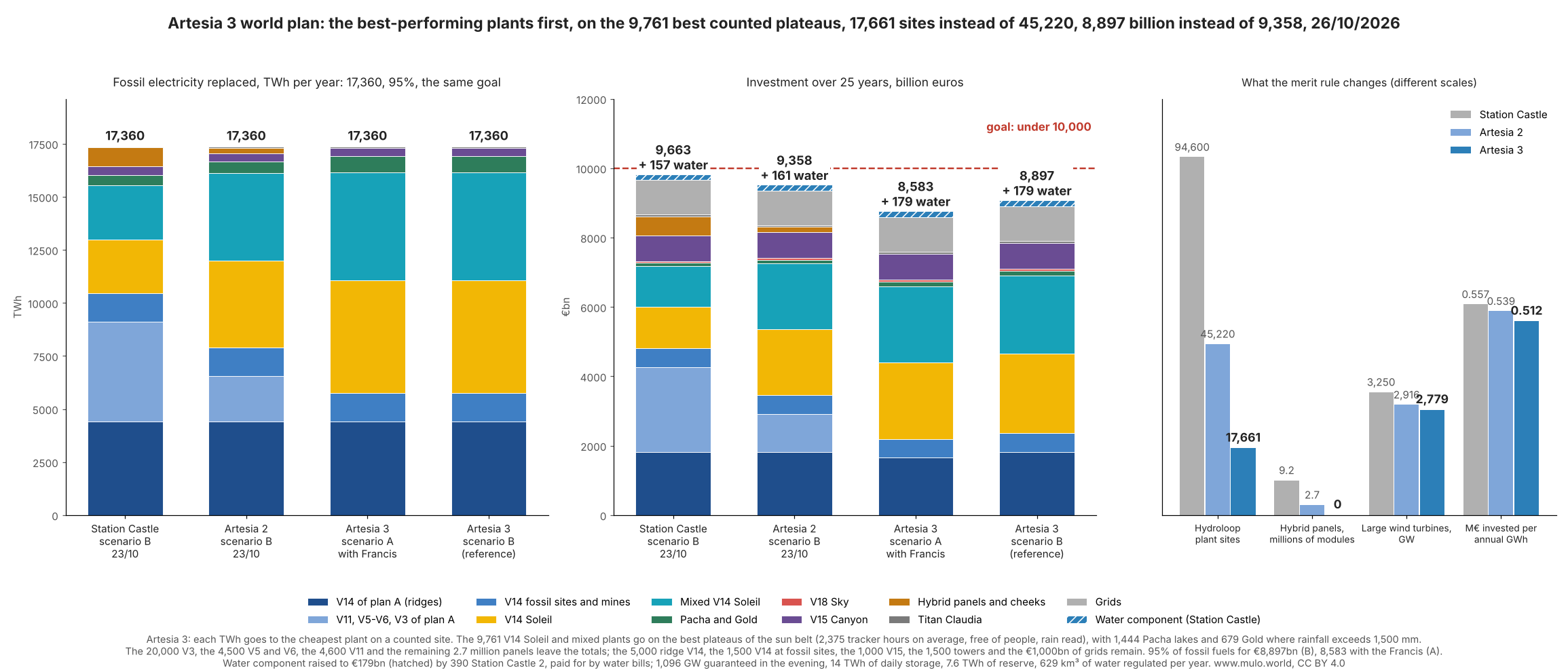
Chart code (Python, free): schema_plan_mondial_artesia_3.py; the calculation of the plan: calcul_plan_mondial_artesia_3.py (reads plateaux_ceinture_soleil.csv; optional second argument: the lines replaced, V3,V56,V11,PAN,JOU by default); the list of the 9,761 plants it places, one per line with its position, its city, its hours, its rain, its type and its cost: plan_mondial_artesia_3_sites.csv (1 MB)
The Artesia 2 plan (in French) had reclassified the plan by the cost of the GWh and halved the number of sites, on plateaus it assumed. Since then, the sun belt scan has counted the plateaus and read their sun, and the crossing with people and rain (in French) has said which are free and which have water: 20,298 cautious sites, each with its tracker hours, its rain and its country. This plan applies a single rule to this list: the best-performing plants first. Each site is ranked by M€ per annual GWh of a V14 Soleil placed on it, Pacha lake included if it rains more than 1,500 mm, make-up water included if it rains less than 75 mm, and the best are taken in order until the TWh are there. Result: 9,761 V14 Soleil and mixed plants at 2,375 tracker hours on average instead of the 2,100 of the reference site, with 1,444 Pacha 2 lakes and 679 Gold, produce 10,675 TWh for 4,586 billion, 0.430 M€ per GWh; this is cheaper than the V3 on streams (0.51), the V5 and V6 on torrents (0.56), the V11 (0.48) and the last panels (0.60), which therefore leave the totals, 29,100 sites and 2.7 million modules. The 5,000 ridge V14 (0.41), the 1,500 V14 on fossil sites, the 1,000 V15, the 1,500 towers and the 1,000 billion of grids remain. The same 17,360 TWh, 95% of fossil fuels, for 8,897 billion euros without betting on the turbine (scenario B), 8,583 with the Francis (scenario A), 461 billion less than Artesia 2, 766 less than Station Castle, and 17,661 plant sites instead of 45,220, not a single panel in the totals. The water section rises to 179 billion, paid for by water bills, with 390 Station Castle 2. Scenario B is the site's reference.
Chart code (Python, free): schema_plan_mondial_artesia_3.py; the calculation of the plan: calcul_plan_mondial_artesia_3.py (reads plateaux_ceinture_soleil.csv; optional second argument: the lines replaced, V3,V56,V11,PAN,JOU by default); the list of the 9,761 plants it places, one per line with its position, its city, its hours, its rain, its type and its cost: plan_mondial_artesia_3_sites.csv (1 MB)
------------------------------
1. THE RULE: THE BEST-PERFORMING FIRST, ON A LIST OF SITES
------------------------------
* The list: the 16,474 class A and B plateaus of the scan, minus the occupied ones, less than 150 km from a city of 100,000 inhabitants; a free plateau counts all its sites, a shared plateau half: 20,298 cautious sites, each with its tracker hours (Global Solar Atlas times 1.25), its rain (WorldClim) and its country.
* The merit: for each site, the cost of a V14 Soleil divided by what it sells there. The hourly model of the V14 Soleil page, run from 1,800 to 2,700 hours, gives 871 GWh sold at 1,800 h, 998 at 2,100, 1,095 at 2,400, 1,167 at 2,700 (the 320 MW connection clips a little more as the sun rises); the mixed plant, 30 wind turbines and 200 MWp, goes from 940 to 1,096. The price does not change with the sun: 465 M€ line included, 461 for the mixed plant. Below 75 mm of rain, 15 M€ more for a pipe or a borehole powered by the plant. Above 1,500 mm, a Pacha 2 lake, 31.1 M€ for 155.6 GWh, and a Gold on 47% of them, 6.4 M€ for 56 GWh.
* The order: sites are taken from the cheapest to the most expensive until the TWh required; one plant in two is a mixed plant, placed on a site with more than 200 mm of rain, as Artesia 2 had decided to share the risk between the wind of the ridges and the sun of the deserts. The last site taken is at 1,946 hours and 0.446 M€ per GWh; everything in the plan that costs more than that, and that a V14 Soleil can replace TWh for TWh, is replaced.
* What costs less remains: the 5,000 ridge V14 of plan A at 0.41, the 1,500 V14 on fossil sites at 0.41, the existing Pacha and Gold. What cannot be replaced per GWh also remains: the 1,000 V15 Canyon, city storage, the 1,500 towers, the 1,000 billion of grids.
------------------------------
2. WHAT CHANGES COMPARED WITH ARTESIA 2
------------------------------
------------------------------
3. THE PLATEAU FLEET, AS THE LIST GIVES IT
------------------------------
The first thirty countries, by number of plants; 63 countries in all, the file and the script give the others.
What the list says: the merit rule sends the plants where the sun is best and onto plateaus where no one lives, but never far from people: all the sites on the list are less than 150 km from a city of 100,000 inhabitants, 6,137 less than 100 km, 2,180 less than 50 km, 789 less than 30 km; it is the 7 km² plateau that is empty, not the region. It sends them to Mexico, the dry Andes, the Sarawat, Iran, Morocco, the American South-West, and not where the coal is. India receives 72 plants, China 30, Australia 3, Indonesia 17: their plateaus are class B, taken last. For these four countries, three quarters of the coal of the sun belt, the plan relies on the 1,000 billion of grids and on their own ridge and fossil-site V14; a variant by country, 1,000 plants reserved for India on its 1,310 sites at 2,000 hours, would cost about 30 billion more than pure merit, and it is a political decision that the rule does not take. Mexico, with 1,556 plants and 1,656 TWh, would produce five times its consumption: this is the other side of the rule, noon-exporting countries and lines to their neighbours.
------------------------------
4. THE TWO SCENARIOS: 17,360 TWh, 95% OF FOSSIL ELECTRICITY
------------------------------
Why this mix:
* The total does not move, 17,360 TWh: a redone plan never shows a lower objective than the previous one. The 2,398 TWh of the lines replaced and the 8,277 TWh of the Artesia 2 plateaus are redone TWh for TWh by the plateau fleet, 10,675 TWh.
* The merit rule stops at 0.446 M€ per GWh, the last site taken, because that is where the TWh required are reached; 10,537 cautious sites remain behind, at 0.45 to 0.51, the plan's margin.
* The 136 additional Sky 2 cost €11.9bn and produce no TWh: they raise the multi-day reserve from 6.2 to 7.6 TWh and give 136 more Station Castle 2, 27 million people with three days of water.
* The 1,000 billion of grids do not move, but they work harder: 29,100 small connections disappear, and more lines leave Mexico, Peru, Chile and the Sarawat towards their neighbours.
* The Francis still separates the two scenarios: 313 billion, because there are 16,261 V14 and more modules. Without confirmation from a manufacturer, scenario A costs 8,897 billion like B.
* Private bills fall from 201 to 49 billion: only the towers remain. The plan relies almost entirely on States and energy companies, 8,897 billion, and that is the counterpart of merit.
------------------------------
5. WHAT THE RULE GAINS, AND WHAT IT GIVES IN EXCHANGE
------------------------------
* It gains 461 billion euros (775 with the Francis) for the same electricity; the margin below 10,000 goes from 642 to 1,103 billion, 11% of the total, and the plan can absorb the market price of wind power (1.2 M€/MW instead of 0.91, about 800 billion) without crossing the bar again.
* It again divides the number of sites by 2.6: 17,661 plants instead of 45,220 and 94,600 two plans earlier, zero panels in the totals, 1,500 construction sites a year instead of 3,900. The 29,100 small plants were 29,100 public inquiries; the 1,541 additional large ones are on stone plateaus where the crossing found no one.
* It returns much more water: 629 km³ regulated per year instead of 457, 4,144 Pacha lakes instead of 3,012, in monsoon countries where floods and droughts strike hardest, and 17 TWh of turbinable rain in seasonal reserve.
* In exchange it gives up 55 GW of evening power, 1,096 instead of 1,151, and the 50 TWh that the V5 and V6 guaranteed 365 days a year through the torrent: the plan's firmness now comes from the V14, the 492 Sky, the 1,000 V15 and the Pacha lakes, not from the torrent. A country that wants its firmness at home keeps its V5 and V6: with them, the plan costs 8,965 billion and 21,602 sites (firmness variant, calculated by the script with V3,V11,PAN,JOU).
* It takes the V3 away from municipalities, 20,000 modules that a municipality decided on alone, and the last panels from owners: only States, energy companies, water boards and cities for the towers and the V15 remain. The V3 and the 85 million panels remain in the margin, outside the totals, for anyone who wants to build them on their own bill.
* It concentrates: 1,556 plants in Mexico, 799 in Peru, 680 in Chile, 523 in Yemen, 502 in Iran, 442 in Arabia. Temperate countries and the large coal countries produce less at home and import more: this is the price of pure merit, and section 3 costs the variant by country.
* It sells even more noon power: 4,881 V14 Soleil, 1,192 in deserts with no customer nearby. Desalination, mines, electrolysis and lines to neighbours are the condition; the 4,880 mixed plants and the 492 Sky correct part of it.
------------------------------
6. THE TIMETABLE: THREE PHASES IN 25 YEARS
------------------------------
Phase 2 requires about 1,500 plant construction sites a year instead of 3,900, and 190 GW of wind turbines a year instead of 200; phase 3 requires only 75 GW a year. The photovoltaics of the V14 Soleil and mixed plants, 3,420 GWp, is installed at 120 to 180 GWp a year, a fifth to a quarter of today's world production.
------------------------------
7. THE NINE CAVEATS TO READ BEFORE QUOTING THIS PAGE
------------------------------
* The caveats of each page remain in full, those of Artesia 2 (in French), the Station Castle plan (in French), the V14 Soleil and the two sites pages: plants that guarantee only a fifth of their output at a fixed hour, thirty-year average rainfall, 2026 series prices. This plan adds up potentials.
* The sites are counted, but at 1 km, with the sun read at the centre of the plateau and a population read on a window; protected areas, uninhabited fields, nomads and fine relief are not in the list. The plan uses only 48% of the cautious sites; if one site taken in four fell, the next 10,537 replace it at 0.45 to 0.51 M€ per GWh, about 130 billion more.
* The wind of the 4,880 mixed plants is not measured: the list gives the sun and the rain, not the 12 km ridge at 6 m/s. If half of the mixed plants do not have their wind, they become V14 Soleil on the same plateau, 4 M€ more and 7% less output each: about 90 billion and 180 TWh to be taken back from the next sites. Measured on 27/10/2026 on the wind scan page: 290 mixed plants have their wind, 164 are short, 4,426 become V14 Soleil, and according to the plan's tables the reclassification adds 133 TWh for 18 billion instead of removing any.
* The sun gain is that of the hourly model, not of a measured plant: 2,375 hours on average is the Global Solar Atlas times 1.25 for trackers, read at the centre of the plateau; at 1.2 instead of 1.25, the fleet loses 4% and the plan rises by about 180 billion, to 9,080.
* The 1,192 V14 Soleil with make-up water are costed at 15 M€ each, an average between a borehole and a 50 km pipe from the coast; in the Atacama and the deep Sahara, some will cost 30 to 50 M€, others will have no water at all, and it is a variant to be measured on ten sites before being counted in series.
* Merit does not look at where the coal is: India, China, Australia and Indonesia receive 122 plants out of 9,761. The variant by country costs about 30 billion more for 1,000 plants in India, and more if China and Australia want theirs on their class B plateaus.
* The price of machines: at the market price of wind power, 1.2 M€/MW, scenario B rises to about 9,700 billion; at the price of trackers in sunny countries, 0.45 M€/MWp instead of 0.57, it falls to about 8,400.
* The value of the noon kWh: 4,881 V14 Soleil sell two thirds of their electricity between 9 am and 4 pm, often in countries that do not consume a quarter of it; without desalination, electrolysis, mines and export lines, part of these TWh find no buyer at 30 €/MWh.
* The Francis is counted only in scenario A, for 313 billion. Without confirmation from a manufacturer, scenario A costs 8,897 billion, like B: that is why B is the reference.
------------------------------
8. THE CHANCES OF SUCCESS, REREAD AFTER THIS PLAN
------------------------------
The chances are those of the index, reread on 26/10/2026 after this plan; what moves, and why:
* Technical, brick by brick: 90%, unchanged. The plan now rests only on the V14, its Pacha lakes and its Gold, catalogue parts, clay and channels; the variable Francis modules have left the totals.
* Costs to within plus or minus 25%: from 72 to 73%. The 9,761 plateaus are counted, free of people, with their rain and their sun read, and the margin below 10,000 goes from 642 to 1,103 billion, enough to absorb the market price of wind power; but the plan depends even more on the price of trackers, the value of noon electricity and a ridge wind that no one has measured on 4,880 sites. One point more, not two.
* Partial deployment, 30 to 50% in 25 years: from 66 to 70%. 17,661 sites instead of 45,220, 1,500 construction sites a year instead of 3,900, and the first plants go to deserts where no one objects and where desalination buys the daytime power: a third of the plan is done with some twenty countries and without a single municipality.
* Complete plan, 95% in 25 years: from 32 to 36% to 34 to 38%. Fewer doors to open and more margin, but a more concentrated plan, 8,897 billion out of 8,897 falling to States and energy companies, and TWh that cross borders: Mexico, Peru, Chile, Yemen and Iran become the noon exporters of the planet, and a plan that depends on lines between countries depends on treaties.
* Slowing warming if the plan is carried out: 80%, unchanged; 629 km³ of regulated water instead of 457 add adaptation, 55 GW less firmness takes a little away.
* 1.5 °C: less than 10%, and 2 °C: 49%, unchanged.
------------------------------
9. CONCLUSION
------------------------------
The Artesia 3 world plan applies a single rule to a list of counted sites: the best-performing plants first. 9,761 Hydroloop V14 Soleil and mixed plants on the best plateaus of the sun belt, at 2,375 tracker hours, with 1,444 Pacha lakes and 679 Gold where it rains, make 10,675 TWh for 4,586 billion, and replace the 20,000 V3, the 4,500 V5 and V6, the 4,600 V11 and the last panels. It still replaces 95% of the planet's fossil electricity in 25 years, for 8,897 billion euros without betting on the turbine (scenario B), 8,583 with the Francis (scenario A), 461 billion less than Artesia 2 and 766 less than Station Castle, with 17,661 plant sites instead of 45,220, not a single panel in the totals, 629 km³ of regulated water per year, 1,096 GW guaranteed in the evening and 7.6 TWh of reserve. What it gives in exchange: the firmness of the torrent, the municipal plants, and a plan that sends its plants where the sun is, not where the coal is, and relies on lines between countries for the rest. What it requires: the wind of 4,880 ridges, the water of 1,192 deserts and the protected areas of 20,298 sites. The plans, diagrams, code, list of sites and figures are on this site, under the CC BY 4.0 licence, with their caveats.
------------------------------
SOURCES
------------------------------
The calculation of the plan (Python, reads the list of plateaus), the 9,761 plants placed, one per line (CSV), the chart
The 21,986 plateaus with their sun, their people and their rain (CSV)
The scan of the plateaus of the sun belt and the crossing with people and rain (in French)
Artesia 2 world plan, the previous version of this plan (in French), Station Castle world plan (in French) and Artesia world plan (in French)
World plan 10,000 billion objective: the ranking by cost per annual GWh (in French)
Hydroloop V14 Soleil and mixed V14 Soleil, and its hourly model, Pacha 2, Gold 2
World Bank: Global Solar Atlas, European Commission: Global Human Settlement Layer, WorldClim 2.1
SIPRI: world military spending, 2,718 billion dollars in 2024
The site's good ideas
Olivier Muhleisen in collaboration with Claude (Anthropic), October 2026. Plans, diagrams, texts and figures under the CC BY 4.0 licence.
© 2009-2026 Onmyweb Production - TOS - Cookies information - Contact us - Free Copyright Open Source -
1. THE RULE: THE BEST-PERFORMING FIRST, ON A LIST OF SITES
------------------------------
* The list: the 16,474 class A and B plateaus of the scan, minus the occupied ones, less than 150 km from a city of 100,000 inhabitants; a free plateau counts all its sites, a shared plateau half: 20,298 cautious sites, each with its tracker hours (Global Solar Atlas times 1.25), its rain (WorldClim) and its country.
* The merit: for each site, the cost of a V14 Soleil divided by what it sells there. The hourly model of the V14 Soleil page, run from 1,800 to 2,700 hours, gives 871 GWh sold at 1,800 h, 998 at 2,100, 1,095 at 2,400, 1,167 at 2,700 (the 320 MW connection clips a little more as the sun rises); the mixed plant, 30 wind turbines and 200 MWp, goes from 940 to 1,096. The price does not change with the sun: 465 M€ line included, 461 for the mixed plant. Below 75 mm of rain, 15 M€ more for a pipe or a borehole powered by the plant. Above 1,500 mm, a Pacha 2 lake, 31.1 M€ for 155.6 GWh, and a Gold on 47% of them, 6.4 M€ for 56 GWh.
* The order: sites are taken from the cheapest to the most expensive until the TWh required; one plant in two is a mixed plant, placed on a site with more than 200 mm of rain, as Artesia 2 had decided to share the risk between the wind of the ridges and the sun of the deserts. The last site taken is at 1,946 hours and 0.446 M€ per GWh; everything in the plan that costs more than that, and that a V14 Soleil can replace TWh for TWh, is replaced.
* What costs less remains: the 5,000 ridge V14 of plan A at 0.41, the 1,500 V14 on fossil sites at 0.41, the existing Pacha and Gold. What cannot be replaced per GWh also remains: the 1,000 V15 Canyon, city storage, the 1,500 towers, the 1,000 billion of grids.
------------------------------
2. WHAT CHANGES COMPARED WITH ARTESIA 2
------------------------------
| Item | Artesia 2, scenario B | Artesia 3, scenario B | Why |
|---|---|---|---|
| V14 Soleil and mixed plants | 8,220 on assumed plateaus, 2,100 h: 8,220 TWh, €3,806bn (0.463) | 9,761 on the 9,761 best counted sites, 2,375 h on average: 10,412 TWh, €4,538bn (0.436) | the sun of the best plateaus gives 7 to 17% more per plant for the same price; 1,192 desert V14 Soleil (Atacama, Sahara, Arabia) have their make-up water counted |
| Pacha 2 and Gold on these sites | 312 and 147: 57 TWh, €10.6bn | 1,444 and 679: 263 TWh, €49.3bn (0.19) | the crossing found 7,435 class A and B sites with more than 1,500 mm; each site taken that is under the monsoon receives its lake |
| V3 on streams, V5 and V6 on torrents, V11 and V12 of plan A | 29,100: 2,140 TWh, €1,089bn (0.48 to 0.56) | 0 | more expensive per GWh than the last plateau taken (0.446), and 29,100 sites; they remain in the plan's margin, a municipality or a country can build them for its own firmness |
| Ridge V14 of plan A | 5,000: 4,425 TWh, €1,820bn (0.41) | unchanged | cheaper than the plateaus |
| Hybrid panels of dams, airports and ports, and their end discs | 2.7 million: 258 TWh, €152bn (0.60) | 0 in the totals | replaced by 240 plants; the hybrid panel keeps its 85 million possible modules outside the plan, installed by their owners on their own bill, and the floating islands of the reservoirs remain the demonstration |
| V18 Sky and Station Castle 2 | 356 Sky, 254 Station Castle 2 | 492 Sky, 390 Station Castle 2: one new Gold 2 in five, as before | 136 more Sky 2, €11.9bn; water section from €161bn to €179bn, paid for by water bills |
| V14 on fossil sites, V15, Titan Claudia, grids | unchanged | unchanged | |
| Electricity total | 17,360 TWh, €9,358bn | 17,360 TWh, €8,897bn | €461bn less, 0.512 M€ per annual GWh instead of 0.539 |
| Hydroloop plant sites | 45,220 | 17,661 | 29,100 fewer sites, 1,541 more |
| Panels in the totals | 2.7 million | 0 |
------------------------------
3. THE PLATEAU FLEET, AS THE LIST GIVES IT
------------------------------
| The 9,761 sites taken | Number |
|---|---|
| Tracker hours: mean 2,375, minimum 1,946, maximum 3,003; class A (2,100 h and more) | 8,698 |
| Class B (1,800 to 2,100 h), taken for their Pacha lake | 1,063 |
| On free plateaus | 9,081 |
| On shared plateaus, counted at half | 680 |
| Less than 75 mm of rain: V14 Soleil with make-up water, 15 M€ each | 1,192 |
| 75 to 250 mm | 2,151 |
| 250 to 1,000 mm | 4,593 |
| 1,000 to 1,500 mm | 381 |
| 1,500 mm and more: Pacha 2 lake, 47% with a Gold | 1,444 |
| Share of the 20,298 cautious sites used | 48% |
The first thirty countries, by number of plants; 63 countries in all, the file and the script give the others.
| Country | V14 Soleil and mixed plants | TWh per year, Pacha and Gold included |
|---|---|---|
| Mexico | 1,556 | 1,656 |
| Peru | 799 | 873 |
| Chile | 680 | 785 |
| Ethiopia | 527 | 571 |
| Yemen | 523 | 578 |
| Iran | 502 | 537 |
| Brazil | 461 | 534 |
| Saudi Arabia | 442 | 487 |
| Bolivia | 419 | 456 |
| Morocco | 397 | 423 |
| United States | 355 | 378 |
| Pakistan | 264 | 285 |
| South Africa | 247 | 259 |
| Madagascar | 198 | 222 |
| Guinea | 187 | 218 |
| Angola | 181 | 192 |
| Argentina | 178 | 196 |
| Tanzania | 175 | 185 |
| Egypt | 154 | 174 |
| Oman | 119 | 130 |
| Cameroon | 117 | 136 |
| Nigeria | 101 | 118 |
| Afghanistan | 100 | 106 |
| Colombia | 93 | 107 |
| Jordan | 93 | 100 |
| Eritrea | 75 | 80 |
| India | 72 | 82 |
| Somalia | 72 | 77 |
| Djibouti | 66 | 69 |
| Zambia | 48 | 50 |
What the list says: the merit rule sends the plants where the sun is best and onto plateaus where no one lives, but never far from people: all the sites on the list are less than 150 km from a city of 100,000 inhabitants, 6,137 less than 100 km, 2,180 less than 50 km, 789 less than 30 km; it is the 7 km² plateau that is empty, not the region. It sends them to Mexico, the dry Andes, the Sarawat, Iran, Morocco, the American South-West, and not where the coal is. India receives 72 plants, China 30, Australia 3, Indonesia 17: their plateaus are class B, taken last. For these four countries, three quarters of the coal of the sun belt, the plan relies on the 1,000 billion of grids and on their own ridge and fossil-site V14; a variant by country, 1,000 plants reserved for India on its 1,310 sites at 2,000 hours, would cost about 30 billion more than pure merit, and it is a political decision that the rule does not take. Mexico, with 1,556 plants and 1,656 TWh, would produce five times its consumption: this is the other side of the rule, noon-exporting countries and lines to their neighbours.
------------------------------
4. THE TWO SCENARIOS: 17,360 TWh, 95% OF FOSSIL ELECTRICITY
------------------------------
| Solution | Artesia 2, scenario B | Artesia 3, scenario A, with the Francis | Artesia 3, scenario B, without betting on the Francis (reference) |
|---|---|---|---|
| Ridge Hydroloop V14 of plan A | 5,000: 4,425 TWh, €1,820bn (with 4,600 V11, 4,500 V5 and V6, 20,000 V3: 34,100, 6,565 TWh, €2,910bn) | 5,000: 4,425 TWh, €1,820bn | 5,000: 4,425 TWh, €1,820bn |
| V14 on fossil sites and mines | 1,500: 1,328 TWh, €546bn | 1,500: 1,328 TWh, €546bn | 1,500: 1,328 TWh, €546bn |
| V14 Soleil on the counted plateaus | 4,110: 4,102 TWh, €1,911bn | 4,881: 5,326 TWh, €2,288bn | 4,881: 5,326 TWh, €2,288bn |
| Mixed V14 Soleil on the counted plateaus | 4,110: 4,118 TWh, €1,895bn | 4,880: 5,086 TWh, €2,250bn | 4,880: 5,086 TWh, €2,250bn |
| Reversible Francis in series (V14, V14 Soleil and mixed) | not counted | -€313bn | not counted |
| V16 Pacha | 3,012: 469 TWh, €94bn | 4,144: 645 TWh, €129bn | 4,144: 645 TWh, €129bn |
| V17 Gold | 1,273: 71 TWh, €8.1bn | 1,805: 101 TWh, €11.5bn | 1,805: 101 TWh, €11.5bn |
| V18 Sky and Sky Artesia | 356: €45.1bn | 492: €57.0bn (136 more Sky 2, on the new Gold 2) | 492: €57.0bn |
| V15 Canyon | 1,000: 405 TWh, €747bn | 1,000: 405 TWh, €747bn | 1,000: 405 TWh, €747bn |
| Industrial hybrid panels, end discs, corridor, crown | 2.7 million: 258 TWh, €152bn | 0 in the totals | 0 in the totals |
| Coastal Titan Claudia 5 and 4 Paris Style | 1,500: 43 TWh, €49bn | 1,500: 43 TWh, €49bn | 1,500: 43 TWh, €49bn |
| Grids, interconnections, long-duration storage | €1,000bn | €1,000bn | €1,000bn |
| Electricity total | 17,360 TWh, 95%, €9,358bn | 17,360 TWh, 95%, €8,583bn (8,897 if the Francis is not confirmed) | 17,360 TWh, 95%, €8,897bn |
| Savings on Artesia 2 | €775bn | €461bn | |
| Water section, separate (V19 Station Castle and small treatment plants) | €161bn | €179bn (390 Station Castle 2 instead of 254) | €179bn |
| Of which public budget or energy companies (electricity) | €9,157bn | €8,583bn | €8,897bn |
| Of which private bills and rents (electricity) | €201bn | €49bn (the towers) | €49bn |
| Water bills (water section) | €161bn | €179bn | €179bn |
| Reserve: existing gas plants, biomass, islands | 880 TWh, 5% | 880 TWh, 5% | 880 TWh, 5% |
| What the plan brings | Artesia 2 | Artesia 3, A and B | |
| Share of fossil fuels replaced by the Hydroloop, Pacha, Gold and Sky included | 91% | 93% | |
| Hydroloop plant sites | 45,220 | 17,661 | |
| Dispatchable power in the evening | 1,151 GW | 1,096 GW (the 29,100 small and medium plants had 129 GW of Pelton, the 1,541 additional V14 bring 74; the 5 TWh of turbinable rain of the 1,132 additional Pacha are not counted in GW) | |
| Storage cycled every day | 13.0 TWh | 14.0 TWh | |
| Multi-day reserve | 6.2 TWh | 7.6 TWh | |
| Turbinable rain in seasonal reserve | 12 TWh | 17 TWh | |
| Regulated water | 457 km³ per year | 629 km³ per year | |
| People with three days of drinking water in reserve, and with sanitation (water section) | 561 million, 277 million | 588 million, 310 million | |
| Large wind turbines | 2,916 GW | 2,779 GW | |
| Photovoltaics | 3,850 GWp | 4,230 GWp | |
| Investment per year | €374bn (B), 364 (A) | €356bn (B), 343 (A), plus 7.2 of water services | |
| Comparison with the world military budget | 15% over 25 years | 14% over 25 years | |
| CO2 avoided | 13.7 billion tonnes per year | 13.7 billion tonnes per year | |
| Plant construction sites per year in phase 2 | 3,900 | about 1,500 | |
Why this mix:
* The total does not move, 17,360 TWh: a redone plan never shows a lower objective than the previous one. The 2,398 TWh of the lines replaced and the 8,277 TWh of the Artesia 2 plateaus are redone TWh for TWh by the plateau fleet, 10,675 TWh.
* The merit rule stops at 0.446 M€ per GWh, the last site taken, because that is where the TWh required are reached; 10,537 cautious sites remain behind, at 0.45 to 0.51, the plan's margin.
* The 136 additional Sky 2 cost €11.9bn and produce no TWh: they raise the multi-day reserve from 6.2 to 7.6 TWh and give 136 more Station Castle 2, 27 million people with three days of water.
* The 1,000 billion of grids do not move, but they work harder: 29,100 small connections disappear, and more lines leave Mexico, Peru, Chile and the Sarawat towards their neighbours.
* The Francis still separates the two scenarios: 313 billion, because there are 16,261 V14 and more modules. Without confirmation from a manufacturer, scenario A costs 8,897 billion like B.
* Private bills fall from 201 to 49 billion: only the towers remain. The plan relies almost entirely on States and energy companies, 8,897 billion, and that is the counterpart of merit.
------------------------------
5. WHAT THE RULE GAINS, AND WHAT IT GIVES IN EXCHANGE
------------------------------
* It gains 461 billion euros (775 with the Francis) for the same electricity; the margin below 10,000 goes from 642 to 1,103 billion, 11% of the total, and the plan can absorb the market price of wind power (1.2 M€/MW instead of 0.91, about 800 billion) without crossing the bar again.
* It again divides the number of sites by 2.6: 17,661 plants instead of 45,220 and 94,600 two plans earlier, zero panels in the totals, 1,500 construction sites a year instead of 3,900. The 29,100 small plants were 29,100 public inquiries; the 1,541 additional large ones are on stone plateaus where the crossing found no one.
* It returns much more water: 629 km³ regulated per year instead of 457, 4,144 Pacha lakes instead of 3,012, in monsoon countries where floods and droughts strike hardest, and 17 TWh of turbinable rain in seasonal reserve.
* In exchange it gives up 55 GW of evening power, 1,096 instead of 1,151, and the 50 TWh that the V5 and V6 guaranteed 365 days a year through the torrent: the plan's firmness now comes from the V14, the 492 Sky, the 1,000 V15 and the Pacha lakes, not from the torrent. A country that wants its firmness at home keeps its V5 and V6: with them, the plan costs 8,965 billion and 21,602 sites (firmness variant, calculated by the script with V3,V11,PAN,JOU).
* It takes the V3 away from municipalities, 20,000 modules that a municipality decided on alone, and the last panels from owners: only States, energy companies, water boards and cities for the towers and the V15 remain. The V3 and the 85 million panels remain in the margin, outside the totals, for anyone who wants to build them on their own bill.
* It concentrates: 1,556 plants in Mexico, 799 in Peru, 680 in Chile, 523 in Yemen, 502 in Iran, 442 in Arabia. Temperate countries and the large coal countries produce less at home and import more: this is the price of pure merit, and section 3 costs the variant by country.
* It sells even more noon power: 4,881 V14 Soleil, 1,192 in deserts with no customer nearby. Desalination, mines, electrolysis and lines to neighbours are the condition; the 4,880 mixed plants and the 492 Sky correct part of it.
------------------------------
6. THE TIMETABLE: THREE PHASES IN 25 YEARS
------------------------------
| Phase | Years | Hydroloop, Pacha, Gold, Sky and water services | Titan Claudia | Result |
|---|---|---|---|---|
| 1. Measured prototypes | 2027 to 2029 | as in Artesia 2: a V2 on a stream, a first Pacha and a first Gold, the geology of ten ramparts, the survey of the 500 fossil substations, a 16 ha covered reservoir measured for a year, a first Station Castle on an existing pumped storage plant, the lidar and rain gauge of 100 plateaus on the list, protected areas crossed on the 20,298 sites, and for scenario A the Francis costed by a manufacturer | a coastal tower | about 200 M€, measured figures, and the decision between A and B |
| 2. Fossil sites, ridges and sun plateaus | 2029 to 2039 | the 5,000 ridge V14; 1,000 V14 on fossil substations; 3,000 V14 Soleil in dry countries, the deserts with make-up water first, where desalination and mines buy the daytime power; 300 V15; 2,500 Pacha lakes and their Gold; the 2,000 small treatment plants and the first 150 Station Castle 2 | 300 towers | 62% of fossil fuels in 2039 |
| 3. Mixed ridges, cities, Sky | 2039 to 2051 | the last 500 V14 on fossil sites; the other 1,881 V14 Soleil and the 4,880 mixed plants, 560 V14 a year; the other 700 V15; the remaining Pacha and Gold; the 492 Sky and the rest of the Station Castle | 1,200 towers | 95% in 2051, gas reserve for the remaining 5% |
Phase 2 requires about 1,500 plant construction sites a year instead of 3,900, and 190 GW of wind turbines a year instead of 200; phase 3 requires only 75 GW a year. The photovoltaics of the V14 Soleil and mixed plants, 3,420 GWp, is installed at 120 to 180 GWp a year, a fifth to a quarter of today's world production.
------------------------------
7. THE NINE CAVEATS TO READ BEFORE QUOTING THIS PAGE
------------------------------
* The caveats of each page remain in full, those of Artesia 2 (in French), the Station Castle plan (in French), the V14 Soleil and the two sites pages: plants that guarantee only a fifth of their output at a fixed hour, thirty-year average rainfall, 2026 series prices. This plan adds up potentials.
* The sites are counted, but at 1 km, with the sun read at the centre of the plateau and a population read on a window; protected areas, uninhabited fields, nomads and fine relief are not in the list. The plan uses only 48% of the cautious sites; if one site taken in four fell, the next 10,537 replace it at 0.45 to 0.51 M€ per GWh, about 130 billion more.
* The wind of the 4,880 mixed plants is not measured: the list gives the sun and the rain, not the 12 km ridge at 6 m/s. If half of the mixed plants do not have their wind, they become V14 Soleil on the same plateau, 4 M€ more and 7% less output each: about 90 billion and 180 TWh to be taken back from the next sites. Measured on 27/10/2026 on the wind scan page: 290 mixed plants have their wind, 164 are short, 4,426 become V14 Soleil, and according to the plan's tables the reclassification adds 133 TWh for 18 billion instead of removing any.
* The sun gain is that of the hourly model, not of a measured plant: 2,375 hours on average is the Global Solar Atlas times 1.25 for trackers, read at the centre of the plateau; at 1.2 instead of 1.25, the fleet loses 4% and the plan rises by about 180 billion, to 9,080.
* The 1,192 V14 Soleil with make-up water are costed at 15 M€ each, an average between a borehole and a 50 km pipe from the coast; in the Atacama and the deep Sahara, some will cost 30 to 50 M€, others will have no water at all, and it is a variant to be measured on ten sites before being counted in series.
* Merit does not look at where the coal is: India, China, Australia and Indonesia receive 122 plants out of 9,761. The variant by country costs about 30 billion more for 1,000 plants in India, and more if China and Australia want theirs on their class B plateaus.
* The price of machines: at the market price of wind power, 1.2 M€/MW, scenario B rises to about 9,700 billion; at the price of trackers in sunny countries, 0.45 M€/MWp instead of 0.57, it falls to about 8,400.
* The value of the noon kWh: 4,881 V14 Soleil sell two thirds of their electricity between 9 am and 4 pm, often in countries that do not consume a quarter of it; without desalination, electrolysis, mines and export lines, part of these TWh find no buyer at 30 €/MWh.
* The Francis is counted only in scenario A, for 313 billion. Without confirmation from a manufacturer, scenario A costs 8,897 billion, like B: that is why B is the reference.
------------------------------
8. THE CHANCES OF SUCCESS, REREAD AFTER THIS PLAN
------------------------------
The chances are those of the index, reread on 26/10/2026 after this plan; what moves, and why:
* Technical, brick by brick: 90%, unchanged. The plan now rests only on the V14, its Pacha lakes and its Gold, catalogue parts, clay and channels; the variable Francis modules have left the totals.
* Costs to within plus or minus 25%: from 72 to 73%. The 9,761 plateaus are counted, free of people, with their rain and their sun read, and the margin below 10,000 goes from 642 to 1,103 billion, enough to absorb the market price of wind power; but the plan depends even more on the price of trackers, the value of noon electricity and a ridge wind that no one has measured on 4,880 sites. One point more, not two.
* Partial deployment, 30 to 50% in 25 years: from 66 to 70%. 17,661 sites instead of 45,220, 1,500 construction sites a year instead of 3,900, and the first plants go to deserts where no one objects and where desalination buys the daytime power: a third of the plan is done with some twenty countries and without a single municipality.
* Complete plan, 95% in 25 years: from 32 to 36% to 34 to 38%. Fewer doors to open and more margin, but a more concentrated plan, 8,897 billion out of 8,897 falling to States and energy companies, and TWh that cross borders: Mexico, Peru, Chile, Yemen and Iran become the noon exporters of the planet, and a plan that depends on lines between countries depends on treaties.
* Slowing warming if the plan is carried out: 80%, unchanged; 629 km³ of regulated water instead of 457 add adaptation, 55 GW less firmness takes a little away.
* 1.5 °C: less than 10%, and 2 °C: 49%, unchanged.
------------------------------
9. CONCLUSION
------------------------------
The Artesia 3 world plan applies a single rule to a list of counted sites: the best-performing plants first. 9,761 Hydroloop V14 Soleil and mixed plants on the best plateaus of the sun belt, at 2,375 tracker hours, with 1,444 Pacha lakes and 679 Gold where it rains, make 10,675 TWh for 4,586 billion, and replace the 20,000 V3, the 4,500 V5 and V6, the 4,600 V11 and the last panels. It still replaces 95% of the planet's fossil electricity in 25 years, for 8,897 billion euros without betting on the turbine (scenario B), 8,583 with the Francis (scenario A), 461 billion less than Artesia 2 and 766 less than Station Castle, with 17,661 plant sites instead of 45,220, not a single panel in the totals, 629 km³ of regulated water per year, 1,096 GW guaranteed in the evening and 7.6 TWh of reserve. What it gives in exchange: the firmness of the torrent, the municipal plants, and a plan that sends its plants where the sun is, not where the coal is, and relies on lines between countries for the rest. What it requires: the wind of 4,880 ridges, the water of 1,192 deserts and the protected areas of 20,298 sites. The plans, diagrams, code, list of sites and figures are on this site, under the CC BY 4.0 licence, with their caveats.
------------------------------
SOURCES
------------------------------
The calculation of the plan (Python, reads the list of plateaus), the 9,761 plants placed, one per line (CSV), the chart
The 21,986 plateaus with their sun, their people and their rain (CSV)
The scan of the plateaus of the sun belt and the crossing with people and rain (in French)
Artesia 2 world plan, the previous version of this plan (in French), Station Castle world plan (in French) and Artesia world plan (in French)
World plan 10,000 billion objective: the ranking by cost per annual GWh (in French)
Hydroloop V14 Soleil and mixed V14 Soleil, and its hourly model, Pacha 2, Gold 2
World Bank: Global Solar Atlas, European Commission: Global Human Settlement Layer, WorldClim 2.1
SIPRI: world military spending, 2,718 billion dollars in 2024
The site's good ideas
Olivier Muhleisen in collaboration with Claude (Anthropic), October 2026. Plans, diagrams, texts and figures under the CC BY 4.0 licence.
© 2009-2026 Onmyweb Production - TOS - Cookies information - Contact us - Free Copyright Open Source -