
Hydroloop Muhleisen 2026, version 17 Gold 2: the full Pacha 2 plus a small river of 3 to 10 m³/s brought from the neighbouring valley, 1,247 GWh a year at 23.1 €/MWh with 3 m³/s, 1,406 at 21.8 with 10, instead of 1,180 at 23.6, a 35 MW rain Pelton in two units running day and night, and up to 573 million m³ of regulated water returned to the valley. The largest of the Golds. 19/10/26
The Pacha 2 is the cheapest plant in the plan: a V14 and a whole mountain, 1,180 GWh at 23.6 €/MWh. The Gold 2 adds the next valley: a small river of 3 to 10 m³/s, diverted by a canal along the mountainside or a tunnel of one to two kilometres through the ridge, which arrives in the lake by gravity. 95 to 315 million m³ a year, 1,247 to 1,406 GWh, 23.1 to 21.8 €/MWh, a lake that no longer empties, pumps stopped, and a rain Pelton that becomes a real run-of-river plant inside the peak plant. This page gives the model by flow, the costs, the sites, and the spring option of the Gold 4.
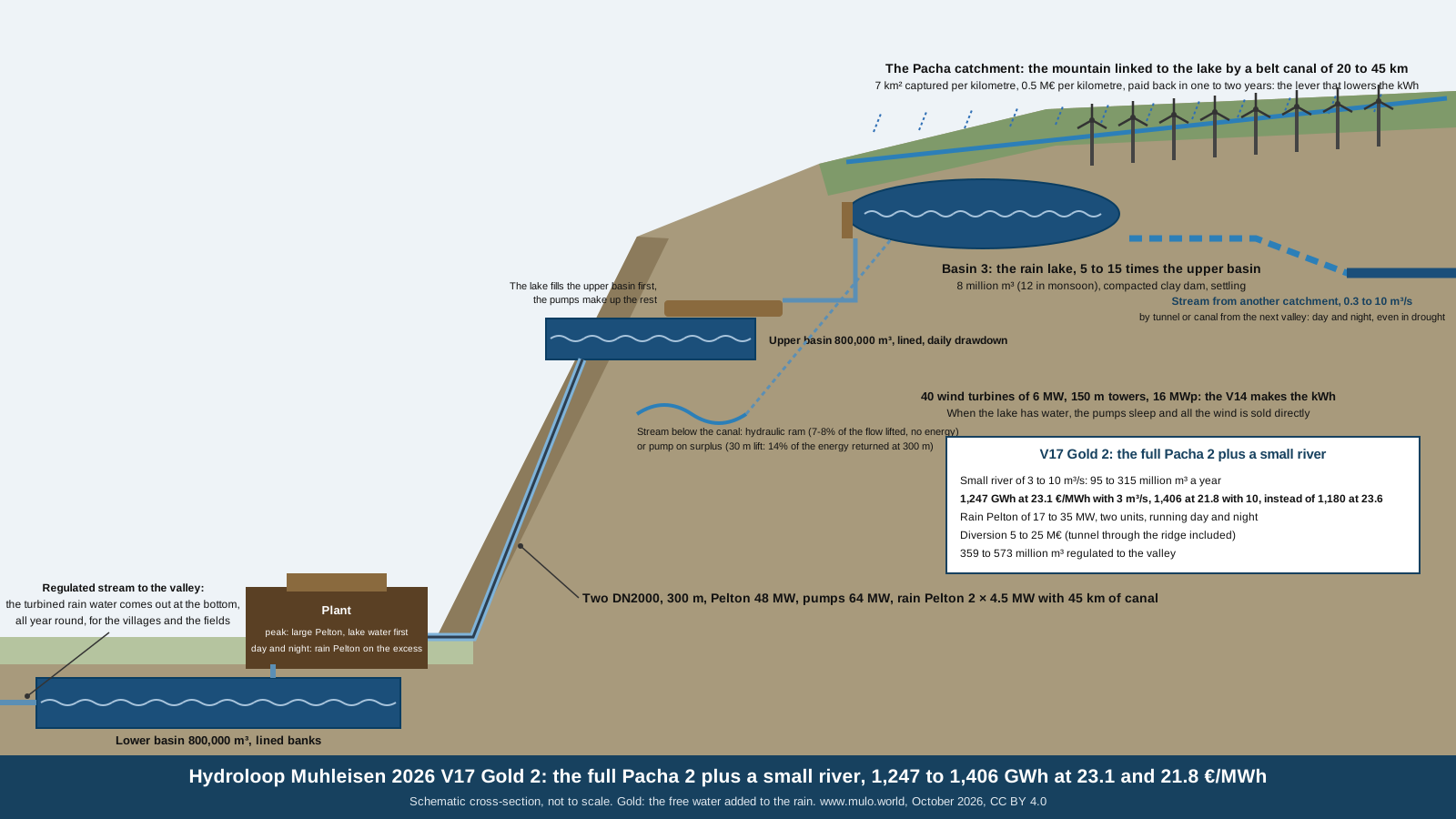
Diagram code (Python, free, the four Golds): schema_hydroloop_v17.py; hourly model: hydroloop_muhleisen_2026_v17_simulation.py (the nine arguments of the Pacha model, then the inflow in m³/s, the lift height in m for a borehole or a pump, the cost of the diversion in M€ and the seasonality: constant, fonte or etiage (constant, snowmelt or low water))
The four Golds: Gold 1 (Pacha 1 + stream, in French) | Gold 2 (Pacha 2 + small river) | Gold 3 (Pacha 3 + torrent, in French) | Gold 4 (the springs); the Pachas: 1 | 2 | 3; the 6-in-1 world plan (in French); the next step with a lower lake: V18 Sky 2
------------------------------
1. WHAT THE GOLD ADDS TO THE PACHA
------------------------------
The full Pacha 2 captures 315 km² with 45 km of canal: 317 million m³ a year, 1,180 GWh at 23.6 €/MWh, and still 26 days with an empty lake. A V14 is big: 208 million m³ go through its peak Pelton turbines every year, and the peak is served first. The Gold 2 gives it a small river, 3 to 10 m³/s, diverted from the neighbouring valley by a canal or a tunnel, or taken below the canal: 95 to 315 million m³ a year, 70 to 230 GWh at 300 m. At 3 m³/s the lake is empty only 2 days and the pumps drop to 7 GWh; at 10 m³/s, the river alone runs a 35 MW rain Pelton day and night, 263 GWh, and the V14 becomes a plant at 21.8 €/MWh, the cheapest on the whole Hydroloop site.
------------------------------
2. WHERE THE WATER COMES FROM
------------------------------
The Gold's water must come from somewhere other than the canal's catchment, because the Pacha's belt canal already cuts all the thalwegs along its course. Three origins, in order of yield, and one rule: water is never lifted higher than necessary, and the target is the upper basin, not the lake, unless it is to be stored.
* The neighbouring valley. A stream from the next catchment, brought by a canal along the mountainside (0.5 M€ per kilometre, like the belt canal) or by a tunnel through the ridge (5 to 15 M€ per kilometre). This is what the Norwegians and Hydro-Québec have been doing for a century: an intake, a sand trap, a tunnel, and the water changes valley. It arrives by gravity in the lake or in the upper basin.
* The stream that passes below the canal but above the lake or the upper basin. It was not cut by the canal (it rises below it, from springs or a side valley): an intake and a pipe are enough, by gravity.
* The stream below the upper basin. It has to be lifted, and there are three ways. The hydraulic ram: a stream with a local drop of 5 m lifts 7 to 8% of its own flow to 40 m, without outside energy and with almost no maintenance; on 1 m³/s, 75 L/s, 2.4 million m³ a year, for a few tens of thousands of euros, the ecological module par excellence. The pump on the plant's surplus: lifting 1 m³/s by 30 m costs 370 kW, 3.2 GWh a year, 14% of what this water returns at 300 m, with a single 0.5 M€ machine that runs when the wind blows, with no urgency, since the lake waits. The multi-blade windpump (American-blade wind turbine): 2 L/s lifted 30 m per 5 m wheel, 60,000 m³ a year, for isolated intakes far from any cable, not for a whole stream, which would need five hundred of them.
* The borehole, what it really gives. A borehole does not raise water for free: unless the aquifer is artesian, in which case it is a spring captured by gravity (see the Gold 4), it has to be pumped, and 9.81 × height is spent per m³ to recover 9.81 × head × 0.9. And above all the flow: a borehole in the mountains gives 10 to 200 L/s, 0.3 to 6 million m³ a year, 1 to 6% of what the canal already brings, while emptying an aquifer that has other users. The figures are in the model table: the borehole is not kept.
------------------------------
3. THE HOURLY MODEL: WHAT THE RIVER CHANGES
------------------------------
Base full Pacha 2: 45 km canal, 315 km², 2,000 mm, temperate regime, 8 million m³ lake, two-unit rain Pelton. The diversion cost is that of a canal of 6 to 10 km or a tunnel of 1 to 2 km.
Reading: on a Pacha 2, 1 m³/s hardly shows (23.6 → 23.6) because the plant already consumes 208 million m³ at peak; it is from 3 m³/s that the river counts, and at 10 it makes a second plant inside the first: 263 GWh of rain Pelton, 35 MW in two units, 21.8 €/MWh. A 2 km tunnel to fetch it remains profitable (22.3). Snowmelt leaves 7 days of empty lake in winter, the spring none.
------------------------------
4. THE FIGURES IN SERIES
------------------------------
------------------------------
5. WHERE IT GOES
------------------------------
Wherever a Pacha 2 has a whole mountain and the neighbouring valley has a river: the large rainy massifs. Of the 67 Pacha 2 sites on the locations page (in French), seven out of ten have the river on the map; one in three is kept. The best: the Western Highlands (Lochaber, Kintail, ten valleys side by side), the Pre-Alps, the Julian Alps and the Dinarides, the Ghats, Sikkim and the Annapurna (glacier torrents), Taiwan, Kii and Hokuriku (snow), Sumatra, the Cascades, the Smokies, the Huasteca, the Chocó and the Yungas, the Serra do Mar, southern Chile, New Zealand's West Coast, Tasmania. In the world plan, 287 of the 800 Pacha 2 become Gold 2.
------------------------------
6. POINTS TO WATCH
------------------------------
* The reserved flow. The whole stream is never taken: in France a tenth of the mean flow stays in the bed, more for spawning grounds, and the same rule applies wherever it exists. The model counts the diverted flow, not the flow of the stream.
* Water rights and downstream users. A stream has irrigators, mills, anglers, a city that drinks from it. The Gold's argument is that the water is returned at the bottom, regulated and all year round, through the lower basin; for a diversion from one valley to another, the water changes valley and the agreement of both is needed. It is the basin committee that decides, as for the Pacha.
* Sediment. A torrent carries sand and pebbles: side intake with a screen, sand trap, and settling in the lake before the Pelton. The Pelton remains the machine of the stream Golds; only the Gold 4, with clear spring water, can go back to reversible Francis units.
* Floods. The intake is sized to let the flood pass without swallowing it: guard gate, side spillway on the feeder canal, and the lake keeps its freeboard. A mountain torrent flood can be a hundred times the mean flow.
* The tunnel. 5 to 15 M€ per kilometre depending on the rock; it is only justified by the head: at 300 m, a 1 m³/s stream is worth 2 M€ a year and pays for 2 to 3 km of tunnel; at 1,500 m, 10 M€ a year and 10 km. The model gives the kWh for each case.
* Dry years. A spring-fed stream drops in summer but does not stop; a snowmelt torrent stops in winter and gives everything in June; a rain-fed stream follows the rain. The model has the three profiles, and it is the profile, as much as the flow, that says how many days the lake stays empty.
------------------------------
7. THE SPRING OPTION: THE GOLD 4 ON A PACHA 2
------------------------------
A large karst spring of 3 to 10 m³/s replaces the river with three advantages: constant flow, clear water (reversible Francis units possible on the eight peak machines, 0.5 €/MWh less), and a simple intake instead of the diversion: 23.0 €/MWh at 3 m³/s, 21.5 at 10. The Dinarides (Slovenia, Croatia, Bosnia, Montenegro, Albania, Epirus), the Pre-Alps, the Picos, the Huasteca, Chiapas, the Verapaz and Hubei have these springs. Details on the Gold 4 page.
------------------------------
8. THE GOOD IDEAS OF THE GOLD 2
------------------------------
* On a large plant, the inflow must be to scale: 1 m³/s does not show on a V14, 3 count, 10 make a second plant inside the first.
* A 10 m³/s river at 300 m is worth 230 GWh a year: enough to pay for 2 km of tunnel through the ridge, the way the Norwegians link their catchments.
* The rain Pelton follows the water: two units of 17.7 MW instead of two of 4.5, because a constant inflow is turbined continuously.
* The water returned to the valley doubles (573 million m³ at 10 m³/s): the argument before the basin committee grows with the Gold.
------------------------------
SOURCES
------------------------------
The hourly model of the Golds (Python, no library), the Pacha model plus a base inflow
Hydroloop V16 Pacha 1 (in French), Pacha 2 and Pacha 3 (in French), the bases of the Golds
The best locations in the world for Hydroloop V16 Pacha, 114 named sites, and what they offer the Golds (in French)
6-in-1 world plan: 1,056 Golds in the plan (in French)
Wikipedia: the hydraulic ram
Wikipedia: reserved flow (in French)
Wikipedia: interbasin water transfers
Wikipedia: the multi-blade windpump
Wikipedia: springs, including karst and artesian springs
Wikipedia: the Fontaine de Vaucluse, the largest spring in France (in French)
Wikipedia: Statkraft, Norwegian hydropower with catchments linked by tunnels
The site's good ideas (in French)
Olivier Muhleisen in collaboration with Claude (Anthropic), October 2026. Royalty-free plans, open source, CC BY 4.0.
© 2009-2026 Onmyweb Production - TOS - Cookies information - Contact us - Free Copyright Open Source -
1. WHAT THE GOLD ADDS TO THE PACHA
------------------------------
The full Pacha 2 captures 315 km² with 45 km of canal: 317 million m³ a year, 1,180 GWh at 23.6 €/MWh, and still 26 days with an empty lake. A V14 is big: 208 million m³ go through its peak Pelton turbines every year, and the peak is served first. The Gold 2 gives it a small river, 3 to 10 m³/s, diverted from the neighbouring valley by a canal or a tunnel, or taken below the canal: 95 to 315 million m³ a year, 70 to 230 GWh at 300 m. At 3 m³/s the lake is empty only 2 days and the pumps drop to 7 GWh; at 10 m³/s, the river alone runs a 35 MW rain Pelton day and night, 263 GWh, and the V14 becomes a plant at 21.8 €/MWh, the cheapest on the whole Hydroloop site.
------------------------------
2. WHERE THE WATER COMES FROM
------------------------------
The Gold's water must come from somewhere other than the canal's catchment, because the Pacha's belt canal already cuts all the thalwegs along its course. Three origins, in order of yield, and one rule: water is never lifted higher than necessary, and the target is the upper basin, not the lake, unless it is to be stored.
* The neighbouring valley. A stream from the next catchment, brought by a canal along the mountainside (0.5 M€ per kilometre, like the belt canal) or by a tunnel through the ridge (5 to 15 M€ per kilometre). This is what the Norwegians and Hydro-Québec have been doing for a century: an intake, a sand trap, a tunnel, and the water changes valley. It arrives by gravity in the lake or in the upper basin.
* The stream that passes below the canal but above the lake or the upper basin. It was not cut by the canal (it rises below it, from springs or a side valley): an intake and a pipe are enough, by gravity.
* The stream below the upper basin. It has to be lifted, and there are three ways. The hydraulic ram: a stream with a local drop of 5 m lifts 7 to 8% of its own flow to 40 m, without outside energy and with almost no maintenance; on 1 m³/s, 75 L/s, 2.4 million m³ a year, for a few tens of thousands of euros, the ecological module par excellence. The pump on the plant's surplus: lifting 1 m³/s by 30 m costs 370 kW, 3.2 GWh a year, 14% of what this water returns at 300 m, with a single 0.5 M€ machine that runs when the wind blows, with no urgency, since the lake waits. The multi-blade windpump (American-blade wind turbine): 2 L/s lifted 30 m per 5 m wheel, 60,000 m³ a year, for isolated intakes far from any cable, not for a whole stream, which would need five hundred of them.
* The borehole, what it really gives. A borehole does not raise water for free: unless the aquifer is artesian, in which case it is a spring captured by gravity (see the Gold 4), it has to be pumped, and 9.81 × height is spent per m³ to recover 9.81 × head × 0.9. And above all the flow: a borehole in the mountains gives 10 to 200 L/s, 0.3 to 6 million m³ a year, 1 to 6% of what the canal already brings, while emptying an aquifer that has other users. The figures are in the model table: the borehole is not kept.
------------------------------
3. THE HOURLY MODEL: WHAT THE RIVER CHANGES
------------------------------
Base full Pacha 2: 45 km canal, 315 km², 2,000 mm, temperate regime, 8 million m³ lake, two-unit rain Pelton. The diversion cost is that of a canal of 6 to 10 km or a tunnel of 1 to 2 km.
| Configuration | Inflow added, million m³ | Total inflow | Lake empty | Pumps, GWh | Rain Pelton, GWh | Sold directly, GWh | Total sold, GWh | Cost added to the V14, M€ | kWh of the plant, €/MWh |
|---|---|---|---|---|---|---|---|---|---|
| Reference full Pacha 2 | 0 | 317 | 26 days | 18 | 56 (2 × 4.5 MW) | 967 | 1,180 | 57.1 | 23.6 |
| + 1 m³/s | 31.5 | 348 | 14 days | 14 | 74 (2 × 5.8 MW) | 972 | 1,203 | 63.0 (diversion 3) | 23.6 |
| + 3 m³/s (kept) | 95 | 411 | 2 days | 7 | 112 (2 × 8.5 MW) | 978 | 1,247 | 70.8 (diversion 5) | 23.1 |
| + 10 m³/s, small river | 315 | 632 | 0 days | 0 | 263 (2 × 17.7 MW) | 985 | 1,406 | 97.7 (diversion 12) | 21.8 |
| + 3 m³/s as a snowmelt torrent | 97 | 414 | 7 days | 11 | 115 | 974 | 1,246 | 71.0 | 23.2 |
| + 10 m³/s through a 2 km tunnel (25 M€) | 315 | 632 | 0 days | 0 | 263 | 985 | 1,406 | 110.7 | 22.3 |
| + 3 m³/s spring (Gold 4, 2.5 M€) | 95 | 411 | 2 days | 7 | 112 | 978 | 1,247 | 68.3 | 23.0 |
| + 10 m³/s spring (Gold 4, 5 M€) | 315 | 632 | 0 days | 0 | 263 | 985 | 1,406 | 90.7 | 21.5 |
Reading: on a Pacha 2, 1 m³/s hardly shows (23.6 → 23.6) because the plant already consumes 208 million m³ at peak; it is from 3 m³/s that the river counts, and at 10 it makes a second plant inside the first: 263 GWh of rain Pelton, 35 MW in two units, 21.8 €/MWh. A 2 km tunnel to fetch it remains profitable (22.3). Snowmelt leaves 7 days of empty lake in winter, the spring none.
------------------------------
4. THE FIGURES IN SERIES
------------------------------
| Item | M€ | Remark |
|---|---|---|
| River diversion: intake, sand trap, feeder canal or short tunnel | 5 (3 m³/s) to 12 (10 m³/s) | 25 with a 2 km tunnel |
| Two-unit rain Pelton, 2 × 8.5 MW (3 m³/s) or 2 × 17.7 MW (10 m³/s) | 18.3 or 38.2 (instead of 9.6) | 900 €/kW, two units for availability |
| 8 million m³ lake, 45 km belt canal | 47.5 | unchanged, those of the full Pacha 2 |
| Total added to the V14 | 70.8 (3 m³/s), 97.7 (10 m³/s) | against 57.1 for the full Pacha 2; complete plant 435 to 462 M€ |
| Result | V14 | Full Pacha 2 | Gold 2 |
|---|---|---|---|
| Electricity sold | 885 GWh | 1,180 GWh | 1,247 GWh (1,406 at 10 m³/s) |
| Pumping | 132 GWh | 18 GWh | 7 GWh (0 at 10 m³/s) |
| Lake empty | 26 days | 2 days (0 at 10 m³/s) | |
| Water returned to the valley | 270 million m³ | 359 million m³ (573 at 10 m³/s) | |
| Annual gain over the V14 | 15.6 M€, net 12.3 | 22.2 M€, net 18.1 (37.8 and 32.0 at 10 m³/s) | |
| Private LCOE of the whole plant | 28 €/MWh | 23.6 €/MWh | 23.1 €/MWh (21.8 at 10 m³/s) |
------------------------------
5. WHERE IT GOES
------------------------------
Wherever a Pacha 2 has a whole mountain and the neighbouring valley has a river: the large rainy massifs. Of the 67 Pacha 2 sites on the locations page (in French), seven out of ten have the river on the map; one in three is kept. The best: the Western Highlands (Lochaber, Kintail, ten valleys side by side), the Pre-Alps, the Julian Alps and the Dinarides, the Ghats, Sikkim and the Annapurna (glacier torrents), Taiwan, Kii and Hokuriku (snow), Sumatra, the Cascades, the Smokies, the Huasteca, the Chocó and the Yungas, the Serra do Mar, southern Chile, New Zealand's West Coast, Tasmania. In the world plan, 287 of the 800 Pacha 2 become Gold 2.
------------------------------
6. POINTS TO WATCH
------------------------------
* The reserved flow. The whole stream is never taken: in France a tenth of the mean flow stays in the bed, more for spawning grounds, and the same rule applies wherever it exists. The model counts the diverted flow, not the flow of the stream.
* Water rights and downstream users. A stream has irrigators, mills, anglers, a city that drinks from it. The Gold's argument is that the water is returned at the bottom, regulated and all year round, through the lower basin; for a diversion from one valley to another, the water changes valley and the agreement of both is needed. It is the basin committee that decides, as for the Pacha.
* Sediment. A torrent carries sand and pebbles: side intake with a screen, sand trap, and settling in the lake before the Pelton. The Pelton remains the machine of the stream Golds; only the Gold 4, with clear spring water, can go back to reversible Francis units.
* Floods. The intake is sized to let the flood pass without swallowing it: guard gate, side spillway on the feeder canal, and the lake keeps its freeboard. A mountain torrent flood can be a hundred times the mean flow.
* The tunnel. 5 to 15 M€ per kilometre depending on the rock; it is only justified by the head: at 300 m, a 1 m³/s stream is worth 2 M€ a year and pays for 2 to 3 km of tunnel; at 1,500 m, 10 M€ a year and 10 km. The model gives the kWh for each case.
* Dry years. A spring-fed stream drops in summer but does not stop; a snowmelt torrent stops in winter and gives everything in June; a rain-fed stream follows the rain. The model has the three profiles, and it is the profile, as much as the flow, that says how many days the lake stays empty.
------------------------------
7. THE SPRING OPTION: THE GOLD 4 ON A PACHA 2
------------------------------
A large karst spring of 3 to 10 m³/s replaces the river with three advantages: constant flow, clear water (reversible Francis units possible on the eight peak machines, 0.5 €/MWh less), and a simple intake instead of the diversion: 23.0 €/MWh at 3 m³/s, 21.5 at 10. The Dinarides (Slovenia, Croatia, Bosnia, Montenegro, Albania, Epirus), the Pre-Alps, the Picos, the Huasteca, Chiapas, the Verapaz and Hubei have these springs. Details on the Gold 4 page.
------------------------------
8. THE GOOD IDEAS OF THE GOLD 2
------------------------------
* On a large plant, the inflow must be to scale: 1 m³/s does not show on a V14, 3 count, 10 make a second plant inside the first.
* A 10 m³/s river at 300 m is worth 230 GWh a year: enough to pay for 2 km of tunnel through the ridge, the way the Norwegians link their catchments.
* The rain Pelton follows the water: two units of 17.7 MW instead of two of 4.5, because a constant inflow is turbined continuously.
* The water returned to the valley doubles (573 million m³ at 10 m³/s): the argument before the basin committee grows with the Gold.
------------------------------
SOURCES
------------------------------
The hourly model of the Golds (Python, no library), the Pacha model plus a base inflow
Hydroloop V16 Pacha 1 (in French), Pacha 2 and Pacha 3 (in French), the bases of the Golds
The best locations in the world for Hydroloop V16 Pacha, 114 named sites, and what they offer the Golds (in French)
6-in-1 world plan: 1,056 Golds in the plan (in French)
Wikipedia: the hydraulic ram
Wikipedia: reserved flow (in French)
Wikipedia: interbasin water transfers
Wikipedia: the multi-blade windpump
Wikipedia: springs, including karst and artesian springs
Wikipedia: the Fontaine de Vaucluse, the largest spring in France (in French)
Wikipedia: Statkraft, Norwegian hydropower with catchments linked by tunnels
The site's good ideas (in French)
Olivier Muhleisen in collaboration with Claude (Anthropic), October 2026. Royalty-free plans, open source, CC BY 4.0.
© 2009-2026 Onmyweb Production - TOS - Cookies information - Contact us - Free Copyright Open Source -