
Floating Muhleisen hybrid solar panel: the island of rotors on floats that turns around a pile, facing the wind when it blows, facing the sun when it is lacking. Without mast or base, the module comes to 4.3 c€/kWh, the cheapest of the invention; on the upper basin of a V14, the island returns 33% more energy than the classic floating cover and sells it in the evening. 23/10/26
The industrial version puts its 6 x 18 m rotor on a 5 m mast and a slewing ring, and the Corridor version (in French) placed it at the top of a slope facing the wind. The floating version removes the mast, the base and the slewing ring: the rotor sits on floats, several modules side by side in a row, the rows linked by articulated flat-iron X links that hold the spacing and let each module pitch, and the whole island turns around a central pile. When the wind blows, the island sets itself across the wind, like a boat at anchor; when it is lacking, a winch turns it to the sun and the locked rotors tilt: the 2-axis tracking of the land version, without an extra part. Between the rows, classic floating PV. The Hydroloop lakes (upper basin of a V14, lakes of the Skys) and dam reservoirs, already counted in the hybrid panel action plan (in French), are the first sites.
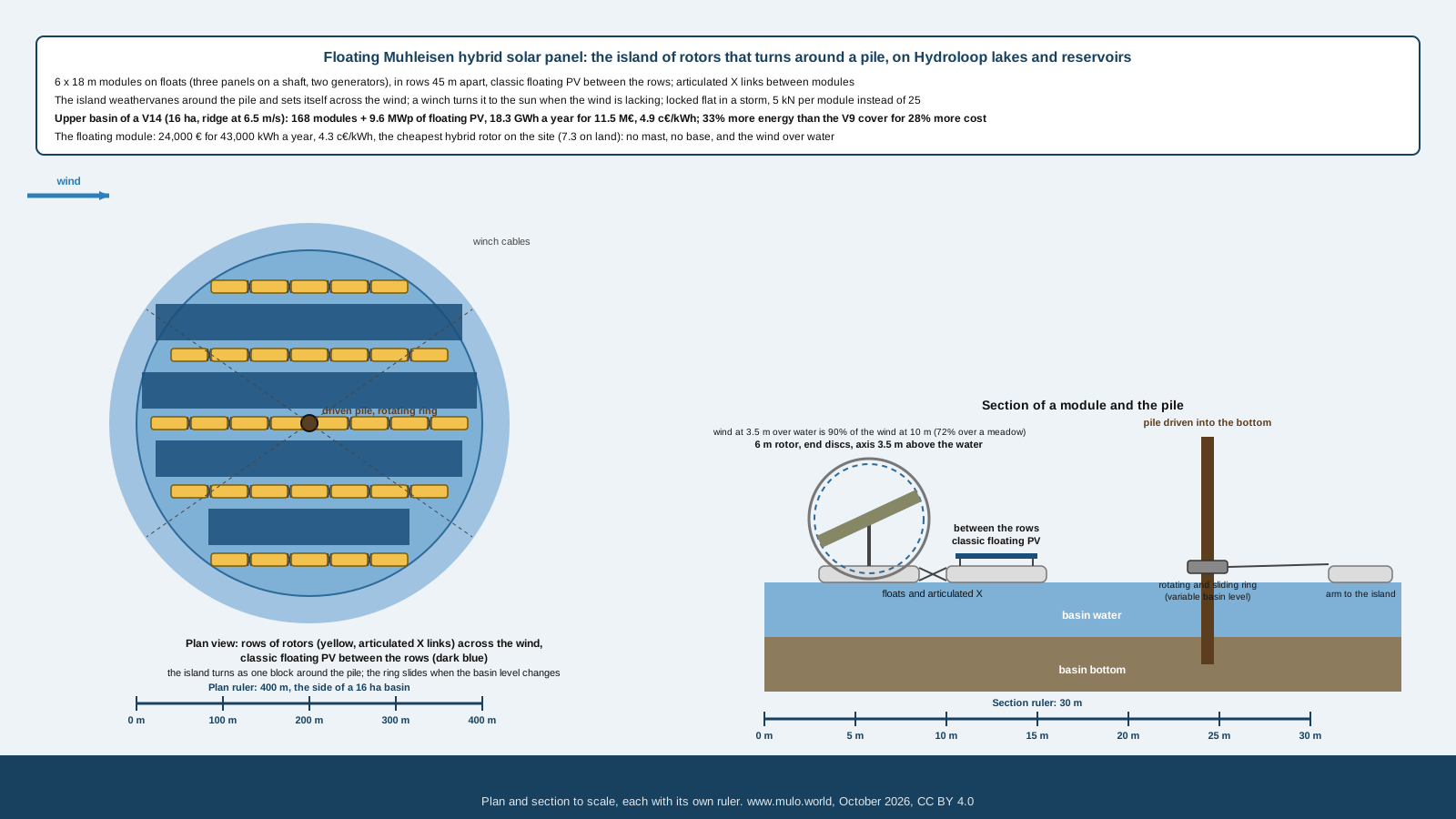
Diagram code (Python, free): schema_panneau_solaire_hybride_muhleisen_flottant.py; the calculation: panneau_solaire_hybride_muhleisen_flottant_calcul.py (without arguments it redoes the five sites of the page; arguments: site name, area in ha, wind at 10 m in m/s, equivalent sun hours, grand or petit (large or small))
The pages of the invention: Presentation | Simple version (in French) | Optimised version (in French) | Double version (in French) | 3-module tower (in French) | Industrial version | Corridor version (in French) | Floating version | World action plan (in French)
------------------------------
1. WHAT WATER BRINGS TO THE ROTOR
------------------------------
* Wind. The roughness of a body of water is a hundred times lower than that of a meadow: at 3.5 m above the water, the axis of a 6 m rotor on its floats receives 90% of the wind measured at 10 m; on land, at 4 m above the grass, 72%, and the 5 m mast of the industrial version (axis at 9 m) is needed to get back to 94%. The floating rotor loses 4% of wind compared with the rotor on a mast, and saves the mast, the base and the slewing ring, about 8,000 € out of the machine's 28,000.
* Cooling. A panel on water produces 3 to 5% more than on the ground, like all floating solar.
* Shade. The island covers the basin: it is the anti-evaporation cover of the V9 (in French), which the Hydroloops of dry sites already pay for, with wind added.
* Free orientation. A row of rotors held by its centre sets itself across the wind on its own, provided the pile is a little ahead of the island's centre of drag. Solar islands that turn around a pile to follow the sun have existed for several years (SolarisFloat in Portugal, Floating Solar in the Netherlands); here it is the wind that does most of the work and the winch that corrects.
------------------------------
2. THE MODULE: THREE PANELS ON A SHAFT, ON A RIGID FLOAT
------------------------------
One panel per rotor multiplies the generators and the electronics; ten panels on a common 60 m shaft, carried by floats that each move in their own way, twist the shaft at the first ripple. The right module is the one that already exists: the 18 m industrial rotor, three 6 m segments on a shaft, two generators of 10 kW in total, 14 kWp of bifacial panels, the cambered flaps, the deflector and the end discs. It is placed on a rigid 20 x 10 m float, and the floats are linked to each other by articulated flat-iron X links at their four corners: they hold the spacing, transmit the pull towards the pile, and let each module pitch by a few degrees. The modules of a row are synchronised electrically, through a common inverter, never mechanically.
The large floating module is the cheapest hybrid rotor of the whole invention: 4.3 c€/kWh on a windy ridge, 5.3 on a valley lake, against 7.3 for the same rotor on its mast. The small module, on the other hand, is not worth it: at 1.5 m above a pond, the wind is too weak (3.7 m/s at the axis), and the rotor brings in only 1,000 kWh a year; on a pond, classic floating PV at 5 c€ wins. Both sizes were costed because the question arose; only one is kept.
------------------------------
3. THE ISLAND: ROWS, FLOATING PV BETWEEN THE ROWS, PILE AND WINCHES
------------------------------
* The rows. Side by side on the same axis, the modules do not hinder each other; but a row placed behind another takes its wake. The rows are spaced 7.5 diameters apart, 45 m, across the prevailing wind. On a square 16 ha basin (400 x 400 m), 8 rows of 21 modules, 168 modules.
* Between the rows, classic floating PV, at 75% coverage of the free space: it makes most of the kWh and pays for the island, like the ground field of the industrial version. On 16 ha, 9.6 MWp, against 12 MWp if the whole basin were covered as on the V9: the rotors take a fifth of the surface.
* The pile. A pile driven into the bottom, at the centre, with a rotating ring that slides: on a Hydroloop basin the level varies by several metres every day, as for the variable-level anchoring of the V9. It is the safety part: a free rotor in a storm pulls up to 25 kN; locked flat, the island weathervaning, 5 kN. For 168 modules, 800 kN on the pile, the load of a moored barge; islands of 1,000 modules and more are split into several islands each with its own pile.
* The winches. Four cables from the pile to the edge of the island; in light wind, the winches turn the island towards the sun (azimuth), and locking the rotors gives the tilt. In strong wind, the winches are slack and the island sets itself across the wind on its own.
* The connection through a flexible underwater cable wound around the pile, as on rotating solar islands.
------------------------------
4. THE FIGURES, SITE BY SITE
------------------------------
Same method as the other hybrid panel pages: effective power coefficient 0.157 (end discs included) on 108 m², 10 kW maximum, cut-in at 3 m/s, Rayleigh wind at the axis, logarithmic profile with the roughness of water (0.2 mm); solar at the site's equivalent hours, +4% from cooling; classic floating PV at 750 € per kWp as on the V11; annuity 6.2% and maintenance 1.5% a year. The value of the MWh is that of the price profile of the V14 Soleil page: 49 €/MWh for midday solar, 73 for wind, which blows at night and in winter.
Three readings:
* On the cost of the kWh, the hybrid island is as good as the classic floating cover on a windy ridge (4.9 against 5.0 c€) and gives way a little on a valley lake (5.3 against 5.0): the floating rotor is cheap, but so is classic floating PV.
* On the value of the kWh, the island wins wherever there is wind: it returns 24 to 33% more energy on the same basin, and the quarter that comes from wind sells at night and in winter, 73 €/MWh instead of 49. On the V14 basin, 1.01 M€ of revenue instead of 0.67, and a payback of 13.9 years instead of 16.7. It is the same argument as the mixed V14 Soleil: midday solar sells poorly, wind corrects it.
* Where the water surface is the limit, the island is the only way to get more out of it: a Hydroloop basin has 16 ha, not one more. On a farm pond, however, the wind at 1.5 m is worth nothing: classic floating PV, and the small module stays on its roof.
------------------------------
5. WHERE IT GOES, AND WHAT IT CHANGES FOR THE HYDROLOOPS AND THE PLAN
------------------------------
* The upper basins of the V14 and V14 Soleil, on their ridge or plateau: it is the best site, ridge wind and a limited surface. The V14 Soleil already covers its two basins with 24 MWp of floating PV; the hybrid island would add 4.6 GWh of wind per basin, sold in the evening, for 2.5 M€ more per basin.
* The lower lakes of the Sky 2 and the Sky 3 (in French), 64 to 128 ha of fresh water on a valley floor or on the coast: less wind than a ridge, but surfaces four to eight times larger, and an island that reduces the evaporation of the lake that the Sky keeps for heat waves. On the lake of a Sky 3, 127 GWh a year, 7% of the plant's production, for 73 M€. The island placed on a complete Sky, lower lake, upper basin and lower basin, is the Hydroloop V20 O Sky, run through the hourly model of the Skys: 1.9 M€ net a year on a Sky 2, 1.3 on a Sky 3, without storing more.
* The rain lakes of the Pachas: no, or at the edge only. The lake is a settling basin that receives the floods of the belt canal and whose level varies by ten metres; an island there would hinder the water more than it would earn.
* Dam reservoirs, already counted in the hybrid panel plan (1.9 million modules "on dams", placed on the ridges and banks): the floating island is the way to put them on the water rather than around it, with the dam's substation next door.
* Quarry and gravel pit lakes in the plains: yes for floating PV, no for the rotor, unless the site is windy.
For the world plan, the floating version does not create a new line: it is a way of placing the modules that the plan already counts on dams, and an option of the Hydroloops that replaces part of their V9 cover. Its effect is the same as that of the end discs or the crown: a few percent on existing items, to be counted in a future overhaul, not now.
------------------------------
6. POINTS TO WATCH
------------------------------
* Waves. On a 16 ha basin or a sheltered 100 ha lake, the swell remains short; on a large lake or a 10 km reservoir, the island needs higher floats and more flexible X links, and the calculation is no longer this one.
* Level. Hydroloop basins empty and fill every day: the sliding ring of the pile and the flexible cable are mandatory, and the island must never touch the bottom in a corner of the basin at low level.
* Corrosion: fresh water only. No lagoon or coastal seawater basin; the fresh-water lower lake of a Sky 3, yes, its salt loop, no.
* Frost, which blocks the rotation of the island and loads the floats; bird droppings, which soil all floating PV and require cleaning.
* The pile and the storm: the rule is to lock the rotors flat from 20 m/s and leave the island weathervaning; the pile is calculated for 5 kN per module and a safety factor, and an island does not exceed 200 modules per pile.
* The wake of the ridge: on the upper basin of a V14, the 40 wind turbines of the ridge are next to it; the island is placed upwind of them, or 10% less wind is counted.
* Nothing is measured: the wind at 3.5 m on a ridge basin, the behaviour of the articulated X links, the behaviour of the island weathervaning with 168 rotors turning. A prototype of one row on an existing basin, measured for a year, before the series.
------------------------------
7. THE GOOD IDEAS OF THE FLOATING VERSION
------------------------------
* On water, the low rotor receives almost the wind of a mast: the roughness of the water replaces the mast, the base and the slewing ring.
* The island held by its centre sets itself across the wind on its own; the winch is only for the sun.
* One rotor per rigid float, three panels on a shaft, and articulated X links between floats: never a common shaft on floats that move.
* On a limited basin, the hybrid island is the only way to get more energy from the same surface, and it sells a quarter of this energy at night and in winter.
------------------------------
SOURCES
------------------------------
The calculation of the floating version (Python, no library)
The industrial version, the base module and the Corridor version (in French)
Hydroloop V9: basin covers and floating photovoltaics (in French), V11: the price of floating PV (in French), V14 Soleil: the value of the midday MWh
SolarisFloat: the Protevs rotating floating solar island (Portugal)
Floating Solar: sun-tracking floating solar islands (Netherlands)
SERIS, Where Sun Meets Water: the World Bank's floating solar guide
World action plan of the Muhleisen hybrid solar panel (in French)
The site's good ideas (in French)
Olivier Muhleisen in collaboration with Claude (Anthropic), October 2026. Royalty-free plans, open source, CC BY 4.0.
© 2009-2026 Onmyweb Production - TOS - Cookies information - Contact us - Free Copyright Open Source -
1. WHAT WATER BRINGS TO THE ROTOR
------------------------------
* Wind. The roughness of a body of water is a hundred times lower than that of a meadow: at 3.5 m above the water, the axis of a 6 m rotor on its floats receives 90% of the wind measured at 10 m; on land, at 4 m above the grass, 72%, and the 5 m mast of the industrial version (axis at 9 m) is needed to get back to 94%. The floating rotor loses 4% of wind compared with the rotor on a mast, and saves the mast, the base and the slewing ring, about 8,000 € out of the machine's 28,000.
* Cooling. A panel on water produces 3 to 5% more than on the ground, like all floating solar.
* Shade. The island covers the basin: it is the anti-evaporation cover of the V9 (in French), which the Hydroloops of dry sites already pay for, with wind added.
* Free orientation. A row of rotors held by its centre sets itself across the wind on its own, provided the pile is a little ahead of the island's centre of drag. Solar islands that turn around a pile to follow the sun have existed for several years (SolarisFloat in Portugal, Floating Solar in the Netherlands); here it is the wind that does most of the work and the winch that corrects.
------------------------------
2. THE MODULE: THREE PANELS ON A SHAFT, ON A RIGID FLOAT
------------------------------
One panel per rotor multiplies the generators and the electronics; ten panels on a common 60 m shaft, carried by floats that each move in their own way, twist the shaft at the first ripple. The right module is the one that already exists: the 18 m industrial rotor, three 6 m segments on a shaft, two generators of 10 kW in total, 14 kWp of bifacial panels, the cambered flaps, the deflector and the end discs. It is placed on a rigid 20 x 10 m float, and the floats are linked to each other by articulated flat-iron X links at their four corners: they hold the spacing, transmit the pull towards the pile, and let each module pitch by a few degrees. The modules of a row are synchronised electrically, through a common inverter, never mechanically.
| Item | Large module (Hydroloop basins, reservoirs) | Small module (farm and quarry ponds) |
|---|---|---|
| Rotor | 6 m diameter, 18 m long, 108 m² swept, three 6 m bifacial glass-glass panels, flaps, deflector, end discs | 2 m diameter, 6.6 m long, 13 m² swept, three 2.2 m panels, the optimised module in a row |
| Electricity | 10 kW of wind, 14 kWp of solar | 1.2 kW of wind, 2.6 kWp of solar |
| Float | 20 x 10 m in polyethylene, adjustable water ballast, axis at 3.5 m | 8 x 4 m, axis at 1.5 m |
| Installed price in series, share of the pile and winches included | 24,000 € (rotor 19,000, float 3,000, X links and cabling 500, pile and winches 1,500) | 5,500 € |
| Production per year on the upper basin of a V14 (wind at the axis 5.9 m/s) | 27,300 kWh of wind + 16,000 of solar = 43,300 kWh, 4.3 c€/kWh | |
| Production per year on a valley lake at 5.5 m/s regional (axis 5.0 m/s) | 18,900 + 16,000 = 34,900 kWh, 5.3 c€/kWh | |
| Production per year on a pond at 4.5 m/s regional (axis 3.7 m/s) | 1,000 + 3,000 = 4,000 kWh, 10.6 c€/kWh | |
| The same rotor on land | 27,987 € on a 5 m mast, 37,500 kWh, 7.3 c€/kWh (industrial page) | the optimised module on a roof, 2,981 kWh at 0.17 €/kWh |
The large floating module is the cheapest hybrid rotor of the whole invention: 4.3 c€/kWh on a windy ridge, 5.3 on a valley lake, against 7.3 for the same rotor on its mast. The small module, on the other hand, is not worth it: at 1.5 m above a pond, the wind is too weak (3.7 m/s at the axis), and the rotor brings in only 1,000 kWh a year; on a pond, classic floating PV at 5 c€ wins. Both sizes were costed because the question arose; only one is kept.
------------------------------
3. THE ISLAND: ROWS, FLOATING PV BETWEEN THE ROWS, PILE AND WINCHES
------------------------------
* The rows. Side by side on the same axis, the modules do not hinder each other; but a row placed behind another takes its wake. The rows are spaced 7.5 diameters apart, 45 m, across the prevailing wind. On a square 16 ha basin (400 x 400 m), 8 rows of 21 modules, 168 modules.
* Between the rows, classic floating PV, at 75% coverage of the free space: it makes most of the kWh and pays for the island, like the ground field of the industrial version. On 16 ha, 9.6 MWp, against 12 MWp if the whole basin were covered as on the V9: the rotors take a fifth of the surface.
* The pile. A pile driven into the bottom, at the centre, with a rotating ring that slides: on a Hydroloop basin the level varies by several metres every day, as for the variable-level anchoring of the V9. It is the safety part: a free rotor in a storm pulls up to 25 kN; locked flat, the island weathervaning, 5 kN. For 168 modules, 800 kN on the pile, the load of a moored barge; islands of 1,000 modules and more are split into several islands each with its own pile.
* The winches. Four cables from the pile to the edge of the island; in light wind, the winches turn the island towards the sun (azimuth), and locking the rotors gives the tilt. In strong wind, the winches are slack and the island sets itself across the wind on its own.
* The connection through a flexible underwater cable wound around the pile, as on rotating solar islands.
------------------------------
4. THE FIGURES, SITE BY SITE
------------------------------
Same method as the other hybrid panel pages: effective power coefficient 0.157 (end discs included) on 108 m², 10 kW maximum, cut-in at 3 m/s, Rayleigh wind at the axis, logarithmic profile with the roughness of water (0.2 mm); solar at the site's equivalent hours, +4% from cooling; classic floating PV at 750 € per kWp as on the V11; annuity 6.2% and maintenance 1.5% a year. The value of the MWh is that of the price profile of the V14 Soleil page: 49 €/MWh for midday solar, 73 for wind, which blows at night and in winter.
| Site | Modules and floating PV | Energy per year (rotor wind / rotor solar / floating PV) | Price | c€/kWh | Revenue per year at the sunny profile, payback | V9 cover alone (75% floating PV): energy, price, c€/kWh, revenue, payback |
|---|---|---|---|---|---|---|
| Upper basin of a V14, 16 ha, ridge at 6.5 m/s | 168 large modules + 9.6 MWp | 18.3 GWh (4.6 / 2.7 / 11.0) | 11.5 M€ | 4.9 | 1.01 M€, 13.9 years | 13.7 GWh, 9.0 M€, 5.0 c€, 0.67 M€, 16.7 years |
| Lower lake of a Sky 2, 64 ha, valley at 5.5 m/s | 714 modules + 37.8 MWp | 68.2 GWh (13.5 / 11.4 / 43.2) | 46.6 M€ | 5.3 | 3.66 M€, 15.7 years | 54.9 GWh, 36.0 M€, 5.0 c€, 2.69 M€, 16.7 years |
| Fresh-water lower lake of a Sky 3, 100 ha, coast at 6.0 m/s, 1,300 hours | 1,144 modules + 58.5 MWp | 127.2 GWh (26.4 / 21.7 / 79.1) | 73.1 M€ | 4.4 | 6.87 M€, 12.7 years | 101.4 GWh, 56.3 M€, 4.3 c€, 4.97 M€, 13.6 years |
| Dam reservoir, 100 ha, 5.5 m/s | 1,144 modules + 58.5 MWp | 106.9 GWh (21.6 / 18.3 / 66.9) | 73.1 M€ | 5.3 | 5.75 M€, 15.7 years | 85.8 GWh, 56.3 M€, 5.0 c€, 4.20 M€, 16.7 years |
| Farm or quarry pond, 1 ha, 4.5 m/s, small modules | 78 small modules + 0.57 MWp | 0.96 GWh (0.08 / 0.23 / 0.65) | 0.90 M€ | 7.2 | 0.05 M€, 25 years | 0.86 GWh, 0.56 M€, 5.0 c€, 0.04 M€, 16.7 years |
Three readings:
* On the cost of the kWh, the hybrid island is as good as the classic floating cover on a windy ridge (4.9 against 5.0 c€) and gives way a little on a valley lake (5.3 against 5.0): the floating rotor is cheap, but so is classic floating PV.
* On the value of the kWh, the island wins wherever there is wind: it returns 24 to 33% more energy on the same basin, and the quarter that comes from wind sells at night and in winter, 73 €/MWh instead of 49. On the V14 basin, 1.01 M€ of revenue instead of 0.67, and a payback of 13.9 years instead of 16.7. It is the same argument as the mixed V14 Soleil: midday solar sells poorly, wind corrects it.
* Where the water surface is the limit, the island is the only way to get more out of it: a Hydroloop basin has 16 ha, not one more. On a farm pond, however, the wind at 1.5 m is worth nothing: classic floating PV, and the small module stays on its roof.
------------------------------
5. WHERE IT GOES, AND WHAT IT CHANGES FOR THE HYDROLOOPS AND THE PLAN
------------------------------
* The upper basins of the V14 and V14 Soleil, on their ridge or plateau: it is the best site, ridge wind and a limited surface. The V14 Soleil already covers its two basins with 24 MWp of floating PV; the hybrid island would add 4.6 GWh of wind per basin, sold in the evening, for 2.5 M€ more per basin.
* The lower lakes of the Sky 2 and the Sky 3 (in French), 64 to 128 ha of fresh water on a valley floor or on the coast: less wind than a ridge, but surfaces four to eight times larger, and an island that reduces the evaporation of the lake that the Sky keeps for heat waves. On the lake of a Sky 3, 127 GWh a year, 7% of the plant's production, for 73 M€. The island placed on a complete Sky, lower lake, upper basin and lower basin, is the Hydroloop V20 O Sky, run through the hourly model of the Skys: 1.9 M€ net a year on a Sky 2, 1.3 on a Sky 3, without storing more.
* The rain lakes of the Pachas: no, or at the edge only. The lake is a settling basin that receives the floods of the belt canal and whose level varies by ten metres; an island there would hinder the water more than it would earn.
* Dam reservoirs, already counted in the hybrid panel plan (1.9 million modules "on dams", placed on the ridges and banks): the floating island is the way to put them on the water rather than around it, with the dam's substation next door.
* Quarry and gravel pit lakes in the plains: yes for floating PV, no for the rotor, unless the site is windy.
For the world plan, the floating version does not create a new line: it is a way of placing the modules that the plan already counts on dams, and an option of the Hydroloops that replaces part of their V9 cover. Its effect is the same as that of the end discs or the crown: a few percent on existing items, to be counted in a future overhaul, not now.
------------------------------
6. POINTS TO WATCH
------------------------------
* Waves. On a 16 ha basin or a sheltered 100 ha lake, the swell remains short; on a large lake or a 10 km reservoir, the island needs higher floats and more flexible X links, and the calculation is no longer this one.
* Level. Hydroloop basins empty and fill every day: the sliding ring of the pile and the flexible cable are mandatory, and the island must never touch the bottom in a corner of the basin at low level.
* Corrosion: fresh water only. No lagoon or coastal seawater basin; the fresh-water lower lake of a Sky 3, yes, its salt loop, no.
* Frost, which blocks the rotation of the island and loads the floats; bird droppings, which soil all floating PV and require cleaning.
* The pile and the storm: the rule is to lock the rotors flat from 20 m/s and leave the island weathervaning; the pile is calculated for 5 kN per module and a safety factor, and an island does not exceed 200 modules per pile.
* The wake of the ridge: on the upper basin of a V14, the 40 wind turbines of the ridge are next to it; the island is placed upwind of them, or 10% less wind is counted.
* Nothing is measured: the wind at 3.5 m on a ridge basin, the behaviour of the articulated X links, the behaviour of the island weathervaning with 168 rotors turning. A prototype of one row on an existing basin, measured for a year, before the series.
------------------------------
7. THE GOOD IDEAS OF THE FLOATING VERSION
------------------------------
* On water, the low rotor receives almost the wind of a mast: the roughness of the water replaces the mast, the base and the slewing ring.
* The island held by its centre sets itself across the wind on its own; the winch is only for the sun.
* One rotor per rigid float, three panels on a shaft, and articulated X links between floats: never a common shaft on floats that move.
* On a limited basin, the hybrid island is the only way to get more energy from the same surface, and it sells a quarter of this energy at night and in winter.
------------------------------
SOURCES
------------------------------
The calculation of the floating version (Python, no library)
The industrial version, the base module and the Corridor version (in French)
Hydroloop V9: basin covers and floating photovoltaics (in French), V11: the price of floating PV (in French), V14 Soleil: the value of the midday MWh
SolarisFloat: the Protevs rotating floating solar island (Portugal)
Floating Solar: sun-tracking floating solar islands (Netherlands)
SERIS, Where Sun Meets Water: the World Bank's floating solar guide
World action plan of the Muhleisen hybrid solar panel (in French)
The site's good ideas (in French)
Olivier Muhleisen in collaboration with Claude (Anthropic), October 2026. Royalty-free plans, open source, CC BY 4.0.
© 2009-2026 Onmyweb Production - TOS - Cookies information - Contact us - Free Copyright Open Source -