
Muhleisen hybrid solar panel, industrial version: 6 × 18 m yawing rotor on a 5 m mast and a 48 kWp ground field, up to 93,814 kWh a year and 0.055 €/kWh on a windy coast, end discs included; with the gravel path and its bifacial crown, up to 120,900 kWh a year and 0.052 €/kWh. 12/10/26, updated 19/10/26
The industrial version seeks the cheapest kWh: a rotor 6 m in diameter and 18 m long, yawing, raised by 5 m, and beneath it a ground field that covers the whole circle swept by the machine. This page compares heights from 0 to 20 m and the fixed axis, and since 19/10/26 adds the rotor's end discs (section 1), the peripheral gravel path with its crown of bifacial panels (section 8) and the natural corridor site criterion. The principle and the comparison of the other versions are on the presentation page.
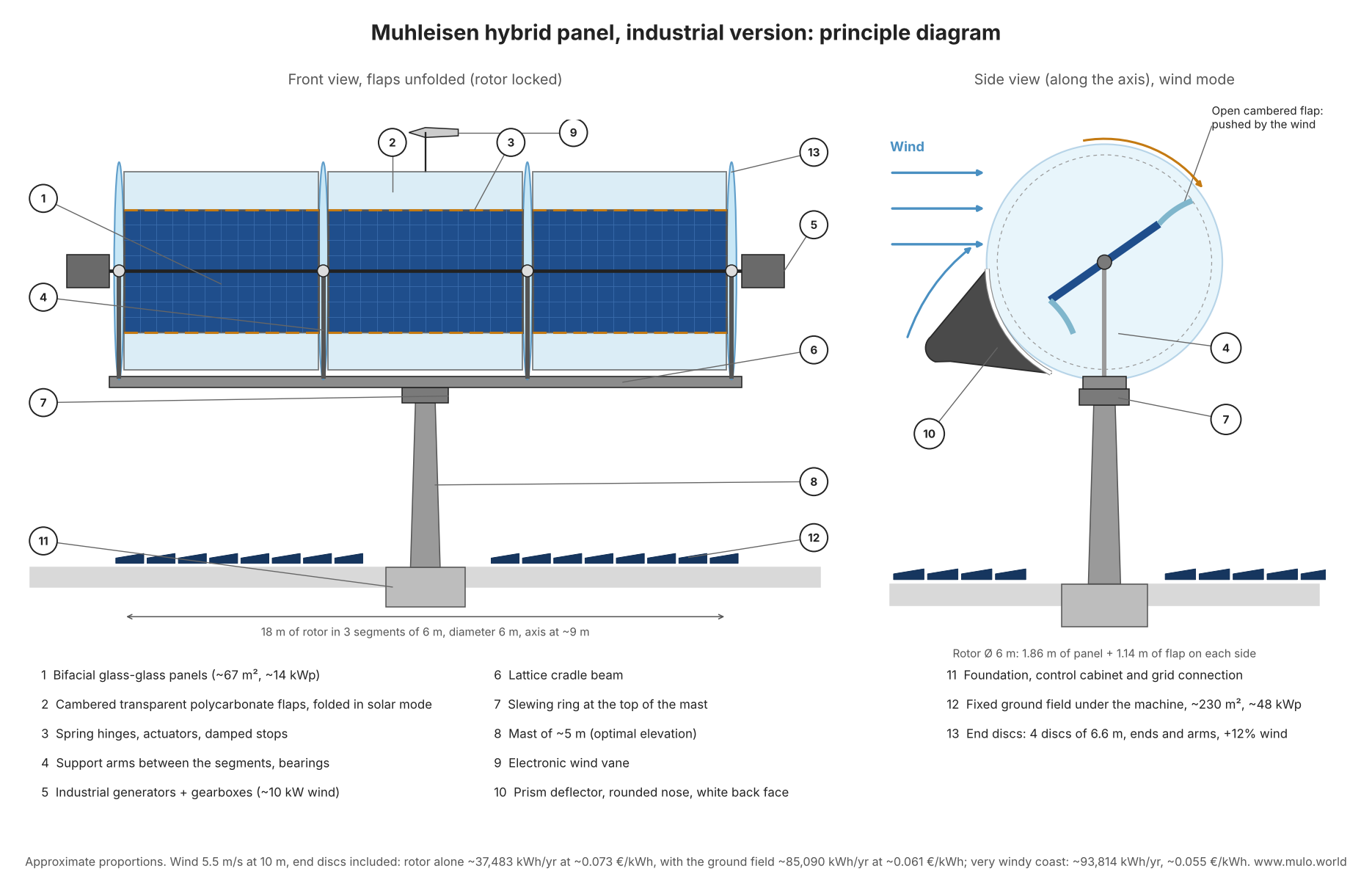
Diagram code (Python, free): schema_panneau_solaire_hybride_muhleisen_industriel.py
The pages of the invention: Presentation | Simple version (in French) | Optimised version (and glass-free option) (in French) | Double version (in French) | 3-module tower (in French) | Industrial version | Corridor version (in French) | Floating version | World action plan (in French)
------------------------------
1. THE PRINCIPLE OF THE INDUSTRIAL VERSION
------------------------------
* Rotor 6 m in diameter and 18 m long, in three 6 m segments between support arms with bearings.
* Bifacial glass-glass panels (~67 m², ~14 kWp), cambered flaps in anti-UV transparent polycarbonate (~41 m²), spring hinges, damped stops; six small actuators fold them behind the panels in solar mode, press them flat in a storm and open them in case of overheating.
* Industrial generators with gearboxes (~10 kW of wind).
* Assisted start (added 23/10/26): the generator acts as a starter when unlocking, powered by the ground field; the drag rotor starts on its own, the starter only helps with short gusts, the dead point and freeing it, less than 1% of production, as on the modules.
* End discs, added 19/10/26: four 6.6 m discs in galvanised sheet on a light frame, at both ends of the rotor and on the two intermediate arms, carried by the cradle beam (~1,600 €). Each 6 m segment works as a closed rotor, air no longer escapes through the ends when the flap pushes: +12% wind (+8 to +15%), i.e. +1,300 to +2,100 kWh a year depending on the wind, the 10 kW generator clipping the surplus above 8.5 m/s. The kWh does not move (0.061 → 0.0614 at 5.5 m/s): they make more kWh on the same footprint, and 12 kW generators (+600 €) would draw 1,000 to 2,000 kWh more from them on a windy coast. Opaque, they cast a negligible shadow on the field (discs in the plane of the wind, perpendicular to the rotor); to be strapped down with the rotor in case of a cyclone.
* Lattice cradle beam on a slewing ring at the top of a ~5 m mast: the whole assembly turns to face the wind and tracks the sun, electronic wind vane.
* Prism deflector with a rounded nose, in galvanised corrugated sheet on a frame, white back face (~2,300 to 2,500 €): it guides the air towards the upper half of the rotor and makes the flow more regular.
* Fixed ground field under the machine: ~230 m² of monofacial panels, ~48 kWp, over the whole circle swept by the yawing (Ø ~19 m).
* Foundation, control cabinet and grid connection.
* Annual maintenance of the flaps: cleaning and a UV protection spray made for polycarbonate, to delay yellowing and embrittlement.
------------------------------
2. THE GROUND FIELD UNDER THE MACHINE
------------------------------
As on the modules, the surface under the rotor receives a ground panel, as large as possible. The rotor yaws, so the field is fixed and covers the whole circle it sweeps as it turns on its mast, Ø ~19 m, minus the foundation and a maintenance aisle: ~256 m² of land, ~230 m² of monofacial panels tilted at 10° due south, in low rows (0.6 m at most), ~48 kWp. The transparent flaps folded in solar mode let the sun through between the rotor and the field, and light also passes through them in rotation.
The rotor is high (axis at ~9 m): its shadow often falls outside the field. Shadow calculation in 3D hour by hour, rotor locked facing the sun or rotating, wind of 5.5 m/s at 10 m:
This is no small thing: the ground field produces more than the rotor itself. It must be said honestly: it is classic ground-mounted photovoltaics, cheap in itself, and it is what lowers the average price, not the rotor. Its interest here is to use land that the machine already occupies, with the same connection and the same cabinet.
------------------------------
3. WHAT HEIGHT?
------------------------------
Rotor and ground field together, depending on the elevation of the rotor, for three mean winds at 10 m. In brackets, the €/kWh of the rotor alone.
The other rows are without end discs (12/10/26): they would gain the same proportion, +1.5 to +2.5%. With the ground field, +5 m and +10 m are equal within a thousandth: at +10 m, the rotor casts less shadow on the field. +5 m is kept: a shorter mast, less wind load, simpler folding. Wind speeds at the axis at +5 m: 4.4, 5.4, 6.4 m/s.
------------------------------
4. YAWING OR FIXED AXIS?
------------------------------
The slewing ring pays for itself: +16% production for a kWh 9% cheaper.
------------------------------
5. WHY NOT LARGER?
------------------------------
A drag rotor with solid plates requires material proportional to its surface multiplied by its size: doubling the diameter multiplies the mass by eight for four times more surface. The optimum is a medium size, between 5 and 8 m in diameter. To go further, the machines are multiplied, not enlarged.
------------------------------
6. PLACE IN THE MIX
------------------------------
With its ground field, 0.055 to 0.061 €/kWh on a windy coast (0.059 to 0.073 for the rotor alone), the industrial version remains more expensive than a large wind turbine (the V11 of the Hydroloop plan holds 35 €/MWh). But it can be installed where a large wind turbine is forbidden or refused: areas near homes, military sites and airports, protected landscapes, and it uses parts that are easy to mass-produce. Footprint: ~280 m² per machine.
On a planetary scale, on a 20 m mast and on land already occupied, see the world action plan of the Muhleisen hybrid solar panel (in French): 109 million modules, about half of the world's fossil electricity.
------------------------------
7. CYCLONE PROTECTION OPTION: FOLDING THE INSTALLATION TO THE GROUND
------------------------------
A cyclone wind at 250 km/h pushes about 2.8 times harder than a storm at 150 km/h.
Tilting an 18 m cradle weighing several tonnes would be tricky. The solution: a telescopic mast with two hydraulic cylinders that lowers the cradle vertically, from about 9 m to 4.5 m of axis height, the bottom of the rotor remaining 1.5 m above the ground field, then the rotor is strapped to anchors placed between the rows of panels. Estimated extra cost 2,500 to 3,500 €: with the ground field, the kWh goes from 0.055 to about 0.058 € on a very windy coast, and from 0.061 to about 0.064 € at 5.5 m/s.
Simpler still in a cyclone zone: do not raise the rotor (+0 m, bottom of the rotor at 0.9 m, above the low rows) and strap it directly. That gives 0.061 and 0.068 €/kWh with the field, almost like the folding version, without cylinders. But the strapped rotor stays up and exposed: the mast, the slewing ring and the anchors are then sized for the cyclone wind.
Sequence before a cyclone: rotor locked flat with flaps closed, deflector folded or removed, wind vane retracted, the whole assembly folded down, ratchet straps on sealed anchor points. The model to follow: the Vergnet wind turbines of the islands, laid on the ground by two people in less than an hour and rated for more than 300 km/h once strapped.
------------------------------
8. UPDATE OF 19/10/26: THE GRAVEL PATH, THE BIFACIAL CROWN AND THE NATURAL CORRIDOR
------------------------------
The study of the Corridor version (in French) (retractable panels forming a wind ramp towards the rotor, calculated and not kept) produced two additions that do lower the kWh of the industrial version.
The gravel path and its bifacial crown. The installation needs an access path: it runs around the field, 3 m of white gravel, access, maintenance parking, and no more vegetation growing up to shade the first rows. It is earthworks that would be needed anyway, outside the solar budget. On its edge, bifacial panels at 30°, back face above the gravel: an isolated row sees the gravel and a good half of the sky from the back. North arc facing south (40 m², +33% per m² compared with the field), east arc facing east (32 m², +18%, +64% in the morning) and west arc facing west (32 m², +18%, +55% in the evening): 104 m², 21.8 kWp, 27,100 kWh a year after 1.1% clipping on the field's 36 kVA inverter, for 14,000 € installed, i.e. 0.041 €/kWh, the cheapest kWh of the installation. The east and west arcs produce when the field is not at full power and do not need a third connection. In monofacial the crown would be worth nothing (-11% facing east): it is bifacial or nothing. Footprint with the path and the crown: 29 m in diameter, about 660 m²; where space is lacking, the machine and its field alone remain the base.
The natural corridor. A machine placed at the top of a slope facing the prevailing wind receives 10 to 30% more wind over the whole height of the rotor (hill of 20 to 50 m, slope of 10 to 20%): +23 to +67% on the wind share of the rotor at 5.5 m/s, and the field laid on the slope is a free amphitheatre, without shading between rows, +5% solar. With the crown and the end discs, 122,000 kWh a year at 0.052 €/kWh for a regional wind of 5.5 m/s, 131,000 kWh and 0.048 €/kWh at 6.5 m/s. The figures, the site rules and the calculations of the abandoned panel ramp are on the Corridor page (in French).
------------------------------
9. CALCULATION METHOD
------------------------------
Same method as the modules (pvlib in Brest, Rayleigh, logarithmic profile), with an effective power coefficient increased by 30% for the cambered flaps and the deflector, plus 5% for the rounded prism shape of the deflector, i.e. an effective coefficient of about 0.14 at the electrical output, to be confirmed on a prototype; since 19/10/26, the end discs add 12% (0.157), the generator remaining capped at 10 kW. Transparent flaps: ~78% transmission on average over their lifetime, 7% of light lost through the back face of the panels in solar mode. Ground field: monofacial panels at 10° due south, 21% efficiency, 15% system losses, 3% shading between rows, rotor shadow calculated in 3D hour by hour, ~0.58 €/Wp installed in series (about 120 €/m²), plus ~3,000 € for a second connection point: machine and field each stay below 36 kVA, which avoids a far more expensive connection above 36 kVA, at the cost of about 2% of energy clipped on the field. Cost annualised by the capital recovery factor over 25 years at 4%, plus maintenance and insurance: 3% a year for the machine, 1.2% for the field. Inverters replaced in year 12 (~2,800 € for the field, ~1,500 € for the wind converter), polycarbonate flaps replaced in year 15 (~1,700 €).
------------------------------
SOURCES
------------------------------
Hydroloop world plan: decarbonising world electricity (in French)
Google Patents: US 8,354,757 B2 (W. E. Lee and R. F. Pienkowski), the 2011 prior art
Sunman Energy: eArc glass-free photovoltaic modules
pvlib python: simulation of photovoltaic production
Wind-Works: Warwick Wind Trials, small roof wind turbines measured
Energy Saving Trust: field trials of small wind turbines in the United Kingdom
Wikipedia: Savonius rotor (drag rotor)
Wikipedia: Rayleigh distribution, distribution of wind speeds
Wikipedia: bifacial solar cells
Wikipedia: corrugated galvanised steel sheet
Vergnet: GEV MP-C wind turbine with tilting mast for cyclone zones (in French)
Batiweb: on Réunion, wind turbines tilt down to avoid cyclones (in French)
photovoltaique.info: grid connection of an installation above 36 kVA (in French)
Auvergne-Rhône-Alpes Chamber of Agriculture: costs of a 36 to 250 kWp photovoltaic plant (in French)
Olivier Muhleisen in collaboration with Claude (Anthropic), October 2026. Royalty-free plans, open source.
© 2009-2026 Onmyweb Production - TOS - Cookies information - Contact us - Free Copyright Open Source -
1. THE PRINCIPLE OF THE INDUSTRIAL VERSION
------------------------------
* Rotor 6 m in diameter and 18 m long, in three 6 m segments between support arms with bearings.
* Bifacial glass-glass panels (~67 m², ~14 kWp), cambered flaps in anti-UV transparent polycarbonate (~41 m²), spring hinges, damped stops; six small actuators fold them behind the panels in solar mode, press them flat in a storm and open them in case of overheating.
* Industrial generators with gearboxes (~10 kW of wind).
* Assisted start (added 23/10/26): the generator acts as a starter when unlocking, powered by the ground field; the drag rotor starts on its own, the starter only helps with short gusts, the dead point and freeing it, less than 1% of production, as on the modules.
* End discs, added 19/10/26: four 6.6 m discs in galvanised sheet on a light frame, at both ends of the rotor and on the two intermediate arms, carried by the cradle beam (~1,600 €). Each 6 m segment works as a closed rotor, air no longer escapes through the ends when the flap pushes: +12% wind (+8 to +15%), i.e. +1,300 to +2,100 kWh a year depending on the wind, the 10 kW generator clipping the surplus above 8.5 m/s. The kWh does not move (0.061 → 0.0614 at 5.5 m/s): they make more kWh on the same footprint, and 12 kW generators (+600 €) would draw 1,000 to 2,000 kWh more from them on a windy coast. Opaque, they cast a negligible shadow on the field (discs in the plane of the wind, perpendicular to the rotor); to be strapped down with the rotor in case of a cyclone.
* Lattice cradle beam on a slewing ring at the top of a ~5 m mast: the whole assembly turns to face the wind and tracks the sun, electronic wind vane.
* Prism deflector with a rounded nose, in galvanised corrugated sheet on a frame, white back face (~2,300 to 2,500 €): it guides the air towards the upper half of the rotor and makes the flow more regular.
* Fixed ground field under the machine: ~230 m² of monofacial panels, ~48 kWp, over the whole circle swept by the yawing (Ø ~19 m).
* Foundation, control cabinet and grid connection.
* Annual maintenance of the flaps: cleaning and a UV protection spray made for polycarbonate, to delay yellowing and embrittlement.
------------------------------
2. THE GROUND FIELD UNDER THE MACHINE
------------------------------
As on the modules, the surface under the rotor receives a ground panel, as large as possible. The rotor yaws, so the field is fixed and covers the whole circle it sweeps as it turns on its mast, Ø ~19 m, minus the foundation and a maintenance aisle: ~256 m² of land, ~230 m² of monofacial panels tilted at 10° due south, in low rows (0.6 m at most), ~48 kWp. The transparent flaps folded in solar mode let the sun through between the rotor and the field, and light also passes through them in rotation.
The rotor is high (axis at ~9 m): its shadow often falls outside the field. Shadow calculation in 3D hour by hour, rotor locked facing the sun or rotating, wind of 5.5 m/s at 10 m:
| Elevation of the rotor | Ground field, kWh per year | Loss from the rotor's shadow |
|---|---|---|
| Without rotor (reference) | 50,970 | |
| +0 m | 41,749 | 18% |
| +2 m | 44,823 | 12% |
| +5 m (kept) | 47,608 | 7% |
| +10 m | 49,631 | 3% |
| +20 m | 50,625 | 1% |
| At +5 m, wind 5.5 m/s at 10 m | Installed price | kWh per year | €/kWh over 25 years |
|---|---|---|---|
| Hybrid rotor alone, end discs included (19/10/26) | 27,987 € | 37,483 | 0.073 |
| Ground field (with the flap actuators) | 30,800 € | 47,608 | 0.052 |
| Total | 58,787 € | 85,090 | 0.061 |
This is no small thing: the ground field produces more than the rotor itself. It must be said honestly: it is classic ground-mounted photovoltaics, cheap in itself, and it is what lowers the average price, not the rotor. Its interest here is to use land that the machine already occupies, with the same connection and the same cabinet.
------------------------------
3. WHAT HEIGHT?
------------------------------
Rotor and ground field together, depending on the elevation of the rotor, for three mean winds at 10 m. In brackets, the €/kWh of the rotor alone.
| Elevation | Installed price | Wind 4.5 m/s at 10 m | Wind 5.5 m/s at 10 m | Wind 6.5 m/s at 10 m |
|---|---|---|---|---|
| +0 m | 54,752 € | 65,084 kWh, 0.074 €/kWh (0.099) | 71,232 kWh, 0.068 €/kWh (0.081) | 78,671 kWh, 0.061 €/kWh (0.065) |
| +2 m | 55,726 € | 70,174 kWh, 0.070 €/kWh (0.095) | 77,302 kWh, 0.064 €/kWh (0.076) | 85,348 kWh, 0.058 €/kWh (0.061) |
| +5 m (kept), end discs included | 58,787 € | 76,583 kWh, 0.068 €/kWh (0.094) | 85,090 kWh, 0.061 €/kWh (0.073) | 93,814 kWh, 0.055 €/kWh (0.060) |
| +10 m | 59,621 € | 79,973 kWh, 0.066 €/kWh (0.093) | 88,791 kWh, 0.060 €/kWh (0.072) | 97,682 kWh, 0.054 €/kWh (0.059) |
| +20 m | 64,490 € | 84,397 kWh, 0.068 €/kWh (0.097) | 94,059 kWh, 0.061 €/kWh (0.076) | 103,351 kWh, 0.056 €/kWh (0.062) |
The other rows are without end discs (12/10/26): they would gain the same proportion, +1.5 to +2.5%. With the ground field, +5 m and +10 m are equal within a thousandth: at +10 m, the rotor casts less shadow on the field. +5 m is kept: a shorter mast, less wind load, simpler folding. Wind speeds at the axis at +5 m: 4.4, 5.4, 6.4 m/s.
------------------------------
4. YAWING OR FIXED AXIS?
------------------------------
| At +5 m, wind 5.5 m/s at 10 m, rotor alone | kWh per year | €/kWh over 25 years |
|---|---|---|
| Yawing (slewing ring, tracking wind and sun), without end discs | 35,644 | 0.073 |
| Yawing, end discs included (19/10/26) | 37,483 | 0.073 |
| Fixed axis, without end discs | 30,764 | 0.080 |
The slewing ring pays for itself: +16% production for a kWh 9% cheaper.
------------------------------
5. WHY NOT LARGER?
------------------------------
A drag rotor with solid plates requires material proportional to its surface multiplied by its size: doubling the diameter multiplies the mass by eight for four times more surface. The optimum is a medium size, between 5 and 8 m in diameter. To go further, the machines are multiplied, not enlarged.
------------------------------
6. PLACE IN THE MIX
------------------------------
With its ground field, 0.055 to 0.061 €/kWh on a windy coast (0.059 to 0.073 for the rotor alone), the industrial version remains more expensive than a large wind turbine (the V11 of the Hydroloop plan holds 35 €/MWh). But it can be installed where a large wind turbine is forbidden or refused: areas near homes, military sites and airports, protected landscapes, and it uses parts that are easy to mass-produce. Footprint: ~280 m² per machine.
On a planetary scale, on a 20 m mast and on land already occupied, see the world action plan of the Muhleisen hybrid solar panel (in French): 109 million modules, about half of the world's fossil electricity.
------------------------------
7. CYCLONE PROTECTION OPTION: FOLDING THE INSTALLATION TO THE GROUND
------------------------------
A cyclone wind at 250 km/h pushes about 2.8 times harder than a storm at 150 km/h.
Tilting an 18 m cradle weighing several tonnes would be tricky. The solution: a telescopic mast with two hydraulic cylinders that lowers the cradle vertically, from about 9 m to 4.5 m of axis height, the bottom of the rotor remaining 1.5 m above the ground field, then the rotor is strapped to anchors placed between the rows of panels. Estimated extra cost 2,500 to 3,500 €: with the ground field, the kWh goes from 0.055 to about 0.058 € on a very windy coast, and from 0.061 to about 0.064 € at 5.5 m/s.
Simpler still in a cyclone zone: do not raise the rotor (+0 m, bottom of the rotor at 0.9 m, above the low rows) and strap it directly. That gives 0.061 and 0.068 €/kWh with the field, almost like the folding version, without cylinders. But the strapped rotor stays up and exposed: the mast, the slewing ring and the anchors are then sized for the cyclone wind.
Sequence before a cyclone: rotor locked flat with flaps closed, deflector folded or removed, wind vane retracted, the whole assembly folded down, ratchet straps on sealed anchor points. The model to follow: the Vergnet wind turbines of the islands, laid on the ground by two people in less than an hour and rated for more than 300 km/h once strapped.
------------------------------
8. UPDATE OF 19/10/26: THE GRAVEL PATH, THE BIFACIAL CROWN AND THE NATURAL CORRIDOR
------------------------------
The study of the Corridor version (in French) (retractable panels forming a wind ramp towards the rotor, calculated and not kept) produced two additions that do lower the kWh of the industrial version.
The gravel path and its bifacial crown. The installation needs an access path: it runs around the field, 3 m of white gravel, access, maintenance parking, and no more vegetation growing up to shade the first rows. It is earthworks that would be needed anyway, outside the solar budget. On its edge, bifacial panels at 30°, back face above the gravel: an isolated row sees the gravel and a good half of the sky from the back. North arc facing south (40 m², +33% per m² compared with the field), east arc facing east (32 m², +18%, +64% in the morning) and west arc facing west (32 m², +18%, +55% in the evening): 104 m², 21.8 kWp, 27,100 kWh a year after 1.1% clipping on the field's 36 kVA inverter, for 14,000 € installed, i.e. 0.041 €/kWh, the cheapest kWh of the installation. The east and west arcs produce when the field is not at full power and do not need a third connection. In monofacial the crown would be worth nothing (-11% facing east): it is bifacial or nothing. Footprint with the path and the crown: 29 m in diameter, about 660 m²; where space is lacking, the machine and its field alone remain the base.
| With the path and the crown | Installed price | Wind 4.5 m/s at 10 m | Wind 5.5 m/s at 10 m | Wind 6.5 m/s at 10 m |
|---|---|---|---|---|
| Machine + field (section 3, +5 m, end discs included) | 58,787 € | 76,583 kWh, 0.068 €/kWh | 85,090 kWh, 0.061 €/kWh | 93,814 kWh, 0.055 €/kWh |
| Bifacial crown on the path | 14,000 € | 27,100 kWh, 0.041 €/kWh | 27,100 kWh, 0.041 €/kWh | 27,100 kWh, 0.041 €/kWh |
| Total | 72,787 € | 103,700 kWh, 0.061 €/kWh | 112,200 kWh, 0.057 €/kWh | 120,900 kWh, 0.052 €/kWh |
The natural corridor. A machine placed at the top of a slope facing the prevailing wind receives 10 to 30% more wind over the whole height of the rotor (hill of 20 to 50 m, slope of 10 to 20%): +23 to +67% on the wind share of the rotor at 5.5 m/s, and the field laid on the slope is a free amphitheatre, without shading between rows, +5% solar. With the crown and the end discs, 122,000 kWh a year at 0.052 €/kWh for a regional wind of 5.5 m/s, 131,000 kWh and 0.048 €/kWh at 6.5 m/s. The figures, the site rules and the calculations of the abandoned panel ramp are on the Corridor page (in French).
------------------------------
9. CALCULATION METHOD
------------------------------
Same method as the modules (pvlib in Brest, Rayleigh, logarithmic profile), with an effective power coefficient increased by 30% for the cambered flaps and the deflector, plus 5% for the rounded prism shape of the deflector, i.e. an effective coefficient of about 0.14 at the electrical output, to be confirmed on a prototype; since 19/10/26, the end discs add 12% (0.157), the generator remaining capped at 10 kW. Transparent flaps: ~78% transmission on average over their lifetime, 7% of light lost through the back face of the panels in solar mode. Ground field: monofacial panels at 10° due south, 21% efficiency, 15% system losses, 3% shading between rows, rotor shadow calculated in 3D hour by hour, ~0.58 €/Wp installed in series (about 120 €/m²), plus ~3,000 € for a second connection point: machine and field each stay below 36 kVA, which avoids a far more expensive connection above 36 kVA, at the cost of about 2% of energy clipped on the field. Cost annualised by the capital recovery factor over 25 years at 4%, plus maintenance and insurance: 3% a year for the machine, 1.2% for the field. Inverters replaced in year 12 (~2,800 € for the field, ~1,500 € for the wind converter), polycarbonate flaps replaced in year 15 (~1,700 €).
------------------------------
SOURCES
------------------------------
Hydroloop world plan: decarbonising world electricity (in French)
Google Patents: US 8,354,757 B2 (W. E. Lee and R. F. Pienkowski), the 2011 prior art
Sunman Energy: eArc glass-free photovoltaic modules
pvlib python: simulation of photovoltaic production
Wind-Works: Warwick Wind Trials, small roof wind turbines measured
Energy Saving Trust: field trials of small wind turbines in the United Kingdom
Wikipedia: Savonius rotor (drag rotor)
Wikipedia: Rayleigh distribution, distribution of wind speeds
Wikipedia: bifacial solar cells
Wikipedia: corrugated galvanised steel sheet
Vergnet: GEV MP-C wind turbine with tilting mast for cyclone zones (in French)
Batiweb: on Réunion, wind turbines tilt down to avoid cyclones (in French)
photovoltaique.info: grid connection of an installation above 36 kVA (in French)
Auvergne-Rhône-Alpes Chamber of Agriculture: costs of a 36 to 250 kWp photovoltaic plant (in French)
Olivier Muhleisen in collaboration with Claude (Anthropic), October 2026. Royalty-free plans, open source.
© 2009-2026 Onmyweb Production - TOS - Cookies information - Contact us - Free Copyright Open Source -