
Muhleisen hybrid solar panel (solar + wind): the panel that tracks the sun when there is no wind and turns like a wind turbine when it blows, from 2.6 to 11.4 times the production of a classic panel on the same ground area. 12/10/26, updated 19/10/26 (end discs on all versions)
A classic solar panel on a roof produces about 950 kWh a year on 4.3 m², during the day only. The Muhleisen hybrid solar panel is mounted on a horizontal axis: without wind, it tracks the sun; when the wind blows, day and night, it turns and also produces wind power. This page presents the principle and compares the six validated versions, each of which has its own page and diagram.
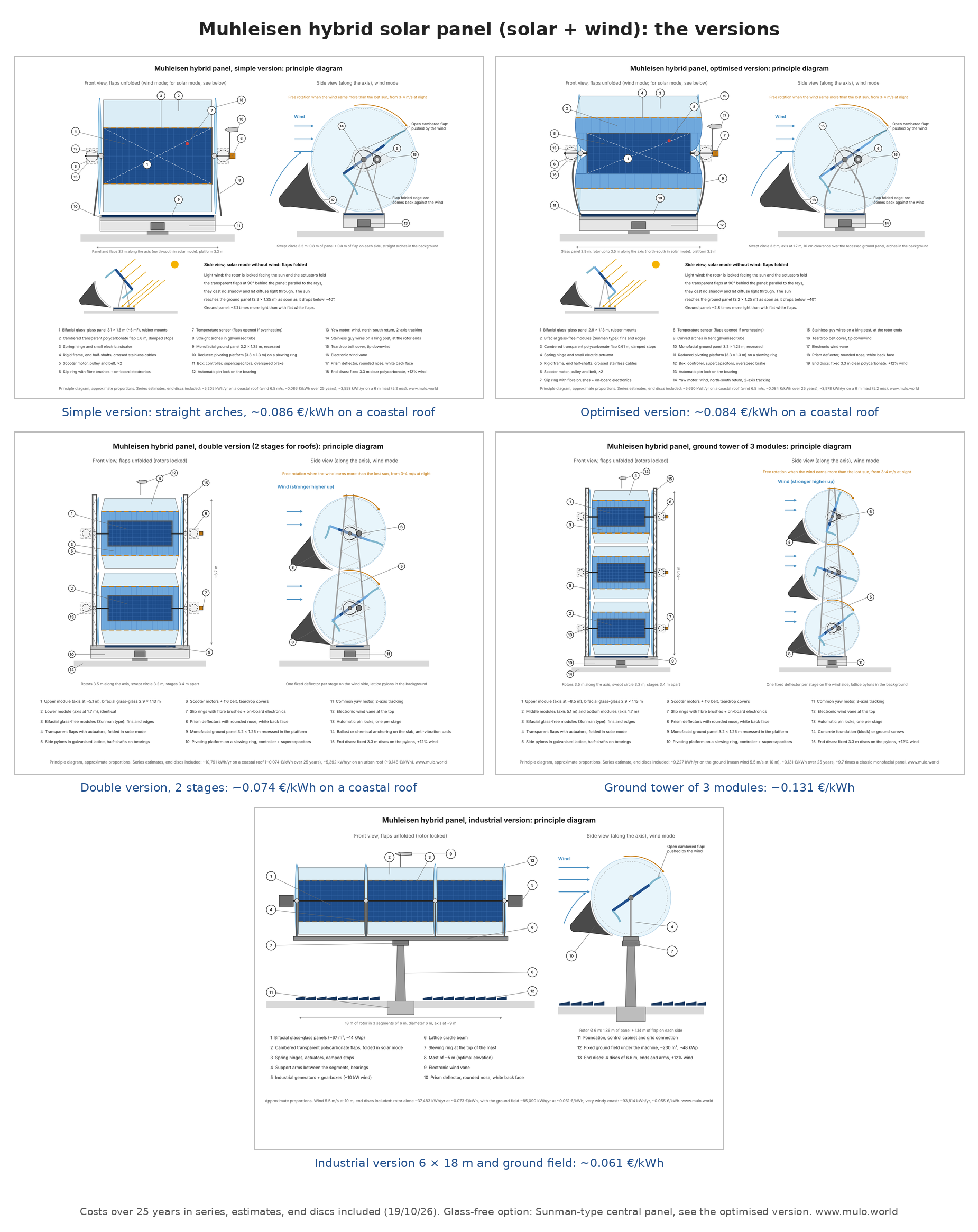
Diagram code (Python, free): schema_panneau_solaire_hybride_muhleisen.py
The pages of the invention: Presentation | Simple version (in French) | Optimised version (and glass-free option) (in French) | Double version (in French) | 3-module tower (in French) | Industrial version | Corridor version (in French) | Floating version
------------------------------
1. THE PRINCIPLE
------------------------------
A bifacial solar panel is mounted on a horizontal axis, between two arches, above a pivoting platform. It carries hinged transparent flaps on its two long edges and, in the optimised version, fins made of bifacial glass-free modules.
Without wind, or when the wind earns less than the sun that would be lost by turning, the rotor is locked and the platform tracks the sun on 2 axes: it is a tracking solar panel. As soon as the measured wind power exceeds this lost solar (about 40% of the tracking solar power, i.e. 4 to 8 m/s during the day depending on the sun), and from 3-4 m/s at night, it is released and turns like a drag rotor: the flap moving with the wind opens and pushes, the one coming back against the wind folds edge-on. Two scooter motors, driven by belt, act as generators.
As it turns, the panel presents its two faces to the sky one after the other: it keeps producing solar while it produces wind power. At night, it produces only wind. A fixed monofacial panel under the rotor, recessed into the platform, recovers the light that passes through.
------------------------------
2. THE VALIDATED VERSIONS
------------------------------
Breakdown of the series price of the optimised version on a roof (excluding VAT, estimate for a few thousand units a year):
On a guyed tilting mast, count ~1,200 € more for 6 m and ~1,600 € for 8 m, foundation and anchors included. Maintenance and insurance: ~60 € a year. In year 12: inverter (~400 €), actuators (~70 €), hub motors, bearings and belts (~200 €). In year 15: polycarbonate flaps (~170 €), yellowed and fatigued by sun and impacts.
------------------------------
3. PRODUCTION BY LOCATION, SINGLE MODULE AND DOUBLE VERSION
------------------------------
Annual production in kWh, and multiple of a classic monofacial panel installed on the same ground area (~950 kWh a year on 4.3 m²).
The façade was studied and rejected: too little useful wind and too many fixing constraints.
------------------------------
4. WHAT WAS KEPT AFTER ALL THE ITERATIONS
------------------------------
* Cambered flaps in anti-UV transparent polycarbonate, hinged with small actuators: they push when open during rotation; in solar mode, they fold at 90° behind the panel, parallel to the rays, and let sun and diffuse light through to the ground panel, which receives ~2.8 times more light than with flat white flaps. The actuators also press them flat in a storm and open them in case of overheating. On the double and the tower, the folded transparent flaps of each stage also let light through to the stage below.
* Fixed prism deflector with a rounded nose, in galvanised corrugated sheet on a frame, back face painted white, ~150 €: its "/" front face stops the wind in front of the blade coming back against the wind and guides it towards the upper half of the rotor; its rounded nose and its rising underside receive the air that climbs along façades; a 2D flow simulation shows a flow three to four times more regular behind it, and the wind gain is counted prudently at +5%. It sits on the shaded side in solar mode and turns its back to the wind in a storm.
* End discs on all versions since 19/10/26: two fixed 3.3 m discs in transparent twin-wall polycarbonate on the arches or pylons (~230 € per module), four 6.6 m discs in galvanised sheet on the industrial version (~1,600 €). Air no longer escapes through the ends of the rotor when the flap pushes: +12% wind (+8 to +15%), +2 to +8% production depending on the site, for a kWh that hardly moves (1 to 2% better on the coast and on a mast, 2% worse in the city, where they can be left off). Transparent and in the plane of the sun in 2-axis tracking, they cast no shadow. To be measured with and without on the prototype.
* No tail vane: a yaw motor driven by an electronic wind vane turns the platform, which also provides 2-axis solar tracking.
* Two scooter hub motors, pulley and 1:6 toothed belt, placed outside the arches, in teardrop covers with the tip downwind.
* Rigid frame with half-shafts at both ends and crossed stainless cables on the back: no tube passes through the panel.
* Rubber mounts, damped stops, automatic pin lock on the bearing.
* Overspeed brake (~50 €): short-circuiting of the motors and a brake that engages on power loss. If the lock or the electronics fail in a storm, the released rotor would rise to about 180 rpm instead of 30 to 40: the brake stops it whatever happens.
* Mode selection based on measured power (anemometer and software, ~30 €): +1 to +2% production compared with a fixed 6 m/s threshold, with hysteresis to avoid constant switching.
* Assisted start (added 23/10/26): the hub motors are motors, they act as a starter when unlocking, two seconds powered by the panel, without an extra part. The drag rotor starts on its own (maximum torque at standstill, the opposite of a Darrieus), so the starter does not serve to lower the cut-in wind: going from 3 to 2.5 m/s is worth only 0.2 to 1% depending on the wind, and wind between 3 and 4 m/s carries only 1 to 4% of the energy. It is used for short gusts that a heavy rotor does not have time to catch, for the dead point of a panel edge-on when unlocking, and for freeing it after frost or dust: less than 1% in total, to be measured on the prototype.
* Vibration sensor and remote monitoring: an imbalance, a worn belt or a cracked panel is detected remotely, which allows a maintenance visit every two years instead of every year.
* Bifacial glass-free modules (Sunman type) on the fins and edges: light, flexible, bifacial.
* Slip ring with fibre brushes, supercapacitors, electronics protected in the platform box, optional buffer battery.
* 3.2 × 1.25 m monofacial ground panel, the whole usable area of the platform, recessed and counted in all calculations. Widening the platform beyond 1.3 m would make a few more kWh but would lower the multiple of a classic panel on the same ground area, which grows with it: on a roof, 1.3 m is kept.
* Cyclone protection option: the installation folds and lies on the ground, strapped to anchors, like the tilting-mast wind turbines of the islands. Arches hinged on the platform, tilting mast or tower, telescopic mast for the industrial version. Extra cost from 150 € for a module on a platform to about 3,000 € for the industrial version. Details on each version page.
------------------------------
5. ADVANTAGES OVER A CLASSIC SOLAR PANEL
------------------------------
* 2.5 to 10.5 times more kWh on the same ground area depending on the version and the site.
* Production at night and in winter, when the sun is lacking and the wind blows the most.
* 2-axis solar tracking included, without an extra part: the wind yaw motor does it.
* Both faces of the panel work: bifacial in solar mode with the reflection from the white deflector, face after face in rotation.
* Partial cleaning by rotation and wind.
* More regular production over the year: less storage needed for the same autonomy.
------------------------------
6. ADVANTAGES OVER SYSTEMS ALREADY ON THE MARKET
------------------------------
* Small roof wind turbines: they produce only wind, often weak in the city. Here, solar remains the base and wind is added.
* Solar trackers: they only track. Here, the same mechanism serves for tracking and for wind.
* Hybrid street lights and masts (a small wind turbine plus a panel): two separate machines. Here, the panel is the rotor.
* The 2011 patent (see below) provides for neither cambered flaps, nor deflector, nor ground panel, nor glass-free fins, nor locked 2-axis tracking.
* Mass-produced parts: scooter motors, belts, panels in standard formats, galvanised corrugated roofing sheet.
------------------------------
7. THE LIMITS AND THE RISKS
------------------------------
* Wind on roofs: the Warwick and Energy Saving Trust trials showed that small roof wind turbines in cities often produce much less than expected. High and clear roofs, coasts, or 6 to 8 m masts must be targeted, and the wind measured for a year beforehand.
* Fatigue of the glass-glass panel in rotation: protections (rubber, stops, rigid frame) and possible fallback to the glass-free option.
* Moving parts require maintenance: belts, bearings, flaps, electronics. Replacements are counted in the price of the kWh.
* Noise and vibration to be checked on a prototype, especially on an inhabited roof.
* Permits: height, wind load of the structure, insurance.
* Cyclones: without the option of folding to the ground, the installation is not designed for cyclone zones.
* All prices are series prices. A prototype will cost two to three times more.
------------------------------
8. PRIOR ART: THE 2011 PATENT
------------------------------
The principle of a solar panel turning on a horizontal axis to also produce wind power exists: US application 2011/0215587, granted as US 8,354,757 B2, "Hybrid horizontal axis energy apparatus", by William Edward Lee and Robert F. Pienkowski, with no assignee company. It expires on 8 March 2031.
Why it is not seen everywhere: wind on roofs disappointed, panels became so cheap that the complexity no longer paid, and no company carried the project.
The Muhleisen hybrid panel takes up the basic idea and completes it: cambered flaps, fixed deflector, bifacial glass-free fins, ground panel, 2-axis tracking in locked mode, scooter motors, half-shafts and crossed cables. Before any sale in the United States before 2031, the patent claims will have to be checked by a patent attorney.
------------------------------
9. AND FOR THE HYDROLOOP PLAN?
------------------------------
The hybrid panel does not lower the price of the Hydroloop world plan: the V11 holds 35 €/MWh with large wind turbines, and even the industrial version remains above (55 to 61 €/MWh with its ground field, 48 to 56 in a natural Corridor (in French) with its crown).
It can serve where large wind turbines are forbidden or refused, if large wind turbine factories become a bottleneck, and to replace the multi-blade wind turbines that pump water directly.
------------------------------
10. PROTOTYPE PLAN
------------------------------
* Measure the wind on the target site for a year (anemometer at axis height).
* Build a full-scale optimised module on a 6 m mast, on open ground or a coast.
* Measure separately the locked solar, the rotating solar, the wind and the consumption of the yaw motors.
* Test fatigue on an accelerated rotating bench: a module turns 1.4 to 3.4 × 10⁸ revolutions in 25 years, whereas the dynamic load test for panels (IEC TS 62782) does only 1,000. For example ±600 Pa at 5 Hz for 1 to 2 × 10⁷ cycles, about 3 weeks, a glass-glass panel and a glass-free panel side by side, with microcrack imaging before and after. Cost 10 to 20 k€, ~15 € per module once spread over the series.
* Measure the end discs with and without, by making them removable on the prototype: they are counted at +12% wind in all versions since 19/10/26, and the measurement will say whether they are kept in the city.
* Measure the losses between the central panel, the fins and the ground panel, which do not see the same light: beyond ~5%, optimisers (~35 € per group) or one inverter input per group lower the kWh by 1 to 3%.
* Fit an ETFE film flap next to the polycarbonate flaps: it lasts 25 years without UV spray, but costs ~180 € more per module and can vibrate in rotation; over 25 years it comes to the same price as polycarbonate flaps replaced in year 15.
* Test storm mode and noise.
* Adjust the figures on this page with the measurements.
------------------------------
11. CALCULATION METHOD
------------------------------
Sun: pvlib simulation on a synthetic year calibrated on the climate of Brest (global irradiation ~1,200 kWh/m² a year, ~52% diffuse), 2-axis tracking in locked mode, bifacial retention in rotation ~66% for glass-glass, ~62% for glass-free, ~38% for a monofacial panel.
Wind: Rayleigh distribution, logarithmic profile (5.5 m/s at 10 m, roughness 0.03), drag rotor with an effective power coefficient of about 0.12 to 0.13 at the electrical output: 0.086 as a base, plus the estimated gains of the cambered flaps, the deflector (+30%) and its rounded prism shape (+5%). It is the top of the range for shielded Savonius rotors: to be confirmed on a prototype. The rotor is released during the day as soon as the wind power exceeds the solar lost by turning, and at night from 3 m/s; this choice based on measured power gives 1 to 2% more than a fixed 6 m/s threshold. End discs: rotor power coefficient increased by 12% (8 to 15% in the literature on drag rotors with end plates, part of the effect being already taken by the deflector), 230 € per module, replaced in year 15.
Cost: series price excluding VAT, installed and commissioned (installation ~1,200 € per module), kWh discounted over 25 years at 4%, annual degradation of the panels. Maintenance and insurance ~60 € a year per module, thanks to remote monitoring (vibration sensor) which allows a visit every two years. Replacements counted: in year 12, inverter (~400 €), actuators (~70 €), hub motors, bearings and belts (~200 €); in year 15, polycarbonate flaps (~170 €); in year 18, control electronics (~250 €); supercapacitors and belts in years 12 and 24.
Ground panel and shading between stages: hour-by-hour cross-section shading model, deflector included, transparent flaps folded behind the panel in solar mode.
Classic reference: a monofacial panel installed on the same ground area, that of the platform (4.3 m²), produces ~950 kWh a year in the same place. The rotor turns above the platform: around it, the ground remains free, for example for classic panels.
These figures are calculation estimates. Only a prototype measured for a year will tell the truth, especially for wind on roofs.
------------------------------
SOURCES
------------------------------
Hydroloop world plan: decarbonising world electricity (in French)
Google Patents: US 8,354,757 B2 (W. E. Lee and R. F. Pienkowski), the 2011 prior art
Sunman Energy: eArc glass-free photovoltaic modules
pvlib python: simulation of photovoltaic production
Wind-Works: Warwick Wind Trials, small roof wind turbines measured
Energy Saving Trust: field trials of small wind turbines in the United Kingdom
Wikipedia: Savonius rotor (drag rotor)
Wikipedia: Rayleigh distribution, distribution of wind speeds
Wikipedia: bifacial solar cells
Wikipedia: corrugated galvanised steel sheet
Vergnet: GEV MP-C wind turbine with tilting mast for cyclone zones (in French)
Batiweb: on Réunion, wind turbines tilt down to avoid cyclones (in French)
photovoltaique.info: grid connection of an installation above 36 kVA (in French)
Auvergne-Rhône-Alpes Chamber of Agriculture: costs of a 36 to 250 kWp photovoltaic plant (in French)
Olivier Muhleisen in collaboration with Claude (Anthropic), October 2026. Royalty-free plans, open source.
© 2009-2026 Onmyweb Production - TOS - Cookies information - Contact us - Free Copyright Open Source -
1. THE PRINCIPLE
------------------------------
A bifacial solar panel is mounted on a horizontal axis, between two arches, above a pivoting platform. It carries hinged transparent flaps on its two long edges and, in the optimised version, fins made of bifacial glass-free modules.
Without wind, or when the wind earns less than the sun that would be lost by turning, the rotor is locked and the platform tracks the sun on 2 axes: it is a tracking solar panel. As soon as the measured wind power exceeds this lost solar (about 40% of the tracking solar power, i.e. 4 to 8 m/s during the day depending on the sun), and from 3-4 m/s at night, it is released and turns like a drag rotor: the flap moving with the wind opens and pushes, the one coming back against the wind folds edge-on. Two scooter motors, driven by belt, act as generators.
As it turns, the panel presents its two faces to the sky one after the other: it keeps producing solar while it produces wind power. At night, it produces only wind. A fixed monofacial panel under the rotor, recessed into the platform, recovers the light that passes through.
------------------------------
2. THE VALIDATED VERSIONS
------------------------------
| Version | What sets it apart | Installed price (series) | Best site | kWh per year | €/kWh over 25 years |
|---|---|---|---|---|---|
| Simple | Straight arches, large 3.1 × 1.6 m glass-glass panel, 0.8 m transparent flaps | 4,845 to 6,645 € | Coastal roof | 5,205 | 0.086 |
| Optimised | Curved arches, 2.9 × 1.13 m panel, bifacial glass-free fins, cambered transparent flaps | 5,195 to 6,995 € | Coastal roof | 5,660 | 0.084 |
| Glass-free option | Glass-free central panel (Sunman type): lighter, no glass breakage | +130 € | Coastal roof | 5,667 | 0.085 |
| Double | Two optimised modules one above the other, for roofs | 9,045 to 10,645 € | Coastal roof | 10,791 | 0.074 |
| 3-module tower | Three modules stacked on the ground, ~10 m high | 14,100 € | On the ground, wind 5.5 m/s at 10 m | 9,227 | 0.131 |
| Industrial | 6 m diameter rotor over 18 m, yawing, on a 5 m mast, 48 kWp ground field | 58,787 € | Very windy coast | 93,814 | 0.055 |
| Corridor | Industrial at the top of a slope facing the wind, gravel path and bifacial crown | 72,787 € | Windy coastal ridge | 131,000 | 0.048 |
Breakdown of the series price of the optimised version on a roof (excluding VAT, estimate for a few thousand units a year):
| Item | Price |
|---|---|
| Panels: bifacial glass-glass central, glass-free fins, ground panel | 450 € |
| Structure: arches, frame, half-shafts, bearings, stainless cables | 450 € |
| Pivoting platform and 2-axis solar tracking | 350 € |
| Generators (2 scooter hub motors) and belts | 210 € |
| Flaps in anti-UV solid polycarbonate and hinges | 170 € |
| Flap actuators | 85 € |
| Prism deflector | 150 € |
| Control, supercapacitors, wind vane, anemometer, slip ring, vibration sensor, overspeed brake | 460 € |
| Certified 2-input grid inverter and limiter for the wind | 450 € |
| Cabling, protections, fixings and ballast | 250 € |
| Factory assembly, transport, manufacturer's margin | 925 € |
| Qualification tests spread over the series (rotational fatigue) | 15 € |
| Installation and commissioning: 2 technicians, lifting, electrical certification | 1,200 € |
| End discs in transparent twin-wall polycarbonate, added 19/10/26 | 230 € |
| Total installed | 5,395 € |
On a guyed tilting mast, count ~1,200 € more for 6 m and ~1,600 € for 8 m, foundation and anchors included. Maintenance and insurance: ~60 € a year. In year 12: inverter (~400 €), actuators (~70 €), hub motors, bearings and belts (~200 €). In year 15: polycarbonate flaps (~170 €), yellowed and fatigued by sun and impacts.
------------------------------
3. PRODUCTION BY LOCATION, SINGLE MODULE AND DOUBLE VERSION
------------------------------
Annual production in kWh, and multiple of a classic monofacial panel installed on the same ground area (~950 kWh a year on 4.3 m²).
| Location | Mean wind at the axis | Simple | Optimised | Glass-free | Double |
|---|---|---|---|---|---|
| Urban roof | 4.0 m/s | 2,564 (× 2.7) | 2,981 (× 3.1) | 2,914 (× 3.1) | 5,392 (× 5.7) |
| Car park shade structure | 4.9 m/s | 3,214 (× 3.4) | 3,630 (× 3.8) | 3,583 (× 3.8) | 7,092 (× 7.5) |
| Platform on the ground without mast | 3.8 m/s | 2,470 (× 2.6) | 2,890 (× 3.0) | 2,819 (× 3.0) | not kept |
| 6 m mast | 5.25 m/s | 3,558 (× 3.7) | 3,978 (× 4.2) | 3,940 (× 4.1) | 7,613 (× 8.0) |
| 8 m mast | 5.5 m/s | 3,795 (× 4.0) | 4,220 (× 4.4) | 4,188 (× 4.4) | not kept |
| Coastal roof (building of ~35 m) | 6.5 m/s | 5,205 (× 5.5) | 5,660 (× 6.0) | 5,667 (× 6.0) | 10,791 (× 11.4) |
| Location | Simple €/kWh | Optimised €/kWh | Glass-free €/kWh | Double €/kWh |
|---|---|---|---|---|
| Urban roof | 0.176 | 0.160 | 0.168 | 0.148 |
| Car park shade structure | 0.139 | 0.129 | 0.134 | 0.112 |
| Platform on the ground | 0.178 | 0.160 | 0.168 | |
| 6 m mast | 0.149 | 0.140 | 0.143 | 0.118 |
| 8 m mast | 0.147 | 0.138 | 0.142 | |
| Coastal roof | 0.086 | 0.084 | 0.085 | 0.074 |
The façade was studied and rejected: too little useful wind and too many fixing constraints.
------------------------------
4. WHAT WAS KEPT AFTER ALL THE ITERATIONS
------------------------------
* Cambered flaps in anti-UV transparent polycarbonate, hinged with small actuators: they push when open during rotation; in solar mode, they fold at 90° behind the panel, parallel to the rays, and let sun and diffuse light through to the ground panel, which receives ~2.8 times more light than with flat white flaps. The actuators also press them flat in a storm and open them in case of overheating. On the double and the tower, the folded transparent flaps of each stage also let light through to the stage below.
* Fixed prism deflector with a rounded nose, in galvanised corrugated sheet on a frame, back face painted white, ~150 €: its "/" front face stops the wind in front of the blade coming back against the wind and guides it towards the upper half of the rotor; its rounded nose and its rising underside receive the air that climbs along façades; a 2D flow simulation shows a flow three to four times more regular behind it, and the wind gain is counted prudently at +5%. It sits on the shaded side in solar mode and turns its back to the wind in a storm.
* End discs on all versions since 19/10/26: two fixed 3.3 m discs in transparent twin-wall polycarbonate on the arches or pylons (~230 € per module), four 6.6 m discs in galvanised sheet on the industrial version (~1,600 €). Air no longer escapes through the ends of the rotor when the flap pushes: +12% wind (+8 to +15%), +2 to +8% production depending on the site, for a kWh that hardly moves (1 to 2% better on the coast and on a mast, 2% worse in the city, where they can be left off). Transparent and in the plane of the sun in 2-axis tracking, they cast no shadow. To be measured with and without on the prototype.
* No tail vane: a yaw motor driven by an electronic wind vane turns the platform, which also provides 2-axis solar tracking.
* Two scooter hub motors, pulley and 1:6 toothed belt, placed outside the arches, in teardrop covers with the tip downwind.
* Rigid frame with half-shafts at both ends and crossed stainless cables on the back: no tube passes through the panel.
* Rubber mounts, damped stops, automatic pin lock on the bearing.
* Overspeed brake (~50 €): short-circuiting of the motors and a brake that engages on power loss. If the lock or the electronics fail in a storm, the released rotor would rise to about 180 rpm instead of 30 to 40: the brake stops it whatever happens.
* Mode selection based on measured power (anemometer and software, ~30 €): +1 to +2% production compared with a fixed 6 m/s threshold, with hysteresis to avoid constant switching.
* Assisted start (added 23/10/26): the hub motors are motors, they act as a starter when unlocking, two seconds powered by the panel, without an extra part. The drag rotor starts on its own (maximum torque at standstill, the opposite of a Darrieus), so the starter does not serve to lower the cut-in wind: going from 3 to 2.5 m/s is worth only 0.2 to 1% depending on the wind, and wind between 3 and 4 m/s carries only 1 to 4% of the energy. It is used for short gusts that a heavy rotor does not have time to catch, for the dead point of a panel edge-on when unlocking, and for freeing it after frost or dust: less than 1% in total, to be measured on the prototype.
* Vibration sensor and remote monitoring: an imbalance, a worn belt or a cracked panel is detected remotely, which allows a maintenance visit every two years instead of every year.
* Bifacial glass-free modules (Sunman type) on the fins and edges: light, flexible, bifacial.
* Slip ring with fibre brushes, supercapacitors, electronics protected in the platform box, optional buffer battery.
* 3.2 × 1.25 m monofacial ground panel, the whole usable area of the platform, recessed and counted in all calculations. Widening the platform beyond 1.3 m would make a few more kWh but would lower the multiple of a classic panel on the same ground area, which grows with it: on a roof, 1.3 m is kept.
* Cyclone protection option: the installation folds and lies on the ground, strapped to anchors, like the tilting-mast wind turbines of the islands. Arches hinged on the platform, tilting mast or tower, telescopic mast for the industrial version. Extra cost from 150 € for a module on a platform to about 3,000 € for the industrial version. Details on each version page.
------------------------------
5. ADVANTAGES OVER A CLASSIC SOLAR PANEL
------------------------------
* 2.5 to 10.5 times more kWh on the same ground area depending on the version and the site.
* Production at night and in winter, when the sun is lacking and the wind blows the most.
* 2-axis solar tracking included, without an extra part: the wind yaw motor does it.
* Both faces of the panel work: bifacial in solar mode with the reflection from the white deflector, face after face in rotation.
* Partial cleaning by rotation and wind.
* More regular production over the year: less storage needed for the same autonomy.
------------------------------
6. ADVANTAGES OVER SYSTEMS ALREADY ON THE MARKET
------------------------------
* Small roof wind turbines: they produce only wind, often weak in the city. Here, solar remains the base and wind is added.
* Solar trackers: they only track. Here, the same mechanism serves for tracking and for wind.
* Hybrid street lights and masts (a small wind turbine plus a panel): two separate machines. Here, the panel is the rotor.
* The 2011 patent (see below) provides for neither cambered flaps, nor deflector, nor ground panel, nor glass-free fins, nor locked 2-axis tracking.
* Mass-produced parts: scooter motors, belts, panels in standard formats, galvanised corrugated roofing sheet.
------------------------------
7. THE LIMITS AND THE RISKS
------------------------------
* Wind on roofs: the Warwick and Energy Saving Trust trials showed that small roof wind turbines in cities often produce much less than expected. High and clear roofs, coasts, or 6 to 8 m masts must be targeted, and the wind measured for a year beforehand.
* Fatigue of the glass-glass panel in rotation: protections (rubber, stops, rigid frame) and possible fallback to the glass-free option.
* Moving parts require maintenance: belts, bearings, flaps, electronics. Replacements are counted in the price of the kWh.
* Noise and vibration to be checked on a prototype, especially on an inhabited roof.
* Permits: height, wind load of the structure, insurance.
* Cyclones: without the option of folding to the ground, the installation is not designed for cyclone zones.
* All prices are series prices. A prototype will cost two to three times more.
------------------------------
8. PRIOR ART: THE 2011 PATENT
------------------------------
The principle of a solar panel turning on a horizontal axis to also produce wind power exists: US application 2011/0215587, granted as US 8,354,757 B2, "Hybrid horizontal axis energy apparatus", by William Edward Lee and Robert F. Pienkowski, with no assignee company. It expires on 8 March 2031.
Why it is not seen everywhere: wind on roofs disappointed, panels became so cheap that the complexity no longer paid, and no company carried the project.
The Muhleisen hybrid panel takes up the basic idea and completes it: cambered flaps, fixed deflector, bifacial glass-free fins, ground panel, 2-axis tracking in locked mode, scooter motors, half-shafts and crossed cables. Before any sale in the United States before 2031, the patent claims will have to be checked by a patent attorney.
------------------------------
9. AND FOR THE HYDROLOOP PLAN?
------------------------------
The hybrid panel does not lower the price of the Hydroloop world plan: the V11 holds 35 €/MWh with large wind turbines, and even the industrial version remains above (55 to 61 €/MWh with its ground field, 48 to 56 in a natural Corridor (in French) with its crown).
It can serve where large wind turbines are forbidden or refused, if large wind turbine factories become a bottleneck, and to replace the multi-blade wind turbines that pump water directly.
------------------------------
10. PROTOTYPE PLAN
------------------------------
* Measure the wind on the target site for a year (anemometer at axis height).
* Build a full-scale optimised module on a 6 m mast, on open ground or a coast.
* Measure separately the locked solar, the rotating solar, the wind and the consumption of the yaw motors.
* Test fatigue on an accelerated rotating bench: a module turns 1.4 to 3.4 × 10⁸ revolutions in 25 years, whereas the dynamic load test for panels (IEC TS 62782) does only 1,000. For example ±600 Pa at 5 Hz for 1 to 2 × 10⁷ cycles, about 3 weeks, a glass-glass panel and a glass-free panel side by side, with microcrack imaging before and after. Cost 10 to 20 k€, ~15 € per module once spread over the series.
* Measure the end discs with and without, by making them removable on the prototype: they are counted at +12% wind in all versions since 19/10/26, and the measurement will say whether they are kept in the city.
* Measure the losses between the central panel, the fins and the ground panel, which do not see the same light: beyond ~5%, optimisers (~35 € per group) or one inverter input per group lower the kWh by 1 to 3%.
* Fit an ETFE film flap next to the polycarbonate flaps: it lasts 25 years without UV spray, but costs ~180 € more per module and can vibrate in rotation; over 25 years it comes to the same price as polycarbonate flaps replaced in year 15.
* Test storm mode and noise.
* Adjust the figures on this page with the measurements.
------------------------------
11. CALCULATION METHOD
------------------------------
Sun: pvlib simulation on a synthetic year calibrated on the climate of Brest (global irradiation ~1,200 kWh/m² a year, ~52% diffuse), 2-axis tracking in locked mode, bifacial retention in rotation ~66% for glass-glass, ~62% for glass-free, ~38% for a monofacial panel.
Wind: Rayleigh distribution, logarithmic profile (5.5 m/s at 10 m, roughness 0.03), drag rotor with an effective power coefficient of about 0.12 to 0.13 at the electrical output: 0.086 as a base, plus the estimated gains of the cambered flaps, the deflector (+30%) and its rounded prism shape (+5%). It is the top of the range for shielded Savonius rotors: to be confirmed on a prototype. The rotor is released during the day as soon as the wind power exceeds the solar lost by turning, and at night from 3 m/s; this choice based on measured power gives 1 to 2% more than a fixed 6 m/s threshold. End discs: rotor power coefficient increased by 12% (8 to 15% in the literature on drag rotors with end plates, part of the effect being already taken by the deflector), 230 € per module, replaced in year 15.
Cost: series price excluding VAT, installed and commissioned (installation ~1,200 € per module), kWh discounted over 25 years at 4%, annual degradation of the panels. Maintenance and insurance ~60 € a year per module, thanks to remote monitoring (vibration sensor) which allows a visit every two years. Replacements counted: in year 12, inverter (~400 €), actuators (~70 €), hub motors, bearings and belts (~200 €); in year 15, polycarbonate flaps (~170 €); in year 18, control electronics (~250 €); supercapacitors and belts in years 12 and 24.
Ground panel and shading between stages: hour-by-hour cross-section shading model, deflector included, transparent flaps folded behind the panel in solar mode.
Classic reference: a monofacial panel installed on the same ground area, that of the platform (4.3 m²), produces ~950 kWh a year in the same place. The rotor turns above the platform: around it, the ground remains free, for example for classic panels.
These figures are calculation estimates. Only a prototype measured for a year will tell the truth, especially for wind on roofs.
------------------------------
SOURCES
------------------------------
Hydroloop world plan: decarbonising world electricity (in French)
Google Patents: US 8,354,757 B2 (W. E. Lee and R. F. Pienkowski), the 2011 prior art
Sunman Energy: eArc glass-free photovoltaic modules
pvlib python: simulation of photovoltaic production
Wind-Works: Warwick Wind Trials, small roof wind turbines measured
Energy Saving Trust: field trials of small wind turbines in the United Kingdom
Wikipedia: Savonius rotor (drag rotor)
Wikipedia: Rayleigh distribution, distribution of wind speeds
Wikipedia: bifacial solar cells
Wikipedia: corrugated galvanised steel sheet
Vergnet: GEV MP-C wind turbine with tilting mast for cyclone zones (in French)
Batiweb: on Réunion, wind turbines tilt down to avoid cyclones (in French)
photovoltaique.info: grid connection of an installation above 36 kVA (in French)
Auvergne-Rhône-Alpes Chamber of Agriculture: costs of a 36 to 250 kWp photovoltaic plant (in French)
Olivier Muhleisen in collaboration with Claude (Anthropic), October 2026. Royalty-free plans, open source.
© 2009-2026 Onmyweb Production - TOS - Cookies information - Contact us - Free Copyright Open Source -