
Hydroloop Muhleisen 2026, version 20 O Sky: the Sky whose waters also produce. Islands of floating hybrid rotors on the lower lake and the upper basin, classic floating PV on the lower basin: on a Sky 2, whose lower basin is reduced to a 200,000 m³ lock, 50.2 M€ net more for +96 GWh sold and +6.8 M€ a year, 2.2 M€ net, the MWh at 28.3 €; on a Sky 3, 77.6 M€ for +78 GWh and +7.2 M€ a year, 1.3 M€ net. It produces more, it does not store more, and the page says so. 23/10/26
A Sky has a lot of open water: a lower lake of 64 to 128 ha, a 16 ha upper basin on the ridge, an 8 ha lower basin, and a rain lake that is left alone. The O Sky (O as in "eau", French for water) places on these surfaces the best the site has for water: the island of floating Muhleisen hybrid rotors, which gives wind at night and in winter on top of the midday sun, on the lower lake and the upper basin; and classic floating PV on the small lower basin, which had to be covered anyway. Two sizes on this page, the O Sky 2 (on the Sky 2, 300 m) and the O Sky 3 (on the Sky 3 (in French), 1,500 m), run through the same hourly model as the Skys. The result is positive, and it is thin: the O Sky is a Sky plus a floating farm that sells directly, not a Sky that stores its sun, because its pumps are already full when the grid overflows. This page gives what it earns, what it costs, the water it keeps, and what it does not change.
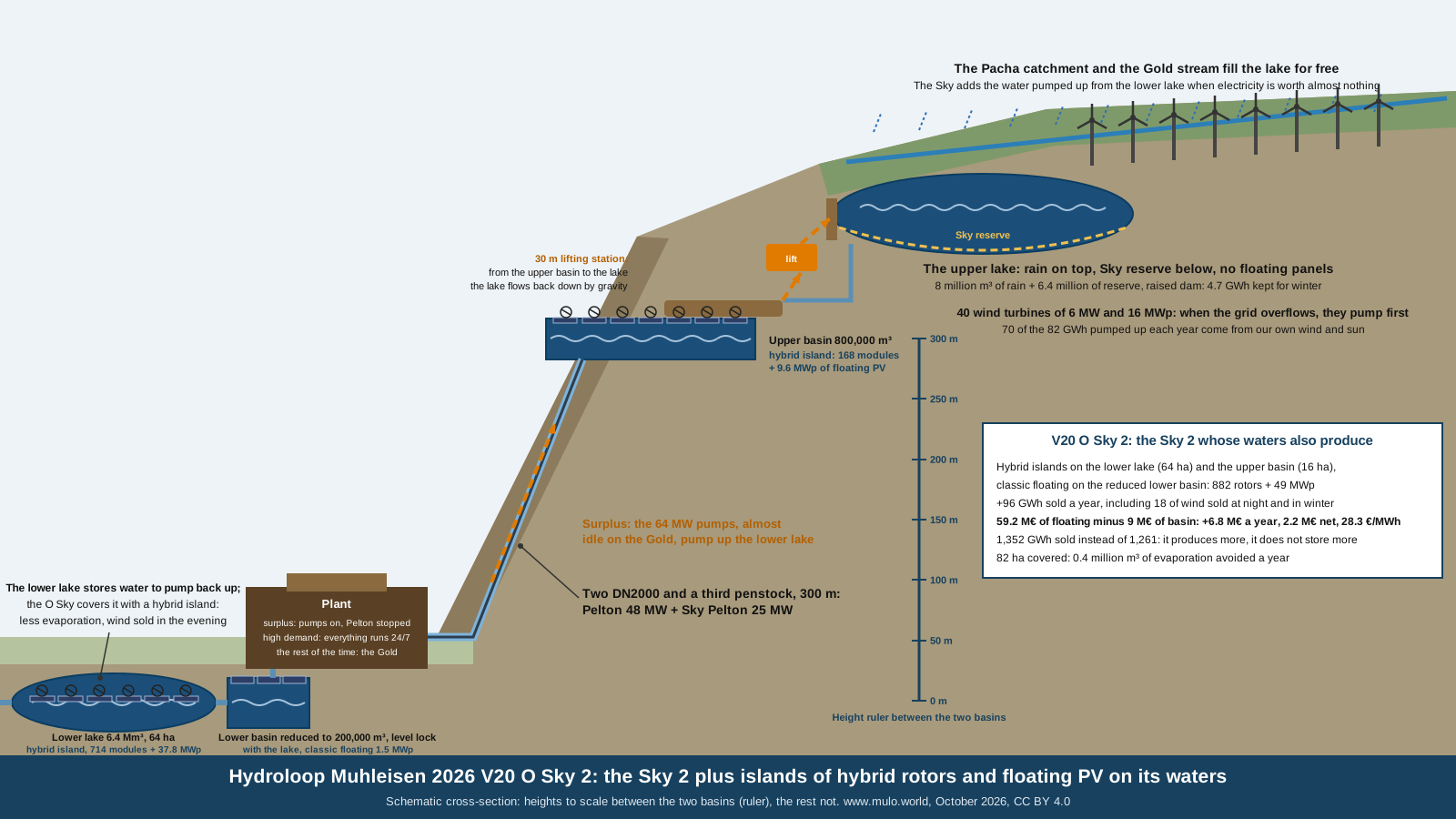
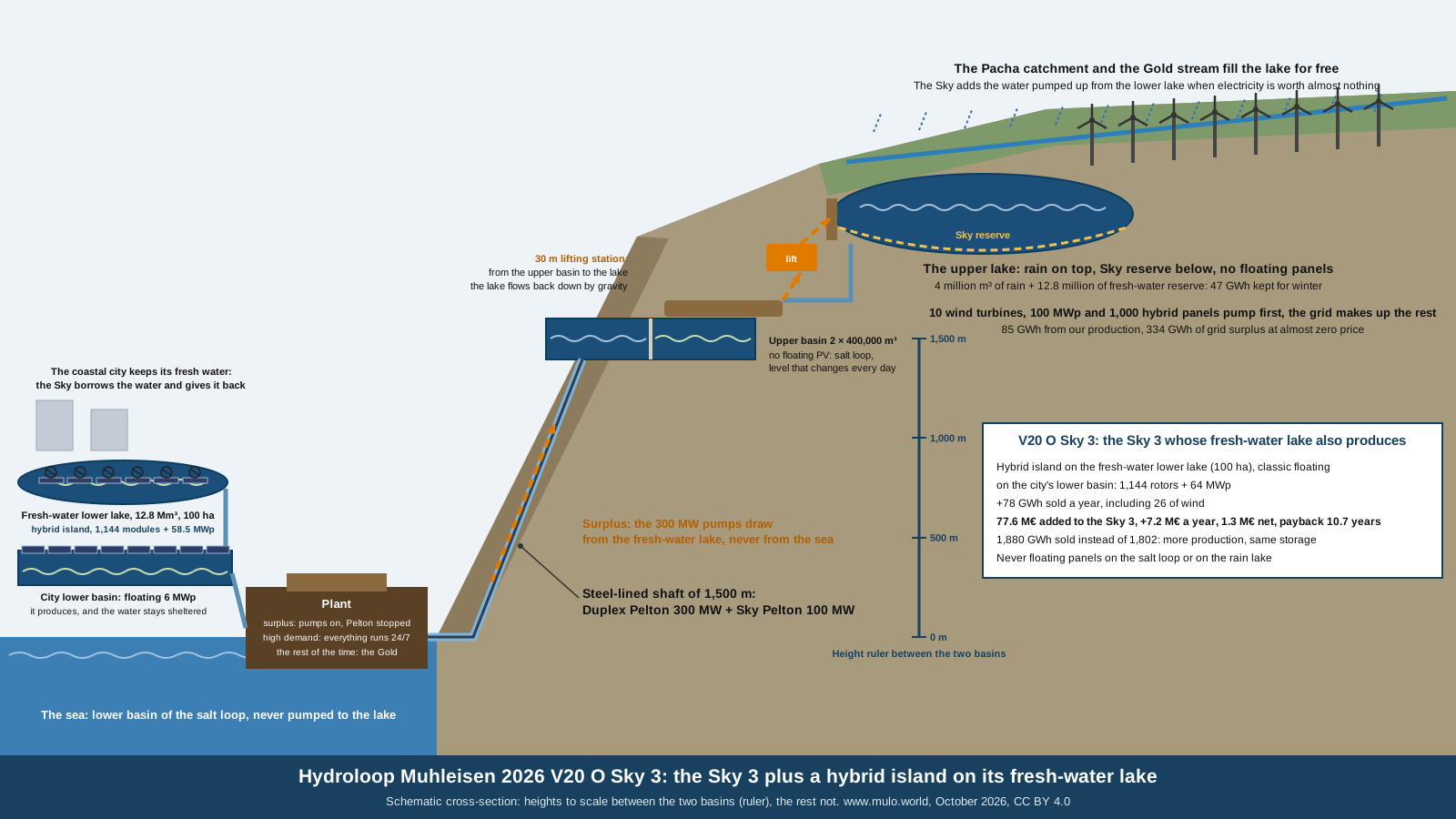
Diagram code (Python, free, the two O Skys): schema_hydroloop_v20.py; hourly model: hydroloop_muhleisen_2026_v20_simulation.py (the 23 arguments of the Sky model, then the floating PV added in MWp, the wind of the rotors in GWh a year, the price of the floating PV in M€ and the area covered in ha; it prints the Sky and the O Sky one below the other)
The lineage: V17 Gold | V18 Sky 2 | V18 Sky 3 | V18 Sky Artesia | V19 Station Castle | V20 O Sky; floating: floating Muhleisen hybrid solar panel and V9 (in French); the Station Castle world plan (in French)
------------------------------
1. WHAT THE O SKY ADDS TO THE SKY
------------------------------
Nothing to the water loop. The lakes, the reserve, the pumps, the Pelton turbines and the operating rules are those of the Sky. The O Sky adds a cover that produces, body of water by body of water:
* On the lower lake, an island of floating hybrid rotors: the 6 x 18 m industrial rotor on its rigid float, three bifacial panels on a shaft, in rows 45 m apart, 75% classic floating PV between the rows, the whole island weathervaning around a pile. On the 64 ha of a Sky 2, 714 modules and 37.8 MWp; on the 100 ha of fresh water of a Sky 3, 1,144 modules and 58.5 MWp. The details of the module and the island are on the floating version page.
* On the ridge's upper basin, the same island (O Sky 2 only): 16 ha at 6.5 m/s, the best square metre of water on the site, 168 modules and 9.6 MWp. On the O Sky 3, the upper basin is in two cells, one of them salt, and its level changes by several metres every day: no floating PV.
* On the lower basin, classic floating PV, and a smaller lower basin (O Sky 2): the lower lake is next to it, at the same level, connected by a wide gate, and the lower basin is now only a lock in front of the pumps. The model confirms it (section 9): at 200,000 m³ instead of 800,000, not a single GWh less. 600,000 m³ of sealed basin are saved, 9 M€ at 15 €/m³, and 2 ha remain to be covered with 1.5 MWp of floating PV, which keeps the water cool in heat waves as the Sky planned. On the O Sky 3, the lower basin is the city's water and the upper basin its daily salt battery: they are not touched.
* On the rain lake, nothing, as the floating page established: it is a settling basin that receives the floods of the belt canal, its level varies by ten metres, an island there would hinder the water more than it would earn.
------------------------------
2. THE HOURLY MODEL
------------------------------
The model is that of the Skys, with floating PV added: its solar follows the same sun as the panels on the ridge, and the wind of the rotors follows the wind of the site, calibrated on the annual production calculated on the floating page (13.5 GWh on the lake of a Sky 2 at 5.5 m/s regional, 4.6 on the upper basin at 6.5 m/s, 26.4 on the coastal lake of a Sky 3 at 6 m/s). The solar part of the rotors is counted in equivalent MWp. Price of classic floating PV 750 € per kWp, floating hybrid module 24,000 € installed, annuity 6.2% and maintenance 1.5% a year, as on the hybrid panel pages. Same electricity prices as the Skys: 1,545 hours of almost free surplus, 18 high-demand days at 150 €/MWh, 90 and 115 €/MWh the rest of the time on the Sky 2 (70 and 120 on the Sky 3), 30% more in winter and less in summer.
Reading: both O Skys gain, and little. On a Sky 2, 59.2 M€ of floating PV return 1.75 M€ net a year, a payback in 9.4 years, and the reduced lower basin adds 0.5 M€ a year without building anything: 2.24 M€ net for 50.2 M€ net invested, 7.4 years; on a Sky 3, 77.6 M€ return 1.26 M€ net, 10.7 years. The hybrid island beats all-classic on both (1.75 against 1.40 and 1.26 against 0.65), because its quarter of wind sells at night and in winter when midday solar sells poorly, and on the Sky 3 it is the wind that makes the difference: in all-classic, the coastal lake returns almost nothing. The lower basin is only there because it had to be covered: its cover produces instead of costing, the net is close to zero.
The table says something that matters: prices that are unfavourable for the Sky are favourable for the O Sky. When the midday surplus is worth 30 €/MWh instead of nothing, midday floating solar is worth something, and the net of the O Sky 2 goes from 2.24 to 3.21 M€. A Sky and its floating PV hedge each other: the less prices diverge, the less the Sky earns and the more the floating PV earns.
------------------------------
3. WHAT THE O SKY DOES NOT DO
------------------------------
It must be said clearly, because it was the starting idea: we would have liked the Sky to store the sun from its waters and sell it on high-demand days. The model says no, for a simple reason: the pumps are already full during surpluses.
* On the Sky 2, 40 wind turbines of 6 MW saturate the 64 MW of pumps as soon as the grid overflows; the floating PV adds only 9 GWh of pumping from our production (79 instead of 70), and all the rest is sold directly, at midday, at the midday price. High-demand days gain only 4 GWh (79 instead of 75).
* On the Sky 3, the 300 MW of pumps already run on the grid surplus, bought for almost nothing: our floating PV replaces purchases at zero with production at zero. Pumping from our production rises from 85 to 129 GWh, energy sold on high-demand days from 174 to 179 GWh, and revenue does not move for all that.
* Adding pumps to store the floating PV does not pay: 32 MW more pumps on a Sky 2 with 40 MWp of floating PV lift 119 GWh instead of 82, but cost 30.8 M€ with their lift, and the net of the plant drops by 0.2 M€ a year.
* The average value of the MWh sold drops a little: 93.8 € instead of 95.6 on the O Sky 2, 107.3 instead of 108.1 on the O Sky 3, because the floating PV sells at midday. This is not a flaw, it is what a solar farm is; the Sky keeps its own value on its own water.
The O Sky is therefore a Sky plus a floating farm connected to the plant's substation. What it is worth is what the floating PV is worth: a kWh at 4.3 to 5.3 cents sold at 46 to 59 € per MWh, a thin but real margin, on a water surface already built, already connected, with no land to buy, and with the rotors' wind to sell a quarter of the energy at the right time.
------------------------------
4. THE WATER THE O SKY KEEPS
------------------------------
The Sky 2 kept its lower basin covered for heat waves and let the lower lake evaporate, 0.47 million m³ a year in the model (64 ha, temperate climate). The island covers 75% of the lake and cuts about 70% of the evaporation beneath it: 0.4 million m³ kept each year on the 82 ha of the O Sky 2, 0.5 million on the 108 ha of the O Sky 3. On the Sky 2, the lake does not lack water, 390 million m³ leave for the valley every year: the water kept changes nothing in the kWh, it only makes the first filling shorter and dry summers easier. On the Sky 3, it is fresh water next to a large coastal city: 0.5 million m³ a year is the water of a town of 9,000 inhabitants, kept instead of rising into the air, and at 0.5 to 1 € per m³ on a dry coast it is 0.25 to 0.5 M€ a year that are not in the tables above, because they are sold to the city and not to the grid.
------------------------------
5. THE FIGURES IN SERIES
------------------------------
------------------------------
6. WHERE IT GOES
------------------------------
On any Sky whose lower lake is windy: 5.5 m/s regional on a valley floor, 6 m/s on a coast, is what the rotors need for the island to beat classic floating PV. Without wind, classic floating PV stays, and on a windless Sky 3 only the lower basin is covered. The windy Sky sites are the right ones: for the O Sky 2, the Western Highlands, Tasmania, the Cascades, southern Chile, Taiwan; for the O Sky 3, the windy coastal escarpments of the best locations page (in French). Sheltered lakes count too: on a 10 km long lake the swell requires other floats, and the calculation of the floating page only applies to the 60 to 130 ha lakes of the Skys.
------------------------------
7. POINTS TO WATCH
------------------------------
* The level of the lower lake. It rises and falls with the surpluses and the high-demand days, by several metres in a week: sliding ring on the pile, flexible cable, and the island must never touch the bottom in a corner at low level. On the upper basin, the level changes every day, as on the V9.
* Frost. The Skys of the Highlands and the Pre-Alps freeze: the island locked flat and the rotors stopped during weeks of ice, which costs a few percent of winter wind, counted in the margin and not here.
* Never on the salt loop or on the rain lake. The salt cell of the upper basin of a Sky 3 corrodes, the rain lake settles: neither carries floating PV.
* The margin is thin. 1.3 to 2.2 M€ net a year for 50 to 78 M€, a payback in 7 to 11 years: floating PV costing 900 € per kWp instead of 750 or a wind of 5 m/s instead of 5.5 brings the net below one million. The O Sky is only done on measured figures, one year of wind on the lake and a quote for the floating PV, and after the Sky, never before.
* Nothing is measured on the hybrid island itself: the prototype of one row on an existing basin, requested on the floating page, comes before any O Sky.
------------------------------
8. THE OPTIONS
------------------------------
* All classic floating PV: 13 M€ less on the O Sky 2 for 0.35 M€ less net a year, 17 M€ less on the O Sky 3 for 0.6 M€ less net. Kept where the lake has no wind.
* The upper basin reduced too (O Sky 2): the model loses nothing either at 400,000 m³, 6 M€ saved, but the upper basin carries the ridge island, the best water on the site, and half of the island is worth 0.2 M€ net a year: roughly what the basin saves. The whole upper basin is kept, and the choice is redone on a site without ridge wind.
* The island on the lower lake only, without upper basin or lower basin: three quarters of the gain for three quarters of the price, and the right first step for a Sky already built.
* More pumps, more turbines: studied, ruled out (section 9).
* The rain lake at the edge: one row along the dam, out of the floods and out of the drawdown, is possible on some sites; not counted, because the lake was designed for water and not for panels.
* The O Sky Artesia: the Sky Artesia (in French) has the same fresh-water lake as the Sky 3; the island sits on it the same way, for the same figures.
* The Station Castle: the V19 (in French) draws the city's water from the upper lake, not from the lower lake; the O Sky and the Station Castle add up without getting in each other's way, and the fresh water kept by the island of the O Sky 3 goes in the same direction as the water service.
------------------------------
9. THE OPTIMISATIONS STUDIED: TURBINES, PUMPS, BASINS
------------------------------
Since the O Sky has a lot of water and pumps that run flat out during surpluses, three questions arose: should there be larger turbines (and the penstock that goes with them), more pumps, and should the two basins stay as large when two lakes surround them? The hourly model answered, in annual net of the Sky plus its floating PV.
* The turbines, and therefore the penstock: no. There are only 18 high-demand days a year. A Sky Pelton twice as large sells only 5 GWh more at 150 €/MWh, 0.75 M€, for 33 M€ of machine and penstock; four times larger, it halves the net. What limits the Sky is neither the water nor the penstock, it is the number of hours when the MWh is expensive. Same answer on the O Sky 3: 150 MW instead of 100 bring the net from 29.5 to 28.1 M€, 300 MW to 20.9.
* The pumps: neutral. On the O Sky 2, 32 MW more lose 0.2 M€, 32 MW of pumps with 50 MW of Pelton come to the same. On the O Sky 3, which absorbs the surplus of a whole region, 100 MW more pumps gain 0.65 M€ a year for 82 M€, 200 MW gain 1.2 for 165 M€: less than 1% return, what the Sky 2 page already called an investor's choice, not an optimisation.
* The basins: yes on the O Sky 2, no on the O Sky 3. On a Sky 2, the upper lake fills the upper basin by gravity and the lower lake is right next to the lower basin: the two lakes do the work of the basins, and halving or quartering them does not take away a single GWh. The lower basin is therefore reduced to 200,000 m³, a lock at the same level as the lake, 9 M€ saved; the upper basin is kept for its island (section 8). On a Sky 3, it is the opposite: the upper basin is the daily seawater battery, 300 MW pumping every day, and halving it loses 1.2 M€ of revenue, quartering it 5.8 M€; the lower basin is the city's water.
* The reversible Francis of 25 MW instead of the Sky Pelton and part of the pumps, one machine and one penstock less: studied on the Sky 2 page, not kept here as long as a manufacturer has not confirmed it on river water carrying sediment.
* The small 30 m turbine on the return from the lake to the upper basin (option of the Sky 2, round trip from 71 to 78%) is worth a little more on the O Sky, which pumps up 9 GWh more; to be costed site by site, depending on the real height of the lake.
------------------------------
10. THE GOOD IDEAS OF THE O SKY
------------------------------
* A water surface already built and already connected to the plant's substation is free solar land: it gets covered, but after the plant, never before.
* A storage plant whose pumps are already full during surpluses does not store the solar added to it: a Sky's floating PV is sold directly, and its value is that of the floating PV, not that of storage.
* A Sky and its floating PV hedge each other: prices that narrow the gap between surplus and high demand make the Sky lose and the floating PV gain.
* On a windy lake, the hybrid island beats classic floating PV because it sells a quarter of its energy at night and in winter; without wind, classic floating PV.
* Covering the fresh-water lake of a coastal Sky keeps 0.5 million m³ a year for the city: water revenue that is not in the kWh.
* When a lake is at the same level as the lower basin, the lower basin is only a lock in front of the pumps: 200,000 m³ instead of 800,000, 9 M€ less, not a GWh lost.
* A larger turbine is worth nothing when there are 18 high-demand days a year: what limits a storage plant is the number of hours when the MWh is expensive, not the water or the penstock.
* The cheapest kWh is not the plant that earns the most: the Gold 2 has the cheapest MWh (23.1 €), the Sky 2 the best margin per MWh (68.5 €), the O Sky 2 the most money per year on the same site (88.6 M€).
------------------------------
SOURCES
------------------------------
The hourly model of the O Skys (Python, no library), the Sky model plus the floating PV and the rotors' wind
Hydroloop V18 Sky 2 and V18 Sky 3 (in French), the bases of the two O Skys, and their model hydroloop_muhleisen_2026_v18_simulation.py
Floating Muhleisen hybrid solar panel: the module, the island, the figures by site and its calculation panneau_solaire_hybride_muhleisen_flottant_calcul.py
Hydroloop V9: variable-level anchored floating PV and basin covers (in French), V14 Soleil: the value of the midday MWh
SolarisFloat: the Protevs rotating floating solar island (Portugal)
Wikipedia: floating solar power plants
The site's good ideas (in French)
Olivier Muhleisen in collaboration with Claude (Anthropic), October 2026. Royalty-free plans, open source, CC BY 4.0.
© 2009-2026 Onmyweb Production - TOS - Cookies information - Contact us - Free Copyright Open Source -
1. WHAT THE O SKY ADDS TO THE SKY
------------------------------
Nothing to the water loop. The lakes, the reserve, the pumps, the Pelton turbines and the operating rules are those of the Sky. The O Sky adds a cover that produces, body of water by body of water:
* On the lower lake, an island of floating hybrid rotors: the 6 x 18 m industrial rotor on its rigid float, three bifacial panels on a shaft, in rows 45 m apart, 75% classic floating PV between the rows, the whole island weathervaning around a pile. On the 64 ha of a Sky 2, 714 modules and 37.8 MWp; on the 100 ha of fresh water of a Sky 3, 1,144 modules and 58.5 MWp. The details of the module and the island are on the floating version page.
* On the ridge's upper basin, the same island (O Sky 2 only): 16 ha at 6.5 m/s, the best square metre of water on the site, 168 modules and 9.6 MWp. On the O Sky 3, the upper basin is in two cells, one of them salt, and its level changes by several metres every day: no floating PV.
* On the lower basin, classic floating PV, and a smaller lower basin (O Sky 2): the lower lake is next to it, at the same level, connected by a wide gate, and the lower basin is now only a lock in front of the pumps. The model confirms it (section 9): at 200,000 m³ instead of 800,000, not a single GWh less. 600,000 m³ of sealed basin are saved, 9 M€ at 15 €/m³, and 2 ha remain to be covered with 1.5 MWp of floating PV, which keeps the water cool in heat waves as the Sky planned. On the O Sky 3, the lower basin is the city's water and the upper basin its daily salt battery: they are not touched.
* On the rain lake, nothing, as the floating page established: it is a settling basin that receives the floods of the belt canal, its level varies by ten metres, an island there would hinder the water more than it would earn.
------------------------------
2. THE HOURLY MODEL
------------------------------
The model is that of the Skys, with floating PV added: its solar follows the same sun as the panels on the ridge, and the wind of the rotors follows the wind of the site, calibrated on the annual production calculated on the floating page (13.5 GWh on the lake of a Sky 2 at 5.5 m/s regional, 4.6 on the upper basin at 6.5 m/s, 26.4 on the coastal lake of a Sky 3 at 6 m/s). The solar part of the rotors is counted in equivalent MWp. Price of classic floating PV 750 € per kWp, floating hybrid module 24,000 € installed, annuity 6.2% and maintenance 1.5% a year, as on the hybrid panel pages. Same electricity prices as the Skys: 1,545 hours of almost free surplus, 18 high-demand days at 150 €/MWh, 90 and 115 €/MWh the rest of the time on the Sky 2 (70 and 120 on the Sky 3), 30% more in winter and less in summer.
| O Sky 2 (Sky 2: 1,261 GWh sold, 120.5 M€) | Modules and floating PV | Cost, M€ | Sold, GWh | Gain per year, M€ | Net per year, M€ | Payback |
|---|---|---|---|---|---|---|
| Island on the lower lake, 64 ha | 714 + 37.8 MWp | 46.6 | 1,330 | 4.8 | 1.25 | 9.6 years |
| Island on the upper basin, 16 ha | 168 + 9.6 MWp | 11.5 | 1,279 | 1.3 | 0.43 | 8.7 years |
| Classic floating PV on the reduced lower basin, 2 ha | 1.5 MWp | 1.1 | 1,263 | 0.1 | 0.04 | 9.1 years |
| Floating PV on the three bodies of water | 882 + 48.9 MWp | 59.2 | 1,352 | 6.3 | 1.75 | 9.4 years |
| O Sky 2 kept: the floating PV and the reduced lower basin (9 M€ saved, 0.5 M€ a year) | 882 + 48.9 MWp | 50.2 net | 1,352 | 6.8 | 2.24 | 7.4 years |
| All classic floating PV, the three bodies of water, reduced lower basin | 61.5 MWp | 46.1 | 1,336 | 5.0 | 1.40 | 9.3 years |
| O Sky 3 (Sky 3: 1,802 GWh sold, 194.8 M€) | Modules and floating PV | Cost, M€ | Sold, GWh | Gain per year, M€ | Net per year, M€ | Payback |
|---|---|---|---|---|---|---|
| Island on the fresh-water lower lake, 100 ha | 1,144 + 58.5 MWp | 73.1 | 1,876 | 6.8 | 1.21 | 10.7 years |
| Classic floating PV on the city's lower basin, 8 ha | 6 MWp | 4.5 | 1,806 | 0.4 | 0.05 | 11.4 years |
| O Sky 3 kept, both | 1,144 + 64.5 MWp | 77.6 | 1,880 | 7.2 | 1.26 | 10.7 years |
| All classic floating PV | 81 MWp | 60.8 | 1,862 | 5.3 | 0.65 | 11.4 years |
Reading: both O Skys gain, and little. On a Sky 2, 59.2 M€ of floating PV return 1.75 M€ net a year, a payback in 9.4 years, and the reduced lower basin adds 0.5 M€ a year without building anything: 2.24 M€ net for 50.2 M€ net invested, 7.4 years; on a Sky 3, 77.6 M€ return 1.26 M€ net, 10.7 years. The hybrid island beats all-classic on both (1.75 against 1.40 and 1.26 against 0.65), because its quarter of wind sells at night and in winter when midday solar sells poorly, and on the Sky 3 it is the wind that makes the difference: in all-classic, the coastal lake returns almost nothing. The lower basin is only there because it had to be covered: its cover produces instead of costing, the net is close to zero.
| If prices change | O Sky 2: gain per year, M€ | O Sky 2: net, M€ | O Sky 3: gain per year, M€ | O Sky 3: net, M€ |
|---|---|---|---|---|
| Assumption of the page (surplus almost free, high demand at 150 €/MWh, seasons) | 6.8 | 2.24 | 7.2 | 1.26 |
| Surplus paid 15 €/MWh | 7.3 | 2.78 | 8.0 | 2.00 |
| Prices without seasons | 6.9 | 2.36 | 7.3 | 1.30 |
| Prices unfavourable for the Sky (surplus at 30 €/MWh, high demand at 120) | 7.8 | 3.21 | 8.6 | 2.57 |
| Winter 2024 prices (high demand at 300 €/MWh) | 7.4 | 2.83 | 8.0 | 2.07 |
The table says something that matters: prices that are unfavourable for the Sky are favourable for the O Sky. When the midday surplus is worth 30 €/MWh instead of nothing, midday floating solar is worth something, and the net of the O Sky 2 goes from 2.24 to 3.21 M€. A Sky and its floating PV hedge each other: the less prices diverge, the less the Sky earns and the more the floating PV earns.
------------------------------
3. WHAT THE O SKY DOES NOT DO
------------------------------
It must be said clearly, because it was the starting idea: we would have liked the Sky to store the sun from its waters and sell it on high-demand days. The model says no, for a simple reason: the pumps are already full during surpluses.
* On the Sky 2, 40 wind turbines of 6 MW saturate the 64 MW of pumps as soon as the grid overflows; the floating PV adds only 9 GWh of pumping from our production (79 instead of 70), and all the rest is sold directly, at midday, at the midday price. High-demand days gain only 4 GWh (79 instead of 75).
* On the Sky 3, the 300 MW of pumps already run on the grid surplus, bought for almost nothing: our floating PV replaces purchases at zero with production at zero. Pumping from our production rises from 85 to 129 GWh, energy sold on high-demand days from 174 to 179 GWh, and revenue does not move for all that.
* Adding pumps to store the floating PV does not pay: 32 MW more pumps on a Sky 2 with 40 MWp of floating PV lift 119 GWh instead of 82, but cost 30.8 M€ with their lift, and the net of the plant drops by 0.2 M€ a year.
* The average value of the MWh sold drops a little: 93.8 € instead of 95.6 on the O Sky 2, 107.3 instead of 108.1 on the O Sky 3, because the floating PV sells at midday. This is not a flaw, it is what a solar farm is; the Sky keeps its own value on its own water.
The O Sky is therefore a Sky plus a floating farm connected to the plant's substation. What it is worth is what the floating PV is worth: a kWh at 4.3 to 5.3 cents sold at 46 to 59 € per MWh, a thin but real margin, on a water surface already built, already connected, with no land to buy, and with the rotors' wind to sell a quarter of the energy at the right time.
------------------------------
4. THE WATER THE O SKY KEEPS
------------------------------
The Sky 2 kept its lower basin covered for heat waves and let the lower lake evaporate, 0.47 million m³ a year in the model (64 ha, temperate climate). The island covers 75% of the lake and cuts about 70% of the evaporation beneath it: 0.4 million m³ kept each year on the 82 ha of the O Sky 2, 0.5 million on the 108 ha of the O Sky 3. On the Sky 2, the lake does not lack water, 390 million m³ leave for the valley every year: the water kept changes nothing in the kWh, it only makes the first filling shorter and dry summers easier. On the Sky 3, it is fresh water next to a large coastal city: 0.5 million m³ a year is the water of a town of 9,000 inhabitants, kept instead of rising into the air, and at 0.5 to 1 € per m³ on a dry coast it is 0.25 to 0.5 M€ a year that are not in the tables above, because they are sold to the city and not to the grid.
------------------------------
5. THE FIGURES IN SERIES
------------------------------
| Item | O Sky 2, M€ | O Sky 3, M€ | Remark |
|---|---|---|---|
| Floating hybrid modules, 24,000 € installed (rotor 19,000, float 3,000, X links and cabling 500, share of the pile and winches 1,500) | 21.2 (882) | 27.4 (1,144) | the industrial rotor without mast, base or slewing ring |
| Classic floating PV between the rows and on the lower basin, 750 € per kWp | 36.7 (48.9 MWp) | 48.4 (64.5 MWp) | as on the V11 and the V9 |
| Piles, sliding rings, flexible cables, connection to the substation | 1.3 | 1.8 | what exceeds the share of the pile included in each module |
| Floating PV, total | 59.2 | 77.6 | annuity and maintenance 4.6 and 6.0 M€ a year |
| Lower basin reduced from 800,000 to 200,000 m³, lock at the same level as the lower lake | -9.0 | 0 | 600,000 m³ of sealed basin at 15 €/m³ (the V11 basin price); 0.5 M€ a year less annuity and maintenance |
| Total net added to the Sky | 50.2 | 77.6 | annuity and maintenance 4.1 and 6.0 M€ a year |
| Result | Sky 2 | O Sky 2 | Sky 3 | O Sky 3 |
|---|---|---|---|---|
| Electricity sold | 1,261 GWh | 1,352 GWh | 1,802 GWh | 1,880 GWh |
| Sold on high-demand days | 75 GWh | 79 GWh | 174 GWh | 179 GWh |
| Pumped from our production during surpluses | 70 GWh | 79 GWh | 85 GWh | 129 GWh |
| Annual revenue at the same prices | 120.5 M€ | 126.8 M€ | 194.8 M€ | 201.8 M€ |
| Average value of the MWh sold | 95.6 € | 93.8 € | 108.1 € | 107.3 € |
| Cost of the MWh (Gold 2: 23.1 €) | 27.1 € | 28.3 € | the V15, Gold 3 and Sky 3 pages reason in revenue, not in cost of the MWh | |
| Margin per year (value minus cost, on the GWh sold) | 86.4 M€ | 88.6 M€ | ||
| Water surface covered | 8 ha | 82 ha | 8 ha | 108 ha |
| Evaporation avoided | 0.4 million m³ | 0.5 million m³ | ||
| Energy kept at the top | 10.6 GWh | 10.6 GWh | 62 GWh | 62 GWh |
------------------------------
6. WHERE IT GOES
------------------------------
On any Sky whose lower lake is windy: 5.5 m/s regional on a valley floor, 6 m/s on a coast, is what the rotors need for the island to beat classic floating PV. Without wind, classic floating PV stays, and on a windless Sky 3 only the lower basin is covered. The windy Sky sites are the right ones: for the O Sky 2, the Western Highlands, Tasmania, the Cascades, southern Chile, Taiwan; for the O Sky 3, the windy coastal escarpments of the best locations page (in French). Sheltered lakes count too: on a 10 km long lake the swell requires other floats, and the calculation of the floating page only applies to the 60 to 130 ha lakes of the Skys.
------------------------------
7. POINTS TO WATCH
------------------------------
* The level of the lower lake. It rises and falls with the surpluses and the high-demand days, by several metres in a week: sliding ring on the pile, flexible cable, and the island must never touch the bottom in a corner at low level. On the upper basin, the level changes every day, as on the V9.
* Frost. The Skys of the Highlands and the Pre-Alps freeze: the island locked flat and the rotors stopped during weeks of ice, which costs a few percent of winter wind, counted in the margin and not here.
* Never on the salt loop or on the rain lake. The salt cell of the upper basin of a Sky 3 corrodes, the rain lake settles: neither carries floating PV.
* The margin is thin. 1.3 to 2.2 M€ net a year for 50 to 78 M€, a payback in 7 to 11 years: floating PV costing 900 € per kWp instead of 750 or a wind of 5 m/s instead of 5.5 brings the net below one million. The O Sky is only done on measured figures, one year of wind on the lake and a quote for the floating PV, and after the Sky, never before.
* Nothing is measured on the hybrid island itself: the prototype of one row on an existing basin, requested on the floating page, comes before any O Sky.
------------------------------
8. THE OPTIONS
------------------------------
* All classic floating PV: 13 M€ less on the O Sky 2 for 0.35 M€ less net a year, 17 M€ less on the O Sky 3 for 0.6 M€ less net. Kept where the lake has no wind.
* The upper basin reduced too (O Sky 2): the model loses nothing either at 400,000 m³, 6 M€ saved, but the upper basin carries the ridge island, the best water on the site, and half of the island is worth 0.2 M€ net a year: roughly what the basin saves. The whole upper basin is kept, and the choice is redone on a site without ridge wind.
* The island on the lower lake only, without upper basin or lower basin: three quarters of the gain for three quarters of the price, and the right first step for a Sky already built.
* More pumps, more turbines: studied, ruled out (section 9).
* The rain lake at the edge: one row along the dam, out of the floods and out of the drawdown, is possible on some sites; not counted, because the lake was designed for water and not for panels.
* The O Sky Artesia: the Sky Artesia (in French) has the same fresh-water lake as the Sky 3; the island sits on it the same way, for the same figures.
* The Station Castle: the V19 (in French) draws the city's water from the upper lake, not from the lower lake; the O Sky and the Station Castle add up without getting in each other's way, and the fresh water kept by the island of the O Sky 3 goes in the same direction as the water service.
------------------------------
9. THE OPTIMISATIONS STUDIED: TURBINES, PUMPS, BASINS
------------------------------
Since the O Sky has a lot of water and pumps that run flat out during surpluses, three questions arose: should there be larger turbines (and the penstock that goes with them), more pumps, and should the two basins stay as large when two lakes surround them? The hourly model answered, in annual net of the Sky plus its floating PV.
| O Sky 2 | Sky Pelton | Pumps added | Cost of the Sky | Sold on high-demand days | Total net per year, Sky and floating PV |
|---|---|---|---|---|---|
| The page | 25 MW | 0 | 87 M€ | 79 GWh | 7.75 M€ |
| Turbine doubled | 50 MW | 0 | 120 M€ | 84 GWh | 7.25 M€ |
| Turbine tripled | 75 MW | 0 | 153 M€ | 87 GWh | 5.64 M€ |
| Turbine quadrupled | 100 MW | 0 | 186 M€ | 88 GWh | 3.94 M€ |
| More pumps | 25 MW | 32 MW | 118 M€ | 79 GWh | 7.56 M€ |
| More pumps and turbine | 50 MW | 32 MW | 151 M€ | 84 GWh | 7.76 M€ |
| Much more of both | 75 MW | 64 MW | 215 M€ | 88 GWh | 7.05 M€ |
| Basins halved, lakes unchanged | 25 MW | 0 | 87 M€ | 79 GWh | 7.75 M€, and 1,352 GWh sold as before |
| Basins divided by four, lakes unchanged | 25 MW | 0 | 87 M€ | 79 GWh | 7.75 M€, and 1,352 GWh sold as before |
* The turbines, and therefore the penstock: no. There are only 18 high-demand days a year. A Sky Pelton twice as large sells only 5 GWh more at 150 €/MWh, 0.75 M€, for 33 M€ of machine and penstock; four times larger, it halves the net. What limits the Sky is neither the water nor the penstock, it is the number of hours when the MWh is expensive. Same answer on the O Sky 3: 150 MW instead of 100 bring the net from 29.5 to 28.1 M€, 300 MW to 20.9.
* The pumps: neutral. On the O Sky 2, 32 MW more lose 0.2 M€, 32 MW of pumps with 50 MW of Pelton come to the same. On the O Sky 3, which absorbs the surplus of a whole region, 100 MW more pumps gain 0.65 M€ a year for 82 M€, 200 MW gain 1.2 for 165 M€: less than 1% return, what the Sky 2 page already called an investor's choice, not an optimisation.
* The basins: yes on the O Sky 2, no on the O Sky 3. On a Sky 2, the upper lake fills the upper basin by gravity and the lower lake is right next to the lower basin: the two lakes do the work of the basins, and halving or quartering them does not take away a single GWh. The lower basin is therefore reduced to 200,000 m³, a lock at the same level as the lake, 9 M€ saved; the upper basin is kept for its island (section 8). On a Sky 3, it is the opposite: the upper basin is the daily seawater battery, 300 MW pumping every day, and halving it loses 1.2 M€ of revenue, quartering it 5.8 M€; the lower basin is the city's water.
* The reversible Francis of 25 MW instead of the Sky Pelton and part of the pumps, one machine and one penstock less: studied on the Sky 2 page, not kept here as long as a manufacturer has not confirmed it on river water carrying sediment.
* The small 30 m turbine on the return from the lake to the upper basin (option of the Sky 2, round trip from 71 to 78%) is worth a little more on the O Sky, which pumps up 9 GWh more; to be costed site by site, depending on the real height of the lake.
------------------------------
10. THE GOOD IDEAS OF THE O SKY
------------------------------
* A water surface already built and already connected to the plant's substation is free solar land: it gets covered, but after the plant, never before.
* A storage plant whose pumps are already full during surpluses does not store the solar added to it: a Sky's floating PV is sold directly, and its value is that of the floating PV, not that of storage.
* A Sky and its floating PV hedge each other: prices that narrow the gap between surplus and high demand make the Sky lose and the floating PV gain.
* On a windy lake, the hybrid island beats classic floating PV because it sells a quarter of its energy at night and in winter; without wind, classic floating PV.
* Covering the fresh-water lake of a coastal Sky keeps 0.5 million m³ a year for the city: water revenue that is not in the kWh.
* When a lake is at the same level as the lower basin, the lower basin is only a lock in front of the pumps: 200,000 m³ instead of 800,000, 9 M€ less, not a GWh lost.
* A larger turbine is worth nothing when there are 18 high-demand days a year: what limits a storage plant is the number of hours when the MWh is expensive, not the water or the penstock.
* The cheapest kWh is not the plant that earns the most: the Gold 2 has the cheapest MWh (23.1 €), the Sky 2 the best margin per MWh (68.5 €), the O Sky 2 the most money per year on the same site (88.6 M€).
------------------------------
SOURCES
------------------------------
The hourly model of the O Skys (Python, no library), the Sky model plus the floating PV and the rotors' wind
Hydroloop V18 Sky 2 and V18 Sky 3 (in French), the bases of the two O Skys, and their model hydroloop_muhleisen_2026_v18_simulation.py
Floating Muhleisen hybrid solar panel: the module, the island, the figures by site and its calculation panneau_solaire_hybride_muhleisen_flottant_calcul.py
Hydroloop V9: variable-level anchored floating PV and basin covers (in French), V14 Soleil: the value of the midday MWh
SolarisFloat: the Protevs rotating floating solar island (Portugal)
Wikipedia: floating solar power plants
The site's good ideas (in French)
Olivier Muhleisen in collaboration with Claude (Anthropic), October 2026. Royalty-free plans, open source, CC BY 4.0.
© 2009-2026 Onmyweb Production - TOS - Cookies information - Contact us - Free Copyright Open Source -