
Hydroloop Muhleisen 2026, version 18 Sky 2: the Gold 2 plus a lower lake. When the grid overflows, our wind turbines and panels pump the water from the lower lake up to the upper lake, and the reserve holds through high-demand days by generating 24 hours a day: 87 M€ added, +11.3 M€ a year, 5.9 M€ net, and each MWh sold is worth 95.6 € instead of 87.6. 22/10/26
The Gold 2 has free water all year round: the rain of the mountain and a small river. It lacks one thing: choosing the moment when it sells. The Sky 2 adds a lower lake next to the lower basin, which keeps the turbined water instead of returning it at once, and a reserve below the rain lake. When electricity is worth almost nothing, it is because wind and sun are doing well everywhere, at our site too: our wind turbines and panels then pump the water up instead of selling it for nothing, and the grid only makes up the rest. On high-demand days, in a windless winter, everything at the top comes down, day and night. This page gives the operating rules, the hourly model, the costs, the sites and the options.
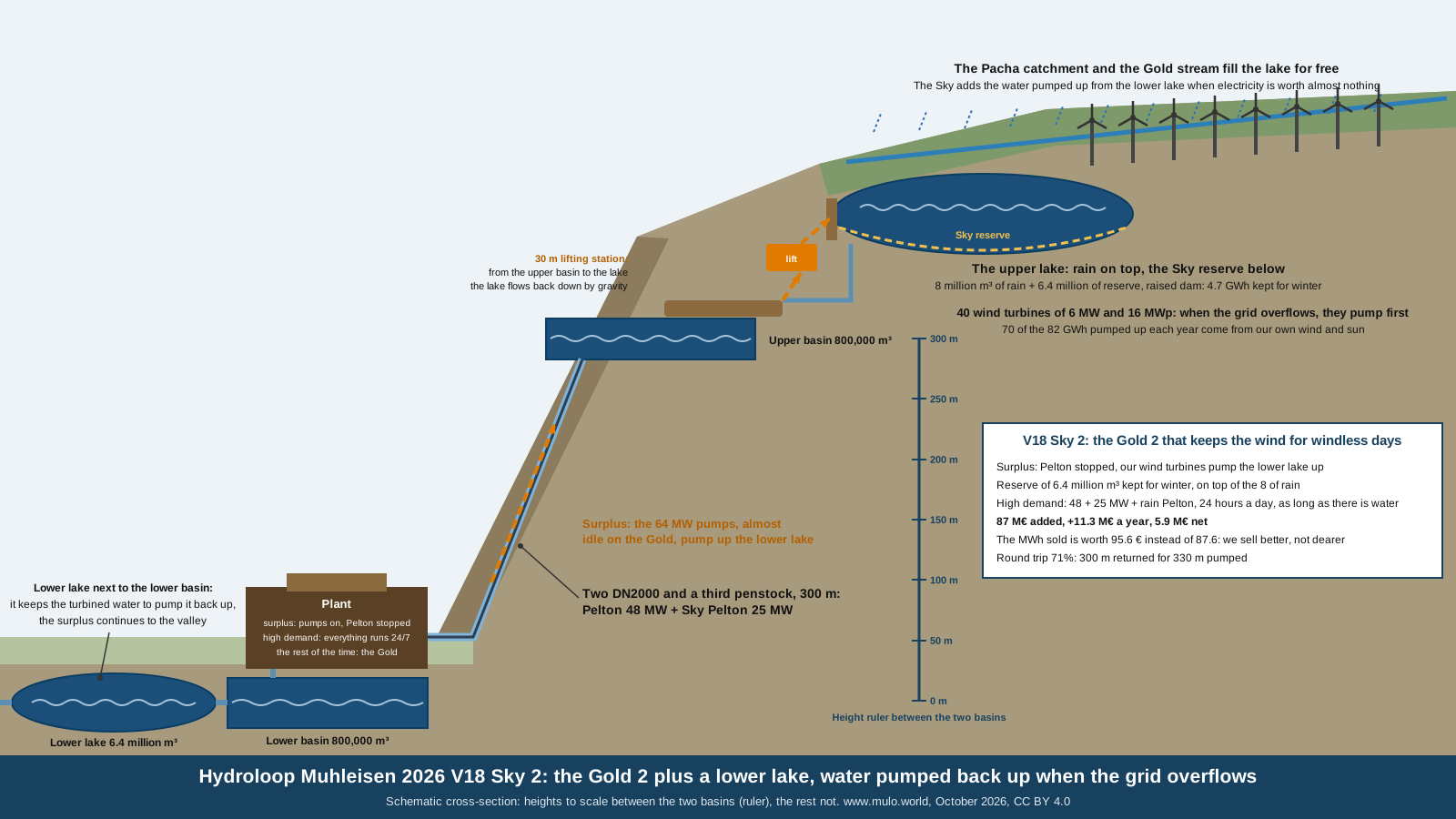
Diagram code (Python, free, the two Skys): schema_hydroloop_v18.py; hourly model: hydroloop_muhleisen_2026_v18_simulation.py (the arguments of the Gold, then the upper reserve and the lower lake as a number of upper basins, the added pumps and Sky Pelton in MW, the price of the surplus and that of high-demand days, the lift height, the rain Pelton, grid purchase yes or no, seasonal prices yes or no, the catchment around the lower lake in km², then the drop between the lower basin and the lower lake, the drop at the outlet of the lower lake and the flow of the small turbines)
The Skys: Sky 2 (Gold 2, 300 m) | Sky 3 (Gold 3, 1,500 m, in French) | Sky Artesia (Sky 3 + artesian spring, in French); next: V19 Station Castle (the Sky 2 plus the water service of its valley, in French) | V20 O Sky (the Sky whose waters also produce); the Golds: 1 | 2 | 3 | 4; the 10,000 billion target world plan optimised for sun (in French)
------------------------------
1. WHAT THE SKY ADDS TO THE GOLD
------------------------------
The Gold 2 sells 1,247 GWh a year at 23.1 €/MWh, but it sells when the water arrives and when the wind blows, not when it is needed. Its 64 MW pumps are hardly used any more, 7 GWh a year, since the river fills the lake. The Sky 2 adds three structures and a rule:
* A 6.4 million m³ lower lake, next to the lower basin, which keeps the turbined water so that it can be pumped back up. The surplus continues to the valley, as on the Gold.
* A 6.4 million m³ reserve at the top, below the rain lake, by raising the dam: 4.7 GWh kept for winter, on top of the 5.9 GWh of the 8 million m³ of rain.
* A 30 m lifting station between the upper basin and the lake, since the lake is above the upper basin, and a 25 MW Sky Pelton on a third penstock, to empty the reserve quickly enough on the days it is needed.
* The rule: what is worth nothing is no longer sold. When the grid overflows, the Pelton turbines stop and the water goes up; when it is short, everything comes down.
------------------------------
2. THE OPERATING RULES
------------------------------
* Surplus hours (saturated grid, almost zero or negative price, usually midday in spring and summer, or strong gusts of wind): the rain Pelton and the peak Pelton stop, unless the lake risks overflowing. Our 40 wind turbines and our 16 MWp pump first, from the lower lake to the upper basin then to the lake; the grid makes up the rest up to the 64 MW of the pumps. The pumps always leave 30% of the rain lake free for the next downpour.
* High-demand days (windless winter, tight grid, high prices): everything generates 24 hours a day, 48 MW Pelton, 25 MW Sky Pelton and rain Pelton, and the wind is sold directly. There is enough at the top to last about five days at full power.
* Winter (November to February): the reserve is open to everyday production, because electricity is worth more then.
* The rest of the time: the Gold 2 as before, and the Sky Pelton turbines the top of the lake as soon as it exceeds half of the rain, to keep room for the next surplus.
* Heat waves: the water of the lower lake is pumped up first, and what must wait at the bottom waits in the 800,000 m³ lower basin, smaller and coverable (floating panels or cover, as on the V14 Soleil), where evaporation is easier to control than on the 64 ha of the lake.
------------------------------
3. WHERE THE ENERGY THAT PUMPS THE WATER UP COMES FROM
------------------------------
When the grid has too much electricity, it is almost always because wind and sun are doing well, and they are doing well at our site too: our wind turbines are running hard at the very moment their kWh is worth nothing. Rather than selling it for nothing, we use it to pump the water up. The model confirms it: out of 82 GWh pumped a year, 70 come from our own wind turbines and panels, and only 12 from the grid. Without any purchase, the Sky 2 still earns 10.7 M€ a year instead of 11.3. Another advantage: the electricity of our wind turbines does not go through the grid before pumping the water up, it stays behind the same substation; in countries where storage pays the grid twice, on purchase and on sale, the Sky pays it only for the small share bought.
The round trip returns 71%: we pump over 330 m (300 m of head plus 30 m of lift) and generate over 300 m. That is the price of selling at the right time, and it pays off very well when what is pumped was worth almost nothing.
------------------------------
4. THE HOURLY MODEL
------------------------------
Gold 2 base kept: 45 km canal, 2,000 mm of rain, temperate regime, 8 million m³ rain lake, small river of 3 m³/s, 16.9 MW rain Pelton. The grid is represented by a regional wind linked to ours and by the sun: 1,545 hours of surplus a year, when the MWh is worth almost nothing (France counted 513 hours at negative prices in 2025), and 18 high-demand days in a windless winter, at 150 €/MWh (Germany exceeded 300 €/MWh during its windless episodes of November and December 2024). Other hours are worth 90 €/MWh and 115 at peak, 30% more in winter and 30% less in summer. The Gold and the Sky are counted with the same prices, and it is the gap that makes the gain.
Reading: the Sky does not produce more, it sells better. Of the 11.3 M€ gained, 1.9 come from the operating rules alone (stopping the Pelton turbines during surpluses, generating everything on high-demand days, opening the lake in winter), which any Gold 2 can apply tomorrow without building anything; the Sky's structures bring in the other 9.4, i.e. 4.0 M€ net a year for 87 M€. The 70 GWh from our wind turbines that were worth nothing during surpluses go up and come back on the days when the MWh is expensive. The large reserve earns the most (19.5 M€ a year) but costs 2.5 times more for the same net: it needs more pumps and more turbines, and only fills and empties a few times a year. The size kept is the one that brings in the most per euro invested.
------------------------------
5. THE FIGURES IN SERIES
------------------------------
It must be said clearly: the Sky raises the production cost of the MWh, from 23.1 to 27.1 €, because it adds structures without producing more. What it increases is the value of what it sells, 8 € more per MWh on the whole production, and the gain far exceeds the cost. It is also a service to the grid: other people's wind turbines and panels no longer have to stop when they produce too much, and windless winter evenings have one more plant.
------------------------------
6. AND ON A GOLD 1?
------------------------------
The model was also run on the Gold 1 (in French): with a reserve and a lower lake of 1.6 million m³ each and 3 MW of Sky Pelton, 23.5 M€ bring in 2.5 M€ a year, 1.1 net. It is possible but small, and it does not have its own page: a Gold 1 will do it if it has room for the lower lake and a grid that often saturates.
------------------------------
7. WHERE IT GOES
------------------------------
On Gold 2 sites that have two more things: a valley floor that accepts a 60 to 70 ha lake next to the lower basin, without a village or road to move, and a grid that already often saturates, with a lot of wind and solar and few lines to carry it away. The best: the Western Highlands, where Scottish wind is often stopped for lack of lines to the south and where the Cruachan and Coire Glas pumped-storage plants show the way; Tasmania, which Australia wants to make its battery; the Pre-Alps and the Julian Alps, between German and Italian solar; southern Chile; the Cascades, between the Columbia's wind and the cities; Taiwan and Japan, where grids are small. The sites are detailed on the Pacha and Gold locations page (in French).
------------------------------
8. POINTS TO WATCH
------------------------------
* Room for the lower lake. 6.4 million m³ is 64 ha at a depth of 10 m, on the valley floor, where the road and the fields often run. It is placed in a bend of the river or on a terrace, never in place of a village, and its dam is calculated for the flood.
* The first filling. 6.4 million m³ are needed once: 25 days of the 3 m³/s small river, in the high season, without touching the reserved flow. After that the water circulates in a loop and the valley receives the same water over the year, better regulated, with less spilling in floods (15 million m³ instead of 51).
* Prices move. If many storage plants are built, the gap between surplus and high demand narrows: that is why the page gives a table of unfavourable prices, where the Sky 2 stays positive (2.4 M€ net a year).
* Forecasting the weather. The model does not know the future: it keeps the reserve full and empties it on high-demand days. A real plant run with the week's weather forecasts will do better, emptying before a gale and filling before a winter anticyclone.
* The third penstock. The two DN2000 of the V14 are taken by the peak and the pumps; the Sky Pelton has its own penstock, counted in the price.
------------------------------
9. THE OPTIONS
------------------------------
* A small turbine at the lake outlet: it recovers the 30 m of lift when the water comes back down to the upper basin, and the round trip goes from 71 to 78%. To be costed site by site, depending on the real height of the lake above the upper basin.
* A 25 MW reversible Francis unit instead of the Sky Pelton: at 300 m it is the standard machine of the world's pumped-storage plants, it would pump and generate on the same penstock. As in the world plan, it remains an option as long as a manufacturer has not confirmed it on river water carrying sediment; it becomes the first choice on a Gold 4 with clear spring water.
* Rain captured around the lower lake (studied, no built catchment): it is indeed free water, but not free energy, because it falls at the bottom: to turbine it, it must first be pumped up, like the water of the lower lake. And the lower lake never lacks water, 400 million m³ a year already go to the valley: with 1 km² of built catchment around it (1.7 million m³ a year, 12 M€), the model gains nothing and the net drops by 0.6 M€. What is kept: placing the lower lake where the slopes already drain into it naturally, which costs nothing, helps the first filling and offsets evaporation. And if the ground drops below the plant, the metres can be turbined: that is the next option.
* The metres below the plant: a small low-head turbine (hourly model of 22/10). A Sky 2 moves about 470 million m³ a year from the lower basin to the lower lake: 390 then go on to the valley and 80 are pumped back up. If the ground drops below the plant, these metres can be turbined, in two possible places: between the lower basin and the lower lake, by placing the lake lower, or at the outlet of the lower lake, at the end of a 1 to 2 km canal along the slope. 25 m³/s turbine:
Reading: between the basins, the turbine sees all the water that goes down to the lower lake once the lower basin is full, the water that leaves for the valley and the water the Sky will pump back up; the water of the Gold's daily cycle stays in the lower basin. The water pumped back up has to climb these metres again, but with the almost free electricity of the surplus hours, and the pumps are not the bottleneck: the gain wins, narrowly, even with unfavourable prices (2.6 M€ net instead of 2.4). For the same drop, one turbine is better than two: 20 m at the outlet bring in more than 10 and 10. The table assumes 4,000 €/kW below 15 m, 3,000 above and a canal at 1.5 M€. Small low-head turbines often cost more: at 6,000 €/kW below 15 m, 4,500 above and 3 M€ of canal, the 10 m options bring in nothing more (5.9 M€ net between the basins, 5.7 at the outlet, the same as without a turbine or less), those at 20 and 30 m keep +0.3 and +0.45 M€ a year. The rule: below about 20 m of drop, no small turbine; above that, look at where the ground drops, place the lower lake lower than the lower basin if it is just below the plant, otherwise turbine at the outlet of the lower lake, and the turbine pays back in 8 to 13 years depending on its price. On the Gold 2 of the plan, with 30 km of canal, 20 m at the outlet add 0.5 M€ net a year (4.3 instead of 3.8), and 10 more metres between the basins almost nothing (4.4).
* Build the plant as low as possible, when the valley allows it: the large Pelton turbines then benefit from the metres on all the water, with their 90% efficiency instead of the 85% of a small turbine and without an extra machine. It is the first thing to look at on the map, before the small turbines.
* More pumps: 64 MW of extra pumps (48.8 M€) lift 175 GWh instead of 82, but only with the large reserve and 50 MW of Sky Pelton; the net does not change, it is an investor's choice.
------------------------------
10. THE GOOD IDEAS OF THE SKY 2
------------------------------
* When the grid overflows, our wind turbines and panels overflow too: it is with them that the water is pumped up first, the grid only makes up the rest (70 of the 82 GWh pumped).
* Keep the turbined water in a lower lake instead of returning it at once: it becomes water that can be pumped back up, and the valley still receives it over the year.
* On a Gold, the pumps are hardly used any more: the Sky gives them work again without buying new ones.
* A storage plant is sized on its turbine as much as on its lake: without the power to empty it quickly, a large reserve only serves a few days a year.
* Stop the rain Pelton when the MWh is worth nothing: the water waits at the top, it does not spoil.
------------------------------
SOURCES
------------------------------
The hourly model of the Skys (Python, no library), the Gold model plus the lower lake, the reserve, the pumps and the Sky Pelton
Hydroloop V17 Gold 2, the base of the Sky 2, and its model hydroloop_muhleisen_2026_v17_simulation.py
Hydroloop V18 Sky 3, the same idea at 1,500 m (in French)
Opéra Énergie, CRE 2025 review: 513 hours at negative prices in France in 2025, 352 in 2024 (in French)
Bundesnetzagentur: the price spikes of the windless and sunless episodes of November and December 2024
Wikipedia: pumped-storage hydroelectricity
Wikipedia: the Cruachan pumped-storage plant, in Scotland
The site's good ideas (in French)
Olivier Muhleisen in collaboration with Claude (Anthropic), October 2026. Royalty-free plans, open source, CC BY 4.0.
© 2009-2026 Onmyweb Production - TOS - Cookies information - Contact us - Free Copyright Open Source -
1. WHAT THE SKY ADDS TO THE GOLD
------------------------------
The Gold 2 sells 1,247 GWh a year at 23.1 €/MWh, but it sells when the water arrives and when the wind blows, not when it is needed. Its 64 MW pumps are hardly used any more, 7 GWh a year, since the river fills the lake. The Sky 2 adds three structures and a rule:
* A 6.4 million m³ lower lake, next to the lower basin, which keeps the turbined water so that it can be pumped back up. The surplus continues to the valley, as on the Gold.
* A 6.4 million m³ reserve at the top, below the rain lake, by raising the dam: 4.7 GWh kept for winter, on top of the 5.9 GWh of the 8 million m³ of rain.
* A 30 m lifting station between the upper basin and the lake, since the lake is above the upper basin, and a 25 MW Sky Pelton on a third penstock, to empty the reserve quickly enough on the days it is needed.
* The rule: what is worth nothing is no longer sold. When the grid overflows, the Pelton turbines stop and the water goes up; when it is short, everything comes down.
------------------------------
2. THE OPERATING RULES
------------------------------
* Surplus hours (saturated grid, almost zero or negative price, usually midday in spring and summer, or strong gusts of wind): the rain Pelton and the peak Pelton stop, unless the lake risks overflowing. Our 40 wind turbines and our 16 MWp pump first, from the lower lake to the upper basin then to the lake; the grid makes up the rest up to the 64 MW of the pumps. The pumps always leave 30% of the rain lake free for the next downpour.
* High-demand days (windless winter, tight grid, high prices): everything generates 24 hours a day, 48 MW Pelton, 25 MW Sky Pelton and rain Pelton, and the wind is sold directly. There is enough at the top to last about five days at full power.
* Winter (November to February): the reserve is open to everyday production, because electricity is worth more then.
* The rest of the time: the Gold 2 as before, and the Sky Pelton turbines the top of the lake as soon as it exceeds half of the rain, to keep room for the next surplus.
* Heat waves: the water of the lower lake is pumped up first, and what must wait at the bottom waits in the 800,000 m³ lower basin, smaller and coverable (floating panels or cover, as on the V14 Soleil), where evaporation is easier to control than on the 64 ha of the lake.
------------------------------
3. WHERE THE ENERGY THAT PUMPS THE WATER UP COMES FROM
------------------------------
When the grid has too much electricity, it is almost always because wind and sun are doing well, and they are doing well at our site too: our wind turbines are running hard at the very moment their kWh is worth nothing. Rather than selling it for nothing, we use it to pump the water up. The model confirms it: out of 82 GWh pumped a year, 70 come from our own wind turbines and panels, and only 12 from the grid. Without any purchase, the Sky 2 still earns 10.7 M€ a year instead of 11.3. Another advantage: the electricity of our wind turbines does not go through the grid before pumping the water up, it stays behind the same substation; in countries where storage pays the grid twice, on purchase and on sale, the Sky pays it only for the small share bought.
The round trip returns 71%: we pump over 330 m (300 m of head plus 30 m of lift) and generate over 300 m. That is the price of selling at the right time, and it pays off very well when what is pumped was worth almost nothing.
------------------------------
4. THE HOURLY MODEL
------------------------------
Gold 2 base kept: 45 km canal, 2,000 mm of rain, temperate regime, 8 million m³ rain lake, small river of 3 m³/s, 16.9 MW rain Pelton. The grid is represented by a regional wind linked to ours and by the sun: 1,545 hours of surplus a year, when the MWh is worth almost nothing (France counted 513 hours at negative prices in 2025), and 18 high-demand days in a windless winter, at 150 €/MWh (Germany exceeded 300 €/MWh during its windless episodes of November and December 2024). Other hours are worth 90 €/MWh and 115 at peak, 30% more in winter and 30% less in summer. The Gold and the Sky are counted with the same prices, and it is the gap that makes the gain.
| Configuration | Upper reserve, million m³ | Lower lake, million m³ | Pumps / Sky Pelton, MW | Pumped by the Sky, GWh (of which our production; the 7 GWh of the Gold's pumps are not counted here) | Sold, GWh | Of which high-demand days | Added cost, M€ | Gain per year, M€ | Net per year, M€ |
|---|---|---|---|---|---|---|---|---|---|
| Reference Gold 2 | 0 | 0 | 64 / 0 | 0 | 1,247 | 52 | 0 | ||
| Short Sky, no reserve | 0 | 1.6 | 64 / 25 | 75 (64) | 1,253 | 68 | 53.6 | 8.4 | 4.9 |
| Sky 2 kept | 6.4 | 6.4 | 64 / 25 | 82 (70) | 1,261 | 75 | 87.2 | 11.3 | 5.9 |
| Large reserve | 12.8 | 12.8 | 128 / 50 | 175 (132) | 1,272 | 85 | 220.2 | 19.5 | 5.6 |
Reading: the Sky does not produce more, it sells better. Of the 11.3 M€ gained, 1.9 come from the operating rules alone (stopping the Pelton turbines during surpluses, generating everything on high-demand days, opening the lake in winter), which any Gold 2 can apply tomorrow without building anything; the Sky's structures bring in the other 9.4, i.e. 4.0 M€ net a year for 87 M€. The 70 GWh from our wind turbines that were worth nothing during surpluses go up and come back on the days when the MWh is expensive. The large reserve earns the most (19.5 M€ a year) but costs 2.5 times more for the same net: it needs more pumps and more turbines, and only fills and empties a few times a year. The size kept is the one that brings in the most per euro invested.
| Sky 2 kept, if prices change | Gain per year, M€ | Net per year, M€ |
|---|---|---|
| Assumption of the page (surplus almost free, high demand at 150 €/MWh, seasons) | 11.3 | 5.9 |
| Without any grid purchase, our production alone | 10.7 | 5.3 |
| Surplus paid 15 €/MWh | 9.9 | 4.5 |
| Prices without seasons | 9.0 | 3.7 |
| Unfavourable prices (surplus at 30 €/MWh, high demand at 120) | 7.7 | 2.4 |
| Winter 2024 prices (high demand at 300 €/MWh) | 14.7 | 9.3 |
------------------------------
5. THE FIGURES IN SERIES
------------------------------
| Item | M€ | Remark |
|---|---|---|
| Upper reserve: lake dam raised for 6.4 million m³ more | 19.2 | 3 €/m³, like the rain lake, compacted clay |
| 6.4 million m³ lower lake next to the lower basin | 20.2 | about 64 ha over 10 m, clay dam, gate to the lower basin |
| 30 m lifting station from the upper basin to the lake, 18.9 m³/s (the flow of the 64 MW pumps), about 6.5 MW | 14.9 | low-head pumps, a short pipe |
| 25 MW Sky Pelton and third 300 m penstock | 32.9 | 900 €/kW plus the penstock |
| Total added to the Gold 2 | 87.2 | annuity and maintenance 5.4 M€ a year |
| Result | Gold 2 | Sky 2 |
|---|---|---|
| Electricity sold | 1,247 GWh | 1,261 GWh |
| Sold on high-demand days | 52 GWh | 75 GWh |
| Annual revenue at the same prices | 109.2 M€ | 120.5 M€ |
| Average value of the MWh sold | 87.6 € | 95.6 € |
| Production cost of the MWh | 23.1 € | 27.1 € |
| Energy kept at the top | 5.9 GWh (the rain) | 10.6 GWh, about five days at full power |
| Water spilled by the lake in flood | 51 million m³ | 15 million m³ |
| Days with an empty lake | 2 | 2 |
It must be said clearly: the Sky raises the production cost of the MWh, from 23.1 to 27.1 €, because it adds structures without producing more. What it increases is the value of what it sells, 8 € more per MWh on the whole production, and the gain far exceeds the cost. It is also a service to the grid: other people's wind turbines and panels no longer have to stop when they produce too much, and windless winter evenings have one more plant.
------------------------------
6. AND ON A GOLD 1?
------------------------------
The model was also run on the Gold 1 (in French): with a reserve and a lower lake of 1.6 million m³ each and 3 MW of Sky Pelton, 23.5 M€ bring in 2.5 M€ a year, 1.1 net. It is possible but small, and it does not have its own page: a Gold 1 will do it if it has room for the lower lake and a grid that often saturates.
------------------------------
7. WHERE IT GOES
------------------------------
On Gold 2 sites that have two more things: a valley floor that accepts a 60 to 70 ha lake next to the lower basin, without a village or road to move, and a grid that already often saturates, with a lot of wind and solar and few lines to carry it away. The best: the Western Highlands, where Scottish wind is often stopped for lack of lines to the south and where the Cruachan and Coire Glas pumped-storage plants show the way; Tasmania, which Australia wants to make its battery; the Pre-Alps and the Julian Alps, between German and Italian solar; southern Chile; the Cascades, between the Columbia's wind and the cities; Taiwan and Japan, where grids are small. The sites are detailed on the Pacha and Gold locations page (in French).
------------------------------
8. POINTS TO WATCH
------------------------------
* Room for the lower lake. 6.4 million m³ is 64 ha at a depth of 10 m, on the valley floor, where the road and the fields often run. It is placed in a bend of the river or on a terrace, never in place of a village, and its dam is calculated for the flood.
* The first filling. 6.4 million m³ are needed once: 25 days of the 3 m³/s small river, in the high season, without touching the reserved flow. After that the water circulates in a loop and the valley receives the same water over the year, better regulated, with less spilling in floods (15 million m³ instead of 51).
* Prices move. If many storage plants are built, the gap between surplus and high demand narrows: that is why the page gives a table of unfavourable prices, where the Sky 2 stays positive (2.4 M€ net a year).
* Forecasting the weather. The model does not know the future: it keeps the reserve full and empties it on high-demand days. A real plant run with the week's weather forecasts will do better, emptying before a gale and filling before a winter anticyclone.
* The third penstock. The two DN2000 of the V14 are taken by the peak and the pumps; the Sky Pelton has its own penstock, counted in the price.
------------------------------
9. THE OPTIONS
------------------------------
* A small turbine at the lake outlet: it recovers the 30 m of lift when the water comes back down to the upper basin, and the round trip goes from 71 to 78%. To be costed site by site, depending on the real height of the lake above the upper basin.
* A 25 MW reversible Francis unit instead of the Sky Pelton: at 300 m it is the standard machine of the world's pumped-storage plants, it would pump and generate on the same penstock. As in the world plan, it remains an option as long as a manufacturer has not confirmed it on river water carrying sediment; it becomes the first choice on a Gold 4 with clear spring water.
* Rain captured around the lower lake (studied, no built catchment): it is indeed free water, but not free energy, because it falls at the bottom: to turbine it, it must first be pumped up, like the water of the lower lake. And the lower lake never lacks water, 400 million m³ a year already go to the valley: with 1 km² of built catchment around it (1.7 million m³ a year, 12 M€), the model gains nothing and the net drops by 0.6 M€. What is kept: placing the lower lake where the slopes already drain into it naturally, which costs nothing, helps the first filling and offsets evaporation. And if the ground drops below the plant, the metres can be turbined: that is the next option.
* The metres below the plant: a small low-head turbine (hourly model of 22/10). A Sky 2 moves about 470 million m³ a year from the lower basin to the lower lake: 390 then go on to the valley and 80 are pumped back up. If the ground drops below the plant, these metres can be turbined, in two possible places: between the lower basin and the lower lake, by placing the lake lower, or at the outlet of the lower lake, at the end of a 1 to 2 km canal along the slope. 25 m³/s turbine:
| Where | Drop | Power | Cost | Produced per year | Revenue per year | Net of the Sky 2 per year |
|---|---|---|---|---|---|---|
| No turbine | 5.9 M€ | |||||
| Between the lower basin and the lower lake | 10 m | 2.1 MW | 8.8 M€ | 9.6 GWh | 1.04 M€ | 6.2 M€ |
| At the outlet of the lower lake | 10 m | 2.1 MW | 9.8 M€ | 7.9 GWh | 0.86 M€ | 6.1 M€ |
| At the outlet of the lower lake | 20 m | 4.2 MW | 14.0 M€ | 15.9 GWh | 1.72 M€ | 6.7 M€ |
| At the outlet of the lower lake | 30 m | 6.3 MW | 20.3 M€ | 23.8 GWh | 2.57 M€ | 7.1 M€ |
| Two turbines, 10 m between the basins and 10 m at the outlet | 20 m | 2 × 2.1 MW | 18.7 M€ | 17.6 GWh | 1.90 M€ | 6.4 M€ |
* Build the plant as low as possible, when the valley allows it: the large Pelton turbines then benefit from the metres on all the water, with their 90% efficiency instead of the 85% of a small turbine and without an extra machine. It is the first thing to look at on the map, before the small turbines.
* More pumps: 64 MW of extra pumps (48.8 M€) lift 175 GWh instead of 82, but only with the large reserve and 50 MW of Sky Pelton; the net does not change, it is an investor's choice.
------------------------------
10. THE GOOD IDEAS OF THE SKY 2
------------------------------
* When the grid overflows, our wind turbines and panels overflow too: it is with them that the water is pumped up first, the grid only makes up the rest (70 of the 82 GWh pumped).
* Keep the turbined water in a lower lake instead of returning it at once: it becomes water that can be pumped back up, and the valley still receives it over the year.
* On a Gold, the pumps are hardly used any more: the Sky gives them work again without buying new ones.
* A storage plant is sized on its turbine as much as on its lake: without the power to empty it quickly, a large reserve only serves a few days a year.
* Stop the rain Pelton when the MWh is worth nothing: the water waits at the top, it does not spoil.
------------------------------
SOURCES
------------------------------
The hourly model of the Skys (Python, no library), the Gold model plus the lower lake, the reserve, the pumps and the Sky Pelton
Hydroloop V17 Gold 2, the base of the Sky 2, and its model hydroloop_muhleisen_2026_v17_simulation.py
Hydroloop V18 Sky 3, the same idea at 1,500 m (in French)
Opéra Énergie, CRE 2025 review: 513 hours at negative prices in France in 2025, 352 in 2024 (in French)
Bundesnetzagentur: the price spikes of the windless and sunless episodes of November and December 2024
Wikipedia: pumped-storage hydroelectricity
Wikipedia: the Cruachan pumped-storage plant, in Scotland
The site's good ideas (in French)
Olivier Muhleisen in collaboration with Claude (Anthropic), October 2026. Royalty-free plans, open source, CC BY 4.0.
© 2009-2026 Onmyweb Production - TOS - Cookies information - Contact us - Free Copyright Open Source -