
Titan Claudia 5: the 262 m coastal tower without offices, which gives the 100 m rotor the place of the 12 levels in cells, 11 stages from 54 to 230 m, a straight-legged tripod and the same solar base, 39 GWh a year, paid back in 7.9 years, 6.6 in a large series. 19/10/26
The Titan Claudia 4 (in French) had shown that on a coast, an office level and a rotor stage pay back at the same speed, and it had kept both. The Titan Claudia 5 chooses: it removes the 12 office levels in cells, whose letting on an industrial port is never certain, stops the trunk at 38 m and lets the rotor come down to take their place, with one more stage. Everything that makes the base remains: the 30 m solar skirt, the 28,000 m² of data centre that buy the electricity on site, the carports, the 20 industrial hybrid panels on the quay. The tripod changes to three straight legs. The result is a simpler tower, without a high-rise building, with a single tenant who is also the customer for the power, and which produces 7% more than the V4 for 12% less capital. The page gives the prices in a series of 10 towers and in a series of 1,000, that of the world plan (in French), saying where the drop comes from. There are also two Paris versions, the Titan Claudia 5 Paris Cône (in French) and the Titan Claudia 5 Paris 80 (in French).
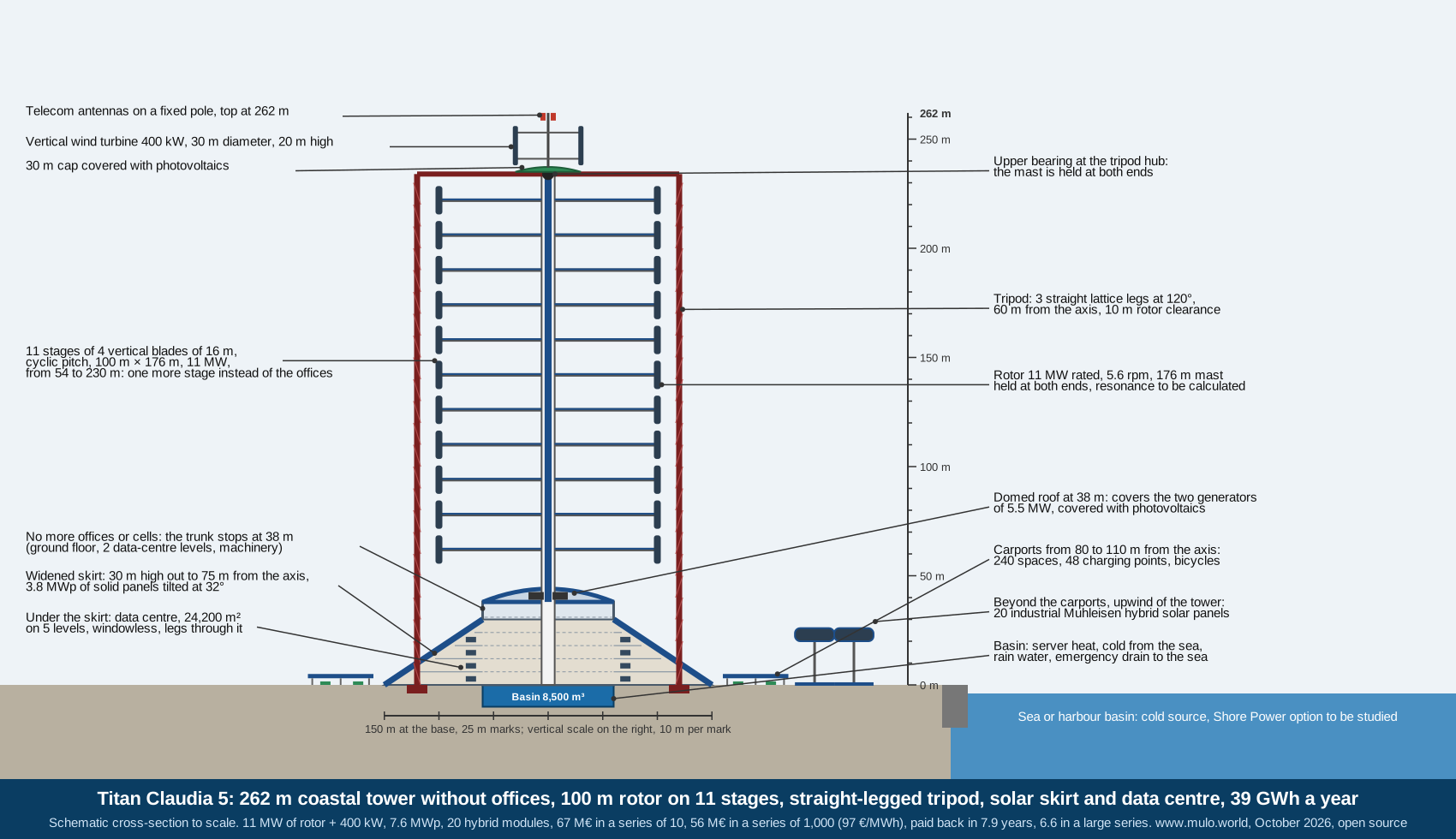
Diagram code (Python, free, the four towers of this series): schema_claudia_5.py
Diagram code (Python, free, the four towers of this series): schema_claudia_5.py
------------------------------
1. IN SHORT: WHAT CHANGES COMPARED WITH THE TITAN CLAUDIA 4
------------------------------
------------------------------
2. WHY REMOVE THE OFFICES WHEN THEY EARN AS MUCH AS A STAGE
------------------------------
Point 2 of the V4 compared a 16 m slice as a rotor stage and as four office levels: 6.3 years against 6.4 years, a draw. The V4 concluded that both were kept. But the two do not carry the same risk. A rotor stage produces as long as the wind blows; an office level earns money if someone rents it, and on an industrial port, in Fos, Dunkirk or Saint-Nazaire, 17,100 m² of new offices do not let as they would in Marseille. The V4 said so itself: at 50% occupancy, the payback went from 7.7 to 8.5 years.
Three ways of filling the 32 m freed up were costed, all with the V4 base kept:
The three are equal within 0.1 year; the V5 takes the 11 stages because the 176 m mast is the limit that the V4 had already discussed (point 3 of its page, the eleventh stage ruled out for resonance), and with a shortened trunk it gets there without exceeding 262 m. The 192 m mast awaits the resonance calculation.
And the opposite, removing lower stages to keep the mast and the height while saving on blades? That raises the price of the kWh instead of lowering it. What is fixed in the tower (tripod, mast, trunk, skirt, grid connection) stays there whatever is done, and a stage costs only its blades, its arms, its cyclic pitch and its share of the generator, 1.9 M€ including the mast. On a coast, the lowest stage still receives 85% of the wind energy at the top. Its marginal kWh is worth 73 to 80 €/MWh, less than the tower's average: removing it makes fewer kWh carry the fixed costs.
On a coast, the mast is therefore filled from bottom to top. It is in Paris, where the wind at 70 m is worth only 40% of that at the top, that the lower stages were removed in the V4 Paris.
------------------------------
3. THE ROTOR: 11 STAGES FROM 54 TO 230 M, A STRAIGHT-LEGGED TRIPOD
------------------------------
The rotor is that of the V4, 100 m in diameter, 4 vertical 16 m blades per stage with cyclic pitch, 5.6 rpm, with one more stage at the bottom: 11 stages from 54 to 230 m, 17,600 m² swept, 11 MW, two 5.5 MW generators at the top of the trunk, at 38 m. The rotating mast is 176 m long, held at both ends: the lower bearing on the trunk, the upper bearing at the tripod hub at 234 m. The first stage moves to 54 m, 24 m above the skirt where the blades pass over it (the skirt is 15 m high at 50 m from the axis).
The tripod changes shape: three straight lattice legs at 120°, 60 m from the axis, 10 m beyond the blade tips, from their foundations on the ground to the ring at 234 m. Vertical legs are simpler to calculate, are erected in identical sections, and let the skirt pass between them without an oblique cut-out; they hold the upper bearing in the same place as the inclined legs of the V4. Cost 6.0 M€ instead of 6.5.
The 176 m mast is the point that decides the number of stages: its resonance with 11 MW rotating is to be calculated before fixing 11 or 10. If the calculation imposes 10, the tower goes back to the V4 rotor on a bare column (first row of the table in point 2) and loses 0.1 year.
------------------------------
4. THE SHORT TRUNK AND THE BASE KEPT
------------------------------
The trunk stops at 38 m: a 2,100 m² ground floor (reception, shops, bicycle station), two 6 m data-centre levels, a machinery level with the two generators, the lower bearing, the transformers, and the domed roof covered with photovoltaics that already closed the V4 at 70 m. The exoskeleton no longer carries 15 levels but 4 and the mast: 3.1 M€ instead of 14.5. There is no longer a skin of cells.
The base is that of the V4, without change: the skirt 30 m high out to 75 m from the axis, 18,100 m² at 32°, 3.8 MWp, 3.25 GWh, the cheapest kWh of the tower; beneath it, five levels of floors, 24,200 m² usable, which together with the two trunk levels make a 28,000 m² data centre let at 120 €/m²; the carports from 80 to 110 m with 240 spaces, 48 charging points and the bicycle station; the 8,500 m³ basin and the seawater heat exchanger; the 4 MWh sodium-ion battery; and on the quay, upwind, the 20 industrial hybrid solar panels spaced 36 m apart. The data centre consumes 25 to 40 MW, three times what the tower produces: all the electricity is sold on site, at 150 €/MWh, without going through the grid.
What the tower loses with the offices is also what went with them: half of the parking (120 spaces are enough for the data centre and visitors, but the carports are kept whole for their solar), the heat sold to the neighbourhood is unchanged (it comes from the servers), and own consumption goes from 1.4 to 1.1 GWh.
------------------------------
5. THE FIGURES: COST IN A SERIES OF 10 AND IN A SERIES OF 1,000, REVENUE, PAYBACK
------------------------------
The towers on the site are costed "in series", that is from the tenth identical tower. The world plan provides for 1,000 of them on the coasts. In wind power, each doubling of cumulative production lowers the cost by 10 to 15%; at 80 towers and more, i.e. three doublings, the rotor goes from 2.35 to about 1.65 M€/MW, close to a classic wind turbine, and the repeated structures (tripod, trunk, skirt) drop by 10%. The panels, the battery, the charging points and the grid connection are already market prices and do not move. If the prices on this page are lower than those of the V4, it is first because they are calculated for a larger series, not because the machine has changed. The "series of 10" column is the one comparable with the V4.
Production, coast at 7 m/s:
Revenue per year, electricity sold on site at 150 €/MWh:
Rents are counted at 90% occupancy and 8% non-recoverable charges, as in the V4. The profit now depends only on the wind and on one tenant.
------------------------------
6. V4 OR V5: TWO TOWERS FOR TWO PORTS
------------------------------
The V4 remains better by 1.4 M€ a year if its offices let, and the V5 is better as soon as they do not. Both have their place, and the world plan, which counts 1,000 coastal towers at the price of the V4, is not modified by this page: the V5 in a large series does better than it assumes.
------------------------------
7. AVENUES STUDIED AND RULED OUT FOR THIS VERSION
------------------------------
* The all-wind tower, without a base: skirt, data centre, solar and carports removed too, rotor and tripod on a bare 70 m trunk. 39.2 M€, 30.4 GWh, 106 €/MWh: barely better than the V4 even though the tower has lost half its capital, because the cyclic-pitch rotor on a mast held at both ends costs 2.35 M€/MW and the tripod and trunk that carry it add 10.5 M€, against 1.3 to 1.5 M€/MW for a classic 10 MW wind turbine that produces as much at 45 to 60 €/MWh. Without a base, the Titan Claudia is a wind turbine twice as expensive as the market, paid back in 22 years at the grid price. Its reason for being is the inhabited structure and the customer on site. Ruled out.
* 12 stages from 38 to 230 m: +1.8 GWh and -2 €/MWh, but a 192 m mast whose resonance has not been calculated. Kept in reserve.
* Lowering the whole tower (10 stages from 40 to 200 m, tripod at 204 m): the wind at the bottom is worth 15% less, the tower loses more than it saves, 111 €/MWh. Ruled out.
* Removing the lower stages while keeping the mast: point 2, the kWh rises. Ruled out.
* End discs on the rotor, as on the hybrid panel: a rotor of 11 stacked stages has only one end at the top and one at the bottom for a height of 176 m and a diameter of 100 m, an aspect ratio of 1.8 where tip losses are real. The domed roof of the trunk and the cap already act as end discs, and the V4 counted their effect at 1 to 2%, not included. No extra end disc; the effect remains uncounted.
* The avenues ruled out in the V2, V3 and V4 (dome, solar on the blades and legs, ring of wind turbines on the crown, 120 m rotor, skirt out to 90 m, 8 MWh battery, hybrid panels as towers) remain so.
------------------------------
8. POINTS TO WATCH
------------------------------
* All those of the V4 remain valid: cyclic-pitch rotor to be developed, fatigue of the blades and arms, flooding of the data centre on a quay, aviation permit at 262 m, data centre operator committed for 10 to 15 years with its 30 to 50 MW connection.
* The 176 m mast: it is the limit that the V4 had identified. Its resonance with the 11 MW of the rotor is the calculation that fixes 11 or 10 stages; in the second case the tower loses 2.1 GWh and 0.1 year, not its principle.
* The first stage at 54 m passes over the skirt at a distance of 24 m and the carports at 50 m: the skirt's wake and the noise on the ground are to be measured on the prototype, this stage being the closest to people.
* A single tenant: the V5 has removed the risk of empty offices by concentrating everything on the data centre. If it is missing, the tower only has the grid at 90 €/MWh, 10.8 years in a series of 10.
* The prices in a series of 1,000 assume that the 1,000 towers of the world plan get built: at 10 towers, it is the figures in the first column that count, and the first tower will cost 82 to 86 M€.
* The 20 hybrid panels assume 5,600 m² of quay upwind of the tower and a measured prototype; their figures are calculated, not measured.
------------------------------
9. CONCLUSION
------------------------------
The Titan Claudia 5 is the V4 without its offices: a 38 m trunk, an 11-stage rotor that occupies the whole height from 54 to 230 m, a straight-legged tripod, and the same solar base with its data centre. It produces 39 GWh, 7% more than the V4, for 67 M€ in a series of 10 and 56 M€ in a series of 1,000, at 110 then 97 €/MWh, paid back in 7.9 then 6.6 years, with a single tenant and without a high-rise building. The V4 keeps the advantage where offices let; the V5 is the tower for industrial ports. What remains to be done is the same as for the V4, plus one calculation: the resonance of a 176 m mast. The plans are royalty-free.
------------------------------
SOURCES
------------------------------
Titan Claudia 4, the previous coastal version (in French)
Titan Claudia 5 Paris Cône, the Paris version (in French)
Titan Claudia 5 Paris 80, the Paris version with a flared trunk (in French)
Titan Claudia 4 Paris Style, the V4 Paris without a tripod
Titan Claudia 3 (in French)
Muhleisen hybrid solar panel, industrial version
6-in-1 world plan, the 1,000 coastal towers (in French)
The site's good ideas (in French)
Wikipedia: high-rise building (IGH) under French rules (in French)
Wikipedia: experience curve, the drop in costs per doubling of cumulative production
IRENA: renewable power generation costs in 2024
Wikipedia: vertical-axis wind turbine
Olivier Muhleisen in collaboration with Claude (Anthropic), October 2026. Royalty-free plans, open source.
© 2009-2026 Onmyweb Production - TOS - Cookies information - Contact us - Free Copyright Open Source -
1. IN SHORT: WHAT CHANGES COMPARED WITH THE TITAN CLAUDIA 4
------------------------------
| Item | Titan Claudia 4 | Titan Claudia 5 |
|---|---|---|
| Height at the top | 262 m | 262 m, unchanged |
| Trunk | 70 m, 15 levels including 12 office levels in cells | 38 m: ground floor, 2 data-centre levels, machinery, domed roof; no more cells |
| Rotor | 10 stages of 100 m, from 70 to 230 m, 10 MW, 160 m mast | 11 stages of 100 m, from 54 to 230 m, 11 MW, 176 m mast |
| Tripod | Legs inclined from 68 m from the axis at the ground to 60 m at the top | Three straight legs 60 m from the axis, ring at 234 m |
| Skirt, data centre, carports, quay panels, battery, basin | Identical: 30 m skirt out to 75 m from the axis (3.8 MWp), 28,000 m² of data centre, 240 spaces under carports, 20 industrial hybrid panels, 4 MWh battery | |
| Lettable area | 47,200 m² (17,100 of offices) | 30,100 m² (data centre and ground floor) |
| Net production, coast at 7 m/s | 36.9 GWh | 39.3 GWh |
| Investment in a series of 10 | 76.4 M€ | 67.3 M€ |
| Investment in a series of 1,000 (world plan) | not calculated | 56.2 M€ |
| Price of the kWh, electricity only | 112 €/MWh | 110 €/MWh in a series of 10, 97 in a series of 1,000 |
| Net profit per year (electricity at 150 €/MWh) | 9.9 M€ | 8.5 M€ |
| Payback | 7.7 years | 7.9 years in a series of 10, 6.6 years in a series of 1,000 |
| Risk of empty offices | At 50% occupancy, 8.5 years | None |
------------------------------
2. WHY REMOVE THE OFFICES WHEN THEY EARN AS MUCH AS A STAGE
------------------------------
Point 2 of the V4 compared a 16 m slice as a rotor stage and as four office levels: 6.3 years against 6.4 years, a draw. The V4 concluded that both were kept. But the two do not carry the same risk. A rotor stage produces as long as the wind blows; an office level earns money if someone rents it, and on an industrial port, in Fos, Dunkirk or Saint-Nazaire, 17,100 m² of new offices do not let as they would in Marseille. The V4 said so itself: at 50% occupancy, the payback went from 7.7 to 8.5 years.
| The 12 office levels of the V4, removed | Value |
|---|---|
| Capital saved (exoskeleton and floors of the 12 levels, 45 m of trunk) | 11.4 M€ |
| Rents lost | 1.7 M€ a year |
| High-rise building | With no occupied level above 28 m, the tower leaves the French high-rise (IGH) regulations: enclosed stairwells, smoke extraction, sprinklers, dry risers, safety commission. The real gain probably exceeds the 11.4 M€, by 1 to 3 M€, not counted. |
| What takes their place | One more rotor stage, 2.65 M€ (blades, arms, cyclic pitch, 16 m of mast, share of the generator), 2.1 GWh a year |
Three ways of filling the 32 m freed up were costed, all with the V4 base kept:
| Coast at 7 m/s, series of 10 | Rotor | Net production | Investment | Net profit | Payback | Price of the kWh |
|---|---|---|---|---|---|---|
| V4 rotor unchanged, bare column from 38 to 70 m | 10 stages from 70 to 230 m, 10 MW | 37.2 GWh | 66.0 M€ | 8.2 M€ | 8.0 years | 111 €/MWh |
| One more stage at the bottom, kept | 11 stages from 54 to 230 m, 11 MW, 176 m mast | 39.3 GWh | 67.3 M€ | 8.5 M€ | 7.9 years | 110 €/MWh |
| Two more stages, 192 m mast | 12 stages from 38 to 230 m, 12 MW | 41.1 GWh | 69.9 M€ | 8.7 M€ | 8.0 years | 108 €/MWh |
The three are equal within 0.1 year; the V5 takes the 11 stages because the 176 m mast is the limit that the V4 had already discussed (point 3 of its page, the eleventh stage ruled out for resonance), and with a shortened trunk it gets there without exceeding 262 m. The 192 m mast awaits the resonance calculation.
And the opposite, removing lower stages to keep the mast and the height while saving on blades? That raises the price of the kWh instead of lowering it. What is fixed in the tower (tripod, mast, trunk, skirt, grid connection) stays there whatever is done, and a stage costs only its blades, its arms, its cyclic pitch and its share of the generator, 1.9 M€ including the mast. On a coast, the lowest stage still receives 85% of the wind energy at the top. Its marginal kWh is worth 73 to 80 €/MWh, less than the tower's average: removing it makes fewer kWh carry the fixed costs.
| V5, coast at 7 m/s | Net production | Capital of the electricity | kWh of the stages removed | kWh of the tower |
|---|---|---|---|---|
| 11 stages from 54 to 230 m | 39.3 GWh | 54.5 M€ | 110 €/MWh | |
| Without the lowest stage | 37.2 GWh | 52.6 M€ | 80 €/MWh | 111 |
| Without the 2 lowest stages | 34.9 GWh | 50.7 M€ | 76 €/MWh | 114 |
| Without the 3 lowest stages | 32.5 GWh | 48.8 M€ | 73 €/MWh | 117 |
On a coast, the mast is therefore filled from bottom to top. It is in Paris, where the wind at 70 m is worth only 40% of that at the top, that the lower stages were removed in the V4 Paris.
------------------------------
3. THE ROTOR: 11 STAGES FROM 54 TO 230 M, A STRAIGHT-LEGGED TRIPOD
------------------------------
The rotor is that of the V4, 100 m in diameter, 4 vertical 16 m blades per stage with cyclic pitch, 5.6 rpm, with one more stage at the bottom: 11 stages from 54 to 230 m, 17,600 m² swept, 11 MW, two 5.5 MW generators at the top of the trunk, at 38 m. The rotating mast is 176 m long, held at both ends: the lower bearing on the trunk, the upper bearing at the tripod hub at 234 m. The first stage moves to 54 m, 24 m above the skirt where the blades pass over it (the skirt is 15 m high at 50 m from the axis).
| Stage, coast at 7 m/s | Height of the centre | Wind | GWh per year |
|---|---|---|---|
| 1 (new) | 62 m | 8.2 m/s | 2.1 |
| 2 to 10 | 78 to 206 m | 8.4 to 9.6 m/s | 2.3 to 3.2 |
| 11 | 222 m | 9.8 m/s | 3.2 |
| Whole rotor | 54 to 230 m | 31.7 |
The tripod changes shape: three straight lattice legs at 120°, 60 m from the axis, 10 m beyond the blade tips, from their foundations on the ground to the ring at 234 m. Vertical legs are simpler to calculate, are erected in identical sections, and let the skirt pass between them without an oblique cut-out; they hold the upper bearing in the same place as the inclined legs of the V4. Cost 6.0 M€ instead of 6.5.
The 176 m mast is the point that decides the number of stages: its resonance with 11 MW rotating is to be calculated before fixing 11 or 10. If the calculation imposes 10, the tower goes back to the V4 rotor on a bare column (first row of the table in point 2) and loses 0.1 year.
------------------------------
4. THE SHORT TRUNK AND THE BASE KEPT
------------------------------
The trunk stops at 38 m: a 2,100 m² ground floor (reception, shops, bicycle station), two 6 m data-centre levels, a machinery level with the two generators, the lower bearing, the transformers, and the domed roof covered with photovoltaics that already closed the V4 at 70 m. The exoskeleton no longer carries 15 levels but 4 and the mast: 3.1 M€ instead of 14.5. There is no longer a skin of cells.
The base is that of the V4, without change: the skirt 30 m high out to 75 m from the axis, 18,100 m² at 32°, 3.8 MWp, 3.25 GWh, the cheapest kWh of the tower; beneath it, five levels of floors, 24,200 m² usable, which together with the two trunk levels make a 28,000 m² data centre let at 120 €/m²; the carports from 80 to 110 m with 240 spaces, 48 charging points and the bicycle station; the 8,500 m³ basin and the seawater heat exchanger; the 4 MWh sodium-ion battery; and on the quay, upwind, the 20 industrial hybrid solar panels spaced 36 m apart. The data centre consumes 25 to 40 MW, three times what the tower produces: all the electricity is sold on site, at 150 €/MWh, without going through the grid.
What the tower loses with the offices is also what went with them: half of the parking (120 spaces are enough for the data centre and visitors, but the carports are kept whole for their solar), the heat sold to the neighbourhood is unchanged (it comes from the servers), and own consumption goes from 1.4 to 1.1 GWh.
------------------------------
5. THE FIGURES: COST IN A SERIES OF 10 AND IN A SERIES OF 1,000, REVENUE, PAYBACK
------------------------------
The towers on the site are costed "in series", that is from the tenth identical tower. The world plan provides for 1,000 of them on the coasts. In wind power, each doubling of cumulative production lowers the cost by 10 to 15%; at 80 towers and more, i.e. three doublings, the rotor goes from 2.35 to about 1.65 M€/MW, close to a classic wind turbine, and the repeated structures (tripod, trunk, skirt) drop by 10%. The panels, the battery, the charging points and the grid connection are already market prices and do not move. If the prices on this page are lower than those of the V4, it is first because they are calculated for a larger series, not because the machine has changed. The "series of 10" column is the one comparable with the V4.
| Item | Series of 10, M€ | Series of 1,000, M€ | Remark |
|---|---|---|---|
| Rotor with 11 stages of 100 m and cyclic pitch, 176 m mast, two 5.5 MW generators | 26.2 | 18.3 | 2.35 then 1.65 M€/MW |
| Tripod with three straight legs 60 m from the axis, ring at 234 m, star, upper bearing | 6.0 | 5.4 | Vertical legs, identical sections |
| 38 m trunk: exoskeleton, ground floor, 2 data-centre levels, machinery | 3.1 | 2.8 | Without the 12 office levels (11.4 M€ in the V4) |
| Skirt: structure and 5 levels of floors | 16.0 | 14.4 | 28,400 m² gross |
| Skirt photovoltaics, 3.8 MWp | 3.23 | 3.23 | 850 €/kWp |
| Photovoltaics: domed roof, 50 m arms, cap | 2.1 | 2.1 | |
| Domed roof | 0.3 | 0.27 | At 38 m |
| Photovoltaic carports | 1.4 | 1.26 | |
| Charging points | 1.15 | 1.15 | 40 of 22 kW, 8 of 150 kW |
| Sodium-ion battery 4 MWh / 4 MW | 1.3 | 1.3 | |
| Basin, seawater exchanger, valves | 0.8 | 0.8 | |
| 400 kW wind turbine at the top | 1.6 | 1.1 | |
| Pole and antenna positions | 0.35 | 0.35 | |
| Bicycle station shelter | 0.05 | 0.05 | |
| 20 industrial hybrid panels on 20 m masts | 1.3 | 1.3 | Price from their page, already in series |
| 11 MW medium-voltage connection, studies, control | 2.4 | 2.4 | Excluding the data centre's own connection |
| Total | 67.3 | 56.2 | The first tower: 82 to 86 M€ |
Production, coast at 7 m/s:
| Source | GWh per year |
|---|---|
| Rotor with 11 stages of 100 m | 31.7 |
| Wind turbine at the top | 1.25 |
| Solar skirt | 3.25 |
| Other photovoltaics (carports, roof, cap, arms) | 2.2 |
| 20 hybrid panels on the quay | 2.0 |
| Own consumption of the tower | -1.1 |
| Net production | 39.3 |
Revenue per year, electricity sold on site at 150 €/MWh:
| Revenue | M€ per year |
|---|---|
| Electricity (38.1 GWh) | 5.71 |
| Electric charging (1.24 GWh) | 0.44 |
| Data centre rents (28,000 m²) | 2.80 |
| Ground floor rents | 0.10 |
| Heat sold to the neighbourhood | 0.50 |
| Parking, antennas, bicycles | 0.15 |
| Total | 9.70 |
| Maintenance, operation, insurance, charging points | -1.18 |
| Net profit | 8.52 |
Rents are counted at 90% occupancy and 8% non-recoverable charges, as in the V4. The profit now depends only on the wind and on one tenant.
| Scenario | Series of 10, coast 7 m/s | Series of 10, coast 8 m/s | Series of 1,000, coast 7 m/s | Series of 1,000, coast 8 m/s |
|---|---|---|---|---|
| Net production | 39.3 GWh | 47.6 GWh | 39.3 GWh | 47.6 GWh |
| Price of the kWh, electricity only, 4% over 30 years | 110 €/MWh | 91 €/MWh | 97 €/MWh | 80 €/MWh |
| Price of the kWh, electricity only, 3% over 35 years (public) | 95 €/MWh | 78 €/MWh | 84 €/MWh | 69 €/MWh |
| Electricity sold to the grid at 90 €/MWh | 6.2 M€ net, 10.8 years | 7.0 M€ net, 9.6 years | 6.2 M€ net, 9.0 years | 7.0 M€ net, 8.0 years |
| Electricity sold on site at 150 €/MWh | 8.5 M€ net, 7.9 years | 9.8 M€ net, 6.9 years | 8.5 M€ net, 6.6 years | 9.8 M€ net, 5.8 years |
| Return over 30 years (150 €/MWh) | 12.1% | 13.9% | 14.6% | 16.8% |
------------------------------
6. V4 OR V5: TWO TOWERS FOR TWO PORTS
------------------------------
| Coast at 7 m/s, series of 10 | Titan Claudia 4 | Titan Claudia 5 |
|---|---|---|
| What pays for the tower | Electricity 48%, rents 41%, the rest 11% | Electricity 59%, data centre 29%, the rest 12% |
| Tenants to find | A data centre operator and 17,100 m² of offices | A data centre operator |
| Net profit, fully let | 9.9 M€, 7.7 years | 8.5 M€, 7.9 years |
| Net profit, offices half empty | 9.0 M€, 8.5 years | 8.5 M€, 7.9 years |
| Regulations | High-rise building | Not a high-rise, an industrial building of 38 m under a machine |
| The right site | Metropolitan port where offices let: Marseille, Le Havre | Industrial or energy port: Fos, Dunkirk, Saint-Nazaire, Montoir |
The V4 remains better by 1.4 M€ a year if its offices let, and the V5 is better as soon as they do not. Both have their place, and the world plan, which counts 1,000 coastal towers at the price of the V4, is not modified by this page: the V5 in a large series does better than it assumes.
------------------------------
7. AVENUES STUDIED AND RULED OUT FOR THIS VERSION
------------------------------
* The all-wind tower, without a base: skirt, data centre, solar and carports removed too, rotor and tripod on a bare 70 m trunk. 39.2 M€, 30.4 GWh, 106 €/MWh: barely better than the V4 even though the tower has lost half its capital, because the cyclic-pitch rotor on a mast held at both ends costs 2.35 M€/MW and the tripod and trunk that carry it add 10.5 M€, against 1.3 to 1.5 M€/MW for a classic 10 MW wind turbine that produces as much at 45 to 60 €/MWh. Without a base, the Titan Claudia is a wind turbine twice as expensive as the market, paid back in 22 years at the grid price. Its reason for being is the inhabited structure and the customer on site. Ruled out.
* 12 stages from 38 to 230 m: +1.8 GWh and -2 €/MWh, but a 192 m mast whose resonance has not been calculated. Kept in reserve.
* Lowering the whole tower (10 stages from 40 to 200 m, tripod at 204 m): the wind at the bottom is worth 15% less, the tower loses more than it saves, 111 €/MWh. Ruled out.
* Removing the lower stages while keeping the mast: point 2, the kWh rises. Ruled out.
* End discs on the rotor, as on the hybrid panel: a rotor of 11 stacked stages has only one end at the top and one at the bottom for a height of 176 m and a diameter of 100 m, an aspect ratio of 1.8 where tip losses are real. The domed roof of the trunk and the cap already act as end discs, and the V4 counted their effect at 1 to 2%, not included. No extra end disc; the effect remains uncounted.
* The avenues ruled out in the V2, V3 and V4 (dome, solar on the blades and legs, ring of wind turbines on the crown, 120 m rotor, skirt out to 90 m, 8 MWh battery, hybrid panels as towers) remain so.
------------------------------
8. POINTS TO WATCH
------------------------------
* All those of the V4 remain valid: cyclic-pitch rotor to be developed, fatigue of the blades and arms, flooding of the data centre on a quay, aviation permit at 262 m, data centre operator committed for 10 to 15 years with its 30 to 50 MW connection.
* The 176 m mast: it is the limit that the V4 had identified. Its resonance with the 11 MW of the rotor is the calculation that fixes 11 or 10 stages; in the second case the tower loses 2.1 GWh and 0.1 year, not its principle.
* The first stage at 54 m passes over the skirt at a distance of 24 m and the carports at 50 m: the skirt's wake and the noise on the ground are to be measured on the prototype, this stage being the closest to people.
* A single tenant: the V5 has removed the risk of empty offices by concentrating everything on the data centre. If it is missing, the tower only has the grid at 90 €/MWh, 10.8 years in a series of 10.
* The prices in a series of 1,000 assume that the 1,000 towers of the world plan get built: at 10 towers, it is the figures in the first column that count, and the first tower will cost 82 to 86 M€.
* The 20 hybrid panels assume 5,600 m² of quay upwind of the tower and a measured prototype; their figures are calculated, not measured.
------------------------------
9. CONCLUSION
------------------------------
The Titan Claudia 5 is the V4 without its offices: a 38 m trunk, an 11-stage rotor that occupies the whole height from 54 to 230 m, a straight-legged tripod, and the same solar base with its data centre. It produces 39 GWh, 7% more than the V4, for 67 M€ in a series of 10 and 56 M€ in a series of 1,000, at 110 then 97 €/MWh, paid back in 7.9 then 6.6 years, with a single tenant and without a high-rise building. The V4 keeps the advantage where offices let; the V5 is the tower for industrial ports. What remains to be done is the same as for the V4, plus one calculation: the resonance of a 176 m mast. The plans are royalty-free.
------------------------------
SOURCES
------------------------------
Titan Claudia 4, the previous coastal version (in French)
Titan Claudia 5 Paris Cône, the Paris version (in French)
Titan Claudia 5 Paris 80, the Paris version with a flared trunk (in French)
Titan Claudia 4 Paris Style, the V4 Paris without a tripod
Titan Claudia 3 (in French)
Muhleisen hybrid solar panel, industrial version
6-in-1 world plan, the 1,000 coastal towers (in French)
The site's good ideas (in French)
Wikipedia: high-rise building (IGH) under French rules (in French)
Wikipedia: experience curve, the drop in costs per doubling of cumulative production
IRENA: renewable power generation costs in 2024
Wikipedia: vertical-axis wind turbine
Olivier Muhleisen in collaboration with Claude (Anthropic), October 2026. Royalty-free plans, open source.
© 2009-2026 Onmyweb Production - TOS - Cookies information - Contact us - Free Copyright Open Source -