
Hydroloop Muhleisen 2026, version 17 Gold 4: a Pacha 1, 2 or 3 plus a large karst, volcanic or artesian spring of 1 to 10 m³/s, captured by gravity: the constant clear water that needs no pumping, a lake that no longer empties, reversible Francis units back, 27.9 €/MWh on a Pacha 1, 21.5 on a Pacha 2 and +28.8 M€ a year on a Pacha 3. The rare resource that makes the best plant. 19/10/26
The Gold 1, 2 and 3 bring a stream to the Pacha. The Gold 4 brings something better: a large spring, from karst, from a volcano or from an artesian aquifer, which comes out on its own, all year round, and clear. It is rare, but where it exists, it makes the best plant on the site: no diversion, no sediment, not a single day of empty lake, and reversible Francis units back. This page explains why a spring is not a borehole, where to place the lake when the mountain is limestone, what a spring of 1 to 10 m³/s gives on each of the three sizes, and where these springs are found among the 114 Pacha sites.
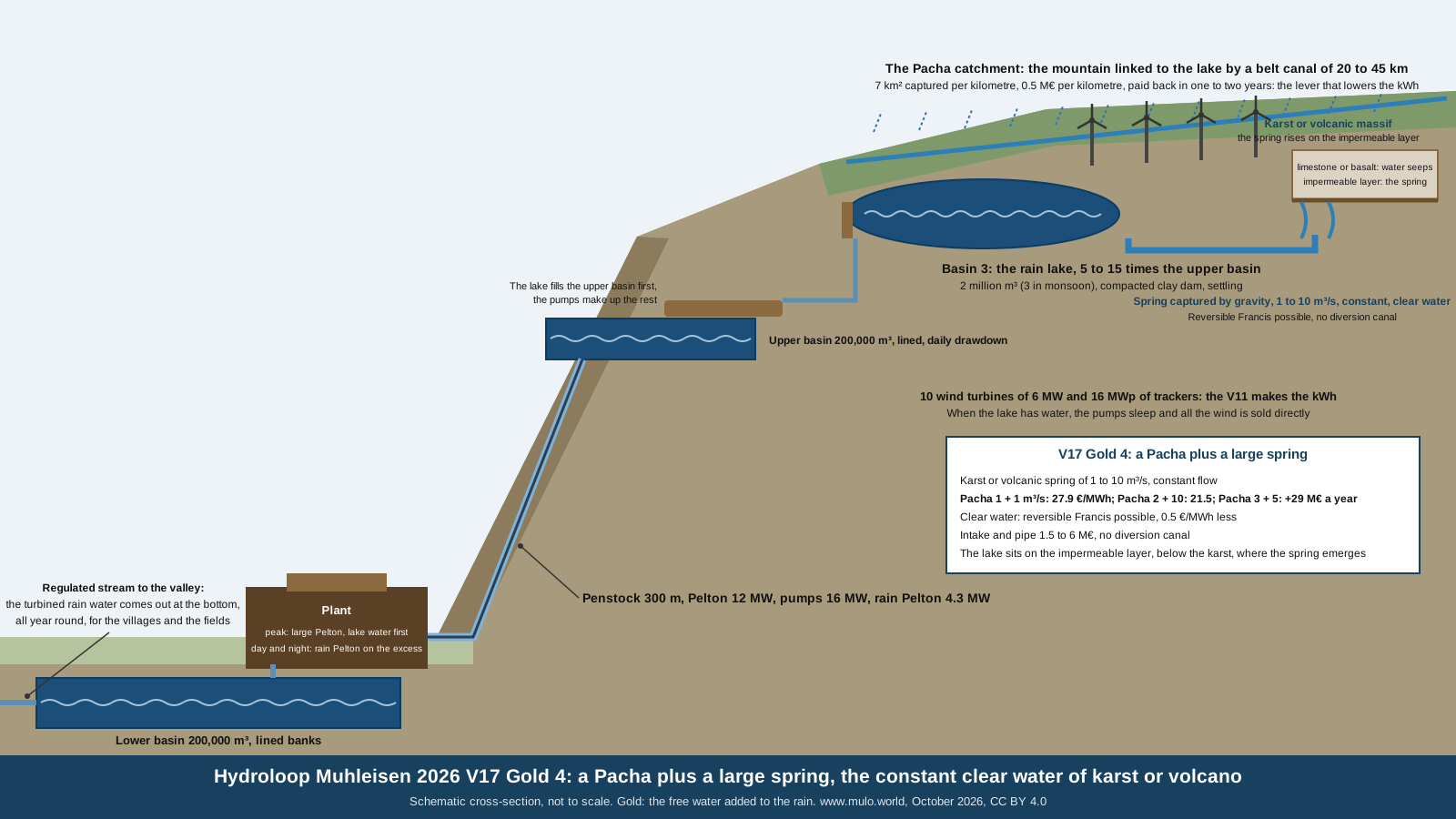
Diagram code (Python, free, the four Golds): schema_hydroloop_v17.py; hourly model: hydroloop_muhleisen_2026_v17_simulation.py (the nine arguments of the Pacha model, then the inflow in m³/s, the lift height in m for a borehole or a pump, the cost of the diversion in M€ and the seasonality: constant, fonte or etiage (constant, snowmelt or low water))
The four Golds: Gold 1 (Pacha 1 + stream, in French) | Gold 2 (Pacha 2 + small river) | Gold 3 (Pacha 3 + torrent, in French) | Gold 4 (the springs); the Pachas: 1 | 2 | 3; the 6-in-1 world plan (in French)
------------------------------
1. A SPRING IS NOT A BOREHOLE
------------------------------
A spring is groundwater that comes out on its own, by gravity, because the rock that holds it (karstified limestone, fissured basalt, gravel) rests on an impermeable layer that forces it out at the contact. Large mountain springs give 1 to 20 m³/s at an almost constant flow: the Fontaine de Vaucluse 20 m³/s on average, the Loue and the Lison several m³/s, the Soča and the Boka in Slovenia, the Buna and the Bosna in Bosnia, the Ombla and the Ljuta on the Adriatic, the Metolius in the Cascades (40 m³/s from a basalt spring), the springs of the Huasteca and Chiapas, the Verapaz, Jamaica, Meghalaya, Hubei, Papua; and on volcanic islands, Java, Kyushu, Hawaii, Réunion, Madeira, the Azores, the basalt springs that made the levadas and the sugar-cane canals. A borehole, on the other hand, goes down to fetch water that does not come out: it has to be pumped, 9.81 × height per m³, to recover 9.81 × head × 0.9, and it gives 10 to 200 L/s, not cubic metres per second. The artesian aquifer, which gushes from a borehole without a pump, is a spring that has been helped out: it counts in the Gold 4, the pumped borehole does not (its figures are on the Gold 1 and 3 pages: +1 to +3 GWh, and a kWh that rises).
Three properties make the spring the best water for a Pacha:
* Constant. A karst or volcanic spring varies little between winter and summer: the lake is never empty from 1 m³/s on a Pacha 1, 5 m³/s on a Pacha 3.
* Clear. No sand, no pebbles: the Pelton, mandatory on rain and torrent water, is no longer mandatory, and variable-speed reversible Francis units become possible again on the peak machines, 0.5 €/MWh less.
* Captured on the spot. An intake structure, a pipe to the lake or the upper basin: 1.5 to 6 M€, no diversion canal or tunnel.
------------------------------
2. WHERE THE LAKE GOES: BELOW THE KARST, ON THE IMPERMEABLE LAYER
------------------------------
The Pacha locations page excludes karst for the lake, because a lake on fissured limestone leaks. The Gold 4 does not contradict the rule, it turns it around: the large spring emerges precisely where the limestone or basalt meets the impermeable layer (marls, clays, schists, bedrock). It is on this layer, below the spring and above the upper basin, that the lake is placed: it is watertight by nature and receives the spring by gravity. When the relief leaves no room for the lake, the spring feeds the lined upper basin directly, and the lake is not built: the constant spring takes its place, the cheapest case of all. Large springs are often already captured for a city's drinking water: it is not taken from the city, the overflowing share is taken, and everything is returned at the bottom, regulated.
------------------------------
3. THE HOURLY MODEL: THE THREE SIZES WITH A SPRING
------------------------------
Same model as Gold 1 to 3, constant inflow, intake and pipe cost instead of the diversion, rain Pelton resized on the excess (or Francis on a Pacha 1 or 2, 0.5 €/MWh less, not counted below).
Reading: the spring does what the stream does, better and for less, because there is nothing to divert and nothing to settle. A Pacha 1 with a 1 m³/s spring goes down to 27.9 €/MWh, 27.4 with Francis units; a Pacha 2 with 10 m³/s, 21.5, the cheapest plant on the whole site; a Pacha 3 with 5 m³/s earns 28.8 M€ more a year for 6 M€, without a single day of empty lake.
------------------------------
4. WHERE IT GOES
------------------------------
Of the 114 sites on the Pacha locations page (in French), one in four has a large spring at a useful altitude on the map; one in nine is kept, because many are already captured for drinking water, or emerge too low. The families of sites:
* Mountain karst. The Dinarides from Slovenia to Epirus (the rainiest mountains in Europe are also the most karstic: Soča, Kupa, Zrmanja, Ljuta, Buna, Bosna, Vikos), the Jura, the Chartreuse, the Bauges and the Vercors, the Basque and Béarn Pyrenees, the Picos de Europa, the Causses at the foot of the Cévennes, the Tatras, Meghalaya, Hubei and Sichuan, the Huasteca, Chiapas, the Verapaz, Jamaica, Cuba, Puerto Rico, Papua.
* Volcanoes. Java, Kyushu, Kamchatka, Cameroon, Kenya, Hawaii, Réunion, Madeira, the Azores, the Cascades, Ecuador, southern Chile: fissured basalt drinks the rain and returns it through constant springs halfway up the slopes.
* Glaciers. Glacier springs are not springs in the strict sense, but they have the same profile, constant in summer, and they fall on the high-head Pacha 3.
In the world plan, 288 of the 2,550 Pacha become Gold 4: 175 Pacha 1, 93 Pacha 2, 20 Pacha 3.
------------------------------
5. POINTS TO WATCH
------------------------------
* Drinking water first. A large spring almost always has a town or villages depending on it: only the share that overflows the existing intake is taken, never theirs, and the agreement is made at the basin committee with the water operator.
* The flow of a karst spring varies. Less than a torrent, but it varies: the Fontaine de Vaucluse goes from 4 to 100 m³/s. The design is based on the low-water flow, not on the average, and the spring flood goes through the spillway.
* Karst under the lake. The lake goes on the impermeable layer, below the spring, and nowhere else: geophysics and survey boreholes before anything else, as for the Pacha, 1 to 3 M€.
* Thermal and mineralised springs (volcanoes, faults) can scale or corrode: water analysis before choosing the Francis.
* The borehole remains ruled out. Even when the aquifer is there, pumping it costs more than it returns and empties it for others; only water that comes out on its own counts.
------------------------------
6. THE GOOD IDEAS OF THE GOLD 4
------------------------------
* A spring is not a borehole: one comes out on its own and is worth cubic metres per second, the other is pumped and gives litres.
* Karst, excluded for the lake, is the best water supplier: the spring emerges at the contact with the impermeable layer, and that is where the lake is placed.
* Spring water is clear: it gives back to the Pacha the reversible Francis units that rain water had taken away.
* Take the share that overflows from a spring already captured, never the city's, and return everything at the bottom.
* Without room for a lake, the constant spring feeds the upper basin directly: the cheapest case of all the Hydroloops.
------------------------------
SOURCES
------------------------------
The hourly model of the Golds (Python, no library), the Pacha model plus a base inflow
Hydroloop V16 Pacha 1 (in French), Pacha 2 and Pacha 3 (in French), the bases of the Golds
The best locations in the world for Hydroloop V16 Pacha, 114 named sites, and what they offer the Golds (in French)
6-in-1 world plan: 1,056 Golds in the plan (in French)
Wikipedia: the hydraulic ram
Wikipedia: reserved flow (in French)
Wikipedia: interbasin water transfers
Wikipedia: the multi-blade windpump
Wikipedia: springs, including karst and artesian springs
Wikipedia: the Fontaine de Vaucluse, the largest spring in France (in French)
Wikipedia: Statkraft, Norwegian hydropower with catchments linked by tunnels
The site's good ideas (in French)
Olivier Muhleisen in collaboration with Claude (Anthropic), October 2026. Royalty-free plans, open source, CC BY 4.0.
© 2009-2026 Onmyweb Production - TOS - Cookies information - Contact us - Free Copyright Open Source -
1. A SPRING IS NOT A BOREHOLE
------------------------------
A spring is groundwater that comes out on its own, by gravity, because the rock that holds it (karstified limestone, fissured basalt, gravel) rests on an impermeable layer that forces it out at the contact. Large mountain springs give 1 to 20 m³/s at an almost constant flow: the Fontaine de Vaucluse 20 m³/s on average, the Loue and the Lison several m³/s, the Soča and the Boka in Slovenia, the Buna and the Bosna in Bosnia, the Ombla and the Ljuta on the Adriatic, the Metolius in the Cascades (40 m³/s from a basalt spring), the springs of the Huasteca and Chiapas, the Verapaz, Jamaica, Meghalaya, Hubei, Papua; and on volcanic islands, Java, Kyushu, Hawaii, Réunion, Madeira, the Azores, the basalt springs that made the levadas and the sugar-cane canals. A borehole, on the other hand, goes down to fetch water that does not come out: it has to be pumped, 9.81 × height per m³, to recover 9.81 × head × 0.9, and it gives 10 to 200 L/s, not cubic metres per second. The artesian aquifer, which gushes from a borehole without a pump, is a spring that has been helped out: it counts in the Gold 4, the pumped borehole does not (its figures are on the Gold 1 and 3 pages: +1 to +3 GWh, and a kWh that rises).
Three properties make the spring the best water for a Pacha:
* Constant. A karst or volcanic spring varies little between winter and summer: the lake is never empty from 1 m³/s on a Pacha 1, 5 m³/s on a Pacha 3.
* Clear. No sand, no pebbles: the Pelton, mandatory on rain and torrent water, is no longer mandatory, and variable-speed reversible Francis units become possible again on the peak machines, 0.5 €/MWh less.
* Captured on the spot. An intake structure, a pipe to the lake or the upper basin: 1.5 to 6 M€, no diversion canal or tunnel.
------------------------------
2. WHERE THE LAKE GOES: BELOW THE KARST, ON THE IMPERMEABLE LAYER
------------------------------
The Pacha locations page excludes karst for the lake, because a lake on fissured limestone leaks. The Gold 4 does not contradict the rule, it turns it around: the large spring emerges precisely where the limestone or basalt meets the impermeable layer (marls, clays, schists, bedrock). It is on this layer, below the spring and above the upper basin, that the lake is placed: it is watertight by nature and receives the spring by gravity. When the relief leaves no room for the lake, the spring feeds the lined upper basin directly, and the lake is not built: the constant spring takes its place, the cheapest case of all. Large springs are often already captured for a city's drinking water: it is not taken from the city, the overflowing share is taken, and everything is returned at the bottom, regulated.
------------------------------
3. THE HOURLY MODEL: THE THREE SIZES WITH A SPRING
------------------------------
Same model as Gold 1 to 3, constant inflow, intake and pipe cost instead of the diversion, rain Pelton resized on the excess (or Francis on a Pacha 1 or 2, 0.5 €/MWh less, not counted below).
| Configuration | Intake and pipe, M€ | Total inflow, million m³ | Lake empty | Total sold, GWh | Cost added to the base, M€ | kWh or revenue |
|---|---|---|---|---|---|---|
| Pacha 1 (V11, 20 km canal) | reference | 105 | 39 days | 312 | 22.2 | 29.4 |
| Pacha 1 + 1 m³/s spring | 1.5 | 137 | 0 days | 335 | 24.8 | 27.9 (27.4 with Francis) |
| Pacha 1 + 3 m³/s spring | 2.5 | 200 | 0 days | 380 | 30.6 | 25.6 (25.1 with Francis) |
| Full Pacha 2 (V14, 45 km canal) | reference | 317 | 26 days | 1,180 | 57.1 | 23.6 |
| Pacha 2 + 3 m³/s spring | 2.5 | 411 | 2 days | 1,247 | 68.3 | 23.0 (22.5 with Francis) |
| Pacha 2 + 10 m³/s spring | 5 | 632 | 0 days | 1,406 | 90.7 | 21.5 (21.0 with Francis) |
| Pacha 3 (coastal V15, 30 km canal) | reference | 211 | 125 days | 1,390 (160 off-peak on water) | 28.0 | earns 21.2 M€ a year |
| Pacha 3 + 2 m³/s spring | 4 | 274 | 53 days | 1,503 (241) | 32.0 | 32.0 M€ a year (+10.8) |
| Pacha 3 + 5 m³/s spring | 6 | 368 | 0 days | 1,718 (429) | 34.0 | 50.0 M€ a year (+28.8) |
Reading: the spring does what the stream does, better and for less, because there is nothing to divert and nothing to settle. A Pacha 1 with a 1 m³/s spring goes down to 27.9 €/MWh, 27.4 with Francis units; a Pacha 2 with 10 m³/s, 21.5, the cheapest plant on the whole site; a Pacha 3 with 5 m³/s earns 28.8 M€ more a year for 6 M€, without a single day of empty lake.
------------------------------
4. WHERE IT GOES
------------------------------
Of the 114 sites on the Pacha locations page (in French), one in four has a large spring at a useful altitude on the map; one in nine is kept, because many are already captured for drinking water, or emerge too low. The families of sites:
* Mountain karst. The Dinarides from Slovenia to Epirus (the rainiest mountains in Europe are also the most karstic: Soča, Kupa, Zrmanja, Ljuta, Buna, Bosna, Vikos), the Jura, the Chartreuse, the Bauges and the Vercors, the Basque and Béarn Pyrenees, the Picos de Europa, the Causses at the foot of the Cévennes, the Tatras, Meghalaya, Hubei and Sichuan, the Huasteca, Chiapas, the Verapaz, Jamaica, Cuba, Puerto Rico, Papua.
* Volcanoes. Java, Kyushu, Kamchatka, Cameroon, Kenya, Hawaii, Réunion, Madeira, the Azores, the Cascades, Ecuador, southern Chile: fissured basalt drinks the rain and returns it through constant springs halfway up the slopes.
* Glaciers. Glacier springs are not springs in the strict sense, but they have the same profile, constant in summer, and they fall on the high-head Pacha 3.
In the world plan, 288 of the 2,550 Pacha become Gold 4: 175 Pacha 1, 93 Pacha 2, 20 Pacha 3.
------------------------------
5. POINTS TO WATCH
------------------------------
* Drinking water first. A large spring almost always has a town or villages depending on it: only the share that overflows the existing intake is taken, never theirs, and the agreement is made at the basin committee with the water operator.
* The flow of a karst spring varies. Less than a torrent, but it varies: the Fontaine de Vaucluse goes from 4 to 100 m³/s. The design is based on the low-water flow, not on the average, and the spring flood goes through the spillway.
* Karst under the lake. The lake goes on the impermeable layer, below the spring, and nowhere else: geophysics and survey boreholes before anything else, as for the Pacha, 1 to 3 M€.
* Thermal and mineralised springs (volcanoes, faults) can scale or corrode: water analysis before choosing the Francis.
* The borehole remains ruled out. Even when the aquifer is there, pumping it costs more than it returns and empties it for others; only water that comes out on its own counts.
------------------------------
6. THE GOOD IDEAS OF THE GOLD 4
------------------------------
* A spring is not a borehole: one comes out on its own and is worth cubic metres per second, the other is pumped and gives litres.
* Karst, excluded for the lake, is the best water supplier: the spring emerges at the contact with the impermeable layer, and that is where the lake is placed.
* Spring water is clear: it gives back to the Pacha the reversible Francis units that rain water had taken away.
* Take the share that overflows from a spring already captured, never the city's, and return everything at the bottom.
* Without room for a lake, the constant spring feeds the upper basin directly: the cheapest case of all the Hydroloops.
------------------------------
SOURCES
------------------------------
The hourly model of the Golds (Python, no library), the Pacha model plus a base inflow
Hydroloop V16 Pacha 1 (in French), Pacha 2 and Pacha 3 (in French), the bases of the Golds
The best locations in the world for Hydroloop V16 Pacha, 114 named sites, and what they offer the Golds (in French)
6-in-1 world plan: 1,056 Golds in the plan (in French)
Wikipedia: the hydraulic ram
Wikipedia: reserved flow (in French)
Wikipedia: interbasin water transfers
Wikipedia: the multi-blade windpump
Wikipedia: springs, including karst and artesian springs
Wikipedia: the Fontaine de Vaucluse, the largest spring in France (in French)
Wikipedia: Statkraft, Norwegian hydropower with catchments linked by tunnels
The site's good ideas (in French)
Olivier Muhleisen in collaboration with Claude (Anthropic), October 2026. Royalty-free plans, open source, CC BY 4.0.
© 2009-2026 Onmyweb Production - TOS - Cookies information - Contact us - Free Copyright Open Source -