
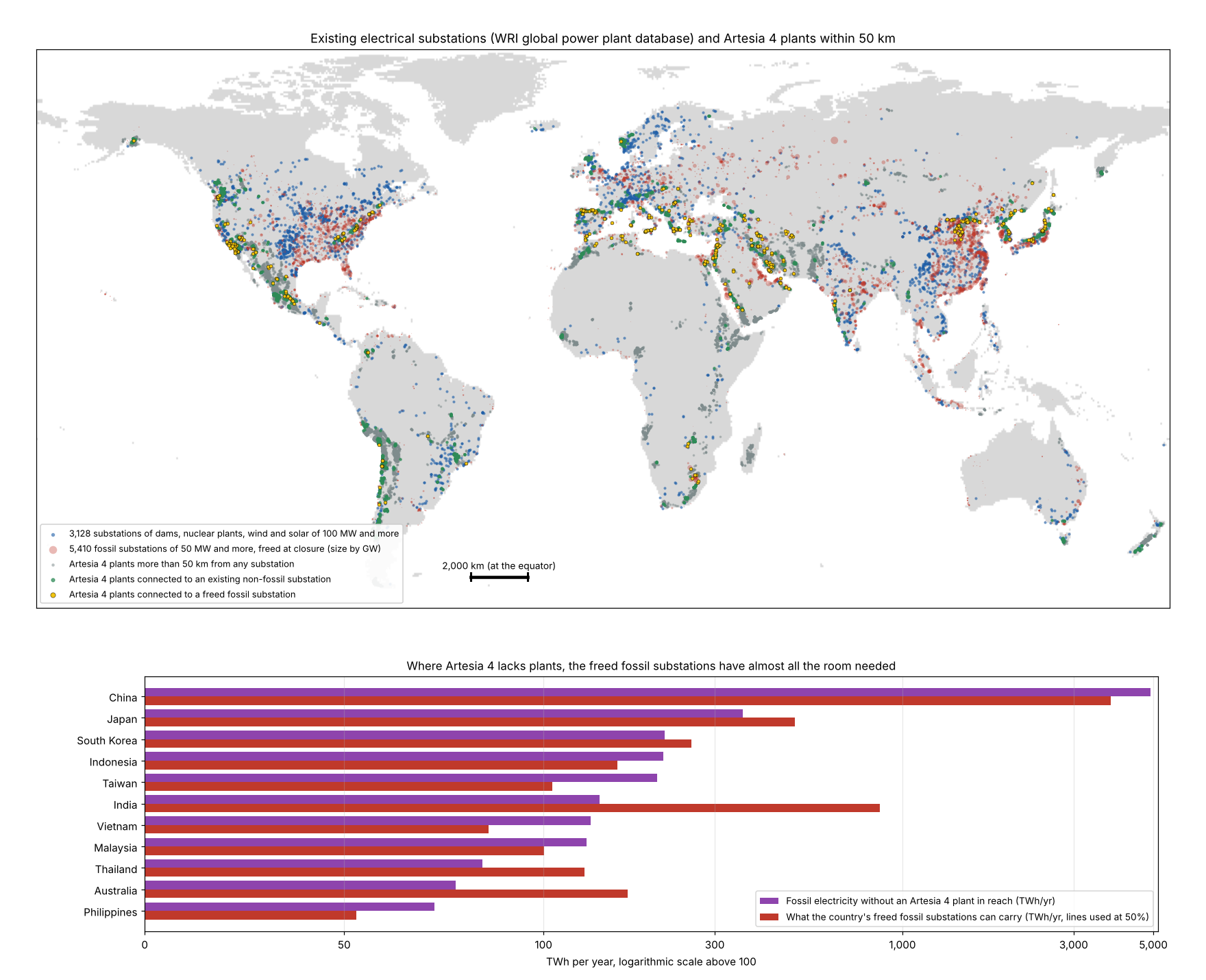
Reusable electrical substations: 5,410 fossil power plants that free 3,496 GW of grid connection when they close, and 3,128 substations of dams, nuclear power plants and large farms; of little use to Artesia 4, whose power plants are far from them, but enough to take almost all the electricity missing in Asia
When a coal, gas or oil power plant closes, its substation, its transformers and its high-voltage lines remain. They were built to carry its power out to a region that consumes it. A new power plant placed next to it only needs a short line to connect to it, and the electricity then follows the existing lines to the cities. The substations of large dams, nuclear power plants and large wind and solar farms free nothing, but they offer a high-voltage entry point closer than a large city. This page counts these substations in the world, connects the Artesia 4 power plants to the nearest one when it is 50 km away or less, and measures the room they offer for what comes next.
Calculation code (Python, free): postes_reutilisables_artesia.py (reads global_power_plant_database.csv, plan_mondial_artesia_4_sites.csv and electricite_pays_prix_part_fossile.csv; optional argument: the search radius, 50 km by default); the map: schema_postes_reutilisables_artesia.py; the results: the 8,538 substations, the GW freed by country, the substation of each Artesia 4 power plant
Related pages (in French): Artesia 4, grids recalculated | electricity country by country | Artesia 4 world plan | the existing reservoirs
------------------------------
1. THE METHOD
------------------------------
* The substations: the WRI (World Resources Institute) global power plant database, 34,936 power plants with their position and capacity. A power plant of 50 MW and more has a high-voltage substation. 5,410 fossil power plants of 50 MW and more are kept (coal, gas, oil, petroleum coke) and 3,128 others of 100 MW and more (dams, nuclear, large wind and solar farms, geothermal).
* What a fossil substation frees: 95% of its capacity, since the plan replaces 95% of fossil electricity; the rest keeps its gas power plants in reserve. In all 3,496 GW: 1,863 of coal, 1,397 of gas and 233 of oil. The 1,500 V14 that Artesia 4 already places on fossil substations take 303 GW of them; 3,193 remain.
* What a non-fossil substation does not free: a dam or a nuclear power plant keeps running. Its substation only serves as a closer entry point; the grid reinforcement still has to be paid for.
* The connection: each Artesia 4 power plant, from the largest to the smallest, takes the nearest fossil substation 50 km away or less that still has enough room, otherwise the nearest non-fossil substation 50 km away or less, otherwise it keeps the connection to its large city (85 km on average). A short alternating-current line, 0.6 M€ per km and per GW with a 15% detour, and 20 M€ per GW to equip the existing substation instead of 50 for a new substation.
* What a freed fossil substation saves: the new substation, the line to the city, the reinforcement at the arrival point (100 M€ per GW), and the long domestic line when the power plant was far from a large city, since the substation's existing lines already go to the customers. The V21 dams keep their substation, as before.
* The limit: the WRI database stops in 2021. China and India have since opened more than 200 GW of coal, which will also close: the GW freed are counted at the lowest.
------------------------------
2. THE SUBSTATIONS OF THE WORLD
------------------------------
The TWh that a substation can carry are counted with lines used at 50%, as on the grids page, and after the 1,500 V14 already placed on fossil substations. The file by country gives the others.
------------------------------
3. WHAT THE SUBSTATIONS CHANGE FOR ARTESIA 4: 86 BILLION
------------------------------
* Few Artesia 4 power plants are near a substation: 439 power plants (447 TWh) connect to a freed fossil substation, 36 km away on average; 2,760 (2,933 TWh) to a non-fossil substation, 33 km away; 10,431 (11,495 TWh) have no substation within 50 km. The plateaus of the sun belt and the windy ridges are far from thermal power plants, which are near cities, ports and mines.
* They use only 102 of the 3,193 GW freed.
* The saving: 22 billion on the power plants connected to a fossil substation, 33 on those connected to a non-fossil substation, 30 on the reinforcement at the arrival point of the 1,500 V14 on fossil substations, which the grids page was still counting; 86 billion in all, plus 3 billion less in losses. The Artesia 4 grid goes from 2,083 to 1,997 billion.
* With a radius of 100 km, the saving rises to 153 billion; with 30 km, it falls to 54.
------------------------------
4. WHAT THEY CHANGE FOR ARTESIA 5
------------------------------
* The room is where the plan lacks power plants: in the eleven countries of Asia and Oceania that do not have enough Artesia 4 power plants within reach, the freed fossil substations can carry 6,299 TWh a year, for 6,610 TWh missing. China has 3,801 TWh of free substations for 4,900 TWh missing, Japan 502 for 360, India 867 for 143, South Korea 258 for 218.
* A site near a freed substation is worth a bonus: about 160 M€ per GW connected (substation, line to the city and reinforcement avoided), i.e. 0.036 M€ per annual GWh, 9% of the price of a power plant. And above all, it avoids export lines, which cost 0.10 to 0.70 M€ per GWh. A slightly less sunny site 40 km from a Chinese coal power plant is worth more than an excellent Peruvian plateau without a buyer.
* If all the freed room were taken, the saving on connection and reinforcement would be of the order of 500 billion compared with power plants placed far from the substations, not counting the export lines avoided.
* What it requires: looking for sites for Hydroloop power plants, hybrid panels and towers within a radius of 50 km around the fossil substations of China, Japan, Korea, India and South-East Asia. Many are on plains, near the coasts: coastal V15, V21 on neighbouring dams, V14 on the nearest hills, and hybrid panels on the land of the power plants themselves will be needed.
* The timetable follows the closures: a substation is only freed when its power plant closes. It is an advantage, the new power plant takes the place of the old one at the moment it stops, as Spain already does with the grid-connection auctions of its closed coal power plants (Teruel, Compostilla, Meirama) and the United States with the shared connection of existing power plants.
------------------------------
5. CONCLUSION
------------------------------
The world has 3,496 GW of fossil grid connection that will be freed with the plan, enough to carry 13,540 TWh a year, three quarters of the plan. Artesia 4 hardly benefits from it, 86 billion of savings, because its power plants are on plateaus and ridges far from thermal power plants. But these substations are precisely where the plan lacks power plants: in China, Japan, Korea and South-East Asia, they can carry 6,299 of the 6,610 TWh missing. The next plan must start from them: that is what the Artesia 5 plan, version 1 (in French) does, with a scan of the terrain around these substations.
------------------------------
SOURCES
------------------------------
The calculation (Python), the substations (CSV), the GW freed by country (CSV), the substation of each Artesia 4 power plant (CSV), the map (Python)
WRI: global power plant database (CC BY 4.0), GeoNames: cities of the world
Artesia 4, grids recalculated (in French), electricity country by country (in French), the Artesia 4 world plan (in French)
The site's good ideas (in French)
Olivier Muhleisen in collaboration with Claude (Anthropic), October 2026. Plans, diagrams, texts and figures under the CC BY 4.0 licence.
© 2009-2026 Onmyweb Production - TOS - Cookies information - Contact us - Free Copyright Open Source -
1. THE METHOD
------------------------------
* The substations: the WRI (World Resources Institute) global power plant database, 34,936 power plants with their position and capacity. A power plant of 50 MW and more has a high-voltage substation. 5,410 fossil power plants of 50 MW and more are kept (coal, gas, oil, petroleum coke) and 3,128 others of 100 MW and more (dams, nuclear, large wind and solar farms, geothermal).
* What a fossil substation frees: 95% of its capacity, since the plan replaces 95% of fossil electricity; the rest keeps its gas power plants in reserve. In all 3,496 GW: 1,863 of coal, 1,397 of gas and 233 of oil. The 1,500 V14 that Artesia 4 already places on fossil substations take 303 GW of them; 3,193 remain.
* What a non-fossil substation does not free: a dam or a nuclear power plant keeps running. Its substation only serves as a closer entry point; the grid reinforcement still has to be paid for.
* The connection: each Artesia 4 power plant, from the largest to the smallest, takes the nearest fossil substation 50 km away or less that still has enough room, otherwise the nearest non-fossil substation 50 km away or less, otherwise it keeps the connection to its large city (85 km on average). A short alternating-current line, 0.6 M€ per km and per GW with a 15% detour, and 20 M€ per GW to equip the existing substation instead of 50 for a new substation.
* What a freed fossil substation saves: the new substation, the line to the city, the reinforcement at the arrival point (100 M€ per GW), and the long domestic line when the power plant was far from a large city, since the substation's existing lines already go to the customers. The V21 dams keep their substation, as before.
* The limit: the WRI database stops in 2021. China and India have since opened more than 200 GW of coal, which will also close: the GW freed are counted at the lowest.
------------------------------
2. THE SUBSTATIONS OF THE WORLD
------------------------------
| Country | Fossil substations | GW freed | What they can carry (TWh per year) | Fossil electricity without an Artesia 4 power plant within reach (TWh per year) |
|---|---|---|---|---|
| China | 1,015 | 965 | 3,801 | 4,900 |
| United States | 1,427 | 774 | 3,015 | 0 |
| India | 280 | 218 | 867 | 143 |
| Russia | 263 | 143 | 569 | 0 |
| Japan | 105 | 132 | 502 | 360 |
| Saudi Arabia | 80 | 80 | 310 | 0 |
| Germany | 174 | 69 | 274 | 0 |
| South Korea | 54 | 66 | 258 | 218 |
| Italy | 77 | 54 | 199 | 0 |
| Australia | 111 | 43 | 172 | 78 |
| Indonesia | 95 | 40 | 160 | 216 |
| Taiwan | 17 | 26 | 106 | 207 |
| World | 5,410 | 3,496 | 13,540, after the 1,500 V14 on fossil substations | 6,646 |
The TWh that a substation can carry are counted with lines used at 50%, as on the grids page, and after the 1,500 V14 already placed on fossil substations. The file by country gives the others.
------------------------------
3. WHAT THE SUBSTATIONS CHANGE FOR ARTESIA 4: 86 BILLION
------------------------------
* Few Artesia 4 power plants are near a substation: 439 power plants (447 TWh) connect to a freed fossil substation, 36 km away on average; 2,760 (2,933 TWh) to a non-fossil substation, 33 km away; 10,431 (11,495 TWh) have no substation within 50 km. The plateaus of the sun belt and the windy ridges are far from thermal power plants, which are near cities, ports and mines.
* They use only 102 of the 3,193 GW freed.
* The saving: 22 billion on the power plants connected to a fossil substation, 33 on those connected to a non-fossil substation, 30 on the reinforcement at the arrival point of the 1,500 V14 on fossil substations, which the grids page was still counting; 86 billion in all, plus 3 billion less in losses. The Artesia 4 grid goes from 2,083 to 1,997 billion.
* With a radius of 100 km, the saving rises to 153 billion; with 30 km, it falls to 54.
------------------------------
4. WHAT THEY CHANGE FOR ARTESIA 5
------------------------------
* The room is where the plan lacks power plants: in the eleven countries of Asia and Oceania that do not have enough Artesia 4 power plants within reach, the freed fossil substations can carry 6,299 TWh a year, for 6,610 TWh missing. China has 3,801 TWh of free substations for 4,900 TWh missing, Japan 502 for 360, India 867 for 143, South Korea 258 for 218.
* A site near a freed substation is worth a bonus: about 160 M€ per GW connected (substation, line to the city and reinforcement avoided), i.e. 0.036 M€ per annual GWh, 9% of the price of a power plant. And above all, it avoids export lines, which cost 0.10 to 0.70 M€ per GWh. A slightly less sunny site 40 km from a Chinese coal power plant is worth more than an excellent Peruvian plateau without a buyer.
* If all the freed room were taken, the saving on connection and reinforcement would be of the order of 500 billion compared with power plants placed far from the substations, not counting the export lines avoided.
* What it requires: looking for sites for Hydroloop power plants, hybrid panels and towers within a radius of 50 km around the fossil substations of China, Japan, Korea, India and South-East Asia. Many are on plains, near the coasts: coastal V15, V21 on neighbouring dams, V14 on the nearest hills, and hybrid panels on the land of the power plants themselves will be needed.
* The timetable follows the closures: a substation is only freed when its power plant closes. It is an advantage, the new power plant takes the place of the old one at the moment it stops, as Spain already does with the grid-connection auctions of its closed coal power plants (Teruel, Compostilla, Meirama) and the United States with the shared connection of existing power plants.
------------------------------
5. CONCLUSION
------------------------------
The world has 3,496 GW of fossil grid connection that will be freed with the plan, enough to carry 13,540 TWh a year, three quarters of the plan. Artesia 4 hardly benefits from it, 86 billion of savings, because its power plants are on plateaus and ridges far from thermal power plants. But these substations are precisely where the plan lacks power plants: in China, Japan, Korea and South-East Asia, they can carry 6,299 of the 6,610 TWh missing. The next plan must start from them: that is what the Artesia 5 plan, version 1 (in French) does, with a scan of the terrain around these substations.
------------------------------
SOURCES
------------------------------
The calculation (Python), the substations (CSV), the GW freed by country (CSV), the substation of each Artesia 4 power plant (CSV), the map (Python)
WRI: global power plant database (CC BY 4.0), GeoNames: cities of the world
Artesia 4, grids recalculated (in French), electricity country by country (in French), the Artesia 4 world plan (in French)
The site's good ideas (in French)
Olivier Muhleisen in collaboration with Claude (Anthropic), October 2026. Plans, diagrams, texts and figures under the CC BY 4.0 licence.
© 2009-2026 Onmyweb Production - TOS - Cookies information - Contact us - Free Copyright Open Source -