
Hydroloop Muhleisen 2026, V22 Saison: summer kept for winter in an existing dam lake. From May to August the dam holds back part of the river's water, from November to February it returns it in the evening through its turbines. On the Hoover Dam: 412 GWh shifted, winter goes from 27 to 33% of the year, without building anything and without loss. 20/11/26
The sun produces mostly in summer. At 40° latitude, a solar plant gives in December, January and February about 14% of its year, whereas these three months weigh a quarter of demand, and more in cold countries. The basins of a Hydroloop do not correct this: they fill during the day and empty in the evening, 365 times a year, and that is what makes them cheap. Seasonal storage is used only once a year, so it needs an immense and free reservoir. That reservoir exists: it is the lake of a large dam, which holds months, sometimes years of water. The V21 Barrage already placed a Hydroloop on an existing dam to return midday sun in the evening. The V22 Saison adds a single thing, and it is not a structure: an operating rule on the scale of the year. From May to August, when the sun overflows, the dam holds back part of the river's water in the upper lake; the valley still receives its water, taken from the lower lake. From November to February, the dam returns this reserve in the evening through its turbines, and the lower lake refills. The example is calculated on the Hoover Dam with its V21: 1 km³ mobilised in Lake Mohave, 412 GWh shifted from summer to winter, the share from November to February goes from 27 to 33% of the year and that from May to August from 39 to 33%: production becomes almost equal from one month to the next, for zero euros of works and zero loss, since the water is not pumped, it waits.
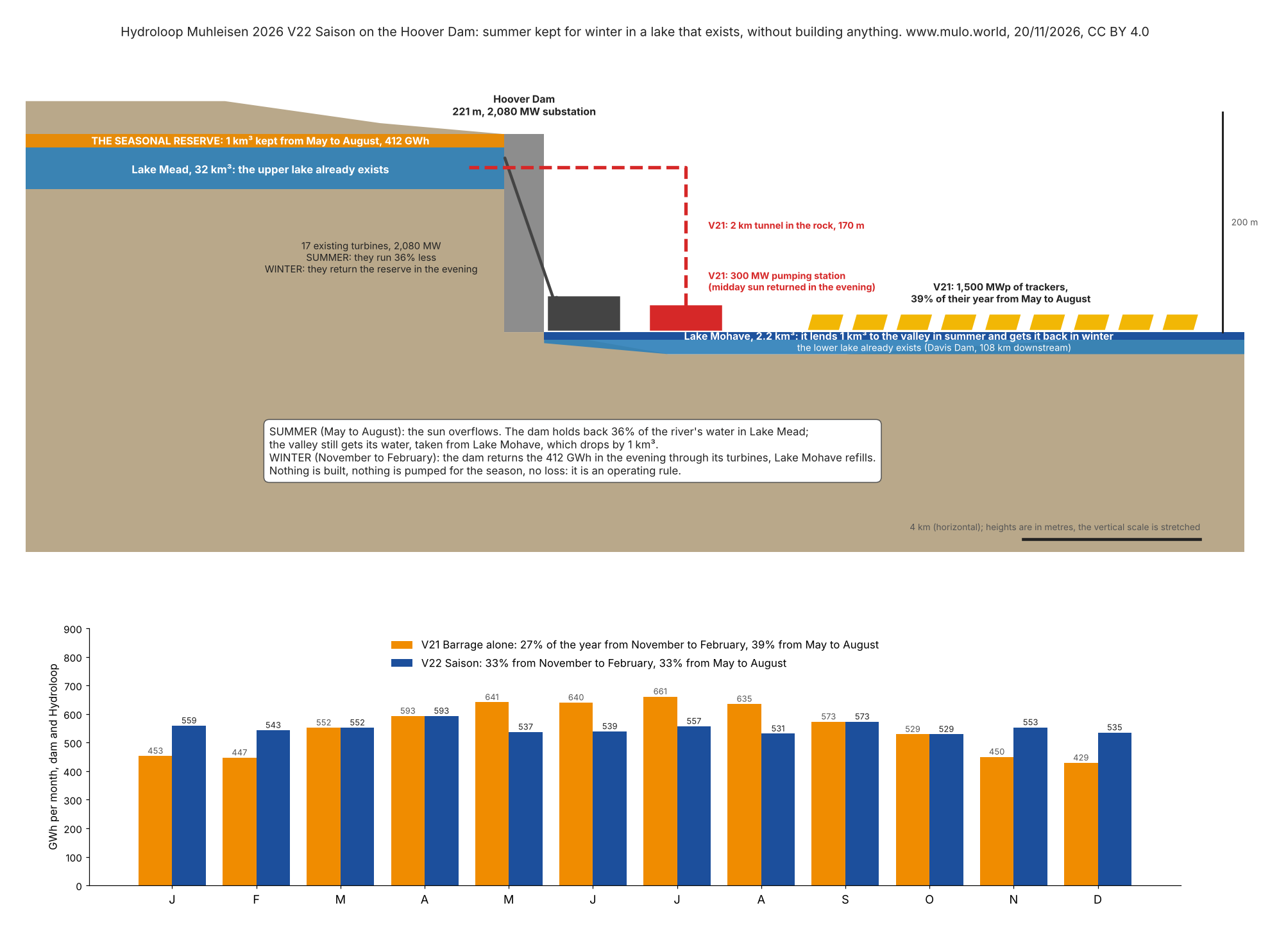
Diagram code (Python, free): schema_hydroloop_v22.py; hourly model: hydroloop_muhleisen_2026_v22_simulation.py (the twelve arguments of the V21, then the volume mobilised in the lower lake in km³ and the share of the river's water held back from May to August)
Neighbouring versions: V21 Barrage | V18 Sky 2 | V14 Soleil | the existing reservoirs screened (in French)
------------------------------
1. WHAT THE V22 ADDS: A RULE, NOT A STRUCTURE
------------------------------
The rule fits in three lines. From May to August, the dam's turbines run less: part of the river's water stays in the upper lake. The valley lacks nothing, because the downstream dam keeps releasing the water required of it, and it is its lake that drops. From November to February, the upper dam turbines the kept water in the evening, on top of the river's water, and the lower lake rises again. The rest of the year, nothing changes. Over the year, the valley has received exactly the same water, on the same dates; only the level of the lower lake has breathed.
------------------------------
2. THE EXAMPLE: THE HOOVER DAM AND ITS V21
------------------------------
We take the reference V21 from the V21 Barrage page: the Hoover Dam (2,080 MW, 3,400 GWh a year from the Colorado's water, 170 m of head), 1,500 MWp of trackers, 300 MW of pumps, 3,201 GWh more sold a year. Together, the dam and its Hydroloop give 6,601 GWh a year. Lake Mead, above, holds 32 km³; Lake Mohave, below, behind the Davis Dam, holds 2.2. The V22 mobilises 1 km³ of it, less than half.
A cubic metre that goes down 170 m through the dam's turbines returns 0.417 kWh. 1 km³ kept at the top is therefore 417 GWh set aside. To gather them in four months, 36% of the river's water has to be held back from May to August; the model gathers 412. In winter, the reserve is returned over 120 evenings, 3.4 GWh per evening, a little more than an hour and a half extra at full power for turbines that run four and a half hours a day.
Four months make up a third of the year: with 1 km³, the plant gives its fair share in winter, no more, no less. The weakest month goes from 429 to 529 GWh, the strongest from 661 to 593. The investment does not change by a single euro: 1,144 M€, those of the V21.
------------------------------
3. THE HOURLY MODEL AND THE VARIANTS
------------------------------
The model is that of the V21, hour by hour, with three additions: a seasonal reserve, capped by the volume that the lower lake can lend; the share of the river's water held back from May to August, as long as the reserve is not full; the return from November to February, in equal shares each evening, through the hours when the substation is free. The model runs over two consecutive years and only counts the second, so that the reserve of January and February is indeed that of the previous summer.
The last row shows how far the rule can go: with 2 km³, the plant produces more in winter than in summer and can cover the shortfall of other solar plants in the region. It is not the reference, because it empties the lower lake almost entirely every summer.
Should one pump for the season? No, as long as the river is enough. Pumping summer sun up to the upper lake for winter would cost 22% in losses and larger pumps, whereas holding back the river's water costs nothing and loses nothing. Both draw on the same volume, that of the lower lake: it is the limit, not the pumps. Seasonal pumping only becomes useful on a dam whose river is small compared with its two lakes.
------------------------------
4. WHY THE LAKES OF A SKY DO NOT HANDLE THE SEASON
------------------------------
The V18 Sky 2 keeps 4.7 GWh in its reserve, plus 5.9 GWh in its rain lake. It is the right tool to hold out for ten days or so without wind or sun, and that is its role. But a solar plant of one terawatt-hour a year at 40° latitude lacks about a hundred GWh over its three winter months: ten times the reserve of a Sky. The seasonal reserve of Hoover is worth 88 Sky 2 reserves, and it did not cost a lake.
The rule to remember: a storage plant is paid by the number of times it is used. A basin that cycles every evening is used 365 times a year; a seasonal reserve is used once. It is only profitable in a lake already paid for.
------------------------------
5. WHERE IT GOES
------------------------------
Wherever two lakes follow each other on a river: the cascade dams of the Colorado, the Columbia, the Tennessee, the Paraná, the Yangtze, the Volga, the Yenisei, the Rhône, the Douro, the Zambezi, and the mountain lakes overlooking a valley reservoir in the Alps, Norway, Turkey, Japan. The condition is the same as for the V21, with one more criterion: a lower lake large enough to lend its water for four months, or an upper lake free enough in its calendar to hold back without the valley suffering.
The global order of magnitude is known. According to the International Energy Agency, the reservoirs of existing hydropower plants can store about 1,500 TWh of electricity in one cycle, roughly 170 times what all the world's pumped-storage plants hold. World hydropower production is on the order of 4,400 TWh a year. Shifting a tenth of it from summer to winter, as at Hoover, represents more than 400 TWh, without a cubic metre of concrete.
------------------------------
6. POINTS TO WATCH
------------------------------
* Water rights. The rule does not change the water received by the valley, but it changes the level of the two lakes, and on a river like the Colorado every level is regulated. It is a decision for the operator and the riparian states, not for a plant operator.
* The lower lake drops in summer. 1 km³ out of 2.2 for Lake Mohave means several metres less in the middle of the swimming and boating season, with water intakes, harbours and spawning grounds to protect. The 1 km³ reference is a ceiling to be discussed, not a given.
* Irrigation needs water in summer. It is precisely the lower lake that supplies it while the upper lake holds back. If there is no lower lake, or if it is too small, the rule does not apply.
* Dry years. A very low upper lake produces less per cubic metre; holding back in summer rather helps there. In a flood year, the rule is suspended: one does not hold back water that will have to be spilled.
* The model applies a fixed rule. It holds back the same share every summer and returns it in equal shares every winter evening. An operator would do better with snow, rain and price forecasts.
* Winter is not at the same time everywhere. South of the equator, water is held back from November to February and returned from May to August. In the tropics, it is the rainy season that rules, not the sun.
------------------------------
7. WHAT THE V22 COULD CHANGE IN THE PLAN
------------------------------
The site's world plans have so far counted electricity over the year: they check that a country has enough terawatt-hours, not that it has them in winter. A plan made mostly of sun must also get through the cold season, and it has three ways to do so: build more plants than needed in summer, import from a country where it is summer, or keep summer in a lake. The third is the cheapest as soon as the lake exists. The V22 gives the plan a tool it did not have, and it gives it first to the countries that already have their dams: Canada, the United States, Russia, China, Brazil, Norway, Turkey, Japan.
------------------------------
8. THE GOOD IDEAS OF THE V22
------------------------------
* Keep summer for winter in a lake that exists: holding back part of the river's water from May to August and turbining it from November to February requires no structure and loses nothing, since the water is not pumped, it waits.
* The lower lake lends the water that the upper lake holds back: the valley receives the same water on the same dates, and it is the volume of the lower lake that sets the size of the seasonal reserve.
* A storage plant is paid by the number of times it is used: an every-evening basin gets built, a reserve used only once a year is only worth it in a lake already paid for.
* Each lake has its role: the basin of a Hydroloop for the evening, the lake of a Sky for the bad week, the lake of a large dam for the season.
------------------------------
SOURCES
------------------------------
The hourly model of the V22 (Python, no library), the diagram
International Energy Agency, Hydropower Special Market Report, 2021: existing hydropower reservoirs store about 1,500 TWh per cycle, 170 times the pumped-storage plants
Bureau of Reclamation: Hoover Dam, 2,080 MW, Lake Mead, annual production
Hydroloop V21 Barrage, the starting plant and its model, V18 Sky 2, the bad-week reserve, V14 Soleil
The existing reservoirs screened (in French)
The site's good ideas (in French)
Olivier Muhleisen in collaboration with Claude (Anthropic), November 2026. Plans, diagrams, code and figures under the CC BY 4.0 licence.
© 2009-2026 Onmyweb Production - TOS - Cookies information - Contact us - Free Copyright Open Source -
1. WHAT THE V22 ADDS: A RULE, NOT A STRUCTURE
------------------------------
| Question | V21 Barrage | V22 Saison |
|---|---|---|
| What it shifts | midday sun to the evening, every day | in addition, summer water to winter, once a year |
| What it builds | trackers, a pumping station, a tunnel, a line | nothing more |
| The reservoir | eight hours of pumping in the upper lake | a slice of the upper lake, the size of what the lower lake can lend |
| Losses | 22% on water pumped then turbined | none on the seasonal reserve: the river's water is not pumped, it is turbined later |
| What limits it | the hours when the dam's substation is free | the volume of the lower lake, and the valley's water rules |
The rule fits in three lines. From May to August, the dam's turbines run less: part of the river's water stays in the upper lake. The valley lacks nothing, because the downstream dam keeps releasing the water required of it, and it is its lake that drops. From November to February, the upper dam turbines the kept water in the evening, on top of the river's water, and the lower lake rises again. The rest of the year, nothing changes. Over the year, the valley has received exactly the same water, on the same dates; only the level of the lower lake has breathed.
------------------------------
2. THE EXAMPLE: THE HOOVER DAM AND ITS V21
------------------------------
We take the reference V21 from the V21 Barrage page: the Hoover Dam (2,080 MW, 3,400 GWh a year from the Colorado's water, 170 m of head), 1,500 MWp of trackers, 300 MW of pumps, 3,201 GWh more sold a year. Together, the dam and its Hydroloop give 6,601 GWh a year. Lake Mead, above, holds 32 km³; Lake Mohave, below, behind the Davis Dam, holds 2.2. The V22 mobilises 1 km³ of it, less than half.
A cubic metre that goes down 170 m through the dam's turbines returns 0.417 kWh. 1 km³ kept at the top is therefore 417 GWh set aside. To gather them in four months, 36% of the river's water has to be held back from May to August; the model gathers 412. In winter, the reserve is returned over 120 evenings, 3.4 GWh per evening, a little more than an hour and a half extra at full power for turbines that run four and a half hours a day.
| Month | V21 alone, GWh | V22 Saison, GWh |
|---|---|---|
| January | 453 | 559 |
| February | 447 | 543 |
| March | 552 | 552 |
| April | 593 | 593 |
| May | 641 | 537 |
| June | 640 | 539 |
| July | 661 | 557 |
| August | 635 | 531 |
| September | 573 | 573 |
| October | 529 | 529 |
| November | 450 | 553 |
| December | 429 | 535 |
| Year | 6,601 | 6,601 |
| November to February | 1,778, i.e. 26.9% | 2,191, i.e. 33.2% |
| May to August | 2,577, i.e. 39.0% | 2,164, i.e. 32.8% |
Four months make up a third of the year: with 1 km³, the plant gives its fair share in winter, no more, no less. The weakest month goes from 429 to 529 GWh, the strongest from 661 to 593. The investment does not change by a single euro: 1,144 M€, those of the V21.
------------------------------
3. THE HOURLY MODEL AND THE VARIANTS
------------------------------
The model is that of the V21, hour by hour, with three additions: a seasonal reserve, capped by the volume that the lower lake can lend; the share of the river's water held back from May to August, as long as the reserve is not full; the return from November to February, in equal shares each evening, through the hours when the substation is free. The model runs over two consecutive years and only counts the second, so that the reserve of January and February is indeed that of the previous summer.
| Volume mobilised in the lower lake | River water held back in summer | GWh shifted | November to February | May to August |
|---|---|---|---|---|
| None: the V21 alone | 0 | 0 | 26.9% | 39.0% |
| 0.5 km³ | 18% | 206 | 30.1% | 35.9% |
| 1 km³: the reference | 36% | 412 | 33.2% | 32.8% |
| 2 km³: almost all of Lake Mohave | 72% | 825 | 39.3% | 26.7% |
The last row shows how far the rule can go: with 2 km³, the plant produces more in winter than in summer and can cover the shortfall of other solar plants in the region. It is not the reference, because it empties the lower lake almost entirely every summer.
Should one pump for the season? No, as long as the river is enough. Pumping summer sun up to the upper lake for winter would cost 22% in losses and larger pumps, whereas holding back the river's water costs nothing and loses nothing. Both draw on the same volume, that of the lower lake: it is the limit, not the pumps. Seasonal pumping only becomes useful on a dam whose river is small compared with its two lakes.
------------------------------
4. WHY THE LAKES OF A SKY DO NOT HANDLE THE SEASON
------------------------------
The V18 Sky 2 keeps 4.7 GWh in its reserve, plus 5.9 GWh in its rain lake. It is the right tool to hold out for ten days or so without wind or sun, and that is its role. But a solar plant of one terawatt-hour a year at 40° latitude lacks about a hundred GWh over its three winter months: ten times the reserve of a Sky. The seasonal reserve of Hoover is worth 88 Sky 2 reserves, and it did not cost a lake.
The rule to remember: a storage plant is paid by the number of times it is used. A basin that cycles every evening is used 365 times a year; a seasonal reserve is used once. It is only profitable in a lake already paid for.
------------------------------
5. WHERE IT GOES
------------------------------
Wherever two lakes follow each other on a river: the cascade dams of the Colorado, the Columbia, the Tennessee, the Paraná, the Yangtze, the Volga, the Yenisei, the Rhône, the Douro, the Zambezi, and the mountain lakes overlooking a valley reservoir in the Alps, Norway, Turkey, Japan. The condition is the same as for the V21, with one more criterion: a lower lake large enough to lend its water for four months, or an upper lake free enough in its calendar to hold back without the valley suffering.
The global order of magnitude is known. According to the International Energy Agency, the reservoirs of existing hydropower plants can store about 1,500 TWh of electricity in one cycle, roughly 170 times what all the world's pumped-storage plants hold. World hydropower production is on the order of 4,400 TWh a year. Shifting a tenth of it from summer to winter, as at Hoover, represents more than 400 TWh, without a cubic metre of concrete.
------------------------------
6. POINTS TO WATCH
------------------------------
* Water rights. The rule does not change the water received by the valley, but it changes the level of the two lakes, and on a river like the Colorado every level is regulated. It is a decision for the operator and the riparian states, not for a plant operator.
* The lower lake drops in summer. 1 km³ out of 2.2 for Lake Mohave means several metres less in the middle of the swimming and boating season, with water intakes, harbours and spawning grounds to protect. The 1 km³ reference is a ceiling to be discussed, not a given.
* Irrigation needs water in summer. It is precisely the lower lake that supplies it while the upper lake holds back. If there is no lower lake, or if it is too small, the rule does not apply.
* Dry years. A very low upper lake produces less per cubic metre; holding back in summer rather helps there. In a flood year, the rule is suspended: one does not hold back water that will have to be spilled.
* The model applies a fixed rule. It holds back the same share every summer and returns it in equal shares every winter evening. An operator would do better with snow, rain and price forecasts.
* Winter is not at the same time everywhere. South of the equator, water is held back from November to February and returned from May to August. In the tropics, it is the rainy season that rules, not the sun.
------------------------------
7. WHAT THE V22 COULD CHANGE IN THE PLAN
------------------------------
The site's world plans have so far counted electricity over the year: they check that a country has enough terawatt-hours, not that it has them in winter. A plan made mostly of sun must also get through the cold season, and it has three ways to do so: build more plants than needed in summer, import from a country where it is summer, or keep summer in a lake. The third is the cheapest as soon as the lake exists. The V22 gives the plan a tool it did not have, and it gives it first to the countries that already have their dams: Canada, the United States, Russia, China, Brazil, Norway, Turkey, Japan.
------------------------------
8. THE GOOD IDEAS OF THE V22
------------------------------
* Keep summer for winter in a lake that exists: holding back part of the river's water from May to August and turbining it from November to February requires no structure and loses nothing, since the water is not pumped, it waits.
* The lower lake lends the water that the upper lake holds back: the valley receives the same water on the same dates, and it is the volume of the lower lake that sets the size of the seasonal reserve.
* A storage plant is paid by the number of times it is used: an every-evening basin gets built, a reserve used only once a year is only worth it in a lake already paid for.
* Each lake has its role: the basin of a Hydroloop for the evening, the lake of a Sky for the bad week, the lake of a large dam for the season.
------------------------------
SOURCES
------------------------------
The hourly model of the V22 (Python, no library), the diagram
International Energy Agency, Hydropower Special Market Report, 2021: existing hydropower reservoirs store about 1,500 TWh per cycle, 170 times the pumped-storage plants
Bureau of Reclamation: Hoover Dam, 2,080 MW, Lake Mead, annual production
Hydroloop V21 Barrage, the starting plant and its model, V18 Sky 2, the bad-week reserve, V14 Soleil
The existing reservoirs screened (in French)
The site's good ideas (in French)
Olivier Muhleisen in collaboration with Claude (Anthropic), November 2026. Plans, diagrams, code and figures under the CC BY 4.0 licence.
© 2009-2026 Onmyweb Production - TOS - Cookies information - Contact us - Free Copyright Open Source -